
In our previous posts, we established three critical truths:
Metformin does not injure the kidneys; it is cleared by them and remains safe to use down to an eGFR of 30. (about one third of normal kidney function)
As kidney filtration slows down, a toxic metabolic byproduct named ADMA surges in the bloodstream, sparking oxidant production, driving blood vessel inflammation, and dramatically increasing the likelihood of heart attacks and strokes.
Metformin acts as a precision molecular shield, blocking ADMA molecule for molecule and turning back on your body’s natural cellular repair switches.
Because metformin blocks ADMA molecule for molecule, every single milligram of metformin you can comfortably take is a direct benefit to your blood vessels, heart, and kidneys.
This reveals a profound shift in how we view kidney disease: instead of stopping metformin when kidney function starts to drop, keeping metformin on board (safely down to an eGFR of 30) is a primary way to protect remaining kidney tissue and prevent cardiovascular disease.
Because this medication is so protective, learning how to take it without stomach side effects is one of the most important steps you can take for your health. Stomach intolerance is almost entirely avoidable when you follow proper dosing precautions.
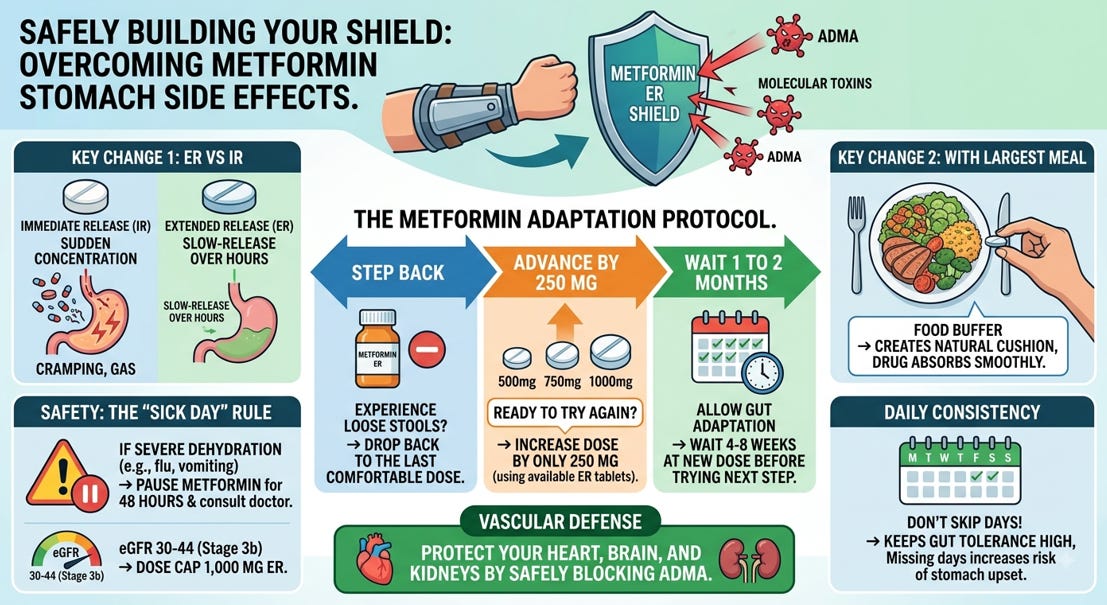
Traditional Immediate-Release (IR) metformin dissolves quickly in the stomach, dumping a sudden concentration of the medication into the small intestine. This rapid flood can cause cramping, gas, and loose stools.
Metformin Extended-Release (ER) oral tablets—available in 500 mg, 750 mg, and 1,000 mg strengths—release the medication slowly over many hours. This slow-release design eliminates the localized flood, drastically reducing intestinal irritation and allowing the drug to absorb smoothly.
Always take Metformin ER midway through or immediately following your largest meal of the day (typically dinner). Food provides a natural intestinal cushion that slows digestive movement, further buffering stomach upset and ensuring steady, comfortable absorption.
If you experience loose stools or diarrhea when increasing your dose, do not abandon the medication entirely. Instead, use a structured step-back strategy:
THE METFORMIN ER ADAPTATION PROTOCOL
│
┌───────────────────────────────┼───────────────────────────────┐
▼ ▼ ▼
1. STEP BACK 2. ADVANCE BY 250 MG 3. WAIT 1 TO 2 MONTHS
Drop back to the last dose Re-introduce the next step Hold at the new dose that caused no stomach upset. using a 250 mg increment. for 4–8 weeks to allow gut adaptation.
Step Back: Instantly return to the last lower dose that caused no digestive issues.
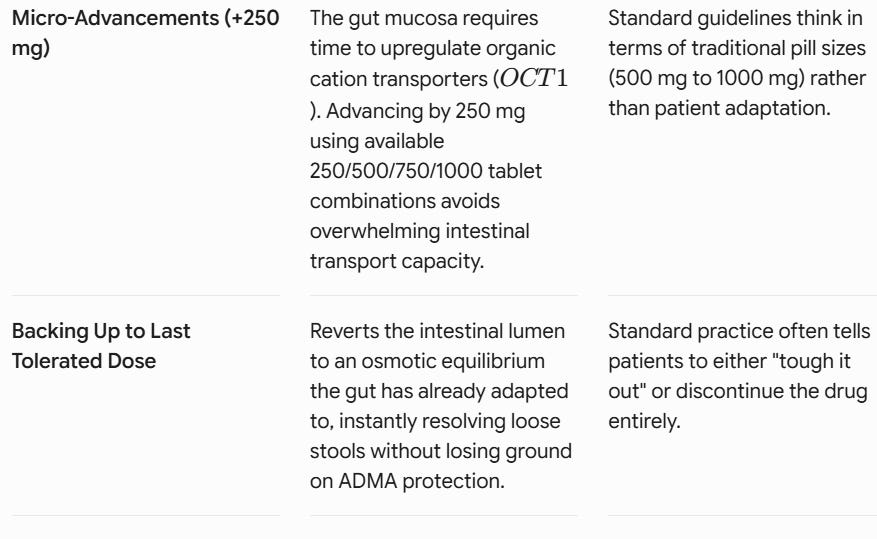
Advance in Small Steps: When you are ready to try increasing again, advance the total daily dose by just 250 mg (for example, moving from 500 mg to 750 mg using available ER tablet strengths).
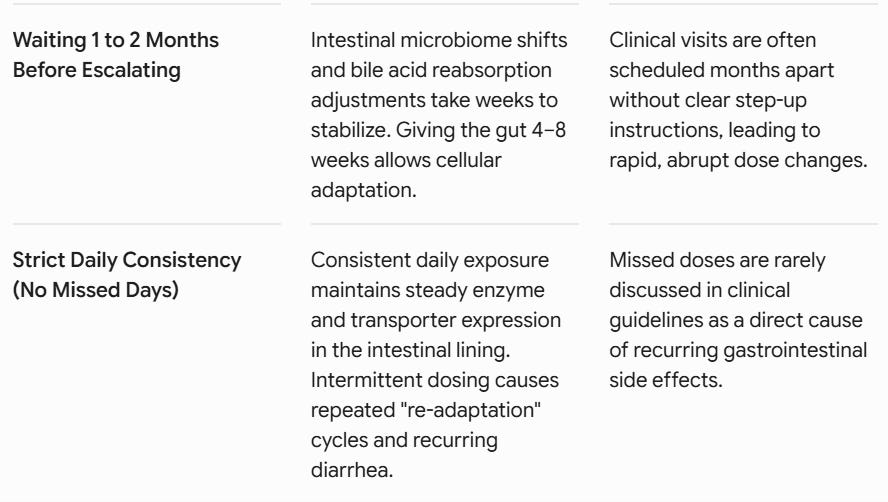
Give Your Body Time: Wait a month or two at the new level before attempting another increase. Your digestive tract adapts over time, and mild stomach discomfort often diminishes entirely if you hang in there.
To keep metformin safe and effective down to an eGFR of 30, keep these clinical rules in mind:
Dose Cap for Reduced Function: If your eGFR drops between 30 and 44 (Stage 3b kidney disease), your physician will cap your daily dose at 1,000 mg ER. Because your body clears the drug more slowly, 1,000 mg provides the full protective tissue concentration needed to block ADMA.
The Sick Day Pause: If you develop severe dehydration (from vomiting, severe fever, or stomach flu) or are scheduled for an imaging procedure using IV contrast dye, pause your metformin for 48 hours until you are fully rehydrated and your doctor approves restarting it.
Taking your Metformin ER faithfully every single day is crucial. When you miss doses or stop and start randomly, your gut loses its natural tolerance. Skipping a day or two makes you much more likely to experience stomach upset and diarrhea all over again when you restart.
Recommendation Why It Works Why Standard Rules Miss It
In patients with metabolic risk who suffer from chronic constipation, metformin's tendency to soften stool isn't a problem—it's an added benefit that can help replace harsh laxatives. By advancing slowly in 250 mg steps, taking Extended-Release tablets with the main meal, and maintaining strict daily consistency, almost every patient can build a comfortable, life-long shield against ADMA while improving their daily bowel regularity."
If you have prediabetes, type 2 diabetes, or reduced kidney function, one of the most powerful actions you can take for your long-term health is to work with your healthcare provider to find the dose of Metformin ER you can comfortably take—and stick with it.
By disarming ADMA, quenching internal oxidant production, and protecting your arterial walls, this simple, low-cost daily habit provides lifelong protection for your heart, brain, and kidneys.
Inzucchi SE, Lipska KJ, Mayo H, Bailey CJ, McGuire DK. Metformin in patients with type 2 diabetes and kidney disease: a systematic review. JAMA. 2014;312(24):2668-2675. doi:10.1001/jama.2014.15298
Blonde L, DiPietro L, Lazzaroni E, et al. Gastrointestinal tolerability of extended-release metformin formulation in patients with type 2 diabetes mellitus. Curr Med Res Opin. 2004;20(4):565-572. doi:10.1185/030079904125003278
American Diabetes Association. 11. Chronic kidney disease and risk management: Standards of Care in Diabetes—2024. Diabetes Care. 2024;47(Suppl 1):S219-S230.
Fliser D, Kronenberg F, Kielstein JT, et al. Asymmetric dimethylarginine and progression of chronic kidney disease: The Mild to Moderate Kidney Disease Study. J Am Soc Nephrol. 2005;16(8):2456-2461. doi:10.1681/ASN.2005020179
Cooke JP. Asymmetric dimethylarginine: The Uber Marker. Circulation. 2004;109(15):1813-1818. doi:10.1161/01.CIR.0000125705.52180.A7
Detaille D, Guigas B, Chauvin C, et al. Obligatory role of membrane events in the regulatory effect of metformin on the respiratory chain function. Biochem Pharmacol. 2002;63(7):1259-1272. doi:10.1016/s0006-2952(02)00858-4
No posts
Comments
Nothing yet. Say the first thing.
Sign in to join the conversation.