
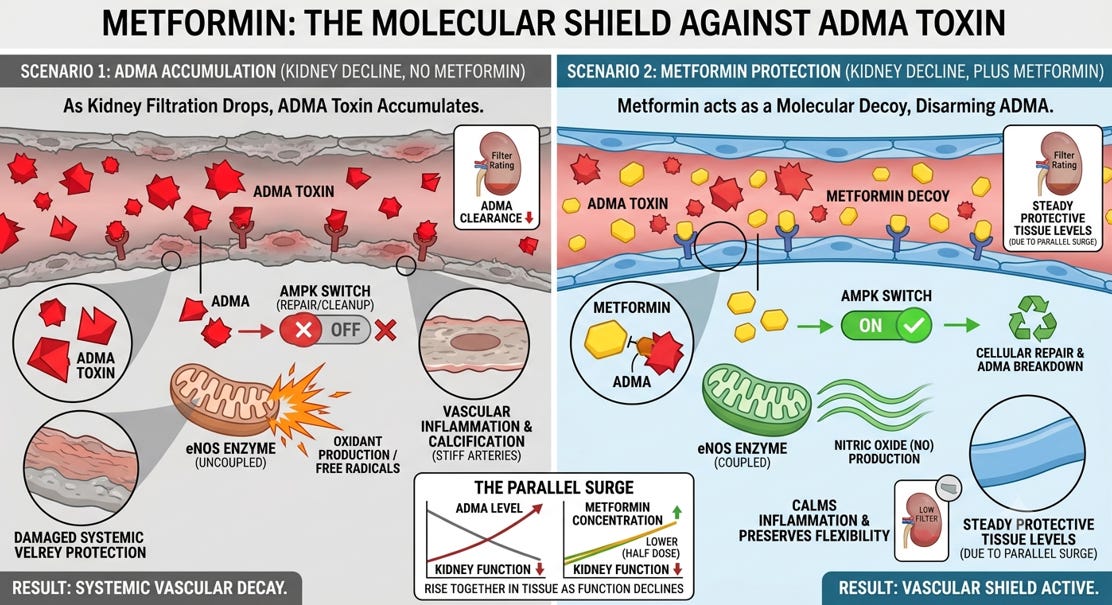
In the last post, we revealed the hidden engine behind cardiovascular collapse in kidney disease: ADMA (Asymmetric Dimethylarginine). As kidney function slows down, ADMA accumulates, turning blood vessels into oxidant factories that drive severe oxidant accumulation and systemic blood vessel inflammation.
For years, top researchers—including Dr. John Cooke, former Chief of Vascular Medicine at Stanford University—searched for a way to block ADMA. They tested dietary supplements like high-dose L-arginine bars to outcompete ADMA, but the body broke them down too quickly to offer real, lasting protection.
The breakthrough Dr. Cooke was looking for wasn’t a brand-new, multi-billion-dollar specialty drug. It was a $4 generic medication that has been right in front of us all along: metformin.
Metformin is a structural chemical cousin to ADMA. Because of this shared molecular shape, metformin acts as a precision decoy at the cellular level:
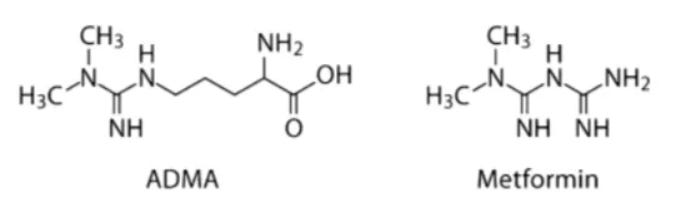
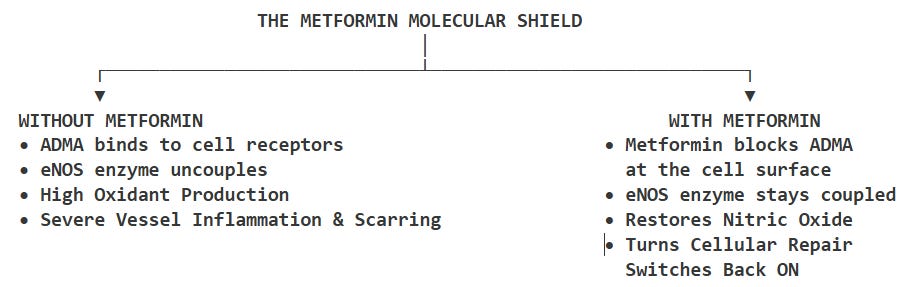
Blocks ADMA at the Cell Surface: Metformin competes directly with accumulating ADMA, preventing the toxin from binding to vascular cell walls and hijacking the cell’s internal machinery.
Quenches Oxidant Production: Metformin reduces ADMA levels. By stopping ADMA from uncoupling the eNOS enzyme, metformin prevents blood vessels from spilling out destructive free radicals.
Flips the Cellular Repair Switch Back ON: ADMA suppresses AMPK—the master switch that cleans out cellular debris and repairs tissue. Metformin directly activates AMPK, turning cellular cleanup back on, preserving delicate kidney micro-capillaries, and protecting heart muscle. Activating AMPK reactivates the enzyme that breaks down ADMA.
Calms Vascular Inflammation: Metformin shuts down the overactive growth signal (mTORC1) triggered by ADMA, halting the arterial wall thickening and calcification that leads to stiff, fragile blood vessels.
As noted in Post 1, because metformin and ADMA are cleared by the exact same pathways in the kidneys, as kidney filtration drops, metformin concentrations in tissue naturally rise alongside ADMA.
This parallel surge means that as your body accumulates more of the ADMA toxin, your body naturally retains higher local levels of the metformin decoy to neutralize it.
When a doctor cuts the oral metformin dose in half for Stage 3b kidney disease (eGFR 30–44), the drug’s longer presence in the bloodstream maintains steady, protective tissue levels—keeping the molecular shield active right when the body needs it most.
Every single molecule of metformin taken blocks a molecule of accumulating ADMA. Depriving a patient of this low-cost, life-saving protection out of an outdated fear of kidney damage takes away their primary line of defense against heart attacks, strokes, and kidney decay.
In the next post, we will tackle the final practical barrier: stomach side effects. We will share the exact step-by-step protocol to eliminate stomach upset, preserve tolerance, and safely take Metformin ER down to an eGFR of 30.
Cooke JP. Asymmetric dimethylarginine: The Uber Marker. Circulation. 2004;109(15):1813-1818. doi:10.1161/01.CIR.0000125705.52180.A7
Foretz M, Guigas B, Viollet B. Understanding the glucoregulatory actions of metformin. Diabetologia. 2019;62(5):887-892. doi:10.1007/s00125-019-4853-3
Landim-Vieira M, et al. Asymmetric dimethylarginine induces oxidative stress and pro-fibrotic pathways in renal tubular epithelial cells. Free Radic Biol Med. 2017;112:573-583. doi:10.1016/j.freeradbiomed.2017.08.025
Scalera F, Borlak J, Beckmann B, et al. Endothelial nitric oxide synthase uncoupling, oxidative stress, and asymmetric dimethylarginine in endothelial dysfunction. Vasc Med. 2006;11(3):153-161. doi:10.1177/1358863x06072223
Inzucchi SE, Lipska KJ, Mayo H, Bailey CJ, McGuire DK. Metformin in patients with type 2 diabetes and kidney disease: a systematic review. JAMA. 2014;312(24):2668-2675. doi:10.1001/jama.2014.15298
No posts
Comments
Nothing yet. Say the first thing.
Sign in to join the conversation.