
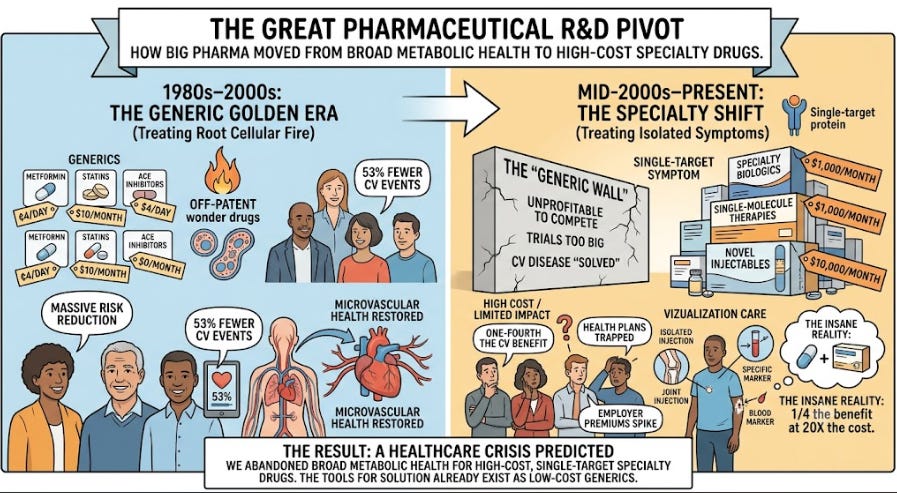
In an earlier post, The Leading Diabetes Drugs: One-Fourth the Benefit at Twenty Times the Cost, we examined a staggering mathematical reality: modern, heavily marketed single-molecule therapies and expensive specialty drugs routinely deliver a fraction of
the risk reduction of first-generation “wonder drugs” like metformin, statins, and ACE inhibitors—while charging twenty to one hundred times the price.
To the average patient or employer paying health insurance premiums, this seems like an incomprehensible glitch in the system. How did we end up paying $1,000 a month for single-digit relative risk reductions while $4 off-patent generics sit underutilized on the pharmacy shelf?
Here is the truth that every patient, employer, and health plan fiduciary needs to understand: This was not an accident. Big Pharma saw this exact situation coming decades ago, predicted the economic wall, and quietly abandoned cardiovascular and metabolic R&D to build the high-cost specialty drug pipeline we are trapped in today.
In the 1980s and 1990s, cardiovascular and metabolic disease was the undisputed crown jewel of pharmaceutical profitability. Blockbusters like atorvastatin (Lipitor), enalapril (Vasotec), and metformin generated tens of billions of dollars.
These drugs were true medical breakthroughs. They didn’t just lower isolated surrogate markers; they acted as fundamental biological circuit-breakers, restoring microvascular health, activating AMPK, and slashing cardiovascular events and mortality in half.
By the mid-2000s, as these patent protections expired and the drugs went generic for pennies a day, pharmaceutical executives ran headfirst into a mathematical and commercial reality known as the “Generic Wall”:
The Bar Was Too High: To get a new branded cardiovascular drug approved and covered by insurance, it couldn’t just beat a sugar pill; it had to show incremental benefit on top of patients who were already taking low-cost metformin, ACE inhibitors, and statins.
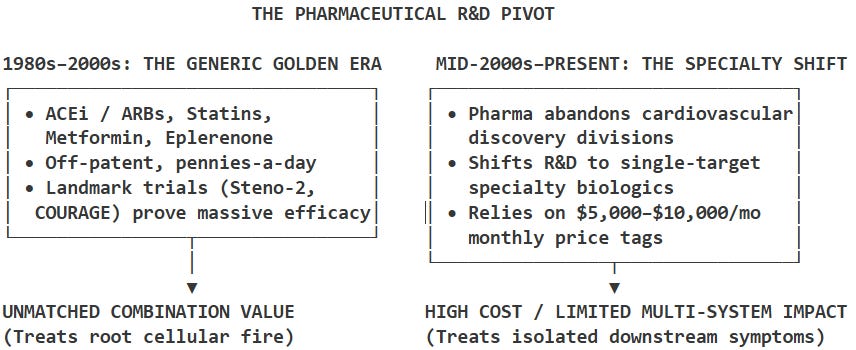
The Trials Became Too Big: Landmark trials like Steno-2 and COURAGE proved that synchronized, multi-target generic protocols reduced cardiovascular events by 53% and kidney disease by 61%. To beat that baseline, pharma would have to enroll 15,000 to 20,000 patients in 7-year outcome trials costing well over $1 billion per drug—with a high probability of failure.
The Executive Consensus: Drug executives concluded that cardiovascular and metabolic disease was, for all commercial purposes, a “solved problem.” The return on investment for primary prevention and broad metabolic health collapsed.
This wasn’t quiet speculation behind closed doors; it is documented throughout academic literature:
The JACC Study (Kesselheim et al., 2016): A landmark Harvard study published in JACC: Basic to Translational Science tracked global clinical trial data. In 1990, cardiovascular drugs accounted for 21% of all Phase 3 clinical trials globally. By 2012, that number had plummeted to just 7%.
Eroom’s Law in Cardiology: While computer power doubles every two years (Moore’s Law), drug discovery efficiency halves every nine years (Eroom’s Law). Papers in Current Problems in Cardiology and Circulation noted that cardiology was hit harder by Eroom’s Law than any other field because cheap generic combination therapy set an impossibly high clinical benchmark.
Pharmaceutical firms systematically dismantled their internal cardiovascular research units. Pfizer, GSK, Sanofi, and others shifted their billions in R&D away from primary metabolic disease and redirected capital into oncology, rare autoimmune diseases, and specialty biologics.
Why? Because in specialty medicine, you can charge $5,000 to $10,000+ per month for a single-target drug evaluated in a small, 500-patient trial.
This historical pivot explains the exact insanity we face today:
What Big Pharma Left Behind: The off-patent, first-generation wonder drugs (ACEi/ARBs, statins, metformin, eplerenone, allopurinol, low-dose aspirin) remain the most potent, multi-system, life-extending medical interventions ever discovered. They act on the root cellular engine of disease—quenching the $mTORC1/\text{NLRP3}$ inflammasome loop and restoring microvascular capillary flow.
What the Market Pushes Today: Because no drug company can make billions on $4 generic metformin or $10 lisinopril, the medical-industrial complex heavily promotes single-molecule branded agents that target isolated downstream signals.
We end up in a distorted reality where health plans routinely authorize $5,000/month specialty biologics or $1,000/month novel injectables that deliver one-fourth the cardiovascular and renal benefit of the $20/month generic combination protocols that pharma abandoned twenty years ago.
Big Pharma made a rational business decision twenty years ago: they walked away from broad metabolic health because cheap generics were simply too good and too inexpensive to compete against.
The insanity is that healthcare delivery followed them into the high-cost specialty trap, abandoning the very generic protocols that produce the greatest clinical outcomes in human history.
We do not need to wait for a $10,000-a-month single-molecule miracle to solve the chronic disease crisis. The tools that reduce cardiovascular events by 50%, halt kidney failure, and extend life expectancy by 8 years already exist. They are sitting on the pharmacy shelf, off-patent, waiting for us to build the protocolized clinical architecture required to deliver them to every patient who needs them.
Reference: Kesselheim AS, et al. “Trends in the Clinical Development of Cardiovascular Drugs.” JACC: Basic to Translational Science, 2016; 1(7): 551–560.
Key Findings: This landmark Harvard study tracked global clinical trial activity and documented a massive collapse in cardiovascular drug R&D:
In 1990, cardiovascular drugs comprised 21% of all Phase 3 clinical trials globally.
By 2012, that number plummeted to just 7%.
The study documented an absolute and relative decline in CV drug development across all phases, even as cardiovascular disease remained the leading cause of death worldwide.
References:
American Heart Association Policy Statement. “A Call to Action for New Global Approaches to Cardiovascular Disease Drug Solutions.” Circulation, 2021; 144(5): e160–e168.
Pepine CJ, et al. “Why is the pharmaceutical industry pulling away from the cardiology market?” Healio / Cardiology, 2009.
Key Findings: These industry analyses directly explain why pharma walked away:
The “Generic Wall”: The influx of cheap off-patent generics (Zocor, Lipitor, Vasotec, Cozaar) meant that any new CV drug could not simply prove it was better than a placebo; it had to prove a 15%–20% incremental reduction in major events on top of patients who were already taking cheap statins and ACE inhibitors.
The Risk/Reward Imbalance: Proving that incremental benefit required enrolling 10,000 to 20,000+ patients in 5-to-7-year cardiovascular outcome trials (CVOTs) costing upwards of $1 billion per drug. Pharma executives concluded that the return on investment (ROI) was far lower than shifting those R&D dollars into oncology or rare diseases, where trial sizes are small and drugs can be priced at $10,000+ per month.
Reference: Fordyce CB, et al. “Overcoming the Declining Trends in Innovation and Investment in Cardiovascular Therapeutics: Beyond Eroom’s Law.” Current Problems in Cardiology, 2018; 43(8): 321–351.
Key Findings:
“Eroom’s Law” (Moore’s Law spelled backwards) describes how drug discovery becomes exponentially more expensive and less efficient over time.
The paper highlights that cardiovascular medicine was hit harder by Eroom’s Law than almost any other field. Between 2000 and 2009, 33% fewer CV therapeutics were approved than in the prior decade, because existing cheap generic therapies had effectively “solved” standard risk reduction so well that novel single-molecule targets struggled to show additional benefit.
Reference: Herper M. “Why Big Pharma Is Giving Up On Heart Disease.” Forbes, 2011.
Key Findings:
Industry analysts documented how massive, multi-hundred-million-dollar failures of promising “next gen” cardiovascular blockbusters (such as Pfizer’s HDL-raising drug torcetrapib) scared big pharma away from the field entirely.
Executive sentiment shifted toward the belief that lipid management and blood pressure control were “essentially solved” by off-patent generic combinations, prompting companies like Pfizer, Sanofi, and GSK to shift billions in R&D budget into immunology, oncology, and rare diseases.
No posts
Comments
Nothing yet. Say the first thing.
Sign in to join the conversation.