
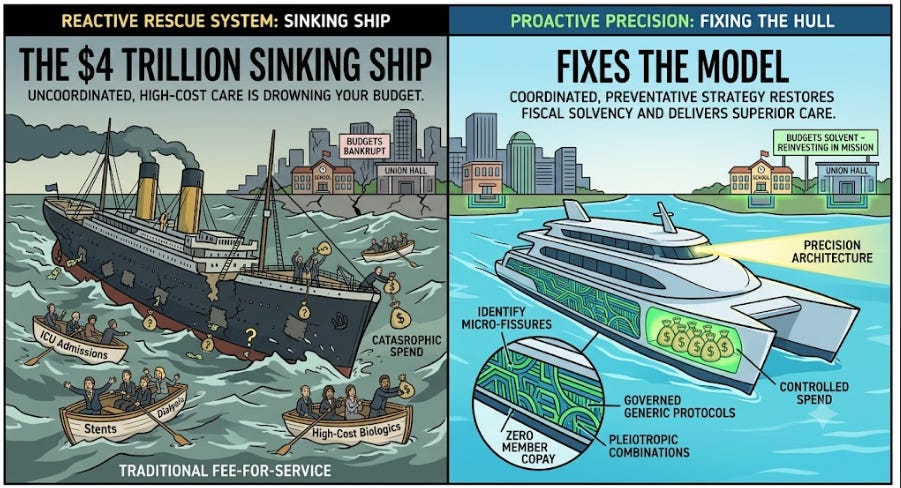
If you sit in the executive chair of a municipal government, lead a public school district, serve as a union trustee, or manage the balance sheet of a self-insured enterprise, you are intimately familiar with the single budget line item that quietly threatens your long-term solvency: employee healthcare expenditure.
In city halls, school board rooms, and corporate C-suites across the country, the story is identical. Healthcare spending rises at two to three times the rate of general inflation and far outpaces tax revenue growth, state funding formulas, or corporate margin expansion. Every budget cycle forces the same demoralizing trade-offs:
Mayors defer critical road resurfacing, reduce public safety hiring, or delay municipal infrastructure projects simply to absorb a 10% to 15% increase in health plan premiums.
School Superintendents delay textbook updates, freeze teacher salaries, or increase class sizes because benefit inflation consumes every new dollar allocated by state legislatures.
CFOs watch health plan expenses eat directly into EBITDA, squeezing capital investment, eroding margin, and reducing competitive advantage in the global market.
Union Leaders are forced to trade wage increases for health benefit preservation, watching their members’ real take-home pay stagnate while out-of-pocket deductibles climb.
Despite spending over $15,000 per employee every year—contributing to a total national health bill that now surpasses $4 trillion—our workforce is growing sicker, less productive, and more prone to early disability.
How can we spend an unprecedented fortune on medical care and receive such a dismal return on investment?
The answer lies in a fundamental structural insight laid out decades ago by the Institute of Medicine in its landmark report, Crossing the Quality Chasm:
“The American health care delivery system is radically broken. The quality chasm is not a gap between what we know and what we do; it is a canyon between the care patients receive and the care they should receive based on scientific evidence.”
The Institute of Medicine established that our current healthcare crisis is not a failure of medical knowledge, nor is it a failure of caring physicians. It is a systemic architecture failure. We are using a 19th-century cottage-industry delivery system—fragmented, uncoordinated, fee-for-service, and organized around acute hospital care—to treat a 21st-century epidemic of chronic, multi-system metabolic disease.
American healthcare functions as a reactive rescue system that profits from downstream catastrophic fires, rather than an upstream precision architecture that prevents the spark.
To a financial officer or public administrator, the current healthcare delivery system represents a catastrophic failure of capital efficiency.
Consider how a municipality handles civil infrastructure. If a city engineer identifies micro-fissures in a bridge support beam, the public works department does not wait for the bridge to collapse into the river so they can deploy a multi-million-dollar emergency response team. They inspect the structure early, apply protective sealant, and reinforce the concrete at a fraction of the cost.
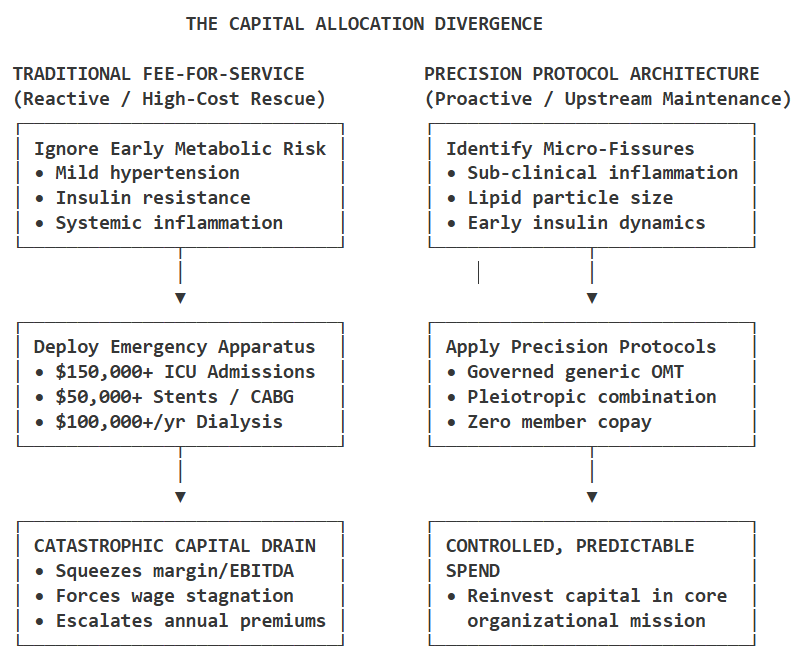
Yet, in employee healthcare, we do the exact opposite.
We ignore the early micro-fissures of disease—slight elevations in blood pressure, subtle weight gain around the midsection, minor shifts in blood sugar, and systemic vascular inflammation. We wait until the employee suffers a massive heart attack, develops advanced kidney failure, or requires a complex joint replacement. Then, the system deploys its full, high-margin, emergency apparatus: intensive care admissions, emergency revascularization procedures, and $50,000-a-year biological infusions.
In corporate accounting terms, we are treating a structural maintenance problem as a series of recurring, unbudgeted capital emergencies.
The assertion that we can deliver vastly superior clinical outcomes while slashing healthcare costs is not a theoretical hypothesis. It has already been proven at scale by pioneering health delivery systems and self-insured innovators across the United States.
When you eliminate the fee-for-service organ silo model and replace it with governed, protocol-driven metabolic care, the financial and clinical transformation is immediate and staggering.
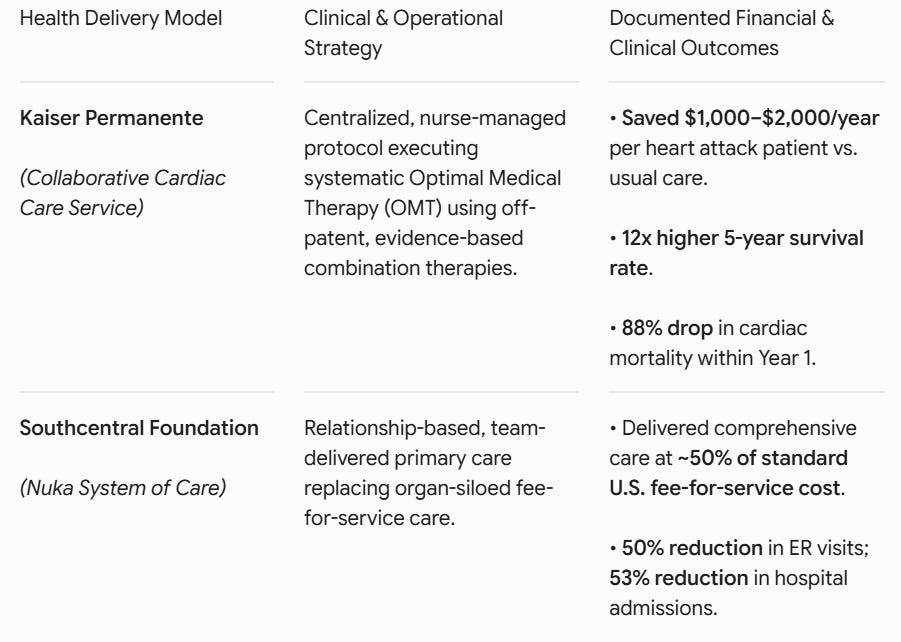
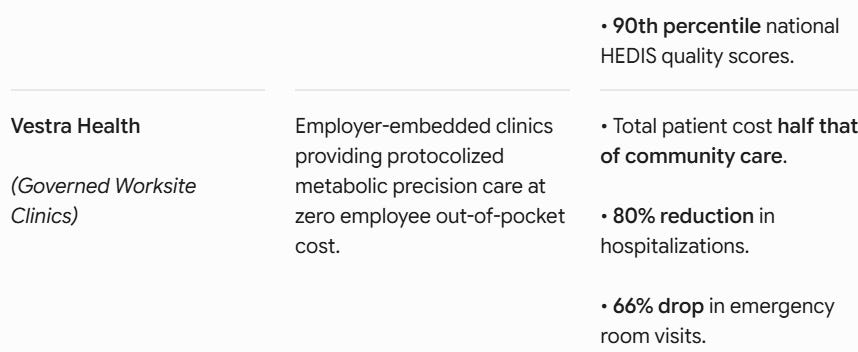
These case studies prove a fundamental economic law: In healthcare, high quality and tight protocol governance are cheap; low-quality, fragmented care is extraordinarily expensive.
If you examine the claims data of any municipal or corporate self-insured health plan, healthcare expenditure follows a stark power-law distribution: roughly 5% of your covered lives generate 50% or more of your total annual health claims.
When plan fiduciaries audit that high-cost 5%, they rarely find healthy people struck down by sudden, unavoidable lightning bolts. Instead, they find individuals trapped in a compounding multi-disease cascade:
The High School Teacher: Diagnosed with mild hypertension in his 40s. By 50, he developed type 2 diabetes. By 56, he had a coronary stent placed. At 61, he is managing stage 3 chronic kidney disease and severe osteoarthritis. He is currently taking seven brand-name drugs, visits four different medical specialists, and costs the school district’s health fund $80,000 per year.
The Public Works Director: Carries metabolic syndrome and chronic low back pain. She receives quarterly high-cost biological injections for joint inflammation while her unmanaged vascular inflammation quietly drives up her risk for an impending stroke or cardiac event.

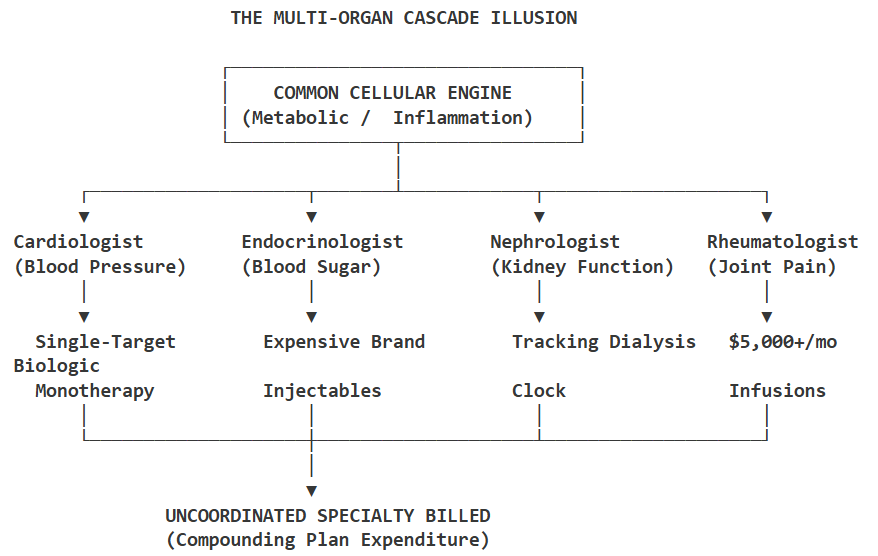
Our current medical delivery system approaches this teacher and director through organ-system fragmentation:
The Cardiologist manages their blood pressure and orders periodic imaging.
The Endocrinologist focuses on their blood sugar numbers, layering on expensive new injectable medications.
The Nephrologist monitors their declining kidney filtration rate, essentially tracking the clock until dialysis is required.
The Rheumatologist treats joint pain with high-cost immune-suppressing biologics.
Each specialist bills independently under fee-for-service. Each prescribes single-target therapies. Yet, because no one is addressing the common cellular engine driving all four conditions, the patient’s health continues to decline, and the plan sponsor receives four separate, compounding, escalating bills.
To evaluate health plan drug spend, decision-makers must understand a remarkable chapter in pharmaceutical history.
During the 1980s and 1990s, cardiovascular medicine produced some of the most effective pharmaceutical innovations in history: ACE inhibitors, ARBs, Statins, Eplerenone, and Metformin. These medications did not merely treat symptoms; they acted as fundamental biological circuit-breakers, halting disease progression at the cellular level.
By the mid-2000s, as these patent-protected blockbusters went generic, major pharmaceutical companies reached a startling conclusion: Cardiovascular disease was a “solved problem.”
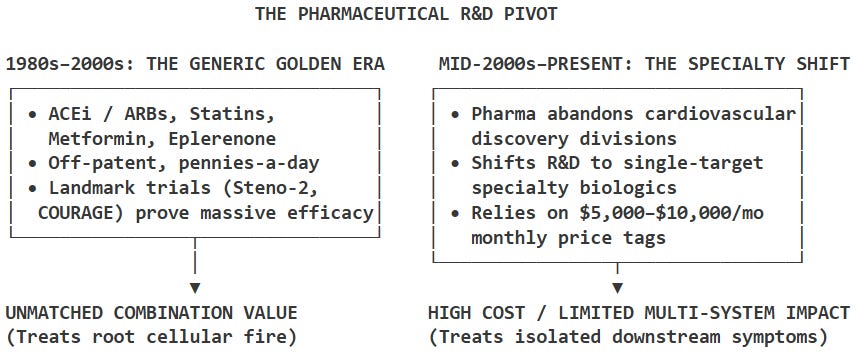
Why the Pharmaceutical Industry Pivoted Away
The Wall of Cheap Generics: Drug executives realized that any new branded cardiovascular drug could not simply beat a sugar pill in clinical trials; it had to beat off-patent combination therapies (e.g., Lisinopril + Atorvastatin + Metformin) that cost pennies a day. The commercial bar for proving incremental value was set impossibly high.
The Steno-2 & COURAGE Proof: Landmark trials demonstrated that synchronized, multi-target generic protocols delivered a 53% reduction in cardiovascular events, a 61% reduction in kidney decay, and an 8-year extension in life expectancy. Pharma executives could not envision a single novel molecule that could outperform this combined off-patent approach.
The Pivot to Specialty Biologics: Consequently, major pharmaceutical firms dismantled their internal cardiovascular research divisions and redirected capital into oncology and specialty biologics—where they could charge $5,000 to $10,000+ per month for single-target therapies with small trial requirements.
This historical shift created a massive structural market anomaly for self-insured health plans: The most clinically powerful, multi-system protective medications in the world are now available as low-cost off-patent generics.
Modern health plans routinely spend millions of dollars on low-value, single-target brand-name specialty drugs while neglecting the governed, multi-target generic protocols that tackle the underlying disease engine.
For mayors, superintendents, union leaders, and CFOs operating under ERISA or public transparency mandates, managing a health plan is a fiduciary responsibility. Continuing to fund an uncoordinated, fee-for-service model that yields poor outcomes and runaway inflation is no longer just an administrative burden—it is a breach of fiscal duty to taxpayers, shareholders, and employees alike.
Consider the baseline financial metrics of unmanaged cardiometabolic progression versus protocolized precision care:
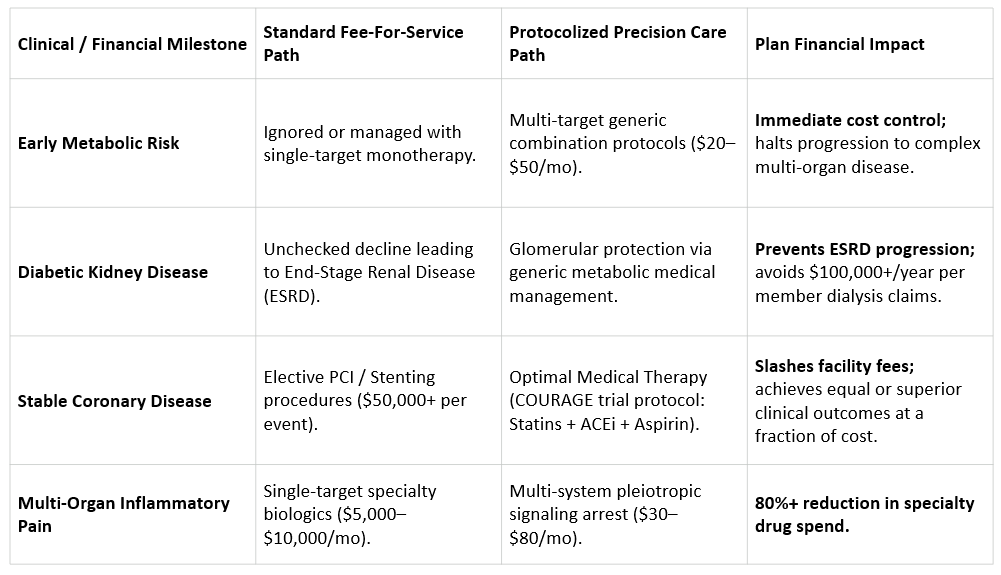
When an employer or municipality implements Metabolic Medical Management, they do not need to wait decades to see a financial return. By stabilizing the top 5% of high-risk members and halting the progression of early metabolic disease in the remaining 95%, health plans routinely observe:
Immediate Reductions in Catastrophic Claims: Fewer emergency revascularizations, acute cardiac events, and hospital readmissions within 12 to 24 months.
Long-Term Plan Solvency: Prevention of end-stage renal disease (ESRD) and dialysis, saving the plan six-figure recurring annual sums per stabilized member.
Pharmacy Spend Optimization: Shifting the drug spend away from low-value, high-cost single-target brand-name drugs toward highly effective, off-patent proven generic protocols that treat multiple root causes simultaneously.
Healthcare inflation is not an unalterable law of nature; it is the predictable financial outcome of a flawed clinical architecture.
When a school district stops wasting millions of dollars on preventable health plan claims, those funds return to where they belong: competitive teacher salaries, updated classroom technology, and expanded student programs. When a city government optimizes its health plan capital, tax dollars are freed up for public safety, infrastructure, and community services. When a corporate CFO tames the health cost curve, those savings flow directly back to competitive employee compensation, research and development, and bottom-line growth.
To fix the budget, we must fix the medicine. As Kaiser Permanente, Southcentral Foundation, and Vestra Health have shown, the blueprint already exists.
To cross the quality chasm, we must move past the 50-year-old myth that chronic disease is merely a collection of isolated organ failures that require expensive, uncoordinated mechanical repairs. By implementing enterprise-grade Precision Protocol Architecture, plan sponsors can restore fiscal solvency while delivering world-class health outcomes to their workforce.
Reference: Kesselheim AS, et al. “Trends in the Clinical Development of Cardiovascular Drugs.” JACC: Basic to Translational Science, 2016; 1(7): 551–560.
Key Findings: This landmark Harvard study tracked global clinical trial activity and documented a massive collapse in cardiovascular drug R&D:
In 1990, cardiovascular drugs comprised 21% of all Phase 3 clinical trials globally.
By 2012, that number plummeted to just 7%.
The study documented an absolute and relative decline in CV drug development across all phases, even as cardiovascular disease remained the leading cause of death worldwide.
References:
American Heart Association Policy Statement. “A Call to Action for New Global Approaches to Cardiovascular Disease Drug Solutions.” Circulation, 2021; 144(5): e160–e168.
Pepine CJ, et al. “Why is the pharmaceutical industry pulling away from the cardiology market?” Healio / Cardiology, 2009.
Key Findings: These industry analyses directly explain why pharma walked away:
The “Generic Wall”: The influx of cheap off-patent generics (Zocor, Lipitor, Vasotec, Cozaar) meant that any new CV drug could not simply prove it was better than a placebo; it had to prove a 15%–20% incremental reduction in major events on top of patients who were already taking cheap statins and ACE inhibitors.
The Risk/Reward Imbalance: Proving that incremental benefit required enrolling 10,000 to 20,000+ patients in 5-to-7-year cardiovascular outcome trials (CVOTs) costing upwards of $1 billion per drug. Pharma executives concluded that the return on investment (ROI) was far lower than shifting those R&D dollars into oncology or rare diseases, where trial sizes are small and drugs can be priced at $10,000+ per month.
Reference: Fordyce CB, et al. “Overcoming the Declining Trends in Innovation and Investment in Cardiovascular Therapeutics: Beyond Eroom’s Law.” Current Problems in Cardiology, 2018; 43(8): 321–351.
Key Findings:
“Eroom’s Law” (Moore’s Law spelled backwards) describes how drug discovery becomes exponentially more expensive and less efficient over time.
The paper highlights that cardiovascular medicine was hit harder by Eroom’s Law than almost any other field. Between 2000 and 2009, 33% fewer CV therapeutics were approved than in the prior decade, because existing cheap generic therapies had effectively “solved” standard risk reduction so well that novel single-molecule targets struggled to show additional benefit.
Reference: Herper M. “Why Big Pharma Is Giving Up On Heart Disease.” Forbes, 2011.
Key Findings:
Industry analysts documented how massive, multi-hundred-million-dollar failures of promising “next gen” cardiovascular blockbusters (such as Pfizer’s HDL-raising drug torcetrapib) scared big pharma away from the field entirely.
Executive sentiment shifted toward the belief that lipid management and blood pressure control were “essentially solved” by off-patent generic combinations, prompting companies like Pfizer, Sanofi, and GSK to shift billions in R&D budget into immunology, oncology, and rare diseases.
No posts
Comments
Nothing yet. Say the first thing.
Sign in to join the conversation.