
March 2001. Concur’s stock was under a dollar. We laid people off in waves, then laid off the people who’d been doing the laying off. I sat in a conference room where a spreadsheet decided who got to keep working, watched a name I knew get highlighted, and told myself the market had done this to us.
It hadn’t. The market pulled the trigger. We’d spent two years loading the gun. We chased every adjacent product, hired ahead of revenue, and believed our own growth story because money was cheap and everyone in the building said go faster. The crash didn’t kill the company that made sense. It killed the version we’d bolted on top of it. When the dust settled, the thing still standing was the small, boring, unglamorous business that had been there the whole time, buried under everything we’d added to look like a rocket ship.
I’ve spent the twenty-five years since reading the same books you have. The ones about the companies that made it. I’ve come to think most of them are the wrong shape.
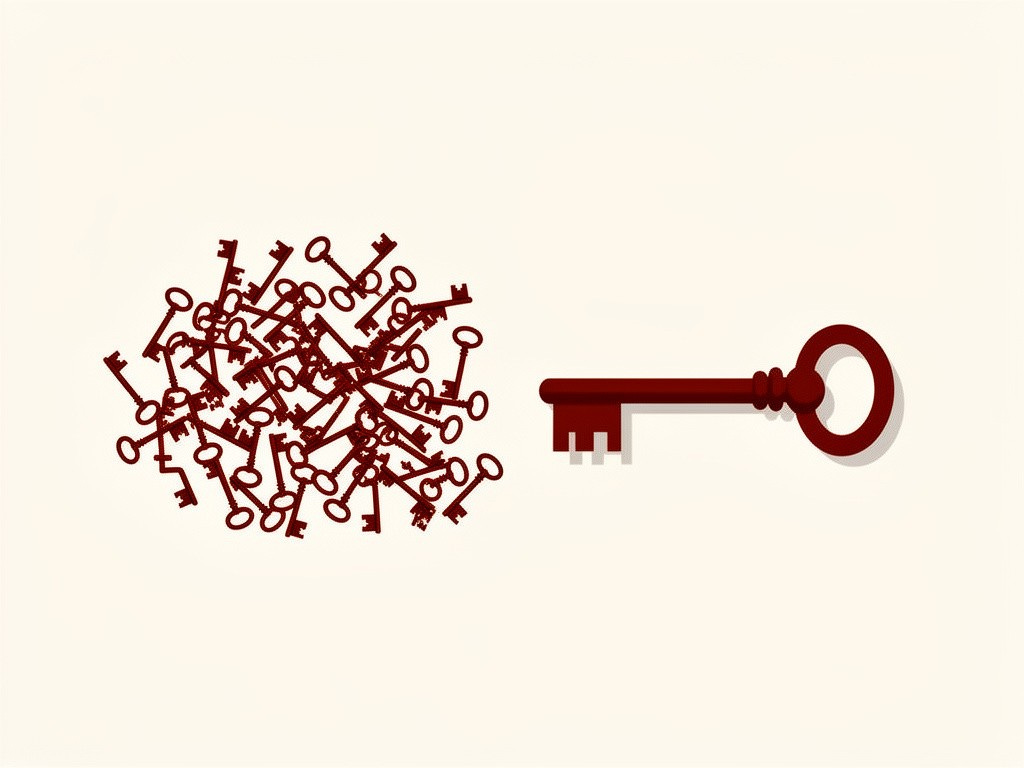
Study ten great companies and you get ten different recipes. One won on timing that couldn’t be repeated if you tried. One won because a competitor imploded at exactly the right moment. One won on a founder who could sell space heaters in July. The lessons don’t stack. They barely rhyme. Success is a lock with a thousand different keys, and the key that opened one door tells you almost nothing about yours. You can read every founder biography ever written and come away no better at building your company, because what you’re really reading is luck assembled backward, after the win, to make it look like a plan.
Failure is the opposite. Watch enough companies die and you stop seeing variety. You start seeing a short list of the same causes, over and over, wearing different clothes.
Think about a generationally talented athlete who never becomes what the talent promised. You know the story before I tell it. It wasn’t the jump shot. It was alcohol, or money he couldn’t hold onto, or the people he let into the building, or a relationship that pulled him apart off the court, or an injury he hid instead of treating. The gift was never the problem. At that level the gift is common. What separated the ones who made it was the absence of a small number of self-inflicted wounds, the same wounds showing up in different players decade after decade.
Startups work this way too. The talent, meaning a real product, a real market, a founder who can actually build, is more common than the mythology admits. What’s rare isn’t brilliance. It’s the absence of the recurring ways founders take themselves out.
Here’s the line I keep coming back to: the founder loads the gun, and the market only pulls the trigger. The crash, the pandemic, the funding winter, none of them invent the cause of death. They just arrive and find the gun already loaded. Which means the useful question was never “how will you win.” Nobody can answer that honestly; winning hasn’t happened yet. The useful question is which round you’re chambering right now.
So I stopped asking founders how they planned to win. I started running a pre-mortem. It’s three years from now, I tell them, and the company is dead. Walk me backward through how it happened. The good ones can do it without flinching. And the causes almost always come off the same short list.
The money wound. Not too little. Too much, spent on the wrong things. This is the founder version of the athlete who signs the contract and is broke in three years. You raise a round and the burn quietly becomes the strategy. I’ve watched a founder with a healthy $30K-a-month business raise his way into a sick $300K-a-month one, then spend eighteen months trying to grow into a number he’d invented on a slide. The capital didn’t buy speed. It bought a taller cliff. Money papers over the exact problems a smaller company would have been forced to solve while they were still cheap to solve.
The wrong crowd. Athletes get the entourage. Founders get the wrong investors, the wrong first three hires, the advisor whose advice is really a rerun of his own last company. Slowly you start building for the people in the room instead of the people paying you. The tell is subtle. Ask a founder in trouble what their board wants and they’ll give you a crisp answer. Ask what their best customer actually did last week and they go quiet. The people around the table have replaced the people the product is for, and nobody noticed the swap.
The partnership that cracks. The relationship that takes a founder out usually isn’t a marriage. It’s the co-founder. Two people who never wrote down who decides what, who split the equity in a hallway, who mistook liking each other for being aligned. It holds fine while things go up. Then a hard fork comes, pivot or persevere, raise or stay lean, and the crack that was always there opens all the way. I’ve seen more good companies end in a founder divorce than in a competitor’s press release. It’s the quietest cause of death and one of the most common.
The hidden injury. Every founder has a part of the business they don’t understand and hope someone else will handle. I call it the black box, and the most dangerous one is never the tech stack or the cap table. It’s the founder’s own head. The boredom that arrives in year three and gets relabeled as strategy, so the founder who built the thing suddenly wants to build a different thing inside the same company. The psychological debt that never gets paid down because our whole ecosystem treats a founder saying “I’m not okay” as a weakness to hide rather than an injury to treat. Far more companies die of the founder quietly checking out than of anything a rival did. It never makes the post-mortem, because the founder writes the post-mortem.
The talent that never turns into work. This one looks most like success, right up until it doesn’t. The product is real. Customers even use it. But the founder keeps adding, feature eleven, feature twelve, furniture nobody asked for, instead of making the three things that matter genuinely exceptional. What looks like product-market fit is often product-market tolerance: customers who stay but don’t lean in, who’d be gone the day something sharper showed up. The gift was there. The discipline to aim it at the few things that mattered wasn’t.
None of these are market problems. That’s the whole point. And you don’t beat the list by finding a better key. You beat it by keeping the list short. Ray Hespen built Property Meld into an eight-figure business from Rapid City, South Dakota, and the thing that stands out isn’t a clever growth hack. It’s what he refused to do. He went embarrassingly narrow. He never raised his way into a burn the business couldn’t carry. He stayed in the weeds of the one industry he actually understood. No entourage, no vanity round, no checking out to go chase the shinier idea. Boring, on purpose, for a decade.
That’s why I trust the failure list more than any success recipe. I can act on it. I can’t teach you to win on timing; timing isn’t a skill, it’s weather. But I can hand you the short list of ways founders take themselves out and make you look at it, honestly, before the market ever walks in the door. The success stories are entertainment. The failure list is a checklist.
You probably already know your answer. Most founders do. They can feel which one is already sitting in the room. They just don’t want to say it out loud yet, because saying it out loud means doing something about it.
So say it. Three years from now, the company is dead. Which round did you chamber?
No posts
Comments
Nothing yet. Say the first thing.
Sign in to join the conversation.