
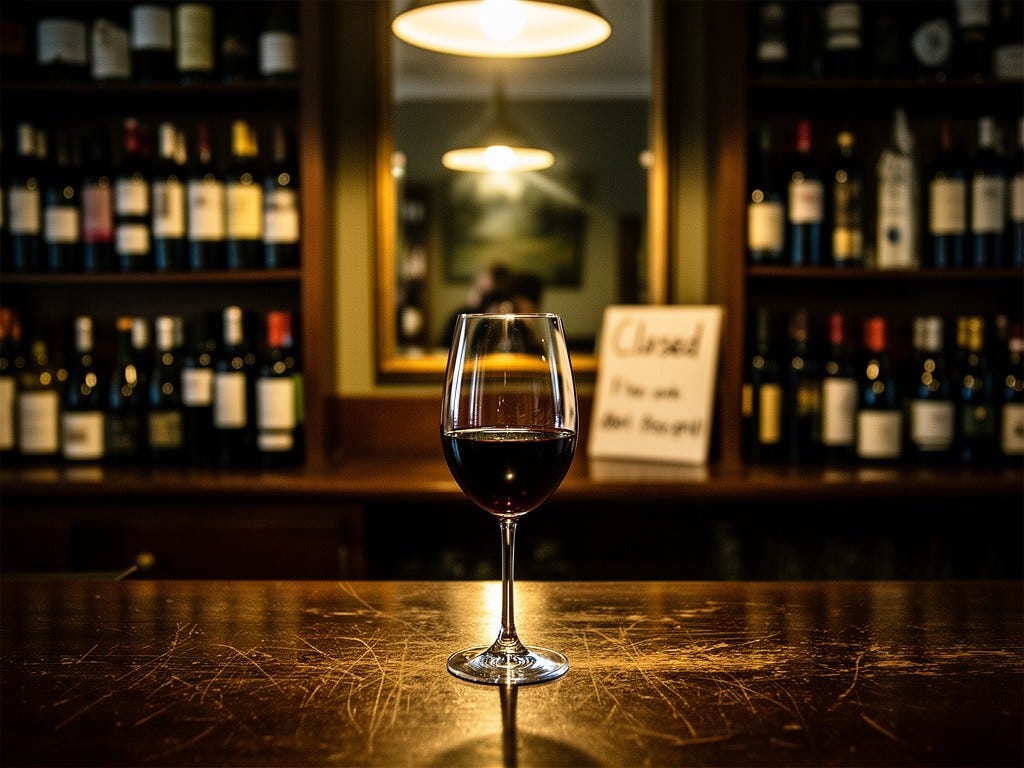
January 18, 2025. Michelle Bonds pours the last glass anyone will ever order at Trova Wine + Market, her bar in Dallas’s Preston Center. Four and a half years, back-to-back nominations for best wine bar in the city, a list built one bottle at a time. She’s closing anyway. When she explains why to local reporters, Ozempic is one of the reasons she gives by name: fewer glasses per table, less food ordered per customer, even after she put high-protein salads on the menu trying to chase the GLP-1 crowd instead of losing them.
A wine bar closing in Dallas is a rounding error. Fourteen months later, the same force showed up on a balance sheet nobody could round away.
February 2026. Kraft Heinz’s new CEO, Steve Cahillane, walks into his first earnings call and kills the plan his predecessor spent a year building: splitting the company into two separate businesses. Instead he commits $500 million to something nobody at Kraft Heinz was budgeting for three years ago. Reformulating the entire portfolio around protein, away from sugar.
That’s not a branding refresh. That’s a 157-year-old food company rebuilding its balance sheet around the same drug that closed Michelle Bonds’s wine bar.
In November 2024, I wrote that GLP-1 medications wouldn’t just treat diabetes and obesity. They’d regulate impulse, and impulse is the fuel under a huge share of the American economy: snacking, drinking, impulse retail, the whole advertising machine built on triggering a craving. Pull the fuel out and you get a slow-motion earthquake under restaurants, alcohol, malls, casinos, advertising.
Fifteen months later, the earthquake has a balance sheet, and it started showing up in bars like Michelle Bonds’s before anyone in a boardroom noticed. Statista puts current GLP-1 use at 1 in 8 Americans, which means Bonds wasn’t watching an outlier. She was watching the leading edge.
Gallup has the share of Americans who say they drink at all falling from 62% to 54% in two years. That’s not a survey artifact, and it’s not just Trova. Trade press covering the spirits industry has started asking whether “no-and-low” alcohol is the last growth category left standing. Diageo’s US spirits sales are down 15.4% in the first half of fiscal 2026, and the damage isn’t spread evenly. Its tequila brands took the worst of it: Don Julio down 20.9%, Casamigos down 30.9%. Morgan Stanley’s research desk models a theoretical ceiling of a 55% drop in alcohol demand if GLP-1 adoption reached the entire overweight and obese population. Nobody’s near that ceiling yet. Nobody’s betting against reaching it, either.
Bars felt it first because a cocktail is pure impulse. Restaurants are close behind. Olive Garden rolled its “Lighter Portions” menu out nationwide, citing GLP-1 users as one reason. Cuba Libre, the multi-location rum bar and restaurant chain, built an entire “GLP-Wonderful” menu around smaller plates. In New York, Tucci’s owner Max Tucci has talked openly about shrinking the meatballs and arancini on his menu, not because food costs went up, but because fewer people can finish what used to be a normal portion. None of this is a chain quietly testing something in three markets. It’s public menu redesign, company by company, in under two years.
A Cornell study built on real transaction data from 150,000 households found GLP-1 adoption cuts grocery spending by more than 5% within six months, about $390 a year off a typical $7,400 grocery bill. Among higher-income households, the drop is closer to 8%. The cuts aren’t spread evenly either: chips and savory snacks down about 10%, sweet bakery down 9%, cookies down 7%, while yogurt and fruit actually ticked up. EY-Parthenon estimates GLP-1 use could pull $12 billion out of snack sales over the next decade. A year ago that was a forecast. Now it’s a capital allocation decision. Kraft Heinz’s $500 million turnaround is the headline, but it’s not alone. Nestlé built an entire brand, Vital Pursuit, around GLP-1 users and is expanding it. PepsiCo is reformulating Lay’s and Gatorade, stripping artificial colors, and piloting mini-meal formats under Sabra and Siete. When three of the largest food companies on earth start moving in the same direction inside the same eighteen months, that’s not a trend piece anymore. That’s the market repricing an entire category of demand.
The most interesting new evidence isn’t about spending. It’s about behavior. A 2026 Rutgers study published in Criminology found that GLP-1 use weakened the statistical link between impulsivity and violence by 62%, and between alcohol and violence by 52%, among current users. The researchers are careful to call this a first step, not proof of causation, and they’re right to be careful. But this is the mechanism underneath everything else in this piece: a molecule that changes how strongly people act on craving, at population scale. Alcohol sales and snack sales are downstream symptoms. The impulsivity data is the actual story.
Here’s the part that should worry anyone modeling this as a straight line. The people who can afford these drugs and the people who can’t are splitting apart faster than the coverage system can keep up. Thirteen states covered GLP-1s under Medicaid for weight loss as of January 2026, down from sixteen the year before. Employers are dropping the coverage too. Medicare is stepping in with a $50-a-month bridge program starting this July, which is itself an admission that the private market wasn’t going to close the gap on its own. A recent survey from The Health Management Academy found more than 70% of Americans already believe these drugs are only realistically accessible to people with money or good insurance.
And the drugs themselves aren’t free of cost to the people taking them. A University of Utah study published in August 2025 found that GLP-1-driven weight loss cuts lean muscle mass by roughly 10%, and that muscles get measurably weaker even in cases where they don’t visibly shrink. Worse for older adults, who are already fighting to hold on to mobility. Nobody’s modeling that against the productivity gains everyone’s excited about. Somebody should.
Kraft Heinz just told you where the food industry thinks this goes. The alcohol numbers just told you where the beverage industry thinks this goes. Nobody yet has told you where the insurance industry, the labor market, or the disability system thinks this goes, and those are the three that decide whether this transformation makes the country healthier or just sorts it into two tiers faster than anyone can build a bridge between them.
Kraft Heinz didn’t spend $500 million because a Substack post was right. It spent $500 million because the data stopped being debatable. Michelle Bonds didn’t need a study to know something had changed in her bar. She just ran out of runway before the rest of the economy caught up to what she already knew.
Which industry hasn’t made its move yet?
Sources
Trova Wine + Market closure, Michelle Bonds — The Drinks Business, “Ozempic partly to blame for wine bar closure, says owner”
GLP-1 usage rate (1 in 8 Americans) — Statista, “Key Figures: Usage and Opinion of GLP-1 Medication”
Kraft Heinz $500M reformulation, EY-Parthenon $12B snack forecast — GV Wire, “Big Food Pours Millions Into Rebrands as Obesity Drugs Reshape US Demand”
Gallup drinking rate, Diageo/Don Julio/Casamigos sales — Poached, “Is GLP-1 Use Cutting Into Your Alcohol Sales?”
“No-and-low” alcohol category trend — The Spirits Business, “Is the ‘Ozempic era’ an opportunity for no-and-low?”
55% alcohol demand ceiling — Morgan Stanley, “Next Order Effects of Increasing GLP-1 Use”
Olive Garden “Lighter Portions” nationwide rollout — Fortune, “Ozempic mania has even Olive Garden and The Cheesecake Factory cutting back on portion sizes”
Cuba Libre “GLP-Wonderful” menu, Tucci portion changes — Fox News, “GLP-1 drugs like Ozempic are reshaping American dining habits and restaurant industry”
Cornell grocery spending study (150,000 households) — Cornell Chronicle, “Ozempic is changing the foods Americans buy”
Nestlé Vital Pursuit, food company reformulation — CNBC, “GLP-1 drugs are changing how Americans eat”
PepsiCo Simply NKD / Sabra / Siete — Food Dive, “Food makers poised to withstand threat of GLP-1 weight loss drugs”
Rutgers/Criminology impulsivity-violence study — Medical Daily, “Ozempic May Be Reducing Violent Crime in America”
Medicaid coverage drop (16 states to 13) — KFF, “What to Know About the BALANCE Model for GLP-1s in Medicare and Medicaid”
Medicare $50/month bridge program — NPR, “Medicare launches weight loss drug option with $50 copay”
70% believe GLP-1s are only accessible to the wealthy — The Health Management Academy, “The GLP-1 Access Gap”
University of Utah muscle/lean mass study — University of Utah Health, “New Study Raises Questions About How Ozempic Affects Muscle Size and Strength”
No posts
Comments
Nothing yet. Say the first thing.
Sign in to join the conversation.