
It felt like 1001 degrees Fahrenheit that morning.
The Friday before a holiday weekend, the beach at Far Rockaway was already filling up well before 10:00AM. Normally, my preferred stretch of sand is relatively quiet, occupied only by a few sunbathers, parents watching their kids at surf lessons, and the surfers out in the water. You can usually count the people in front of you on two hands. Not this day.
After a few hours on the beach, I packed up my bag at exactly 10:03AM and headed for the subway. I needed to get home, shower, and slip into something that felt like I was wearing nothing. We were in the middle of the summer’s first proper heatwave. A thin ocean breeze followed me as I passed a fresh wave of beachgoers carrying towels, wetsuits, folding chairs, and umbrellas.
On the subway ride home, my biggest concern was whether it would be appropriate to wear shorts to the theater. I had tickets to the 1:00PM matinee of Arthur Miller’s Death of a Salesman, and I didn’t want to be late or poorly dressed. It seemed undignified to arrive in swim trunks straight from the beach, and the thought of shifting in my seat while sand sifted down my leg was dreadful. As the train approached Howard Beach–JFK Airport, I wondered whether I’d have enough time to rummage through my closet and find something that could survive both the heat outside and the air-conditioned chill of the theater.
And then we came to a halt just after crossing Jamaica Bay. A maddening halt. A stifling halt. Ten minutes stretched into thirty. I obsessively checked the time on my phone, calculating whether I could still make it home, shower, and get to the theater before the curtain rose.
A teenager, his younger sibling, and their infant brother sat at one end of the car, the baby periodically wailing at full volume. An older woman next to me, dressed in her finest housecoat and mesh slippers, kept looking over with an expression that said, Can you believe this? I telepathed back, No, I cannot. Across the aisle, a younger woman began shouting obscenities at no one in particular—or perhaps at anyone willing to listen—in protest that we were all being held captive on this train.
We were eventually informed that the train ahead of us had struck debris on the tracks and that we would remain where we were until the MTA cleared a path. Suddenly, the most pressing question was no longer which pair of shorts I was going to wear to this much-celebrated production of Death of a Salesman. It was whether we were going to move at all.
Over an hour passed and suddenly the rush of nerves were eating at me. I couldn’t get a refund and it was doubtful I would be let in halfway through the play. Naturally, my phone chose this moment to begin dying. Lyft from this far out in Queens to my apartment in Brooklyn would have been the same cost as the ticket, which I didn’t want to spend. I was trapped with the screaming baby, the shouting woman, and the older woman in the mesh slippers, whose expression had moved from silent to visibly annoyed.
At around 11:48AM, with my phone clinging to 4% battery, the train finally budged from its perch. We were moving again. In the slowest of slow motion, we made our way back to civilization.
Finally, the train pulled into the Nostrand Avenue station and I bolted out to connect to the C train, but just narrowly missed it. As a New Yorker, there is nothing worse than seeing a subway train car close right within your grasp, particularly when you’re pressed for time. I couldn't bear waiting for the next train. By this point, my phone was down to 2% battery and it was already 12:17PM. I hopped on a CitiBike and raced down Fulton Street, weaving my way through traffic.
I arrived home and in under eight minutes I managed to shower, call a car, and change into Dries Van Noten. I was still sliding into my shoes when I got into the backseat of the Toyota Camry that would chauffeur me to the theater.
“I have tickets for 1 o’clock at this theater. Take whatever is the fastest route!” I said to the driver.
I was eager to see Death of a Salesman; it would be my first encounter with Arthur Miller's work. At 1:03PM, I told the driver I'd get out and run—we were only half a block from the theater. There I was, just beyond the bright lights of Times Square, sprinting toward Broadway in the middle of a heatwave.
The theater attendant, a pleasant older woman, told me to wait a moment. The performance had just begun, and the latecomers would be let in shortly. The sigh of relief that came over me was unlike anything I'd ever experienced. I felt as though I'd just finished the New York City Marathon—or won an Academy Award.
In the darkness of the Winter Garden Theatre, I made my way to my seat, one in from the aisle in the mezzanine. My heart was still racing when the gentleman seated beside me leaned over and whispered with genuine excitement, “Glad you made it.”
For a split second I wondered if I knew him. Had I forgotten I was supposed to meet someone? Then it became clear. This was the communal experience unique to live theater. My seatmate wasn't simply happy I'd made it. He was happy another person would get to experience what he was about to experience. We would sit for the next few hours and watch a play about the performance of masculinity, the tangled web of parent and child relationships, and the fuzzy fantasy of the American Dream.
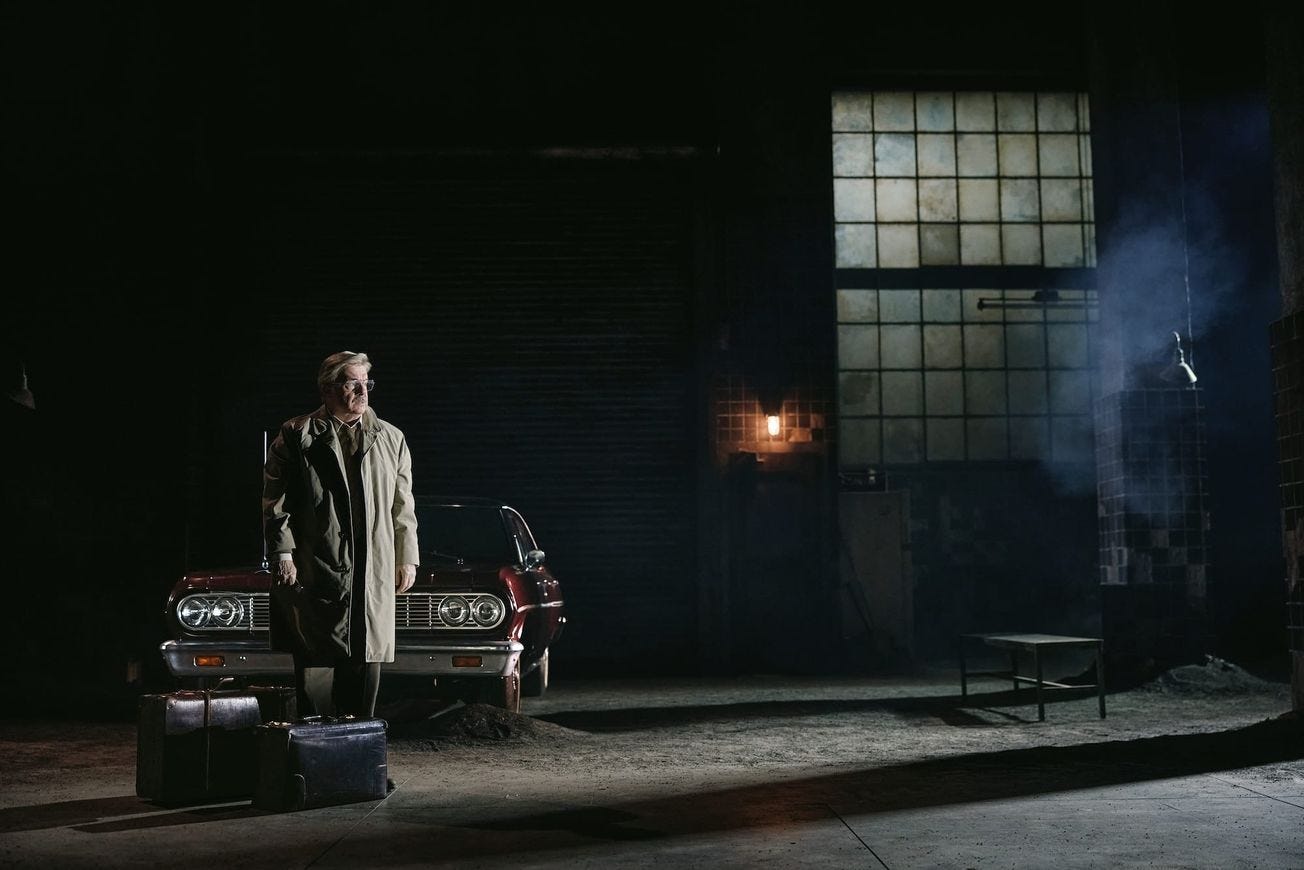
The first thing that struck me wasn't Nathan Lane or Laurie Metcalf, but Chloe Lamford’s scenic design. Industrial columns and a 1964 Chevy Chevelle occupied much of the stage. Almost present for the entirety of the play, you can’t take your eyes of the angular Chevelle and what its muscular presence might suggest about the characters and action that unfolds around it. Something so hulking and coded as masculine, yet visibly worn, became a smart visual metaphor for the men orbiting it. Director Joe Mantello's set transforms from a family home to office to motel room, its stark surfaces allowing memory, hallucinations and present day reality to bleed into one another. The stark lighting courtesy of lighting designer Jack Knowles casts moody shadows in the distance to add dimension, and when necessary, and to great dramatic effect, it spotlights a key cast member.
Willy Loman (Nathan Lane) has reached that stage of life when everything seems just beyond his grasp. His career is evaporating, his sons Biff (Christopher Abbott) and Happy (Ben Ahlers) remain emotionally stunted in their arrested development, and his wife Linda (Laurie Metcalf) quietly manages the disappointments of all three men.
In Act 1, the play sets up how, or if, these men will navigate their own failures. For a play that is nearly eighty years old, the failure of man is a timeless topic worth investigating in each of it generational iterations. The Willy Loman of 2026 isn't necessarily a traveling salesman. He's the man laid off mid career from a tech company. He's drowning in credit-card debt. He's spent decades believing that hard work alone would guarantee dignity, only to discover that the rules have changed without anyone telling him. If he isn’t working and providing, his life holds very little meaning. It’s a sharp observation that cuts to the bone, and my seat mate let me know it when the curtain closed for the intermission.
"What did you think?" he asked the moment the audience erupted into applause.
Caught off guard, I assured him that I was thoroughly impressed by the fantastic array of performances from Lane, Metcalf, and Abbott. During what felt like an unusually long intermission, this stranger waxed about his life story and how he felt a special connection to Loman. In his mid-50s with a kind demeanor, my seatmate felt like he’d been waiting all day to tell someone his story. Ordinarily I would have found this conversation disruptive. Instead, I was moved by his generosity and unabashed enthusiasm for the theater.
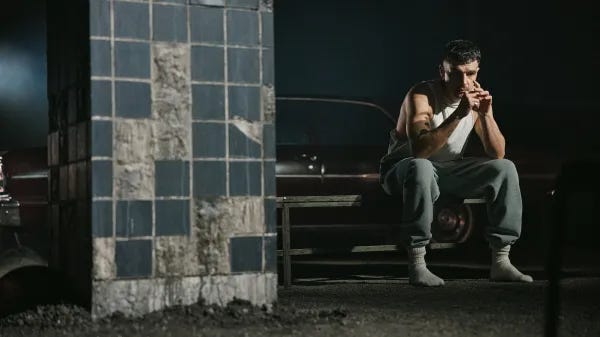
As Act 2 began, the production sunk its teeth into the myriad of ways Willy and Biff chase after their misguided desires. This is my first live performance with Lane, an actor I’m more familiar with in film. His sturdy frame and hangdog face tell you everything you need to know about a man struggling to find his place in a world rapidly changing around him. The gruff disappointment of old age that Lane etches into the character is the opposite of his buoyant presence in The Birdcage and The Lion King. Abbott is well cast here too, adding another psychologically damaged young man to the growing gallery of troubled souls he has played throughout his career. Their dynamic is palpably believable. Abbott knows just the right gestures to prop up his father and conjure the feelings of rage that he is destined to be ordinary, not extraordinary as he was led to believe.
In lesser hands, Linda could easily be reduced to the familiar role of the long-suffering wife. Metcalf acts with her darting eyes that I could see all the way from my seat, even when she wears sunglasses to the funeral. She belongs to that rare group of character actresses—alongside Dale Dickey and J. Cameron Smith, to name a few—who alter the chemistry of every scene they enter. To think that Metcalf can expertly do what she does in the funeral scene in this play and then turn in a brief, but comically deadpan cameo on the final season of Hacks affirms that she is a distinct treasure of American theater, television, and film.
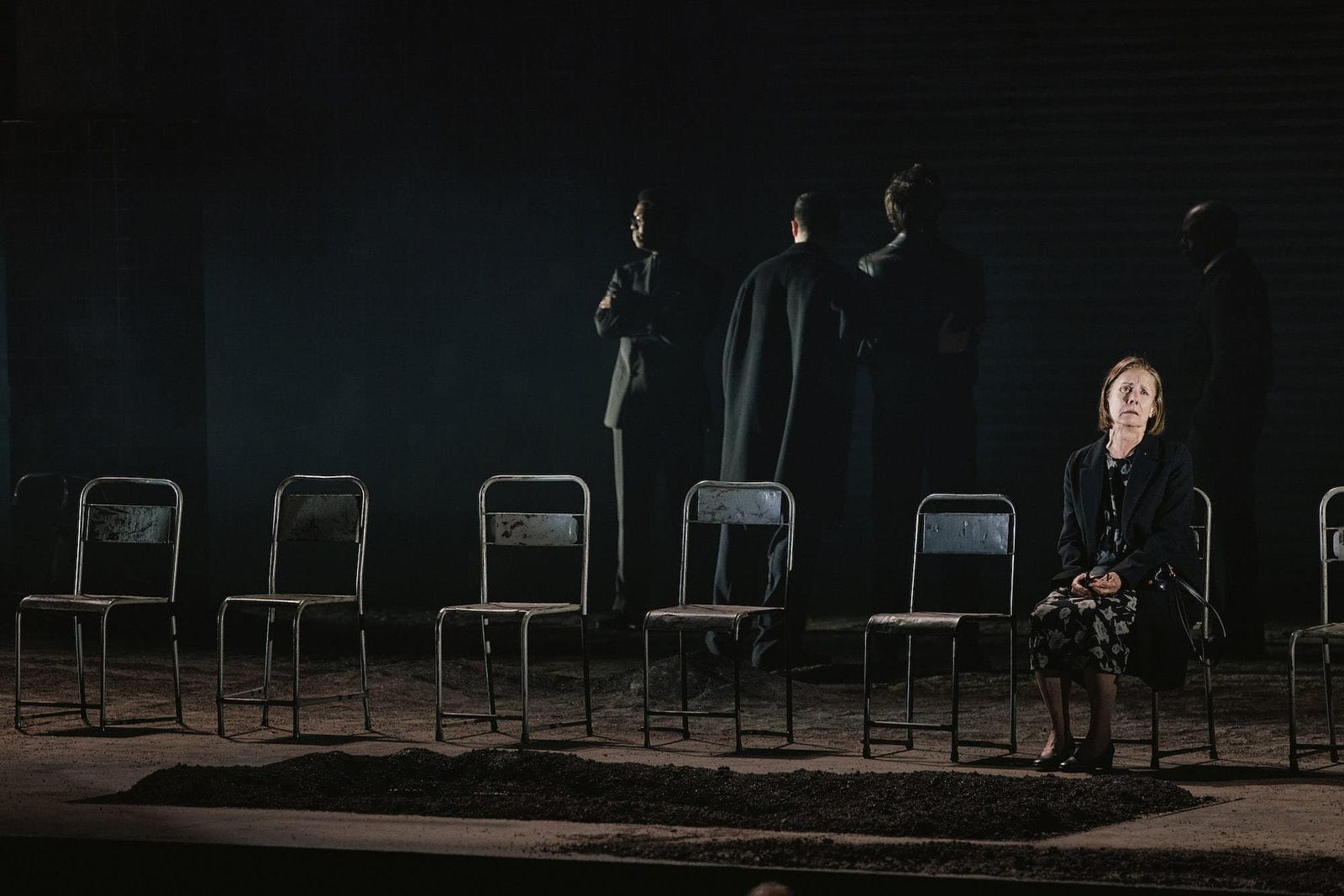
In the final moments of the play, the tragedy goes into overdrive with revelations of family secrets, death, and possible new beginnings. It’s a shock when a funeral is under attended, and yet there is a strange freedom in finally being released from the burden of debt, even if that freedom comes at a bleak cost. While this story might have felt like a dour, cautionary tale for and about men, the rapturous applause at the cast curtain call seemed to be release that we as the audience needed on this hot day.
The stranger next to me turned to me one final time and said with watery eyes, “That was great. We’re all Willy Loman.” As the crowd hurriedly made their way out of the theater, my seatmate disappeared into thin air.
Death of a Salesman might have been a blistering three hours at the theater, but I was more than satisfied that I made it in the end, even if I was a few minutes late. As I left the theater and stepped into Times Square, I saw the optimism of tourists, the usual bus and car traffic, the M&M store couldn’t have been more packed, and sailors were in town for Fleet Week. A large costumed gorilla and Super Mario roamed the block, taking pictures with anyone who seemed charmed by their unusual stature. The Naked Cowboy merrily played to the crowd. For the first time that day, I could finally move through the city at a leisurely pace.
A free subscription includes:
✓ Weekly essays delivered to your inbox
✓ Access to Notes and community discussions
✓ Occasional interviews and special features
A paid subscription gets you:
✓ Subscriber-only essays and series
✓ Select archive access to earlier pieces
✓ Recommendations, lists, and cultural deep dives
If you’ve been reading for a while, subscribing is the most direct way to support the work—and stay close to it.
Comments
Nothing yet. Say the first thing.
Sign in to join the conversation.