
This essay is part one in a three-part series exploring the work of filmmaker Tony Scott through a queer lens. Throughout his career, Scott crafted a string of largely genre-driven box-office hits that often focused on relationships between men, whether in intimate pairings or tightly knit groups. His films unfold in hermetic worlds coded as masculine: the Air Force and Navy, NASCAR, organized crime, espionage, professional sports, and surveillance. Part one looks at Revenge, a sensual neo-noir from 1990 set in Mexico that is just as much about a heterosexual affair as it is an emotional saga between two men.
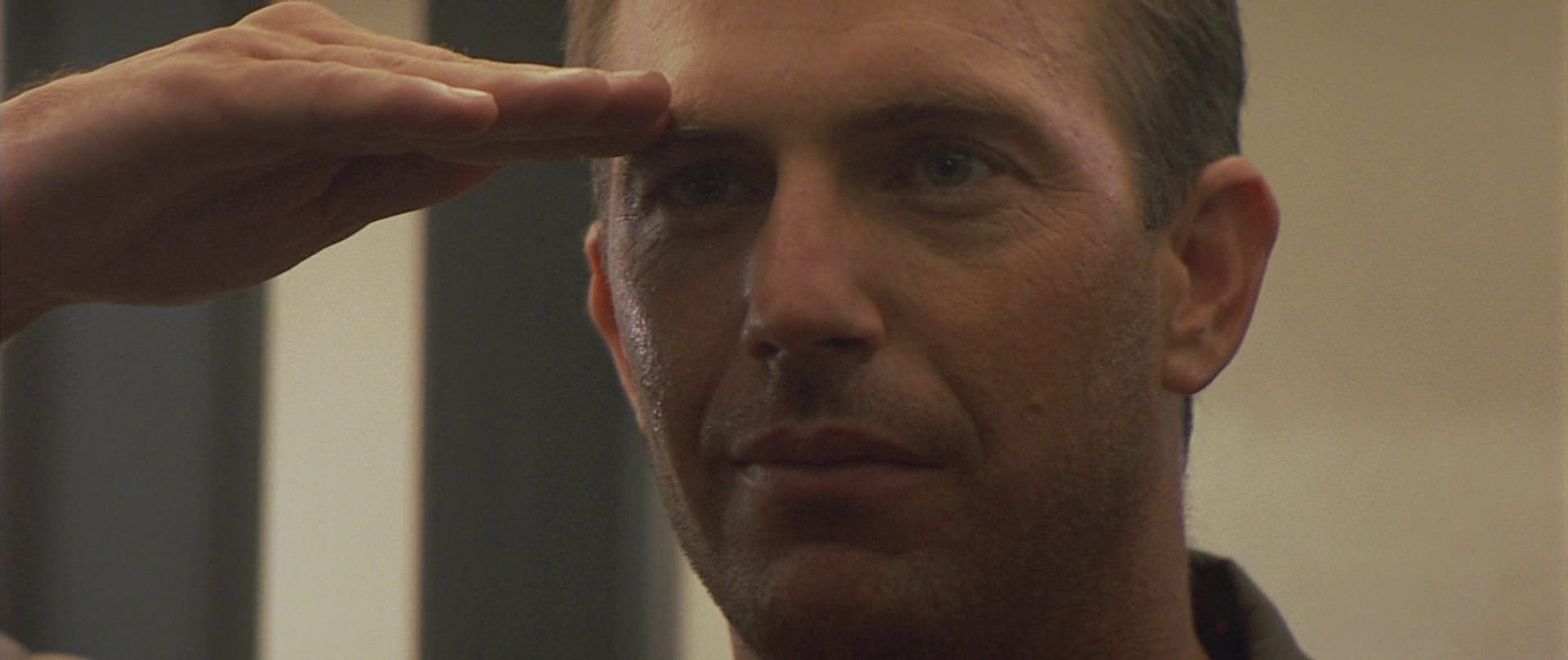
I love movies about moisture and heat.
In Tony Scott's Revenge, Jay Cochran (Kevin Costner), a recently retired Navy pilot, finds himself on a palm-tree-lined beach in Mexico with Miryea Mendez (Madeleine Stowe), the beautiful wife of his friend and mob boss, Tibey (Anthony Quinn). Jay and Miryea have spent the afternoon making lemonade with limes and frolicking on the beach with his dog. The sun hangs overhead when an unexpected rain shower bursts from the clouds. They exchange heated glances that can't be extinguished as they become drenched. This brand of forbidden love seems to exist only in the movies. This being a Tony Scott film, however, we're soon reminded that the most charged relationship isn't between the lovers on the beach, but the male bond with a shadowy past.
When Top Gun: Maverick was released, I took it upon myself to revisit the original Top Gun for the first time in decades. In my memory, it had survived in our cultural consciousness largely because of a memorable catchphrase ("I feel the need... the need for speed"), a movie star on the ascent (Tom Cruise), and one of the most homoerotic displays of heat and sweat ever committed to mainstream Hollywood cinema (the famous volleyball scene, whose sequel counterpart lost most of its erotic charge). I still think Top Gun is a good film, perhaps not a great one. But revisiting it piqued my curiosity enough to spend more time in Scott's cinematic world. I watched Enemy of the State, The Fan, Days of Thunder, The Taking of Pelham 123, Unstoppable, Man on Fire, Domino, and eventually Revenge, a potentially lesser known film in Scott's oeuvre.
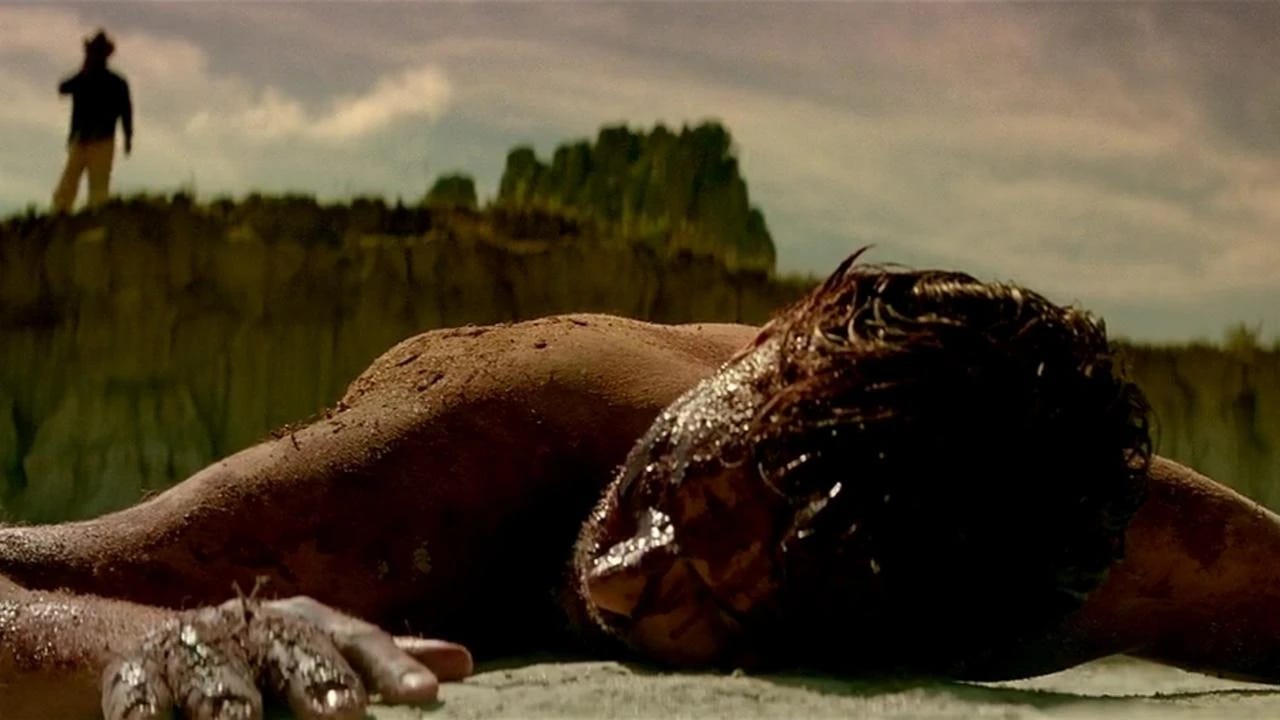
The opening minutes of Revenge almost play like a continuation of Top Gun. Hazy, saturated aerial vistas sweep across the desert as Jay and his co-pilot occupy the confines of their fighter jet cockpits. Below them, a bloodied man crawls across the desert floor. Perhaps this isn’t the patriotic utopia of Top Gun after all.
Back at the airfield, Jay is greeted with a surprise retirement party. Cinematographer Jeffrey L. Kimball fills the frame with wall-to-wall men in flight suits embracing, laughing, and congratulating their friend on early retirement. The scene reminded me of the opening sequence in Ray Mendoza and Alex Garland’s Warfare, where a platoon of soldiers crowd around Eric Prydz’s horny music video for “Call on Me.” Military institutions seem uniquely suited to Scott’s cinema. They permit a physical expressiveness between men—touching, competing, supporting or sparring with one another. The camaraderie established here isn’t incidental. It lays the emotional groundwork for much of the film’s potent intimacy that exists amongst men.
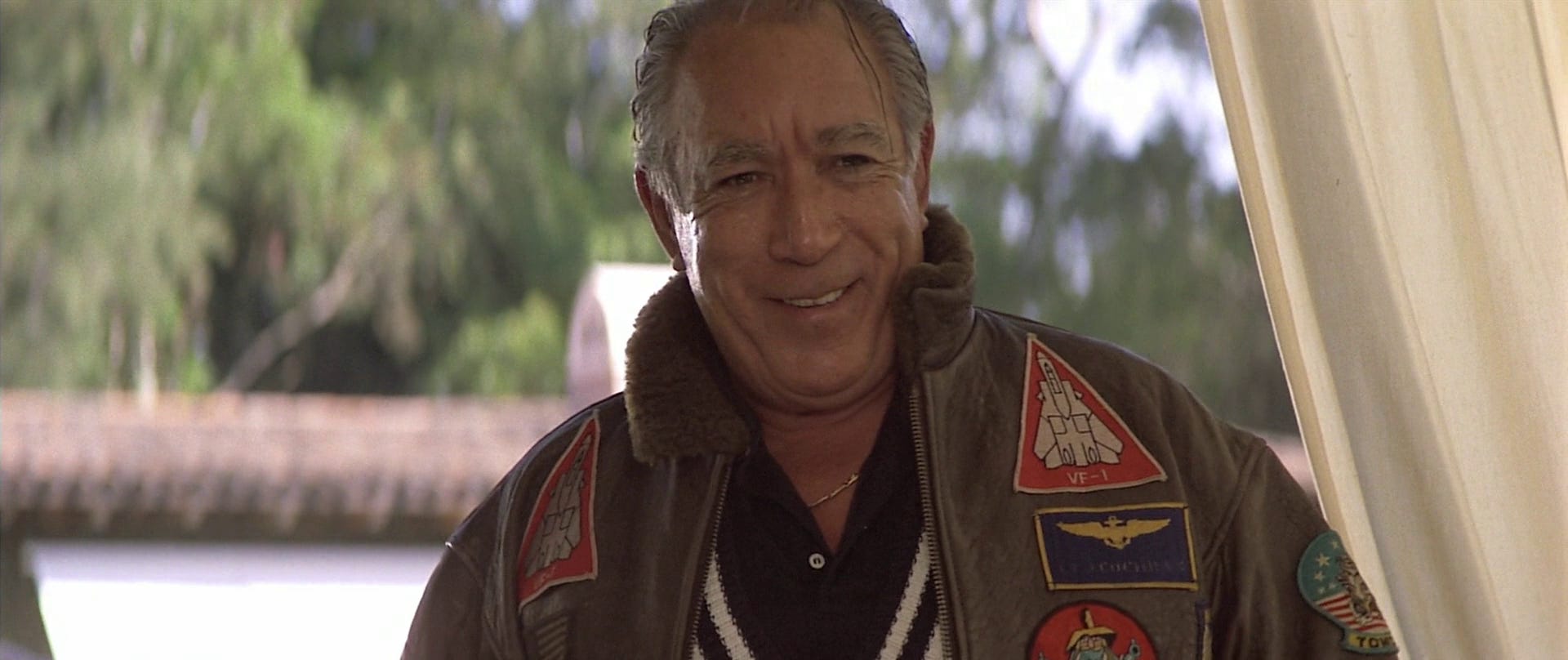
When Jay arrives in Mexico to spend time at his friend Tibey's palatial estate, he's immersed in an intoxicating world where everyone plays tennis in the scorching heat, dresses for candlelit dinners, and treats women as polished accessories to masculine power. He never asks how Tibey amassed such wealth (the film implies he's a drug kingpin). Jay gifts Tibey a Navy G-1 leather flight jacket, a sentimental totem that Tibey literally holds close to his chest until his final scene. Costner and Quinn are an unusual pairing, stars from different systems. Quinn carries menace, gravitas, and sensitivity, while Costner projects a wholesome, all-American masculinity. Scott offers remarkably little exposition about their friendship. We never fully learn how these men met or why they trust one another so completely. Yet Costner and Quinn make the relationship immediately believable through gesture, charm, and mutual admiration.
Costner embodies the kind of archetypal American masculinity that Scott explored throughout his career. Alongside Costner, Scott built films around Robert Redford, Robert De Niro, Denzel Washington, Brad Pitt, Bruce Willis, Will Smith, Gene Hackman, and Tom Cruise—all screen personas that exude strength and know how. By 1990, audiences knew Costner from The Untouchables, No Way Out, Bull Durham, and Field of Dreams—films that each offered a different vision of American masculinity. As Jay, Costner doesn't leave masculinity behind when he retires from the Navy. He simply moves from one fraternity to another. His sojourn in Mexico could be any red-blooded man's fantasy: early retirement in an exotic landscape, endless days spent with a trusted friend, a beautiful lover to roll around the beach with, and a faithful dog at your side.
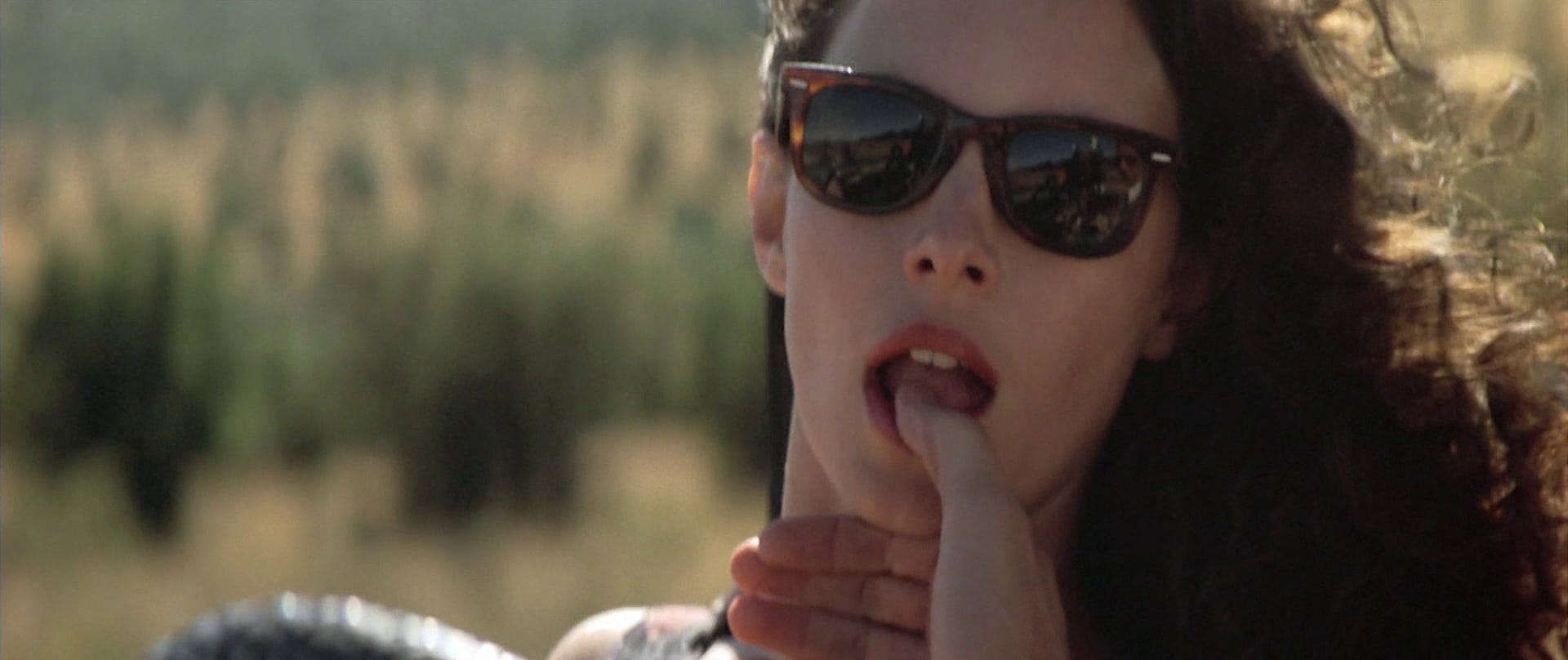
The test in Jay and Tibey’s relationship comes in the form of Miryea. The sexual heat is turned up upon her arrival when she coolly directs Jay to the house in their first introduction. She’s in all white, a virginal doll with the exception of her saucy red lipstick. Stowe is somewhat memorable as the kept bride with her own voracious sexual appetite (although her Mexican accent is a bit wobbly). The sex scenes—they’re not romantic love scenes—between her and Costner are literally steamy, often with billowing curtains in the background or a mind-expanding feat of mechanics while he’s driving a Jeep through the jungle.
This polished form of sex on screen can be found more in Scott’s earlier films like The Hunger and Top Gun (both feature gauzy sex scenes and those signature curtains), before sex and romance largely fizzled out in his later films. Here, sex isn't merely an expression of pleasure; it is a transgression that threatens to destroy the film's central male relationship. It also functions as a tool of power. In one scene, Tibey plunges two fingers into a dense bowl of caviar and licks them clean, a frank sexual gesture that asserts his position as the man with the money, the wife, and the power.
When Tibey discovers the affair, the scorn isn’t entirely aimed at the cheating wife, but also at the male companion who seems to have participated in an even greater betrayal. In a telling scene, Tibey asks Jay to personally fly him on a private mission, but Jay turns down the offer because it coincides with the weekend he’s meant to have a secret rendezvous with Miryea. Quinn and Costner physically shuffle around each other in the scene, and while their dialogue is matter-of-fact—the dates simply don’t align—the actors play the exchange with an unspoken suspicion of what’s happening beneath the surface. It feels like a subtle plea to maintain their own affair, except a woman has entered the picture and temporarily replaced her husband in the dynamic.
The film takes quite the turn from hot-and-heavy melodrama to pulpy revenge saga as its characters sort through the consequences of the affair. Jay is left for dead in the desert (he's the mysterious figure from the opening sequence), while Miryea is permanently scarred on her left cheek and dumped in a brothel, where she is made available to be sexually abused by Tibey’s gang. As Jay crawls his way back to life and embarks on his revenge, Miryea is totally stripped of her already limited agency. In one of the film's most shocking moments, she deliberately shares a needle with another worker in the brothel in an apparent attempt to contract HIV. For a mainstream Hollywood film released in 1990, the image inevitably evokes the cultural anxieties of the AIDS crisis. Miryea's body becomes a sacrificial site to punish and symbolize a very specific form of death sentencing.
Before Miryea eventually dies, Jay reunites with Tibey in a tense exchange on a hilltop where he believes he will finally exact his revenge. Instead, Tibey asks only that Jay seek forgiveness for stealing his wife. Sensing that Tibey has been hollowed out by grief, Jay obliges. He asks for forgiveness and lowers his weapon. It is the emotional closure both men have been searching for. The reconciliation isn't romantic or sexual, but it is undeniably intimate. Scott stages their final encounter like the end of a love story, one in which betrayal gives way to mutual recognition rather than murder. The two men live, while the woman in this sordid tale suffered the most.
In a 1990 Los Angeles Times interview, Revenge screenwriter Jim Harrison reflected on Scott's adaptation of his own novella. "I was so swept away by it that I cried—I really did. And I'm not known for crying." (The Times noted that Harrison was better known for his macho style, on and off the page.) Harrison's response is revealing. Scott's films often look like muscular genre entertainment, yet there’s always unexpected emotional tenderness bubbling beneath. Queer theory often describes these emotionally charged but nonsexual relationships between men as homosocial (a term new to me, but a perfect combination of words), and Revenge becomes far more interesting when viewed through that lens.
Revenge isn't a gay romance masquerading as modern noir. What fascinates me about Scott's work is that while he worked within recognizable genre conventions and used visually intoxicating imagery to convey emotion, his films always find their way back to the power and beauty of relationships between men. Best friends, co-captains, criminals, rivals, drinking buddies, or tennis partners, Scott is deeply attuned to where men find connection. His films offer all the moisture and heat that comes with desire, but through a queer reading, they also reveal masculine intimacy as an affair always worth remembering.
A free subscription includes:
✓ Weekly essays delivered to your inbox
✓ Access to Notes and community discussions
✓ Occasional interviews and special features
A paid subscription gets you:
✓ Subscriber-only essays and series
✓ Select archive access to earlier pieces
✓ Recommendations, lists, and cultural deep dives
If you’ve been reading for a while, subscribing is the most direct way to support the work—and stay close to it.
Comments
Nothing yet. Say the first thing.
Sign in to join the conversation.