
This essay is part two in a three-part series exploring the work of filmmaker Tony Scott through a queer lens. Throughout his career, Scott crafted a string of largely genre-driven box-office hits that often focused on relationships between men, whether in intimate pairings or tightly knit groups. His films unfold in hermetic worlds coded as masculine: the Air Force and Navy, NASCAR, organized crime, espionage, professional sports, and surveillance. Part two looks at Domino, one of the few films directed by Scott to place an untamed woman at the center of its story.
Somewhere at an outdoor cafe, a woman with a blond, angular chop sits with an espresso in one hand and oversized mirrored aviators framing her face. She’s smiling and yet mysterious. The woman is model Iselin Steiro, and the image is from her August 2018 cover shoot by David Sims for Vogue Paris.
This was a visual departure for Steiro, who was known for her distinctly Norwegian beauty and long, wavy mane that bounced down the catwalks at Versace, Chloé, and Balmain. Emmanuelle Alt, then editor-in-chief of Vogue Paris, described the shoot in connection to the overall tone of the issue: “Summer is a time where we dream of adventure and reinvention. For some women, it epitomizes the desire for the unknown and wanting to live in the moment, and this rebellious spirit is what we’re celebrating with this issue.” She sounds like a Tony Scott woman.
That image of Steiro with a boyish haircut and big sunglasses came nearly thirteen years after another similarly fashioned, rebellious woman appeared onscreen. This time, she was a model turned bounty hunter: Domino Harvey (Keira Knightley), the titular heroine of Scott’s dream-like and overlooked biopic, Domino.
Nicole Kidman, Halle Berry, Kelly McGillis, Radha Mitchell, Paula Patton, Catherine Deneuve, Dakota Fanning, and Regina King are just some of the women who shaped Scott’s cinematic oeuvre. Yet his films rarely belong to them; more often, women exist in relation to men—as lovers, wives, daughters, foils, or objects to be protected. That’s what makes Knightley such an outlier in Scott’s pack of actresses. Domino has agency because she is the story. She’s drawn into an unknown world of danger like Susan Sarandon in The Hunger, and can kill a man with her bare hands like Patricia Arquette in True Romance. Scott might have a fetish for dangerous women (or women caught in danger), but here he places one at the center, creating an expressive portrait of a wild woman on her own terms.
From the first to last frame, Scott positions Domino as a hardened lone wolf, someone who performs emotional detachment even as she searches for somewhere to belong. Her father, the actor Laurence Harvey, dies when she is young, leaving Domino with her mother, Sophie Wynn (Jacqueline Bissett), a woman intent on maintaining her own proximity to fame. As Domino grows up, she struggles to connect with other girls; the sorority and fashion worlds offer versions of femininity that feel alien to her and far removed from the life of adventure she seeks. Her backstory is filled with female spaces she never quite fits into, yet she finds solace in the macho world ahead of her, joining a chosen family of bounty hunters and ne’er-do-wells caught in a constant web of crime and deception.
Chosen families, outsiders, and the freedom to construct an identity beyond what’s been prescribed for you all lend themselves naturally to a queer reading. The dream of adventure and reinvention personified by Domino is perhaps the film’s queerest proposition. Knightley transforms into a tough-as-nails doll who can credibly exist among Scott’s most macho men without surrendering the femininity that makes her an anomaly within their world. If Scott’s cinema often reserved its agency and emotional complexity mostly for men, Domino gives a woman access to that same terrain: violence, criminality, surrogate families, masculine institutions, and the freedom to reinvent herself within them. She emerges as a particularly fringe heroine: boyish and feminine, desirable and physically imposing, searching for belonging without ever quite being truly knowable.
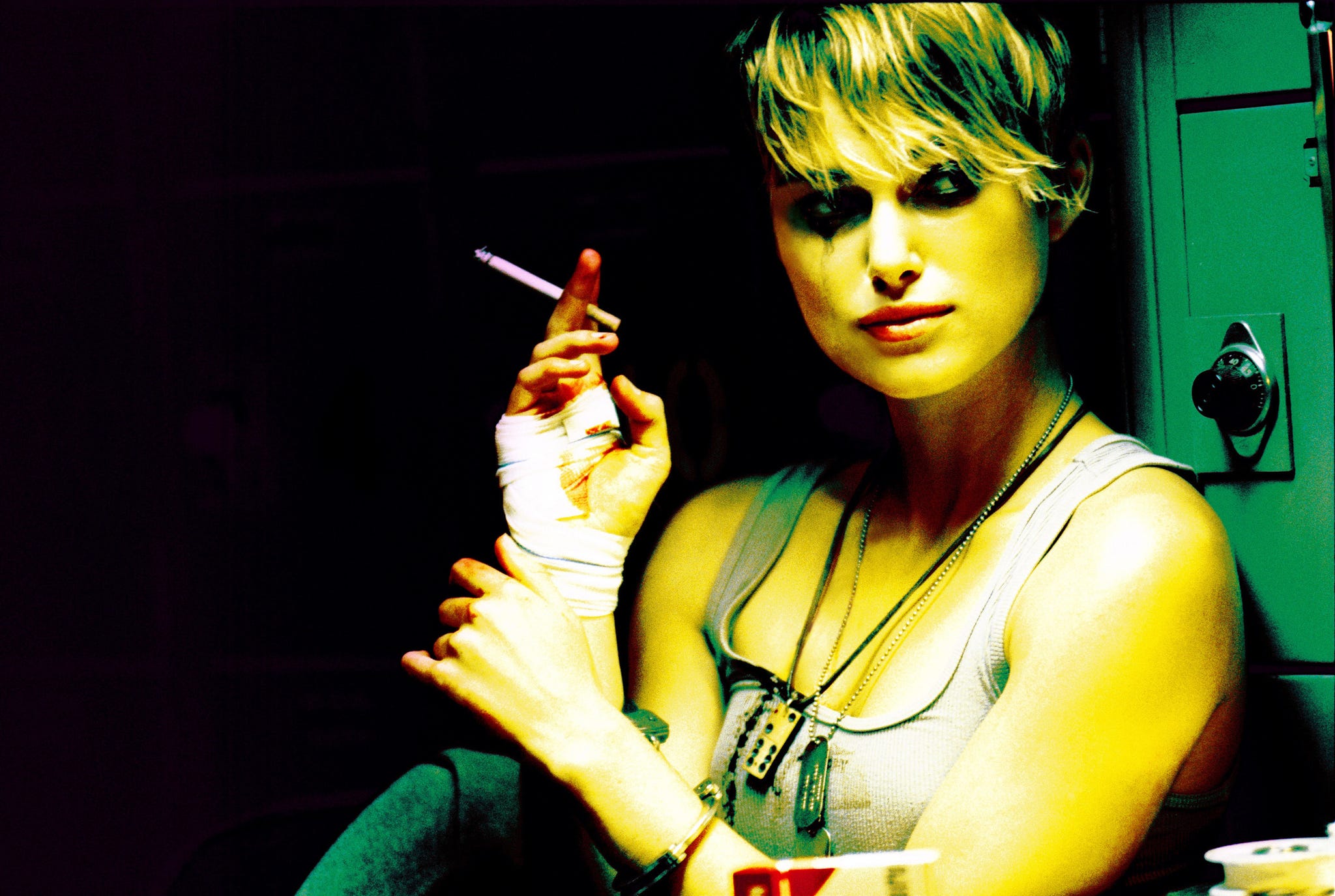
Working with cinematographer Dan Mindel (Mindel and Scott collaborated on three films), the film opens in garish acid tones of yellow and halogen green during its narrative framing device: an interview between Domino and criminal psychologist Taryn Mills (Lucy Liu). These are two tough broads performing for one another—Domino, the mischievous daughter of famous people who has to explain why she chose a life of crime, and Taryn, the psychologist with an eager ear and steely reserve. As the film unfolds, viewers, like Taryn, might wonder why a woman of great beauty and means would leave it all behind to get caught up in a world of violence and destruction. Scott plays with the expectation that beauty and femininity should only signify softness or passivity; in Domino, they coexist with alienation, grit, and an appetite for danger.
Knightley was a wise choice for Domino. In the early 2000s, she was mostly known either for classic English rose roles or as a more conventionally feminine woman within action-oriented worlds. Domino is both and then some. At the time, much would be made of an actress’s physical transformation for a role, whether it involved gaining weight, going makeup-free, shaving her head, or presenting as unapologetically unglamorous. Knightley’s extreme makeover fit that narrative, but with a twist: her short flop of hair is paired with a come-hither wardrobe of tight low-rise pants and bustier tops. She screams obscenities, totes guns, and emotes beneath smoky eyes and dark fingernails. A tattoo on the back of her neck reads “Tears in the Rain,” a not-so-subtle nod to Rutger Hauer’s famous final monologue in Ridley Scott’s Blade Runner. She’s the ultimate fantasy of the hyper-confident woman who can hang with the tough guys and, in another scene that has not aged particularly well, offer a lap dance in her bra to a house full of gang members in exchange for information her bounty-hunter team needs. It’s an external performance of toughness, sexuality, masculinity, and femininity constructed across Knightley’s body from head to toe.
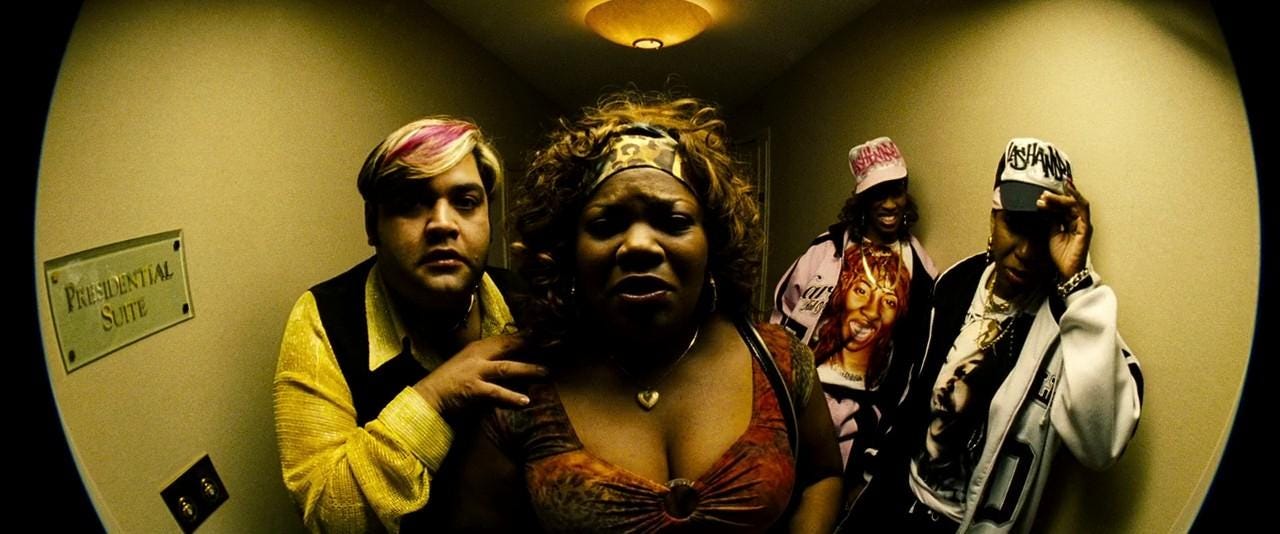
Knightley is also surrounded by one of the most disparate casts of women you’re likely to find in any movie, much less a Scott movie—Mo’Nique, Lucy Liu, Dale Dickey, Macy Gray, Donna Scott, Jacqueline Bissett, and Mena Suvari. Domino’s relationship to other women is complex. As a young woman she rejects the sorority girls around her, responding to a nasty comment about her boyish body with a punch to the face, yet throughout the film she repeatedly finds herself entangled with women navigating institutions and circumstances larger than themselves. Lateesha Rodriguez (Mo’Nique), a DMV employee desperate to pay for her granddaughter’s medical care, becomes involved in a scheme that promises the kind of money the American health care system keeps out of reach for those without Domino’s means. Edna Fender (Dickey), meanwhile, takes matters into her own hands after the bounty hunters show up with her son’s severed arm, secretly dosing their coffee with mescaline and sending them on the film’s most hallucinatory detour. These women aren’t necessarily Domino’s allies, but they aren’t passive entities around the men either.
Domino’s journey eventually brings her back to the woman she spent much of her life running from. In the grief following her father’s death, Domino finds a replacement family among men; once that family is destroyed, she is released back into the swimming pool of her mother’s home, finally returning to the female relationship she had rejected years before.

Putting a woman at the center of Domino doesn’t mean Scott abandons the boys’ club that has defined so much of his cinema. Ed Moseby (Mickey Rourke) and Choco (Édgar Ramírez) become her partners, protectors, and surrogate family, but her presence also threatens the relationship that already exists between the two men. When Choco’s attraction to Domino causes the men to fight, Ed warns him that women know how to ruin men and that he shouldn’t let Domino come between them. It’s a familiar configuration in Scott’s films: men must protect their relationship from the women that threaten to come between them. The difference here is that the woman isn’t a supporting femme fatale, she’s the leading lady.
As much as the film makes a to-do about Knightley’s body, the camera lingers on Choco’s body on more than one memorable occasion. All shaggy hair and quiet swagger, there’s a revealing scene set in a laundromat in which Domino is chatting with Ed while, in the background, Choco strips to bikini briefs as he puts his soiled clothes in the wash. Choco can sense he’s being watched, even if it’s only by the backs of Domino and Ed’s heads. There are quick close-ups of his lower abdomen and briefs that left me giggling at how much Scott adores a hunk, even in a movie about a woman.
The film’s queerest male character is treated quite differently. Raul Chavez (Joe Nunez), Lateesha’s gay co-worker at the DMV, is folded into a group Domino describes as “three sassy Black women and Raul.” The distinction is telling: with a pink streak through his bangs and a performance largely defined by shrieking alongside his female co-conspirators, Raul is a man firmly in a woman’s world. When the foursome carries out the $10 million heist, they disguise themselves as First Ladies—a sly gender flip on the bank robbers of Kathryn Bigelow’s Point Break, who famously wear masks of male presidents. For a film that traces Domino’s ability to move between masculine and feminine codes, Raul remains a frustratingly stock gay character. Scott can eroticize Choco’s masculinity and turn Domino’s boyishness into something dangerous and sexy; yet male femininity is afforded considerably less dimension.
Visually, Domino is one of Scott’s most audacious and experimental films. Much of the world depicted in Domino looks like a drug trip, with unusual color grading, varying film stocks, rapid editing, and a non-traditional expression of time that is frequently sped up, slowed down, and repeated from different angles to play with subjectivity, memory, and time. Scott called this approach “heightened reality,” a world where the colors are more vibrant, “the blacks are blacker, the whites are whiter, the reds are redder.” The annihilation of the senses feels purposeful for a story based on a real life that already seems too outsize to be true.
Scott often used the advertising campaigns and commercials he directed between features as laboratories for pushing filmmaking beyond the conventions of narrative cinema. Before Domino, he made a BMW short set in Las Vegas with Clive Owen and James Brown whose ugly-beautiful grit and grime would bleed into his later work. Another commercial experiment with cinematographer Mindel, using hand-cranked cameras and unconventional film processes, helped produce the streaking images they would eventually push further in Domino. Scott and Mindel even referred to the film’s visual language as “Domino vision,” taking the viewer out of ordinary reality and placing us inside hers.
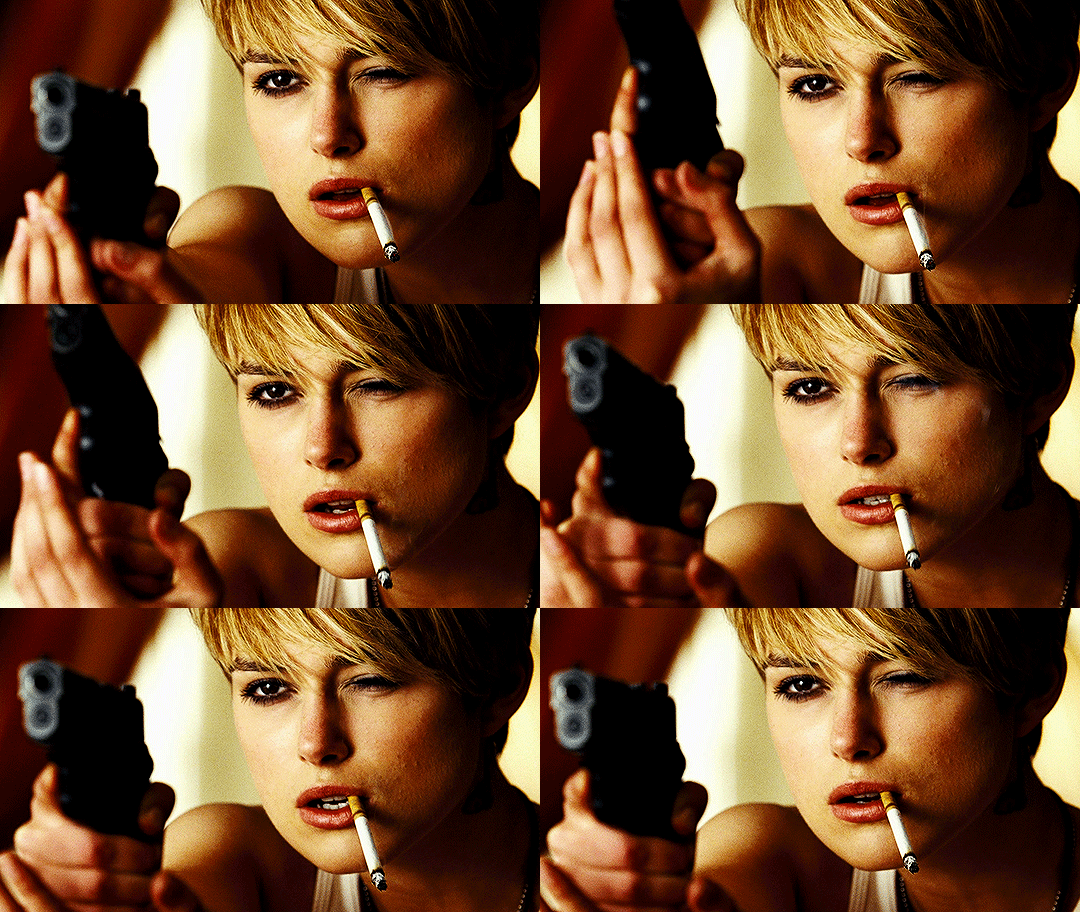
In addition to his advertising work, Scott studied fine art at the Sunderland College of Art and Leeds College of Art before graduating from the Royal College of Art in London. He drew his own storyboards, meticulously mapping out films that could nevertheless be photographed with as many as six cameras simultaneously, and often cited a connection to Robert Rauschenberg, an artist whose work he personally collected. His painterly hand is on full abstract display in Domino, where dissolves, superimpositions, blown-out color, and fractured images call to mind Rauschenberg’s collage-like surfaces. Scott understood from advertising how to make an image stick, whether it was Domino blowing smoke at a gun aimed at her face or the bombastic climactic shootout atop a hotel in Las Vegas. The apparent chaos was carefully engineered, but Scott also embraced accidents: photographic “mistakes” became part of the finished film when they captured the emotional texture he was after.
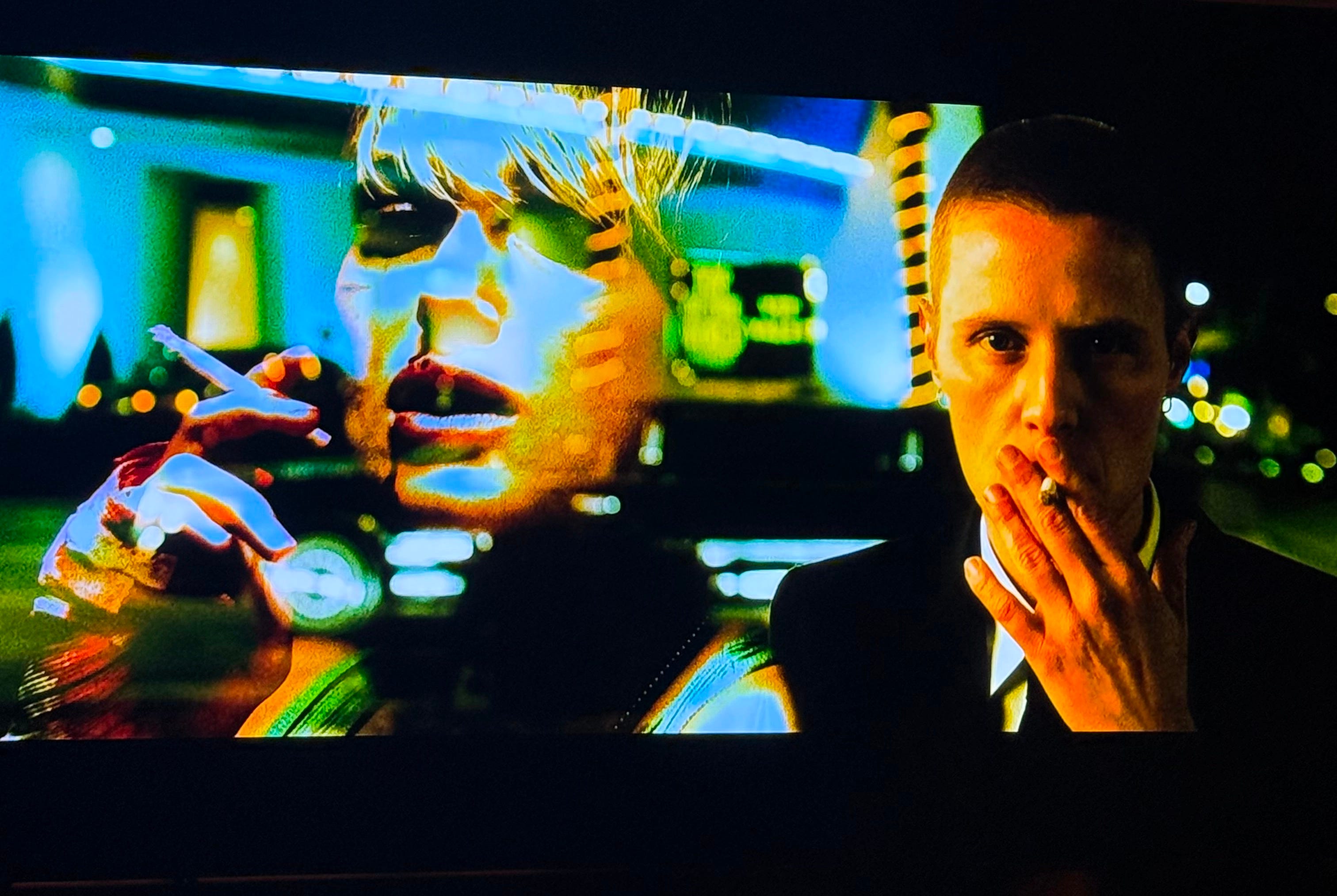
The last image in the film is itself a Rauschenberg-like collage: Knightley as Domino dissolves into the real-life Domino Harvey, a composition of actress merging into the film’s subject. Each smokes a cigarette. The real Domino has a more closely cropped mane than Knightley and two small hoop earrings; there are no sexy bangs framing her face, no aviators to heighten her mystique. She stands with firm confidence in a black suit and smiles at the camera as a car smashes behind her beneath the glittering lights of Las Vegas. After two hours of Scott constructing his own heightened image of Domino Harvey, the real woman finally appears. She looks like a Tony Scott woman.
A free subscription includes:
✓ Weekly essays delivered to your inbox
✓ Access to Notes and community discussions
✓ Occasional interviews and special features
A paid subscription gets you:
✓ Subscriber-only essays and series
✓ Select archive access to earlier pieces
✓ Recommendations, lists, and cultural deep dives
If you’ve been reading for a while, subscribing is the most direct way to support the work—and stay close to it.
Comments
Nothing yet. Say the first thing.
Sign in to join the conversation.