
Welcome new subscribers xo
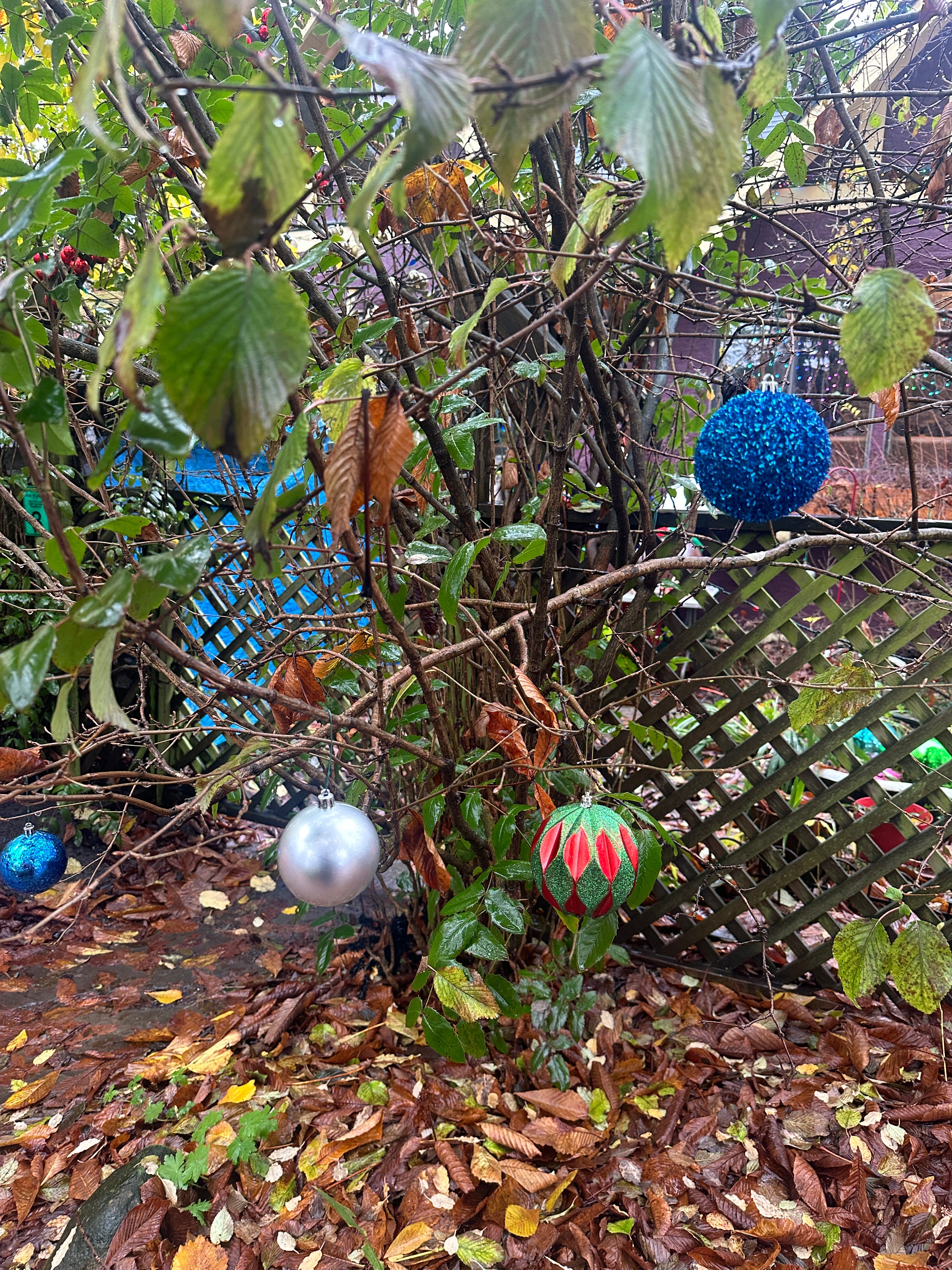
Winter solstice (in the northern hemisphere) approaches within days, and as always, I am sensitive to these seasonal shifts—the solstice is my meaningful transition marker of choice during this time of the year. Having spent the last few years visiting my family in a remote area of Maui over the (let’s call it Capitalist Christmas) season, I don’t register the frenzy of the holidays anymore. Meanwhile, in Vancouver this year, it is mild, green, and wet—a Pacific rainforest winter. Glittering decorations seem absurd (as they always struck me whilst living in Australia), the faux crystalline glint of ornament-shaped plastics having no hard edge of icy air to mirror them. This year, I’ll conduct new rituals, reflective of the place and space I’m in for the first time. Earlier in the month, I came across swathes of ripe-berried holly wrapping around the vegetation of the UBC Endowment Lands (a beautiful place to hike). These prickly sinews of vine were gathered and bent into a humble, unembellished wreath. Thus far, it is my sole decoration.
The spatio-temporal para-location I live comes from being a time traveller, as in, I am never fixed in a time zone, location, climate, or … vibe. My circadian rhythm has become transitional, adapting quickly to whatever daylight hours I find myself in. I don’t work a traditional “work day”—I work to deadlines, for as many hours a day required to meet them. Sometimes that is 3, sometimes it is 15. Sometimes I sleep for 12. So, then, what meaning shall I assign to this year’s winter solstice, as I experience it? Traditionally, winter solstice gives us hope in the gloom: the return of longer days and less darkness. We yearn for the sun, in our imaginations, as we light candles and project ourselves into the fullness of summer and perhaps playful frolicking on the beach. This year, in the periods of prolonged darkness I have experienced while (actually present) in Vancouver, I have been resting, a lot—the haze of clouds that shroud the mountains make me sleepy. Next month, I’ll be returning to Maui, anyway. And then Montreal. And then Ireland. And then…
Before you come after me about my carbon footprint, let me qualify my travel schedule with this: I don’t drive much. I take public transit in inclement weather, and cycle in more favourable weather. Or I walk. Vancouver is absolutely wonderful, infrastructure- and climate-wise, in facilitating this type of fuss-free mobility around the city (including for those with mobility challenges), and even outside of the city. I can get most everywhere, cheaply. The public transit system is efficient, affordable, clean, and enjoyable. The bike pathways are separate from road and pedestrian traffic, making them safely navigable. I wish car culture didn’t exist. When I’m in Maui, I do have to drive sometimes because my accommodations are remote. But there are days when I just don’t leave the property, have no desire to go anywhere other than for a trot down the dirt road to the seaside. My varied sense of place and space is for the most part built around where I move my body without a car, though I take a plane to get there initially.
Perhaps movement is my ritual focus this year. In this sense, solstice becomes more than a celestial turning, more a practice of noticing how I cross from one state to another. Using the solstice as a hinge, I can register my low(er)-speed passages as a seasonally slowed-down transition that allows me to notice, and to stay in relation to, place—through interactions with people, plants, and our traces through the various environments I find myself in. I do (and we all do) this semi-unconsciously anyway, but making an action more deliberate, for a purpose, is what ritual is. My dear friend and fellow researcher, Dr. Anna Walker, who organizes the Art Research Ecology group I am part of (based in the UK), uses walking as a part of her creative practice, in a long line of artists who have done the same pscyhogeographical sorts of moving meditations.1 Psychogeography is a term that describes the affective dimensions of place, as palimpsests of meaning are made in them over and over again in time. Your psychogeographies may be different from mine, but many are shared. Places bear resonances of our common experiences there—understanding their histories makes this even richer.2
So, I want to take this moment, in this reflection on meaning of place, to address the impacts I have felt from the recent horrific Bondi Beach mass shooting, of Jewish people gathered for the first day of Hanukkah. I am immediately brought to tears every time I pause to think about this. Gathering in community to mark a seasonal event with deeply spiritual meaning, only to be gunned down and/or to witness the traumatic loss of part of your shared communal body, is beyond description. I have a tight network of beloved Jewish friends in Australia, and this event has cut me deeply as I try to imagine the level of terror, rejection, and targeted harassment they must feel. The severe violence of antisemitism is no fucking joke, though in recent years, its cultural import has been seemingly washed out with abuse of the term to justify the genocide of Palestinians in Gaza. When I open TikTok, to get a feel for the pulse of the moment, with regards to this very thing, I am utterly shocked at the rife antisemitism I see. It’s actually beyond anything I could have imagined I would ever witness in my current lifetime.
I have seen videos posted by people who have put Hitler’s speeches into ChatGPT to get an English translation of them, to then try to give the impression we’ve been duped all these years and that if you listen to him in English you will finally realize this, to then spin him as a revolutionary hero who was merely protecting his country and even acknowledging the abuse of Palestinians. This is a profound level of ignorance. There are comments, in the hundreds (probably some bots) on such videos, saying terrible, cruel things like that, “we owe Germany an apology” or that “the Austrian painter was right” or “88” or some such utterly unhinged neo-Nazi rhetoric and signalling.3 What the actual fuck, humans? There are evil players in governments, in several nations and territories, and deluded individuals who enact their twisted, dehumanizing beliefs. I am compelled to be vocal about what I see and feel about these matters, on this platform, with its public reach—to state clearly that I am saddened to my core, and concerned by what has happened, and is happening, to people I care about in places I love. The Jewish people I know in Australia are like extended family to me, and Australia was my home for a period of time, with its beautiful beaches and my memories of lighthearted enjoyment of them. Bondi Beach will never be the same. It is forever marred by antisemitic violence, not as the random act of madmen but by meticulously calculated terrorism. The psychogeography of a communal beach is now stained in panic and horror. This does not in any way negate other sites of violence occurring in the world, it merely adds to the disgraceful list of them. And, I acknowledge and cling to the humanity and selflessness of the Muslim man, Ahmed al-Ahmed, who courageously disarmed one of the shooters (and suffered his own injuries).
I am not Jewish (other than a small ethnic percentage of Ashkenazi); I am a practicing witch. But I embrace all rituals of wholesome meaning-making and community building. As someone perpetually in transit, I don’t necessarily experience solstice as a fixed point but more as something distributed, across train platforms, bike paths, airports, and now, sidewalks spongy with moss and rain. My rituals are embedded in such in-between spaces of daily life. Walking, cycling, etc. keeps me legible to place, even as I leave from and/or return to it. The solstice, then, becomes a kind of secular, quotidian pilgrimage, through ordinary terrain marked by my attentiveness.
So, let me wrap this up as my solstice gift to you: I wish to stay present in the dark without abandoning one another—this is where the light returns. Let’s move through these spaces/places of conflict holding on to the humanity we share, staying porous to place, accountable to history, and responsive to lives moving alongside us. If ritual is deliberate action that is imbued with meaning, then make ritual about attentiveness and a lightness of being that may come from observing our movements together. We are all, collectively, desperate for some of this, for reprieve from the onslaught of media-saturated, overlapping days of barbarity and loss. For my part, I will reflect on where my body is welcome, where other bodies are welcome, where it is threatened, where joy gathers, and where violence ruptures the everyday. Please notice what you carry forward this solstice, how you move and with whom, and what you refuse to normalize in your day-to-day, wherever that is. Let’s practice rituals that bind against the fragmentation of society, and resist alienation—even as we hunker down into our little cells of individual comfort against the dark.
I don’t want to end on platitudinous musings—that is not my intention (nor style). And, I’m the last to impose a valoristic moral lens. But I hurt, this week. It has consumed my attention, and handicapped my regular functioning. Something absolutely HAS to shift. Solstice will be the intentional framework to do that, for me.
I’ve been fascinated with psychogeography since I learned about it in the first year of my masters program, almost 15 years ago now. It’s wound its way into my work repeatedly, including developing notions of digital pscyhogeography through online mapping and surveilling technologies. You can join Dr. Anna Walker on her Walking The Spiral journey — more information on that on her website here: https://www.anna-walker-research.com/
Comments
Nothing yet. Say the first thing.
Sign in to join the conversation.