
This week in London, a gathering of witches stirs beneath the city’s stone ribs. Almost immediately following this, in Western Australia, the forest will hum with the pulse of ecofeminist resonance. Calling in the north, and calling in the south, my materials join as witness to histories recast through collective creative work. I’ll share these two upcoming exhibitions first, and then follow with a short critique of two current news articles I’ve come across (that were sent to me multiple times by multiple people, actually), to address their potential and problematic views of menstrual research. Finally, I’ll tie this up with a recent messy situation I found myself in, which resulted in some fierce hyperlocal menstrual activism on my part.
The Crypt Gallery, St Pancras | 13 – 19 November 2025
whichwitchcollective.com/they-call-me-witch
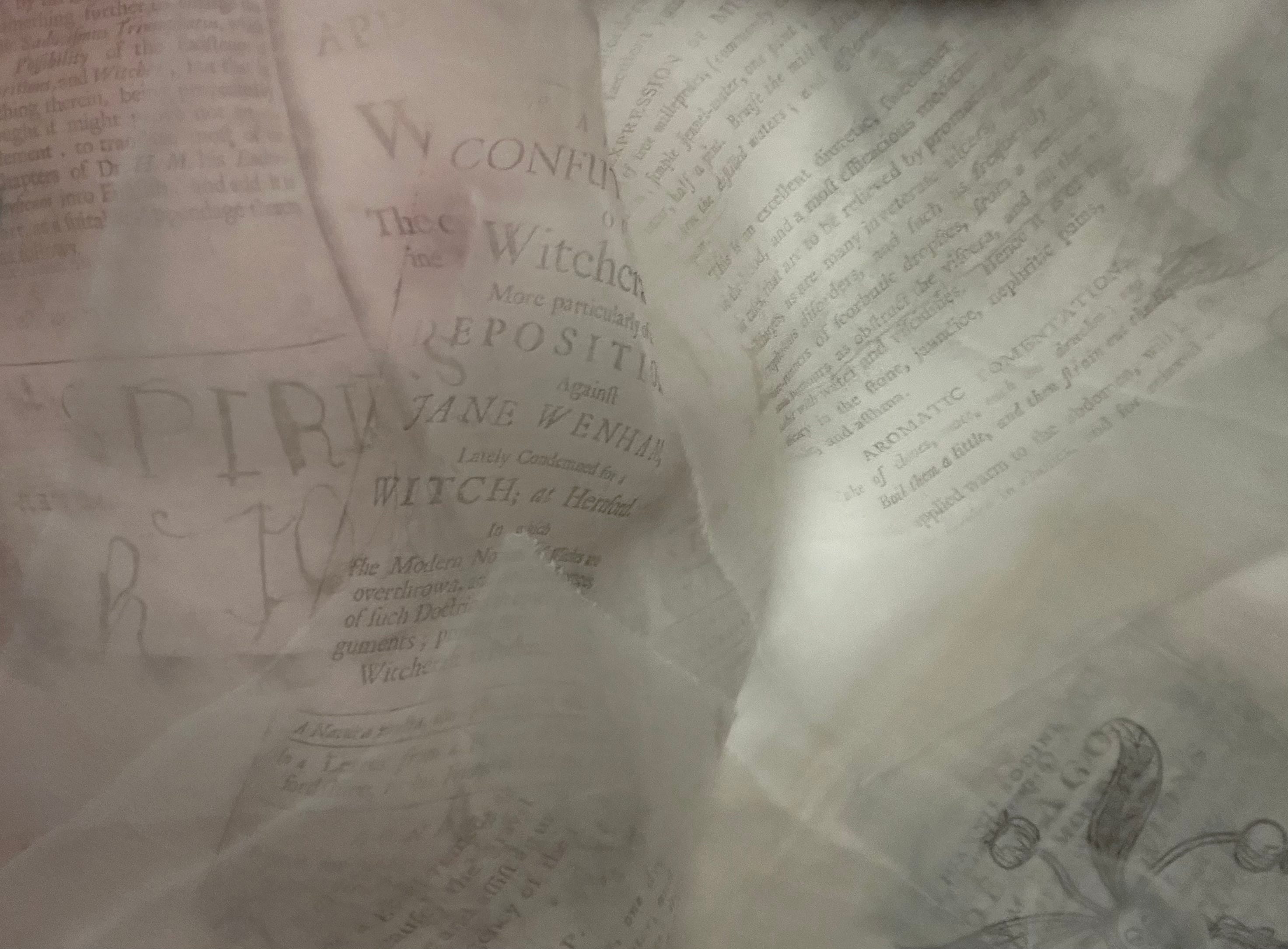
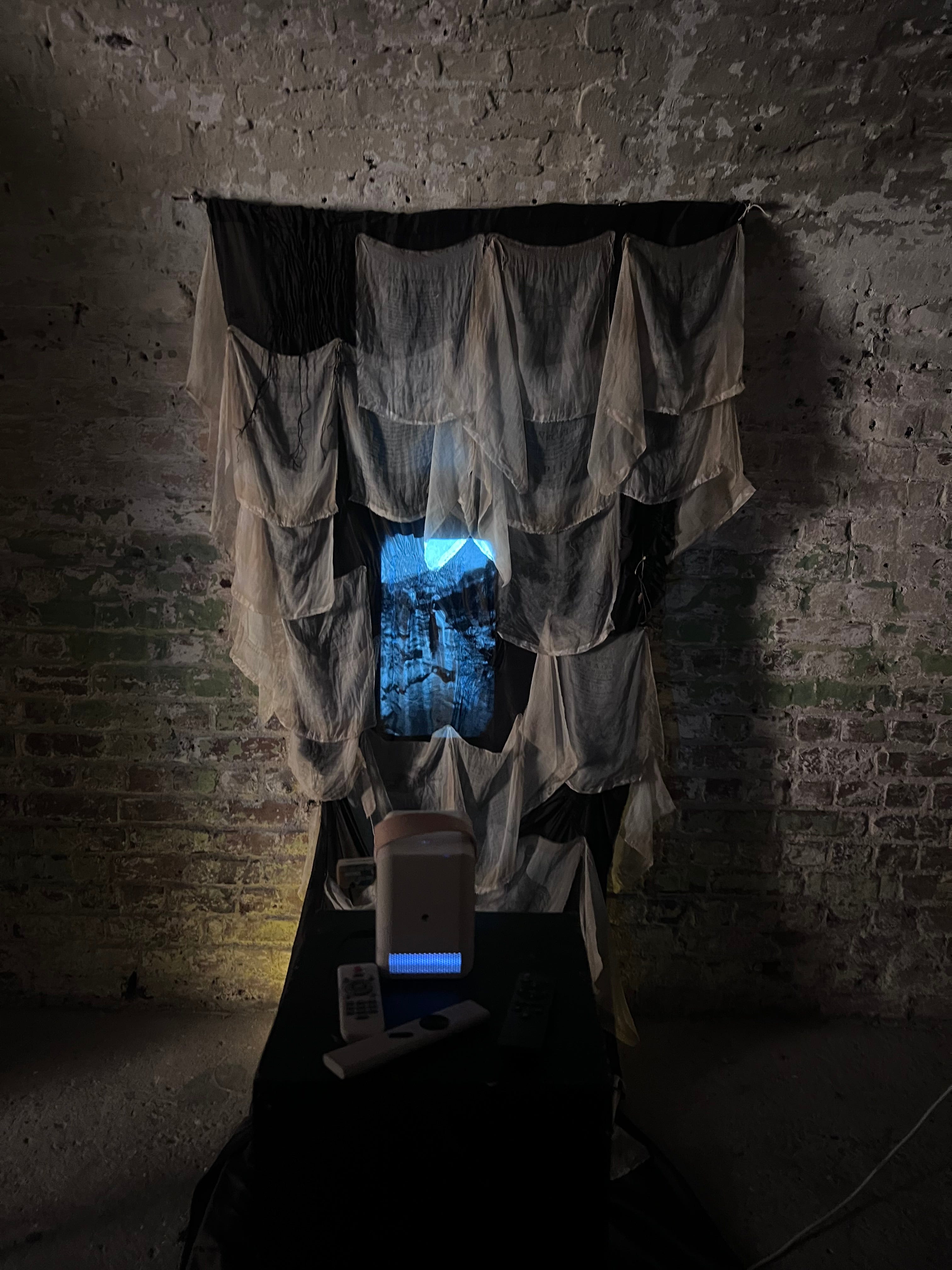
Beneath London streets, in the vaulted undercroft of The Crypt Gallery, the Which Witch Collective convenes artists who reclaim the witch as both cultural wound and inextinguishable force. My contribution, Palimpsest, graciously on loan from the Museum of Witchcraft & Magic, counter-interrogates and rewrites the surface of historical witchcraft accusations. Each gauzy layer is a ghost page that reanimates the archive of rare books and demonological texts from the 1600s onward, which I researched onsite at the museum in 2022 and 2024. The exhibition, They Call Me WITCH, runs 13–19 November, 12–7 pm daily. Enter the crypt for free, where old stories have been dug up and re-stitched.
Painted Tree Gallery, Southern Forest Arts | 29 November 2025 – 1 February 2026
southernforestarts.com.au
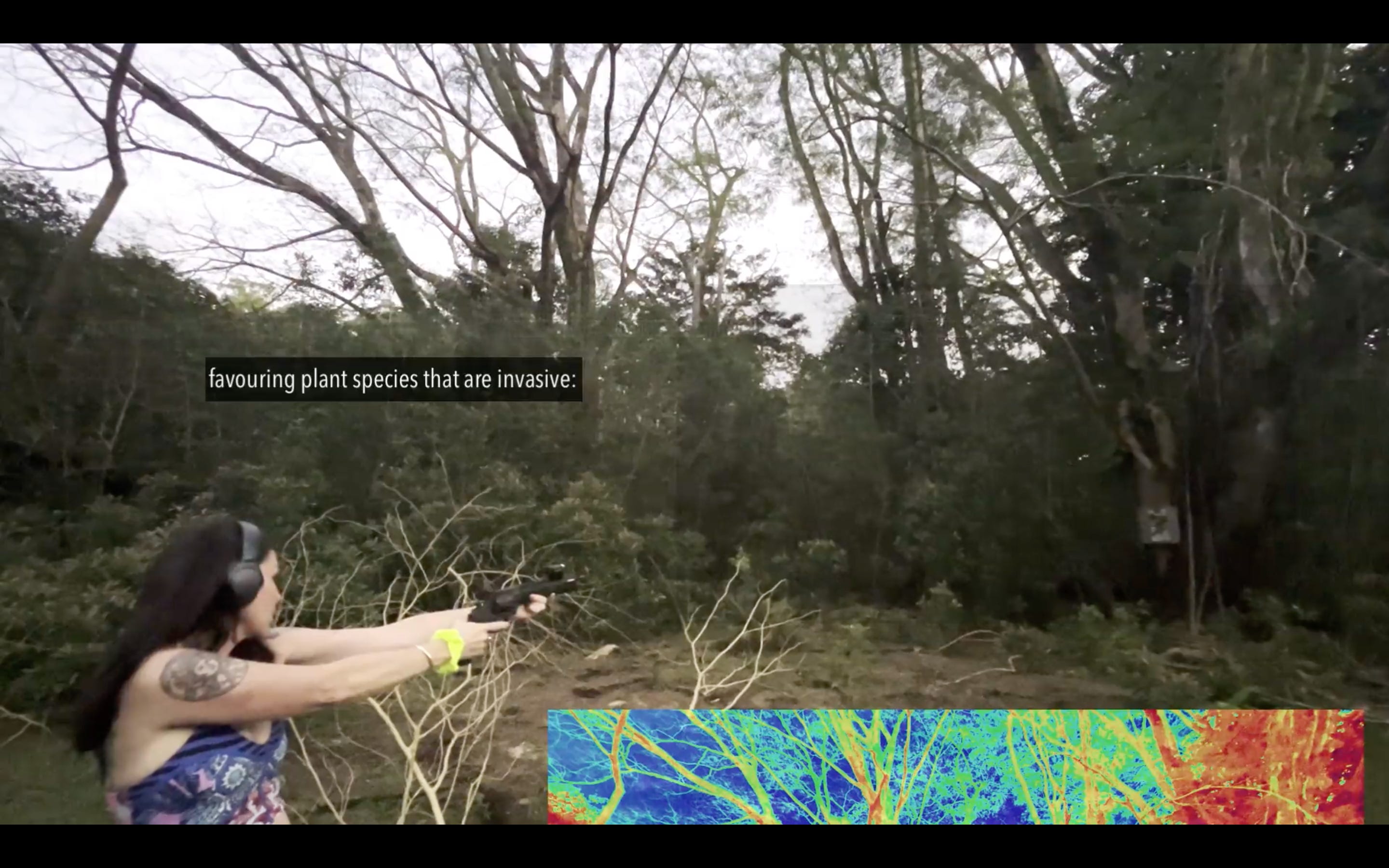
On the other side of the planet, Resonance: Dialogues in Art & Ecology, part of the ecoartspace Australian dialogues, gathers sixteen eco-artists (ecofeminists) translating the languages and politics of soil, fungi, wind, and water into an array of artworks in various media: fibre, interactive pieces, sculpture, etc. My work joins this collective inquiry of landscape, its roots/ uprootedness, decay, and porosity, through a video work that provides a personal lens on colonial migration, trans-plantation of people, and the flora that follow them—specifically across the Pacific.
These two exhibitions open as my research continues to find new forms of visibility.
My work with menstrual serum experiments was recently featured in Dr. Camilla Mørk Røstvik’s essay, “The Alchemy of Menstruation” in Historica: Journal of Gender Studies (University of Groningen, Vol 48, No 3, 2025),1 further situating my practice within a lineage of feminist alchemy, where blood and craft are alembic constituents for cultural transformation.
On December 1, I’ll be lecturing at Duke University as part of their series on bioprinting and creative research, sharing my work with DIY biofabrication and feminist worldbuilding. This month, crypt, canopy, and campus form a continuum of gritty epistemologies of making.
Menstrual Miracles and Market Mess
Now I want to discuss two recent articles that have emerged: one from The Guardian and the other from CBC News, both of which hit on several aspects of menstrual market madness that I addressed in my last post on The Red Rush, and one several months before that on Influencer Feminism and the Viral Grab. Both of these previous posts were discussions of the new dash for dollars around all things menstrual fluid, including stem cells and other new technological applications. As if on cue, these recent articles echo the fervour I’ve been avidly scrutinizing.
In both The Guardian article, titled, ‘A medical miracle’: is period blood ‘the most overlooked opportunity’ in women’s health? and the shorter CBC News article, titled, McMaster research targets menstrual cup ‘mess’ with absorbent tablets to tackle period stigma (the less sensationalized title of the two), profiteering and problematic language frame the outcomes.
CBC’s article is slightly more tempered, with the main focus on how a new product benefits menstruators culturally and practically, but still features one of the main researchers comparing menstrual innovations to gold mining—which is exactly the critique and comparison I gave in my Red Rush post last month: “Hosseinidoust said as a researcher, finding such a big gap in work towards innovation in menstrual products was like discovering a gold mine.”2 Other than this, the research and the article itself are potentially doing good things: confronting stigma in productive ways, making menstrual cups possibly easier to manage for those who find them difficult, and exploring additional clinical applications that may make our lives easier. Essentially, they have designed an algae-based tablet that can be inserted into a menstrual cup to provide an absorbent buffer against spills, though with my degree of heavy bleeding, I doubt very much it would make any difference for me. Ultimately, it’s a grant applicant or startup team’s dream pitch, but it’s saddening that profitability is the main push behind attempts to humanize menstruators. I can appreciate the research (and how it addresses the lack of existing research), to be sure, but again, it ultimately instrumentalizes bodies that bleed.3 Until I try out the proposed absorbent seaweed tablet for myself, I’m unsure if it would change the way my menstrual cup functions, or if it would simply be an add-on for an extra expense.
The Guardian, much more robust in its period proselytizing, positions menstrual fluid as a ‘miracle’ substance, hearkening to the scripts of tech-evangelism, which I have long been a heavy critic of. This kind of marketing hype is the opposite end of the pendulum swing with regards to stigma, instead utilizing heightened valorization to sell an idea once hard to digest. Such polarity simply replaces shame with sanctification, keeping the cycle of exploitation intact. The underlying incentives remain those of resource discovery, turning menstruation into market capital. The menstrual body is positioned as a ‘frontier’ of innovation (cringe colonial capitalistic terminology), with the usual techno-utopian vocabulary, including menstrual fluid being, “a real treasure.”4 Yes, dig in prospectors! The framing mirrors the extractive logic of any new resource rush, as if menstruation itself were a deposit waiting to be mined.
Do I think additional avenues for diagnostic testing are useful? Definitely, especially when it presents a less invasive alternative. My own research is pointedly about addressing stigma and lack of research around women’s and other deviant bodies, though completely against techno-utopian spin. Even when the science is sound, its translation into headlines distorts the intention, turning feminist research into promotional copy.
For example, The Guardian piece quotes medical anthropologist, Dr. Kate Clancy, whose research has included reframing menstruation as an immunological and endocrine process across a spectrum of bodies. But even her carefully restrained observations about menstrual stem cell potential (which I very much appreciate) are swept into the article’s ecstatic register, where the focus shifts from scientific nuance to monetizable marvel. In this strange economy of care / control, every discovery is packaged as a new revelation. The feminist labour of researchers like Clancy (and actual experimental results of menstrual stem cell research, like mine) become raw material for tech extractionism: there’s gold in our blood, and new billions to be made from our uterine labour.
A cultural whiplash is unfolding in real time, from eras of disgust to an economy of panting techno-worship; both extremes flatten the lived reality of menstruators. The taboo isn’t gone but re-engineered as capitalist counter-narrative. The miracle masks the same extractive impulses that have long governed biomedicine.
This leads to my discussion of recent menstrual activism that I unwittingly found myself engaged in, as a matter of necessity. In the past week, I had the pleasure of being invited to guest lecture for Dr. Kate Hennessy’s graduate class on research-creation methodologies. Upon arrival at SFU, I realized that in my haste to leave my apartment, I’d forgotten to bring any menstrual products with me. I was intermittently heavily bleeding with an irregular flow, typical of perimenopause, and discovered that my uterus had resumed its contractual work just before I was scheduled to lecture.
In the women’s restroom (they are gender segregated at SFU), I searched high and low for any menstrual products, and found none. So, I went to another restroom. Not a tampon or product of any kind in sight. Then, another. Same: nothing. Then, another. Likewise, nada. Meanwhile, I am at risk of bleeding through my pants and time is ticking. Incredulous, I went to the security desk to inquire as to why there was not a single menstrual product to be found in any restroom anywhere on campus. I was interrogated: “You mean you have nothing?” as if bloody accidents never occurred ever in the history of the university and it was really none of their concern. When I replied, “No?” I was instructed to visit the student services room (though I am not a student) and ask for something. I was also informed that there had been break-ins to the tampon vending machines and that was why they had removed them.
The student services room, a tiny office space on one floor of the massive campus building, had a little basket of tampons on a shelf, which I discovered after walking in and scanning the room. No signage, so I assumed this was the supply I could use, grabbed one or two (heavy bleeder, remember?), waved them at the person sitting behind a desk and in a meeting, to which I received a nod of acknowledgement, and left. Crisis averted, I made my way to the classroom to give my lecture on 3D bioprinting with menstrual stem cells.
Following this experience, I wrote to the facilities management system (automated, of course) with my complaints and demand that they rectify the situation. I heard nothing back after 24 hours, so wrote to the director of the campus. This isn’t merely an inconvenience in an accident scenario like mine, but an actual health risk for menstruators. Not being able to change a tampon in time puts us at risk of toxic shock syndrome (TSS), which can be fatal—a widely known health and safety issue. Not only this, but being put in a position of having to ask strangers for a tampon, etc. is extremely culturally insensitive: many of SFU’s student body come from a variety of different cultural backgrounds, with varying levels of taboo surrounding menstruation, which means certain individuals just may not ask for the menstrual products they need, and thus be put at risk (again for TSS). I explained that this was a liability issue for the university, should a serious health incident result from lack of accessibility to menstrual products.
The director was extremely empathetic when I shared my experience, concerns, and assertion that this was unacceptable. He responded immediately, prioritizing resolving the issue as soon as possible, in the most respectful and accountable manner. I’m happy to say that before the end of the semester, all SFU campus buildings will have free menstrual products available in their restrooms. This is true leadership, and I was inspired to see it in the upper administration.
In my work, I engage with body materials that have entered the spin of the capitalist casino: menstrual blood, tissue, and cell ‘products.’ They are valourized as life-saving, yet in my day-to-day professional / personal life (there’s no separation), I’ve seen menstruators disregarded at best, and at worst, cast as shady thieves breaking in to tampon vending machines. As headlines proclaim miracles and gold mines and beseech women for their ‘waste’, the witch writes her own anatomy and its autonomy from the cool shadows of the crypt. The witch’s labour, like that of soil, is cyclical and slow; it composts the narratives of extraction until they become nourishment for something vitally present yet unbeholden to dominant technosocial metrics of worth.

I’ll share the link to the digital copy once I have it.
See the full article here: https://www.cbc.ca/news/canada/hamilton/menstrual-tablets-mcmaster-9.6964518
I haven’t yet but most definitely plan to read Camilla Mørk Røstvik’s book, Cash Flow: The businesses of menstruation, which is fully open access as a downloadable PDF: https://uclpress.co.uk/book/cash-flow/ Although Camilla’s book is focused on menstrual products and fem tech developments, not the topic of menstrual stem cells as profit margin material in the biotech industry, it is nonetheless deeply applicable to my criticisms of tech-pilfering of menstrual materiality.
Comments
Nothing yet. Say the first thing.
Sign in to join the conversation.