
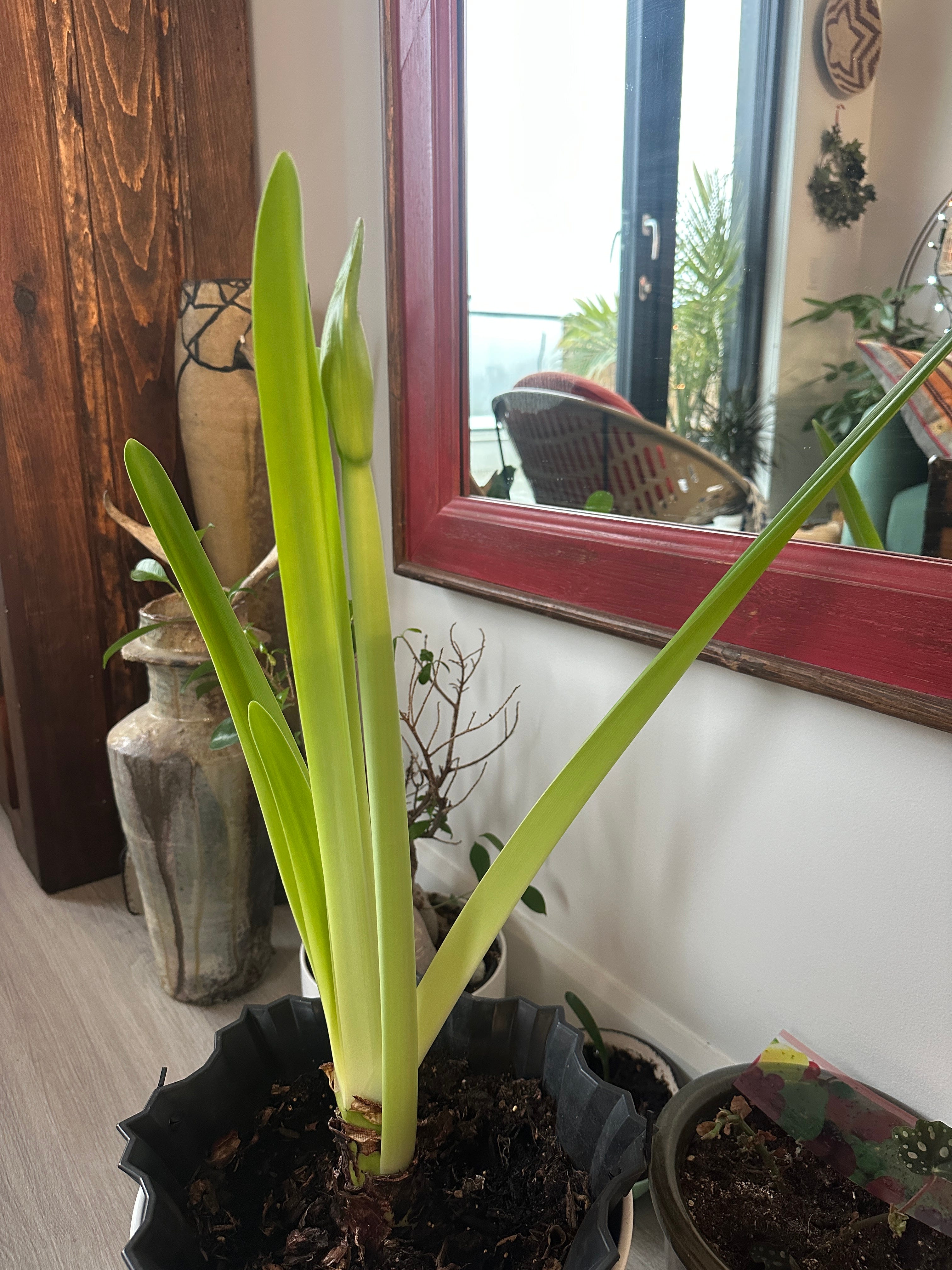
January in Vancouver feels like a slow, wet squirm in the muted space of a climatic underground. With mountains obscured by curtains of heavy vapour, light slants through in hints, time moves slowly or sideways, breath is held between dimensions. These days are black pearls strung along a continuum of rainy days and nights, a barely perceptible line threading between each. In the wet outer world, my balcony has become carpeted in a slimy green layer of algae and moss. Indoors, I am buried in a season of hidden activity, planting new seeds without any witnesses, preparing unseen plant beds for a raucous emergence sometime around March. As an outward symbol, a potted amaryllis I was gifted at Christmas sits on the floor next to my desk, robust green shoots penetrating the space, defiant of its lacklustre environment; it is juuuuuust about to bloom forth some bold, red declarations of life. And soon, I will likewise break through the cloud ceiling to leave my dim cocoon, heading back to Maui for a wee, sunny writing retreat.
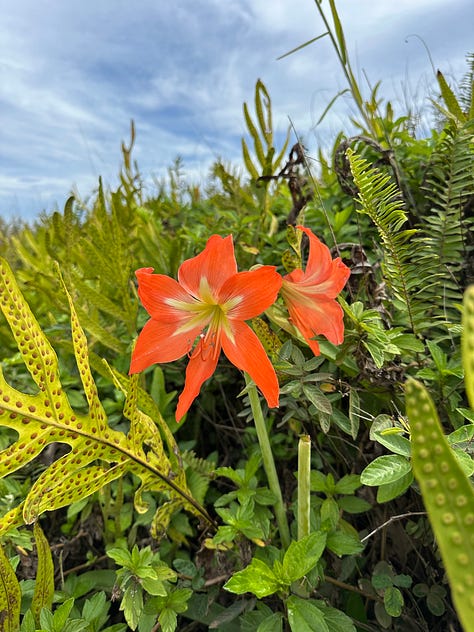
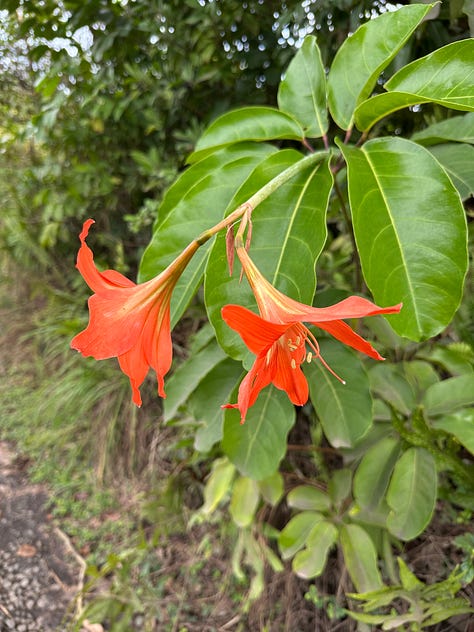
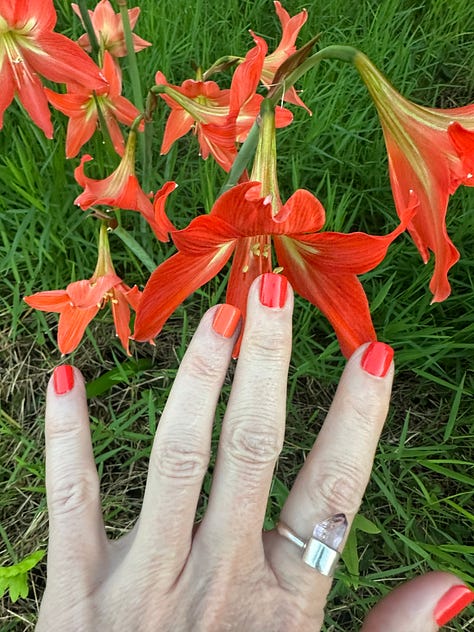
Amaryllis is an ancestor plant for me, and symbol of continuity, since my grandmother always received an amaryllis bulb at Christmas that bloomed in January, matching the bright male cardinals that graced her window bird feeder. Likewise, my dad has planted amaryllis around his farm on Maui, since it is among his many favourite plants. Spiritually speaking, amaryllis is a plant of quietly contained intensity, until it’s not: its bulb holds a vibrant force in a short period of stillness, momentum building invisibly. It rests in its autopoetic knowledge of how to wait. Because amaryllis is often grown indoors and blooms during the darkest months, it represents light generated from within, an endogenous exuberance not overtly derived from the sun. To get even more woo-woo, red amaryllis is a root chakra bloom, building life from the base up, erupting of its own accord, in its own time. What an absolute boss!
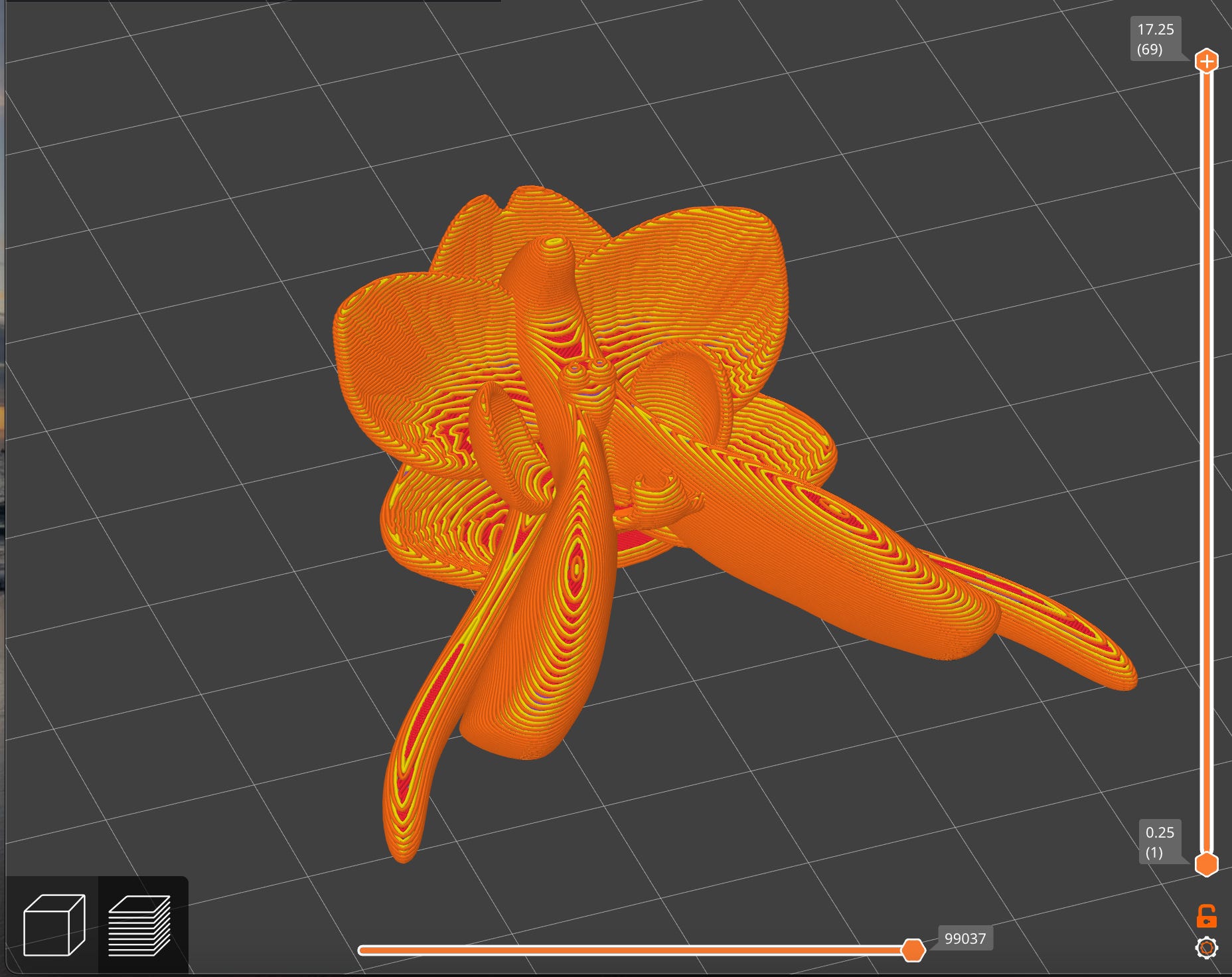
This recognition and nod to plant intelligence, and my relationships with its various manifestations across geographies and memories, also finds its way into my bioengineering work, shaping my recent prototyping with IMARA, where organs are no longer human-only systems, but new botanical and ecological inheritances. With these experiments, specifically an orchid-clitoris (shown below) and vulvar-lepidopteran (the design of which I’m still working through), the body borrows strategies from plants and pollinators. These are hybrids that acknowledge the import of desire, and that sensation and emergence are multi-speciated affairs. Like the amaryllis, these new forms resist the technofascistic rush of biotech urgency. Instead, they grow according to the conditions of attainable infrastructure, material possibilities and limitations, emerging when these variables align, and insisting that the future of the body is not something optimized, but moreso blooming in relation. On that note, I have finally secured a welcoming biosafety level 2 lab at SFU to work in! Yee! Huge thanks to the amazing women in the Molecular Biology and Biochemistry department.
The same sensibilities carry through in my ongoing work on the Blood Riot tarot deck, where plant knowledge and symbolism, bodily intelligence, and underground timing are my structuring principles. The deck is being built very slowly through illustrative floral motifs that root back into my lived anatomy, with archetypes emerging from potent dreams I’ve had: The Spell, from a dream of covert ritual, exposure, and psychic backlash, holding tension between secrecy, desire, and power; The Interrogation, drawn from a dream of false accusation and a forced trial, navigating unjust systems and reclaiming truth from imposed narratives; The Claim, a declaration dream, where hard-earned authority is demanded and named, refusing erasure by gatekeepers and insisting on recognition. Like hybrid organs forming through IMARA, Blood Riot operates on a principle of power as something that gathers below the surface before declaring itself (dream-like). It is meant to be an oracular system attuned to gestation rather than acceleration, its actions happening when conditions are finally right. Instead of predicting the future, Blood Riot signals the drawing of numerous possible fates, which are then integrated and materialized. I’ll keep you posted on how this deck evolves (examples below for my very few, but loyal paid subscribers—thank you).
I want to note here, for all my readers, that I’m choosing to keep my writing hyperlocal this time, to my immediate reality that I can actually tend to. The wider state of the world feels quite overwhelming, an experience I’m sure we share, and constant exposure has fractured my attention, jacked my nervous system, and continuously disrupted my sleep. Staying close to place, its weather, plants, and what I can breathe in and metabolize feels like a form of care and resistance. It is also copasetic with the winter cycle here in the northern hemisphere, from which I extend you a fuzzy virtual hug.
Comments
Nothing yet. Say the first thing.
Sign in to join the conversation.