
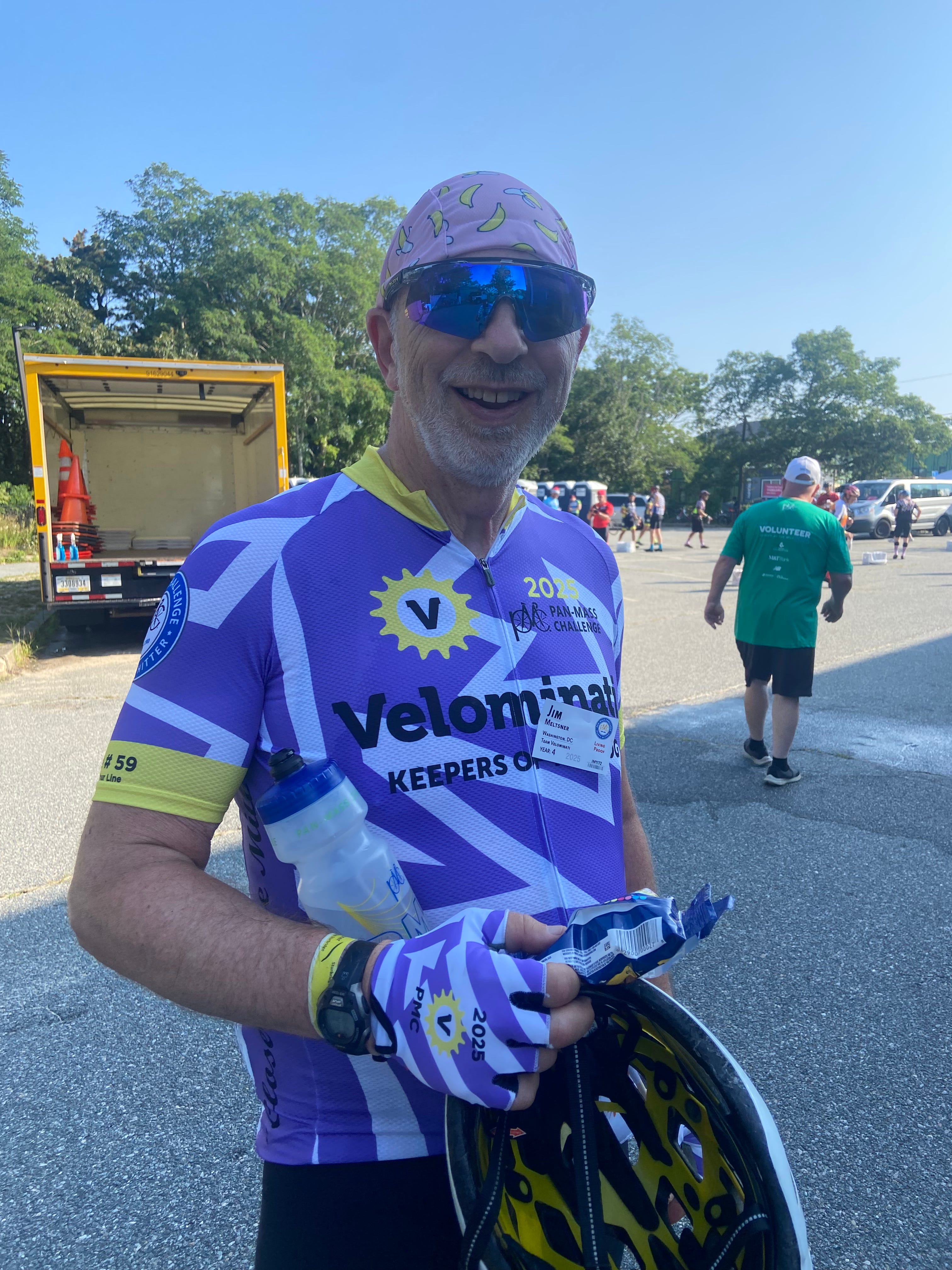
Last year, I rode in my first Pan-Mass Challenge (PMC) with my sister-in-law Dillon and two of her friends in honor of her dad Jon, my friend Holly, and the many people who have lost their lives to cancer of all kinds. Since its inception, the PMC has raised over a billion dollars for cancer research via the Dana-Farber Cancer Institute in Boston. The ride is about 180 miles over two days. This year, I’m back for round two. I asked the PMC if they could connect me with a member of their Living Proof group—riders who are cancer survivors or patients. Jim, a fellow DC resident, was kind enough to speak to me about his experience riding in the PMC over the past several years—first as a survivor of prostate cancer, then as a patient in active treatment, and then once again as a survivor. Jim and I talked about why the PMC is such a memorable weekend, and how advancements in cancer research have kept him and so many others alive, while also improving their quality of life.
Kathleen: Can you tell me how you first got involved with the PMC as a rider?
Jim: I first started with the PMC as a contributor. A friend of mine from high school, a football teammate, said he was riding in this thing called the PMC and was asking for a contribution. He was a cancer survivor, and I sent him a check, and then I got cancer.
Kathleen: I’m so sorry.
Jim: I used to do triathlons and I have a nice bike, but I hadn’t ridden in several years. My wife said, you know, you need to get back in shape after my cancer surgery. So I’m like, yeah, okay. And then I got this solicitation again from my friend for the next PMC saying, hey, I’m doing it again. And I’m thinking, this is perfect. A 180-mile bike ride across Massachusetts. And I called my friend and I said, hey, I want to do this ride. I don’t want to give you money anymore. I want to ride!
I broke out my old bike and started riding again, training and raising money for cancer research through the PMC. I joined my friend’s team, Team Velominati, an amazing team committed to fighting cancer and having fun. We are one of the larger PMC teams with well over 50 riders. My first PMC was a fun and wonderful experience. I’d never been to Cape Cod before, and it was just a wonderful weekend.
Kathleen: You shared with me that your cancer came back, unfortunately, but you continued to ride. Can you talk about that?
Jim: Sure. I think it was my second year of training for the PMC. I had been cancer-free for just about two years. I had prostate cancer and my PSA was rising and probably in May, I was told that my cancer was definitely back and I would have to go on hormone therapy and get radiation. Which was a serious blow.
Kathleen: Of course. But then you rode that year, is that right?
Jim: Sorry. Yeah, I did.
Kathleen: That’s incredible.
Jim: I delayed the radiation until after the PMC in August, but I started the hormone treatment, I think, in June. So it all timed out. I’d have to be on the hormones first for several weeks before starting radiation. I was actually on hormone therapy when I did the PMC. And I wasn’t really sure I would make it because it was—sorry.
Kathleen: No, don’t apologize. Take your time.
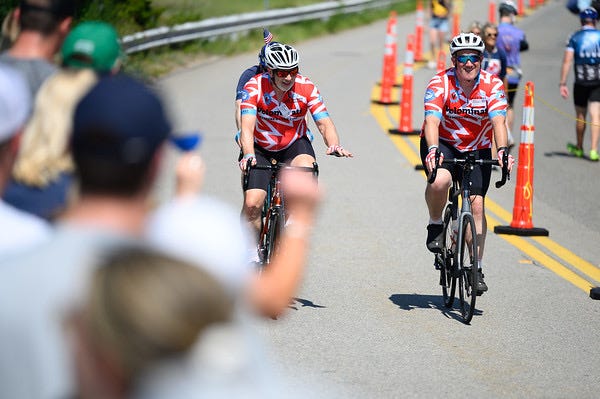
Jim: It was really, really hard because I was tired and weak from the hormone therapy. One of my teammates said you know, I’m just going to ride with you, Jim. No matter what, no matter how slow you go or how fast you go, I’ll just stay with you all the way. And he did.
Kathleen: That’s beautiful.
Jim: Yeah. And we got through it.
Kathleen: Hats off to you. It’s an incredible feat for someone who is in the prime of health. And that’s really amazing that you were able to do it that year.
Jim: It was great. I really wasn’t sure I could do it, but, but I did both days and actually felt pretty good riding. I don’t know if you’re competitive, but I’m a competitive person. And my times over the five years of riding the PMC are pretty much almost identical year to year.
Kathleen: Wow. That’s amazing.
Jim: I like the fact that my times are staying consistent. It’s a great challenge for me because I need challenges to stay focused and to keep myself in shape.
I don’t wake up every morning going, oh, my God, I could have died. I don’t think that way. But I want to be in shape. With the PMC, I train from April through August to get ready. I usually do a bike trip in August somewhere with my wife. There are a lot of beautiful places to ride in the world. It keeps me in shape for that as well. The fact that Dana-Farber is such a cutting-edge institution—that’s why the event is so successful. It’s really done well. And the mission is important and critical. Everybody knows someone who has cancer or who died from cancer.
The truth is that the Living Proof group gets bigger and bigger every year. This year the total is over 1,000. It’s really cool that more and more people are surviving because of places like Dana-Farber. I work hard at fundraising too. I’m in a place where I have the ability to be a PMC “heavy hitter” in the top 10% of fundraisers. And that’s something I work hard at as well. My friends all run from me now when they see me coming.
Kathleen: It’s hard asking people for money, I’ve found. But it’s for such a good cause. It’s not like we’re lining our pockets.
Jim: Right, right. Exactly.
Kathleen: Are there specific ways that you have seen cancer research really benefit you or people you know?
Jim: Absolutely. A friend of mine was telling me about how his stepfather had prostate cancer. He said the radiation almost killed him. He was in pain the rest of his life from the radiation. But he had radiation in maybe the 1980s. I don’t know exactly when, but it was a long time ago. Things are very different today.
I got treated here in D.C. at Sibley and they had one of the few proton lasers in the region. Proton lasers are a newer method of radiation. In the old days, the photon laser beam would go right through you, hitting healthy tissue. Now they can focus the beam so it just hits the spot where the cancer is, and it doesn’t go all the way through. So you don’t have the same kind of damage to the rest of your body that you would get from the radiation in the past.
I was also on some cutting-edge medicine for hormone therapy. Previously you had to have an injection in the stomach to receive the hormone medicine. My understanding is that treatment was uncomfortable, painful, and there was a much higher rate of heart attack with that medication. I was on a new kind of medication that was oral, so I could take a pill once or twice a day. The chances of having a heart attack almost went away. And with the old medicine, it took months for your body to get back to normal, to get back to testosterone levels and hormone levels that were normal for you. For me with the new medicine, it took weeks as opposed to months.
Kathleen: That’s amazing.
Jim: So those are quality of life things. And that was 3 or 4 years ago. Now it’s probably even better.
Kathleen: Thank you—that was very powerful and specific. Do you have a favorite part of doing the ride every year?
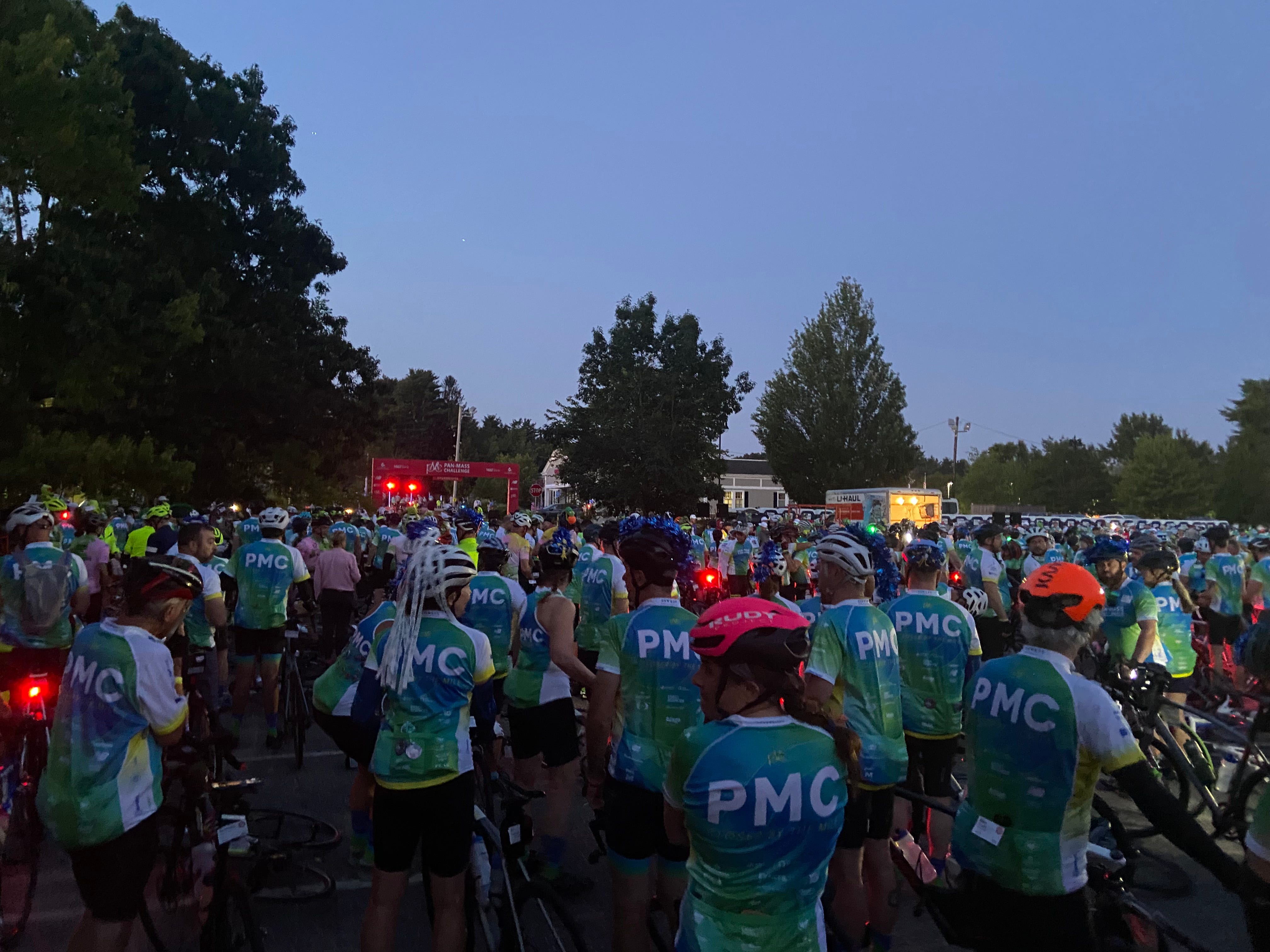
Jim: At the PMC, there are badges on everybody’s bikes that say the number of years people have ridden. I’m always blown away by how many people have been doing this ride for 20 years, 25 years, 35 years. It’s amazing.
And there’s no ego. Everybody just helps the person next to them and is joyful and committed. It’s really a beautiful thing to see people just keep coming back year after year after year. It’s not easy riding 180 miles. I mean, I’m used to it. I train hard, but if you tell people, oh yeah, I rode 70 miles this weekend to train, they look at you like you’re crazy.
Kathleen: I was amazed at the scale and the size of the ride. I think last year it was 6,500 riders and 3,500 volunteers. Then there are all of the people who are outside their homes, who get up really early and probably do this every year. And they have snacks and cowbells and signs.
Jim: There’s a place—I think it’s on the Cape—where someone has all the PMC jerseys from every year. They made it into a flag. Then there’s the bagpipes.
Kathleen: I forgot about the bagpipes.
Jim: There are cancer survivors out there with signs saying, thank you, I’m cancer free 20 years, or five years, or five months. It doesn’t matter.
It’s the largest single-day charity event in America. There are others—the American Heart Association has Heart Day all over the country, and they raise more money, but not for a single event in a single place. It’s beyond (Founder and Chairman) Billy Starr’s wildest imagination.
If you feel so inclined to donate to Jim’s ride or mine, we would really appreciate it—all the money goes to the same place, lifesaving cancer research at Dana-Farber.
Jim’s 2023 thank you letter to his PMC donors:
Dear PMC Supporter,
Thank you for supporting me and the 44th annual Pan Mass Challenge (PMC). With your help, I achieved my fundraising goal of $20,000 for Dana Farber in the fight against cancer. Because of your support, the PMC is expected to reach its fundraising target of a whopping $70 million for the year. Since its inception, PMC has raised almost $1 billion for Dana Faber, made possible because of contributions like yours - thank you, thank you, thank you!
Because of my recurrent cancer and on-going treatment, I was apprehensive about riding the PMC this year. My long training rides in the weeks prior to the PMC were less than ideal - slow, challenging, and exhausting. The cancer medication was taking its toll. I contemplated not starting or just riding part of the PMC. I told myself “Donors will understand, I am in the middle of treatment for cancer.” Despite the challenges, your tremendous financial and emotional support, and notes of encouragement kept me training for the PMC weekend. I thought, “Worse case, I bike as far as I can and then hop a ride in the sag wagon.”
Friday night before the start, my teammate, Jeff M promised to ride with me every mile, no matter the pace or duration. He was at my side for every mile of the ride, leading me up hills, breaking the wind on the flats and offering encouragement. With Jeff’s help, and knowing I had all of you cheering me on, I finished.
The ride was fantastic, and the training paid off! The weather was perfect for biking, with two days of sunny skies, light breezes and temperatures ranging from the low 60’s to the mid 70’s. Ideal New England summer days. I felt strong, and had a big smile on my face for most of the 190-mile ride, including approximately 7,000 feet of climbing. On day two at about mile 50, fatigue set in. The thought of stopping crossed my mind, but I committed to finishing the ride, which kept me pedaling forward. By this point, Jeff was also feeling the effects of 150 miles on a bike, and we struggled to the next water stop at mile 57. After refueling and recommitting, we rode the last 19 miles to the finish. The final 7 miles, rolling through the dunes of the Cape Cod National Seashore is breathtaking and inspiring. I crossed the finish line with a big grin and a huge sigh of relief knowing the ride was over with all my 2023 PMC goals met.
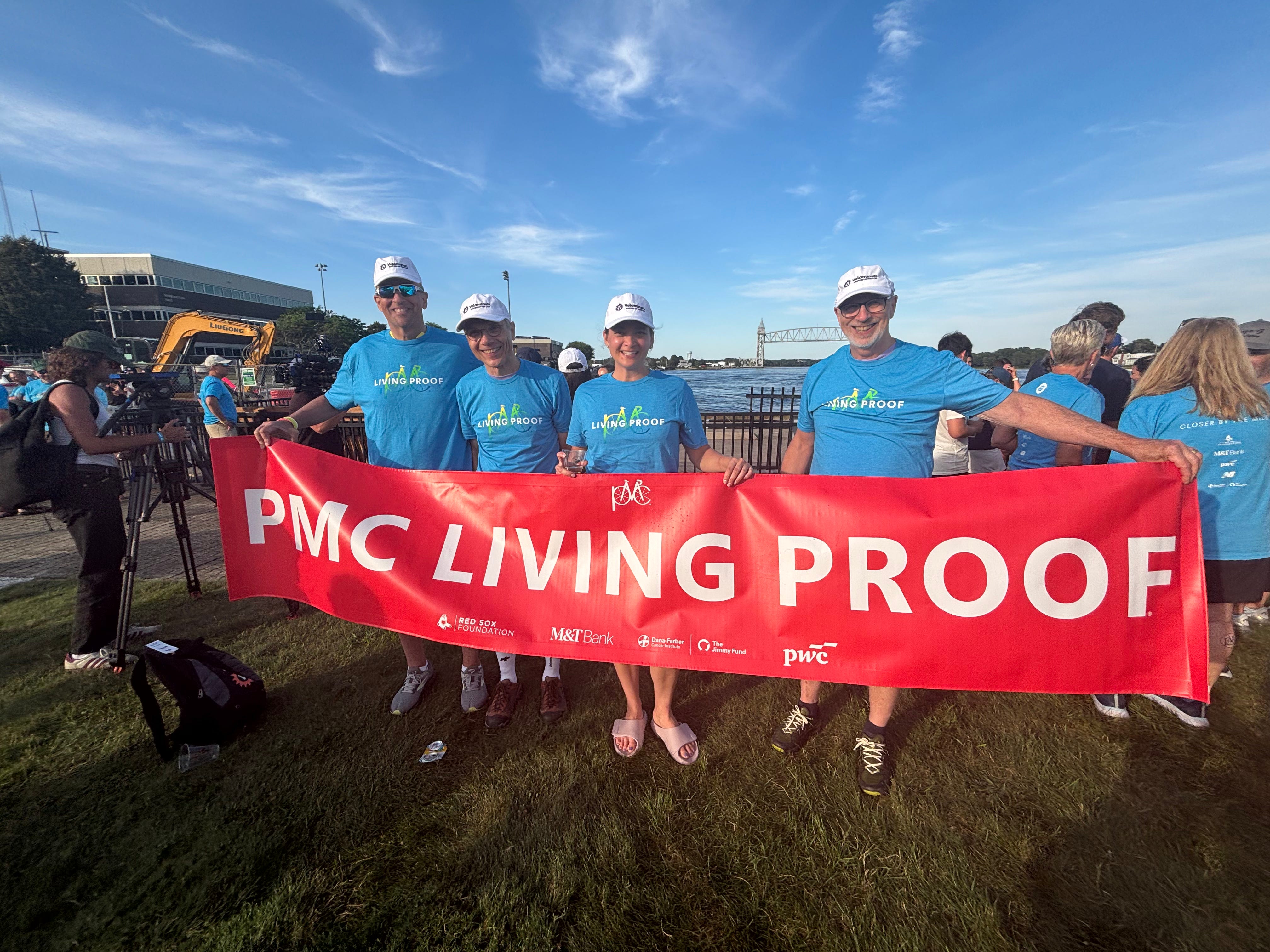
One of the highlights of the PMC weekend is the “Living Proof Ceremony,” where riders and volunteers who survived cancer, or are currently undergoing treatment, gather after the day one ride at the water’s edge on the campus of the Mass Maritime Academy for a toast. PMC founder and Executive Director, Billy Starr, riding in his 44th PMC, says a few words and leads the toast. Standing among other cancer survivors in a moment of celebration is a moving experience.
Sadly, cancer remains an often-deadly disease that touches us all. Durning PMC weekend, I connected with a friend from college who was riding in memory of his wife who died from brain cancer in 2020. Unfortunately, his story is still all too common. However, the PMC gives us hope of ending cancer. With each pedal and with each contribution, we are “Closer by the mile” in reaching that goal.
On a personal note, I start my proton beam radiation therapy on 16 August at Sibley Hospital in Washington, DC. The therapy is 5 days a week for 8 weeks. I am told the side effects and risks are minimal – fingers crossed on this! The expectation is I will be cancer free at the end of the treatment.
With the PMC over, my goal during treatment is to ride the 8 miles round trip from home to hospital as often as possible. Upon the completion of therapy, I plan to start training for next year’s “One in a billion”45th year PMC ride.
Thank you again for all your support of the PMC!
With love and “Closer by the mile,”
Jim
Comments
Nothing yet. Say the first thing.
Sign in to join the conversation.