
I connected with San Diego-based artist Mikey through our mutual friend Amanda. Amanda and I were counselors-in-leader-training and then counselors at the same incredible summer camp, and she’s also a great connector and the source of Where the Gridlock Ends nominations (thanks, Amanda! And I’m always on the lookout for interesting people to chat with.) Mikey has built a career out of being an artist. He owns a studio space in Leucadia, California, where people can come for classes or rent studio space to make art. Mikey is especially interested in interactive installations and facilitating experiences—no matter the finished project. We chatted about how he made his lifelong dream of making a living as an artist into a reality, and how he manages to bring people together with intention and purpose. If you’ve lost hope that people of different political beliefs can spend time together without it devolving into a shouting match, this one’s for you.
Kathleen: Mikey, I was hoping that you could start off by telling me about your gallery and studio space in Leucadia.
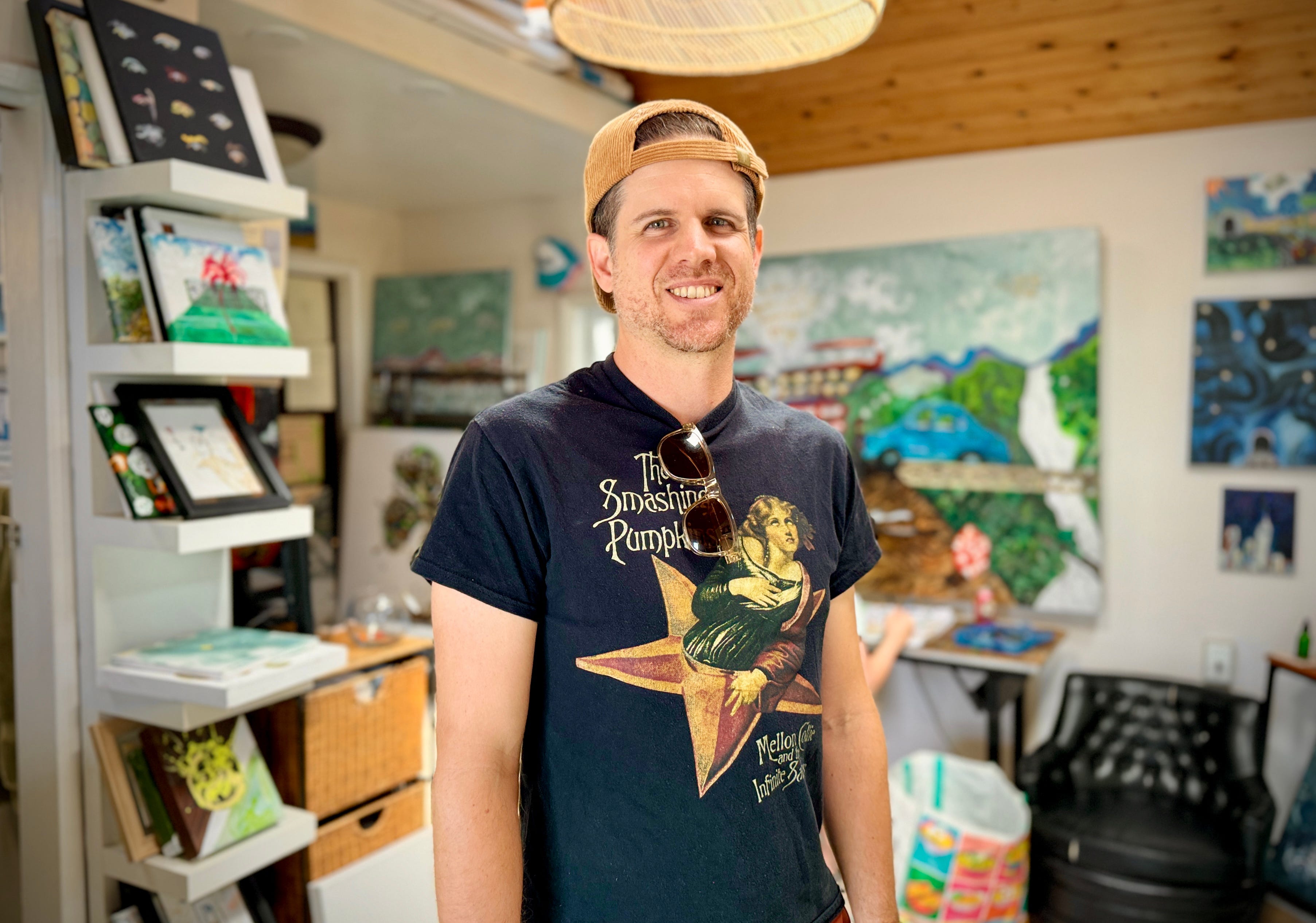
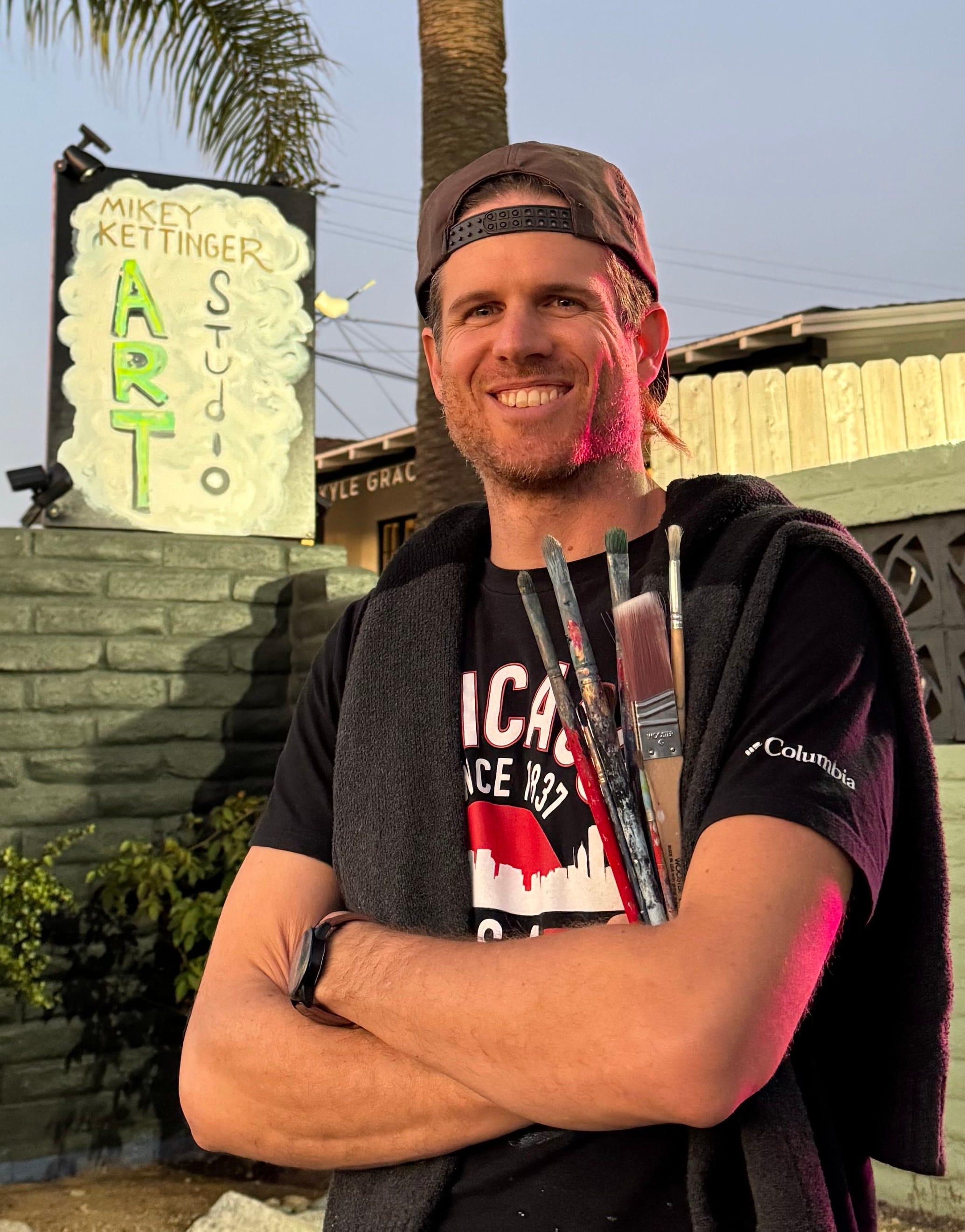
Mikey: Yes, the Mikey Kettinger Art Studio is a multi-dimensional space where I make paintings and my own art that I love to make and that I sell. But it’s also a place where people of all ages and all skill levels come to draw and paint, some of whom take classes with me and others who just use the studio because they need studio space. And then I also do shows pretty regularly with local artists and live music and DJs, as well as different types of cultural events like poetry readings and film screenings and stuff like that.
Kathleen: That’s very cool. How did the studio come to be?
Mikey: I got the idea because I was doing a lot of side jobs teaching private painting and drawing classes while also working at various art galleries. I thought it’d be cool if I could have a place where I could bring all my students as opposed to me going to them. I would just, you know, go to their houses and teach them there. I got a small studio space for me to be able to make my own big paintings, then expanded that so it could be a classroom kind of setting too. This was about three years ago that I took the gamble and said let’s see if I can make this work in terms of a business. I’ll try it for a few months and see how people respond to it. And if they do, I’ll keep doing it. If not, then I’ll downsize to keep it as my own art studio space. And the response was very positive, so I decided to keep doing it and expanding it.
Kathleen: When did you realize you wanted to become an artist?
Mikey: I’ve always been really into art since I was a toddler and old enough to hold a crayon. My brother said recently that I was drawing before I could walk. I always was really into it as a way to amuse myself, but when I was about 17 and I started to think about the future in terms of what I was going to do with my life, that’s when I decided to get really serious about it and pursue it as an academic major in college. Then I became an art educator, worked in museums and galleries, ultimately went to graduate school, and then became a professional artist. I’ve been doing every different type of art job that I could find for the last 20 years, ultimately building toward me being a full-time artist like I am now, which has been a very exciting and humbling journey. It’s taken lots of different side paths, but now I’m where I dreamed I would be in terms of having a space that I can share with people and having built a nice community around our shared creative passion.
Kathleen: I read in your bio—and I’m going to quote because I liked it—you emphasize “the creation of experiences over objects and inspiration over decoration”. Can you elaborate on that?
Mikey: That’s specifically referring to the emphasis that I’ve put on interactive art and installations. That is the most powerful type of art that I create. It’s very abstract for most people, whereas painting is something that’s more familiar. Interactive art might be something like my studio experience, which involves making art and making friends in this community and the setting is totally geared toward creating an environment that is good for creativity and inspiration. Anybody can draw or paint in their own space or with any piece of paper and any pencil. But to do it in this setting makes it more interesting and more fulfilling, especially for me.
I try to instill in my students that even if you spend three hours painting and drawing and working really hard to create something, if at the end all you do is take whatever you made and you throw it into the garbage, there’s still a lot of benefit to those three hours that you just spent. That was not a waste of time at all. You just had an experience that you created that was really good, even if the object might not have been that good. That’s not a problem. That’s actually a good thing. I think it certainly took me a long time to embrace the idea that the process is sometimes even more valuable than the result.
Kathleen: Can you give an example of what an interactive installation might look like? What might someone experience if they visit one?
Mikey: At the studio right now, I have an interactive project called the Love Letters Project. I have a mailbox which has a little sign that says write a love letter, and I provide all the materials for you to create a letter—stamps, envelopes, paper and pens. The idea is that you take that prompt and that opportunity to write a love letter, and then you stick it in the mailbox and then I mail it for you. So there is an experience, and there’s an object that’s created through that too, but it’s an interactive project that’s way more about that experience than it is about the display of a physical artwork. I am really interested in the social interaction aspect, which people seem to be really getting excited about as a reaction to being overwhelmed by the disconnection of the digital world.
It feels really good to have a face-to-face interaction or conversation or to write a love letter or to receive one. The feeling of opening your mailbox and getting some really cool handmade envelope with a stamp and then that there’s something inside of it other than, pay this bill. That’s a visceral experience. It’s a small one but it really goes a long way. Anybody who has lived in the era of letter writing and postcard making, they all understand that. Even people who get boxes from Amazon delivered. Everybody understands that good feeling that brings. I’m just trying to facilitate those experiences more.
Kathleen: Our mutual friend Amanda mentioned your home is also a gathering space. What does the community that you’ve built mean to you?
Mikey: It’s so fulfilling. It’s my livelihood intertwined with my purpose. It means that I’m really doing what I’m supposed to be doing. That’s the way that I feel that when I see the joy that people have interacting with my studio and with each other. I’m facilitating these really positive experiences for all different types of people, and I’m connecting people who otherwise wouldn’t really interact with each other in a similar way. There are people of all different ages who are intimately engaged in a way that’s really cool because they’re all in the same art class or art space.
Usually you wouldn’t have this mix of different ages like that. I’ve actually never seen it anywhere else except for other community art projects that I’ve facilitated through museums. But it’s the shared passion of being creative that connects everybody. And there’s something really to be said for this integration of ages and backgrounds, and they’re all connected by an interest in expressing themselves.
Kathleen: Do you feel like there’s also something about it that transcends politics and things that might divide people in a different setting?
Mikey: Yes, it certainly does. That’s a very obvious thing that I notice here because we have people of so many different backgrounds and different beliefs who have in common that they respect the space that is the art studio and find it sacred. They want to preserve that harmonious positive feeling. So when things get passionate and contentious, as they always do, especially in the Trump era, it still is held together because of the commonality of, we don’t want to mess up this thing.
I hope that I’m able to facilitate that too, that this is very important and special and don’t be the one that messes up this vibe that we all have. We all come here for peace and to be able to express ourselves. I’m certainly not telling anybody to not express their opinions—everyone’s welcome to do that. But we want to try to do it in a way that is positive and that is respectful for everybody so we don’t screw up the whole philosophy of the place and the whole experience for everybody else.
Kathleen: I feel like there’s a wider lesson there, right? If people treated the public sphere or their communities like that, maybe the discourse would be a little less toxic.
Mikey: I think it used to be more of a common thing that people thought there were certain spaces where you don’t bring that up or you just try to be respectful. But that kind of attitude seems to have severely diminished in the last few years. I don’t know exactly why that is, but I’m trying to be the place that still does those good things and upholds a tradition of respect and calm disagreement. I know absolutely that a wide range of the entire political spectrum is represented with the people that come here.
And everyone is able to coexist in a very positive way, to support each other and to laugh together and to eat together and go to parties together and to have art shows together and to share really positive experiences, just like a family does, or a community. It’s very special because of that delicate nature, but it is a thing that does exist here. I intend to keep that. And I hope that I can.
Kathleen: It’s wonderful that you’ve built that space. My own speculation on why that has become rarer is first of all, the news is so hard to avoid, right, between social media and push notifications. Then also the stakes feel so high, which is certainly understandable that people would be very engaged given all of the things that are happening. But people still need to recharge, to express themselves, to find community with people who might not agree on every single thing. I think in many ways, having those spaces is even more important now, since they’re rarer than they were a few years ago.
Mikey: Yeah, I think you’re right. The thing that people need to remember or realize is that everybody has a choice of how they spend their time. You have the opportunity to support things that are positive and or to spend all your time on Facebook. It requires some discipline, some awareness. But there still is that freedom to make those choices. The studio or other things that are similar to it, that are good, positive things, will still be here if they are supported by the community. And if they are not, they will no longer exist. When it does happen to places like ours, it’s usually because they’re priced out. Then the community regrets losing that space. You just hope that they don’t continue that cycle over and over because once the community is eroded and it’s turned into just a bunch of strip malls or something, those cool places don’t come back.
Comments
Nothing yet. Say the first thing.
Sign in to join the conversation.