

Quick recap, if you’re joining mid-series: a publicly traded company lost a $45,807.94 judgment because its subsidiary LLC was a shell — no independent staff, no independent control of its own cash, no independent say in who got paid. The court’s test came down to one question: would an outsider, looking only at how money moves between two entities, conclude they’re actually separate businesses?
If you read Part 1, you also saw the odds attached to sitting still: most small businesses get touched by litigation at some point, and the businesses that get hurt worst are the ones where every asset they own sits inside the same entity that’s taking on the risk. That’s the problem this issue solves. Not by adding paperwork to your existing LLC — by building a second entity that’s actually built to do something, instead of just existing.
That question is the entire design brief for what follows. Everything below is built to pass it.
The underlying idea is the same one insurance is built on: you don’t reduce risk by hoping nothing goes wrong; you reduce it by controlling how much any single bad outcome can reach. A two-entity structure applies that logic to your own balance sheet. Instead of one container holding both what you’ve built and the activity that could put it at risk, you split the two apart — deliberately, on paper, and in how money actually moves.
The model most asset-protection attorneys default to for a business your size isn’t parent-subsidiary — it’s sibling entities. You personally own two separate companies, connected to each other only by contracts, not by ownership.
The Holding Company owns the things worth protecting: cash reserves beyond working capital, equipment, intellectual property, real estate.
The Operating Company does the things that carry risk: it signs client contracts, employs your team, and runs the business day to day. This is usually the entity with your existing S-Corp election already in place.
The two are linked by lease and license agreements — the Operating Company pays the Holding Company for the use of what it owns, at arm’s-length rates, on a real payment schedule.
Sibling ownership over parent-subsidiary isn’t just a preference — it sidesteps a specific landmine. S-corp shareholder rules only allow individuals, certain trusts, and estates to hold stock; a corporation or partnership can’t. A single-member LLC is an exception only while it stays disregarded — never adds a second member, never elects to be taxed as a corporation or partnership. If your Operating Company keeps its S-corp election and you put a Holding LLC above it as the shareholder, you’ve now made your S-corp’s survival dependent on your Holding LLC never changing its tax classification. Owning both entities directly, side by side, means that risk doesn’t exist. Your S-corp election is exactly as protected as it always was.
There are legitimate reasons some attorneys still recommend parent-subsidiary — usually centralized control ahead of a future sale, or a specific state’s charging-order protections. If that’s a live consideration for you, it’s worth a direct conversation with a business attorney in your state before you form anything. For most founders reading this, sibling entities are the simpler, lower-maintenance default.
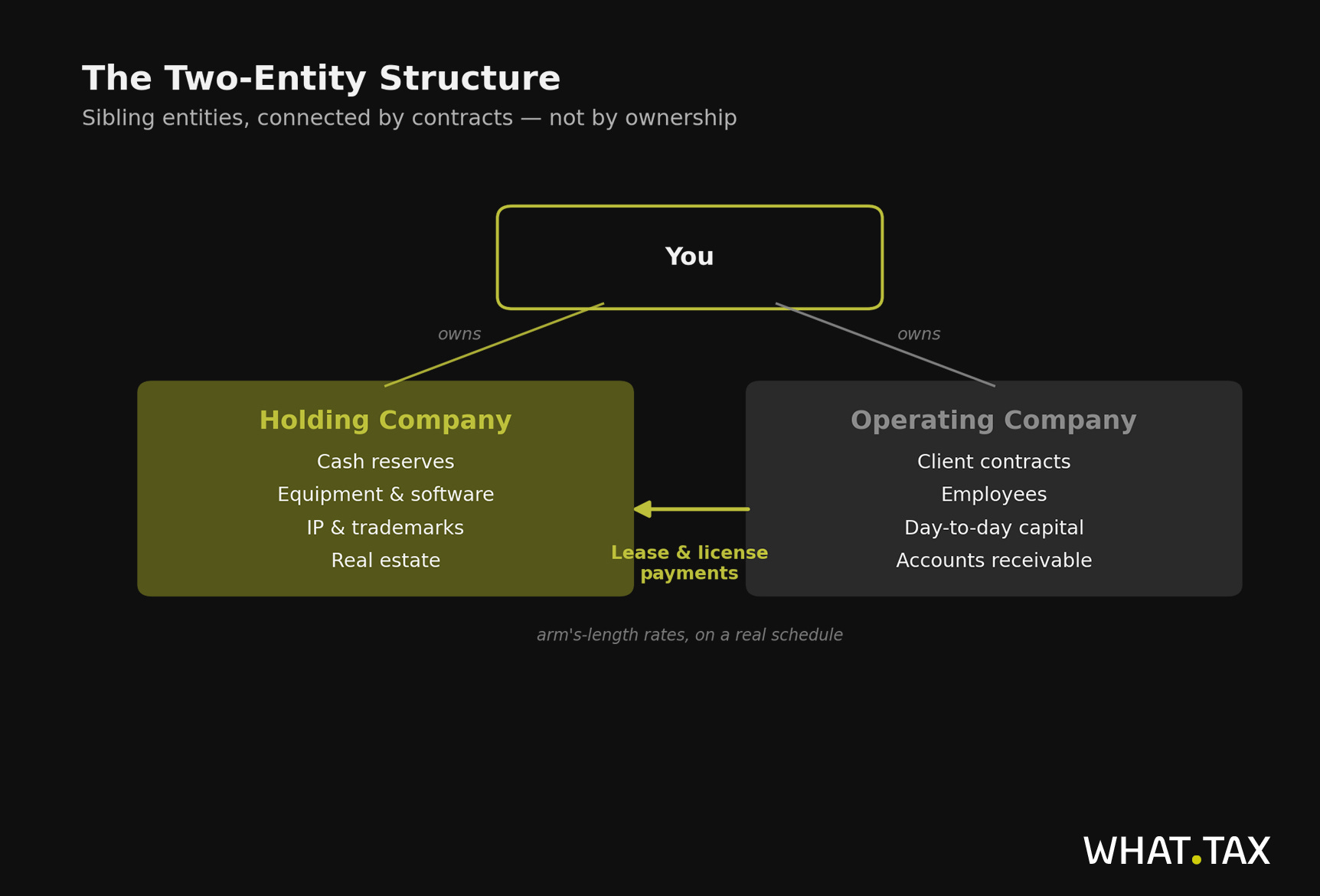
Not everything needs to move, and moving everything is usually a mistake — the Operating Company still needs enough working capital to run without leaning on the Holding Company for every expense. As a starting framework:
Into the Holding Company:
Cash reserves beyond 3-6 months of operating expenses
Equipment, software licenses, and other durable assets
Trademarks, proprietary processes, content, and other IP
Any real estate the business owns or occupies
Stays in the Operating Company:
Client and vendor contracts
Payroll and employee relationships
Day-to-day working capital
Accounts receivable from active client work
The logic behind the split is worth spelling out, because it’s what you’d need to defend if anyone ever asked: cash reserves and equipment aren’t part of what makes the Operating Company risky — a client dispute doesn’t happen because you own a laptop. IP and real estate are often the most valuable things a growing business has and the least connected to its day-to-day liability. Client contracts and employees, on the other hand, are exactly where the risk actually lives, which is exactly why they stay put — moving them anywhere doesn’t reduce the risk, it just relocates it.
The next question is how those assets actually move without creating a tax bill you didn’t plan for — and how the agreements between the two entities have to be written for the split to hold up to the same scrutiny GreenHunter’s didn’t.
Worth setting expectations before you get into the mechanics: this isn’t a multi-month undertaking, and it isn’t something you need a full legal team to execute. For a straightforward two-entity split, most of the actual work fits into a few weeks — a new LLC filing, a round of agreements, new bank accounts, and a handful of documented transfers. What takes longer isn’t the paperwork. It’s making sure each piece is done in the right order, which is exactly what the rest of this issue walks through.
Here’s what paid subscribers get in the rest of this issue:
The exact mechanics for moving cash, equipment, IP, and real estate into a holding company without triggering a taxable event
The specific landmines in each asset category — including the one that can quietly blow up a financed piece of real estate
How to structure the lease and license agreements so they hold up, including the self-rental tax rule most owners have never heard of
A full step-by-step implementation order, in sequence
A worked example on the $800,000 firm from Part 1: what moves, what it’s leased for, and what changes
The five mistakes that undo this structure after it’s built
Comments
Nothing yet. Say the first thing.
Sign in to join the conversation.