
In 2009, a Wyoming LLC called GreenHunter Wind Energy signed a consulting contract with an environmental firm, Western Ecosystems Technology, for work on a proposed wind farm in Platte County. Western did the work. GreenHunter didn’t pay.
By the time the contract wound down in mid-2010, GreenHunter owed $43,646.10 in unpaid invoices. Western sued for breach of contract — and won a judgment for that amount, plus $2,161.84 in attorney’s fees.
Then Western tried to collect, and found nothing to collect. GreenHunter Wind Energy, LLC turned out to be an entity in name only:
It had no employees of its own
Its parent company, GreenHunter Energy, Inc. — a publicly traded corporation — controlled its bank account
The parent decided which bills got paid, and let the LLC’s operating balance run down to zero
Western simply wasn’t on the list of creditors that got paid
So Western went back to court and asked a judge to disregard the LLC entirely and hold the parent company liable instead. In November 2014, the Wyoming Supreme Court agreed. It pierced the LLC’s veil and made GreenHunter Energy personally responsible for the full $45,807.94 — the original debt, plus what it cost Western to prove in court that the “separate” entity had never really been separate at all.
The legal test the court applied is worth knowing, because it’s the same test that would apply to your structure. Courts pierce an entity’s liability shield when two things are both true:
There’s a “unity of interest” between the entity and its owner — the entity isn’t really operating as anything separate
Treating them as separate would work a fraud or an injustice on the other side
GreenHunter hit both, on the same facts already laid out above: no independent staff, no independent control of its own cash, no independent say in who got paid. None of that required fraud in the criminal sense. It just required a court to look at the LLC and conclude it wasn’t actually a separate business — it was a name on a contract.
Sit with who lost that case. This wasn’t a solo consultant who skipped an operating agreement. It was a publicly traded company, with real counsel, that did the standard move — form a subsidiary to isolate a project’s risk — and still lost the shield. Not because the LLC didn’t exist on paper. Because on every day that mattered, it functioned as an extension of its parent instead of a business in its own right.
That’s the part most entrepreneurs never learn until it costs them: forming a second entity isn’t protection. Running it like a real, separate business is.
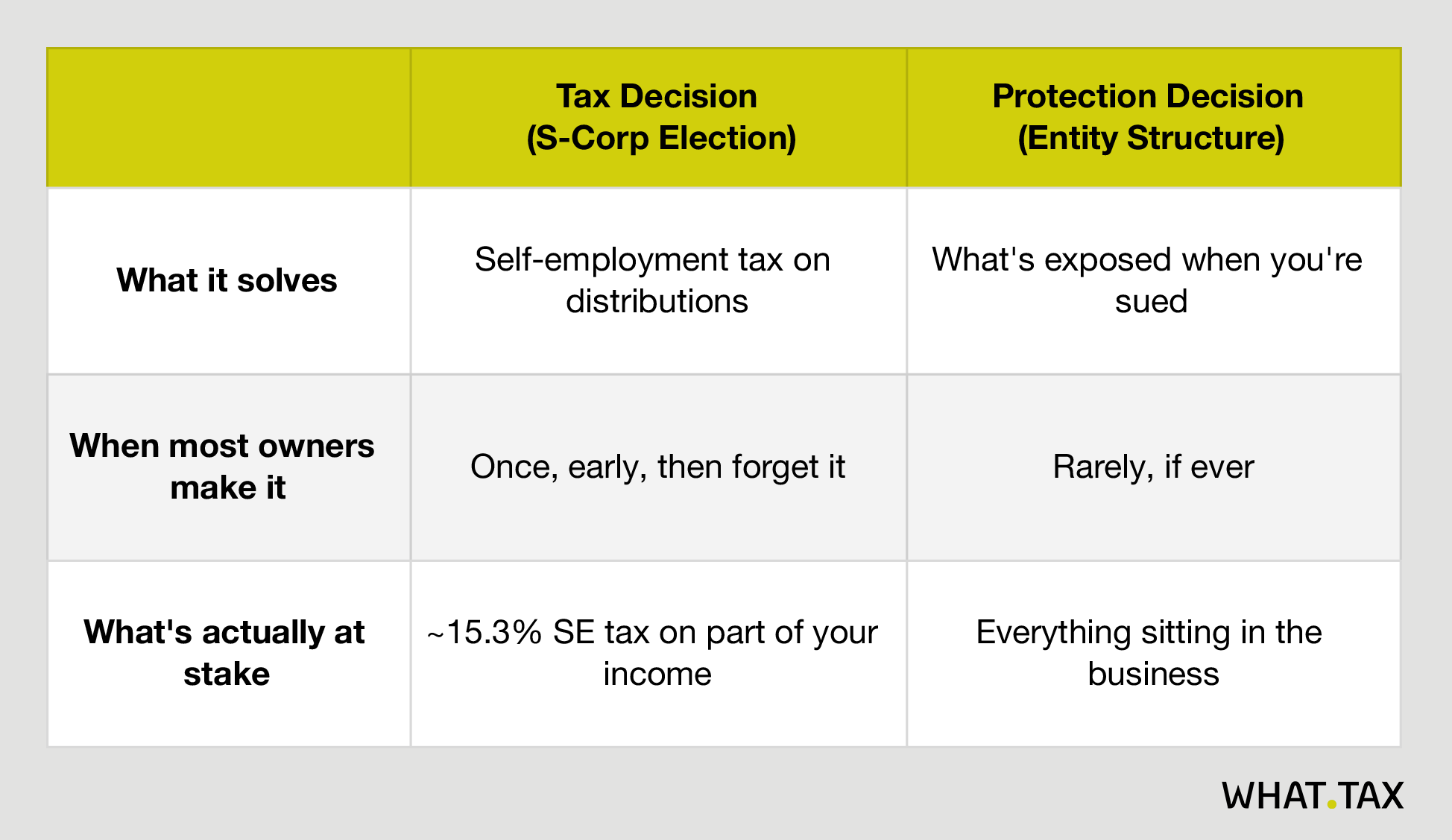
If you’ve read this newsletter for a while, you’ve probably already made your first structural decision: sole prop or single-member LLC, taxed as an S-corp once profit justified it. That decision solves a tax problem. It keeps a chunk of your income out of the 15.3% self-employment tax that hits every dollar of profit in a default LLC or sole prop.
It’s a good decision. For most founders, it’s also the only structural decision they ever make.
What it doesn’t solve is what happens to everything you’ve built if that one entity — the one that signs your contracts, employs your team, and holds every dollar you’ve saved — gets sued. And “if” is doing less work than you’d like it to.
There’s a reason the tax decision gets made and the protection decision doesn’t: the tax decision has a deadline. Miss the window to elect S-corp status for the year, and you’re stuck paying the higher tax bill for twelve more months. That urgency gets it done.
The protection decision has no deadline at all. Nothing forces it. Your LLC keeps operating exactly the same way whether it’s holding $5,000 in reserves or $500,000. No accountant sends a reminder. No form comes due. The only signal that the structure has outgrown itself is the event you’re trying to avoid in the first place — and by then, it’s not a planning conversation anymore. It’s litigation.
That’s the trap. The decision with a deadline gets made once and revisited never. The decision without one gets made, precisely because nothing forces the conversation until it’s too late to matter.
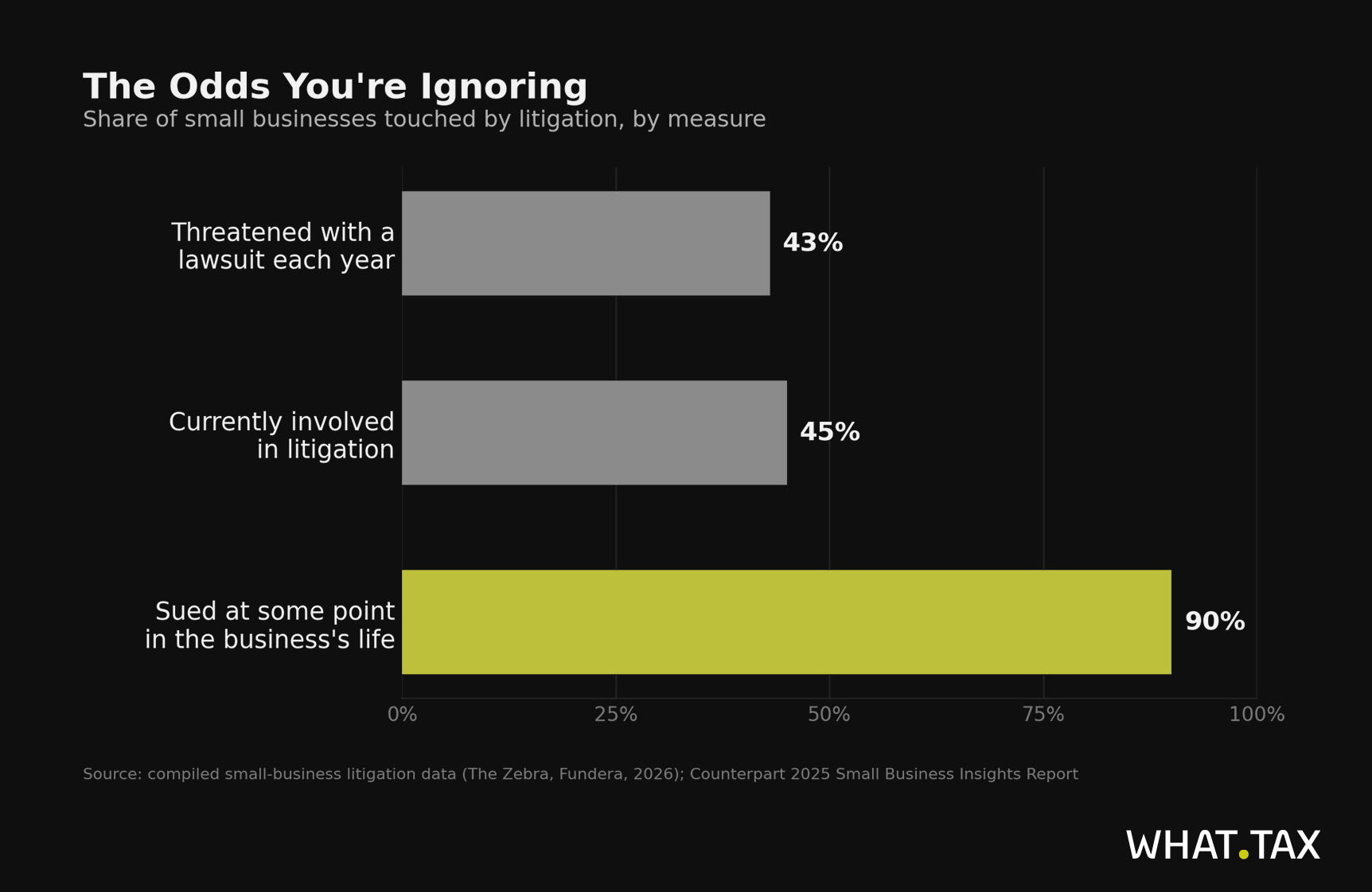
Compiled small-business litigation data puts it plainly: roughly 43% of small businesses are threatened with a lawsuit every year, and about 45% are involved in some form of litigation at any given time. Zoom out to a business’s full lifespan, and the number climbs to 90% of companies experiencing a lawsuit at some point. There are an estimated 12 million contract lawsuits filed against small businesses annually, and the average liability suit costs at least $54,000 to resolve.
The trend is also getting worse, not better. Counterpart’s 2025 Small Business Insights Report found that lawsuits exceeding $1 million surged fivefold year-over-year — from 1.4% to 7% of reported claims. Litigation isn’t just common. It’s getting bigger.
None of this means you’re reckless for running your business through one LLC. It’s the normal, sensible first move, and it’s the one almost every founder makes. It just means “normal” carries real odds attached to it, and those odds compound every year you don’t revisit the structure.
Picture a consulting firm doing $800,000 a year: $150,000 in cash reserves built up over a few good years, $60,000 in equipment and software licenses, and every client contract and every employee sitting inside the same LLC.
That’s a completely standard setup. It’s also completely concentrated. If a client dispute, an employee claim, or a vendor lawsuit ever gets past that LLC’s liability shield — the way one got past GreenHunter’s — everything inside the entity is exposed. Not just this year’s revenue. The reserves. The equipment. Whatever built up while things were going well.
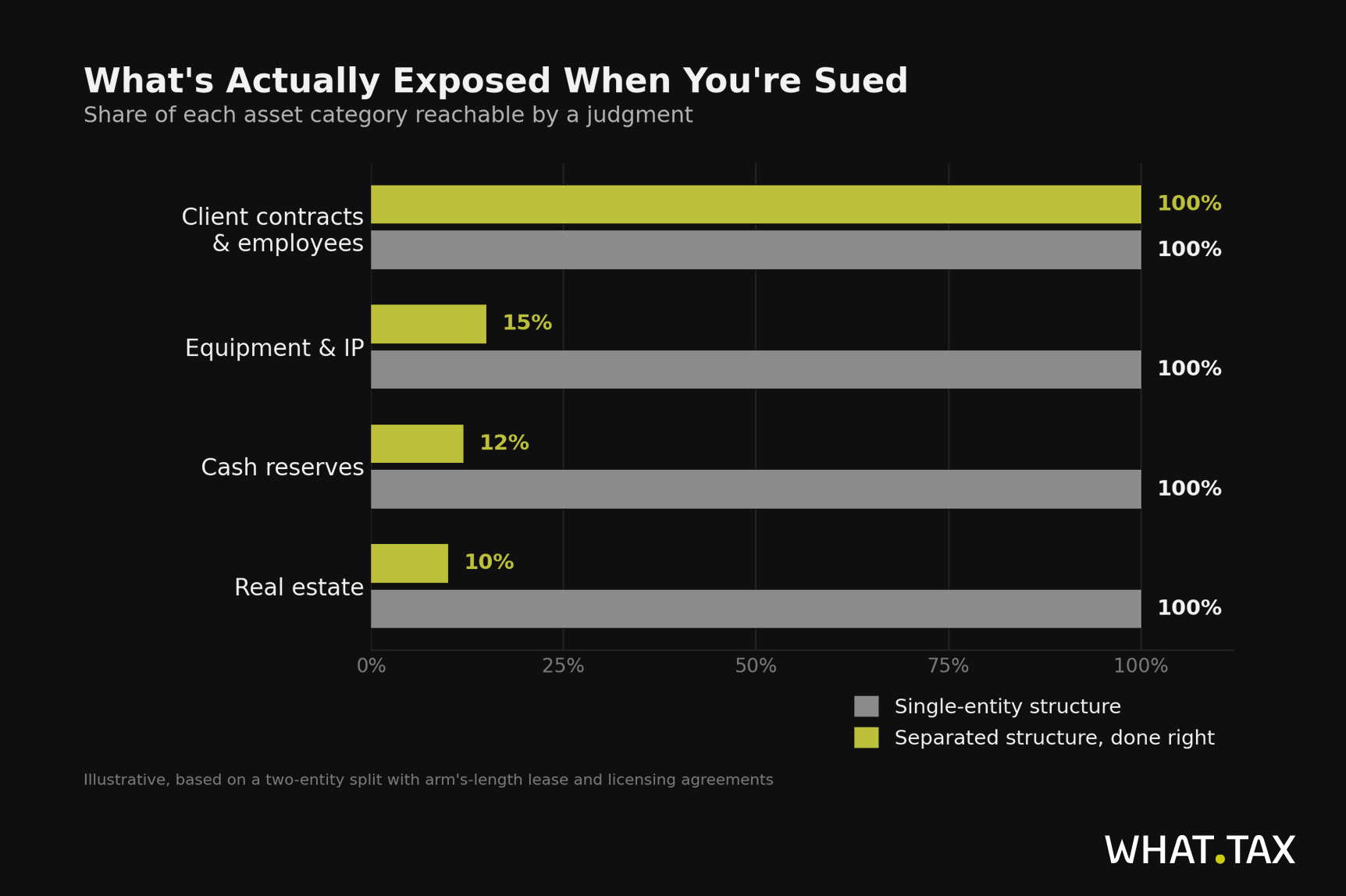
A single entity doesn’t just take on liability. It concentrates it. Every year you don’t revisit the structure, more of what you’ve built sits inside the same legal container that signs your riskiest contracts and carries your highest-risk relationship: your team.
You don’t need to restructure the day you form your LLC, and you don’t need to do it every year out of caution. But there are specific moments where the risk profile of a single entity changes enough that it’s worth an actual conversation instead of a default:
You hire your first employee. Every employee is a new source of potential claims — wage disputes, discrimination complaints, wrongful termination — sitting inside the same entity as everything else you own.
Cash reserves cross a threshold that would hurt to lose. The first $10,000 sitting in reserve isn’t worth restructuring around. The first $150,000 probably is.
You create something worth protecting on its own. A proprietary process, a piece of software, a course, a brand — intellectual property has value independent of the business that built it, and that value shouldn’t live in the same entity that’s signing risky contracts.
You take on a client or contract large enough to change your risk if it goes wrong. A single engagement worth more than your total reserves changes what one bad relationship can cost you.
You start operating in more than one state. Multi-state operations bring multi-state liability exposure, and state tax and registration traps that compound the case for separating what you own from what you do.
None of these moments demand action alone. Together, they’re the difference between a founder who revisits structure on purpose and one who only finds out it mattered after a process server does.
And the cost of waiting compounds quietly. A firm carrying $50,000 in exposed reserves this year is often carrying $150,000 to $200,000 in exposed reserves three years later, if revenue keeps growing and the structure doesn’t change with it. The risk isn’t static. It grows at the same rate your business does — which means the “someday” conversation gets more expensive to postpone every year you postpone it.
Here’s where GreenHunter’s story becomes the actual lesson instead of just a cautionary one. The company didn’t lose because it only had one entity. It lost because its second entity was a shell — no employees, no real operations, cash controlled entirely by the parent, bills paid selectively based on who the parent wanted to pay.
A second entity that exists only on paper protects nothing. The structure has to do something real: hold assets under its own name, operate under its own agreements, get paid and pay out on terms that would make sense between two unrelated companies. That’s a genuinely different exercise than checking a box with your state’s Secretary of State.
Every state’s version of the veil-piercing test asks some version of the same questions, and they’re worth holding yourself to before a court ever does: Is the entity capitalized enough to plausibly stand on its own? Are its funds ever mixed with anything else? Does it follow its own paperwork — its own agreements, its own resolutions, its own records? Would an outsider, looking only at how money moves between the entities, conclude they’re actually separate businesses? GreenHunter failed every one of those questions. A structure built to pass them looks very different, and that’s exactly what the rest of this series is built to walk through.
This is Part 1 of a three-part series on business structure. The next two go to paid subscribers, and they get specific.
Part 2 covers the two-entity split in practice: how a holding company and an operating company actually work together, what has to move where, how to transfer assets into a holding entity without triggering a taxable event you didn’t plan for, and the lease and licensing agreements that make the split real instead of cosmetic — the exact thing GreenHunter never had.
Part 3 covers what you do once the structure exists: how owners with multiple entities legally shift income between them through a management company, which sections of the tax code govern it, and the mistakes that turn a legitimate structure into an audit target.
If you made the S-corp decision and stopped there, Part 2 is where this actually gets useful.
This article is for informational purposes only and does not constitute tax advice. Consult a qualified tax professional before making decisions about your estimated tax payments.
If you get value from this newsletter, please consider liking this post. It makes a significant impact and helps this work reach more entrepreneurs.
Thank you for your support.
No posts
Comments
Nothing yet. Say the first thing.
Sign in to join the conversation.