
Quick recap: Part 2 built a Holding Company and an Operating Company, connected by a lease and a license: real payments, on a real schedule, for real assets. That structure shifts passive income: rent, royalties, the kind of money that comes from owning something rather than doing something. It’s a real benefit, and it’s available to almost anyone who did the work in Part 2, regardless of how big or small the business is.
This issue is about the other kind of income, the kind that comes from actually running the business. The income that’s still sitting entirely in your Operating Company, still fully subject to self-employment tax, no matter how well Part 2’s structure is built. It’s a more powerful lever than anything in Part 2, and it’s also the one place in this series where “more powerful” and “more available to everyone” pull in opposite directions.
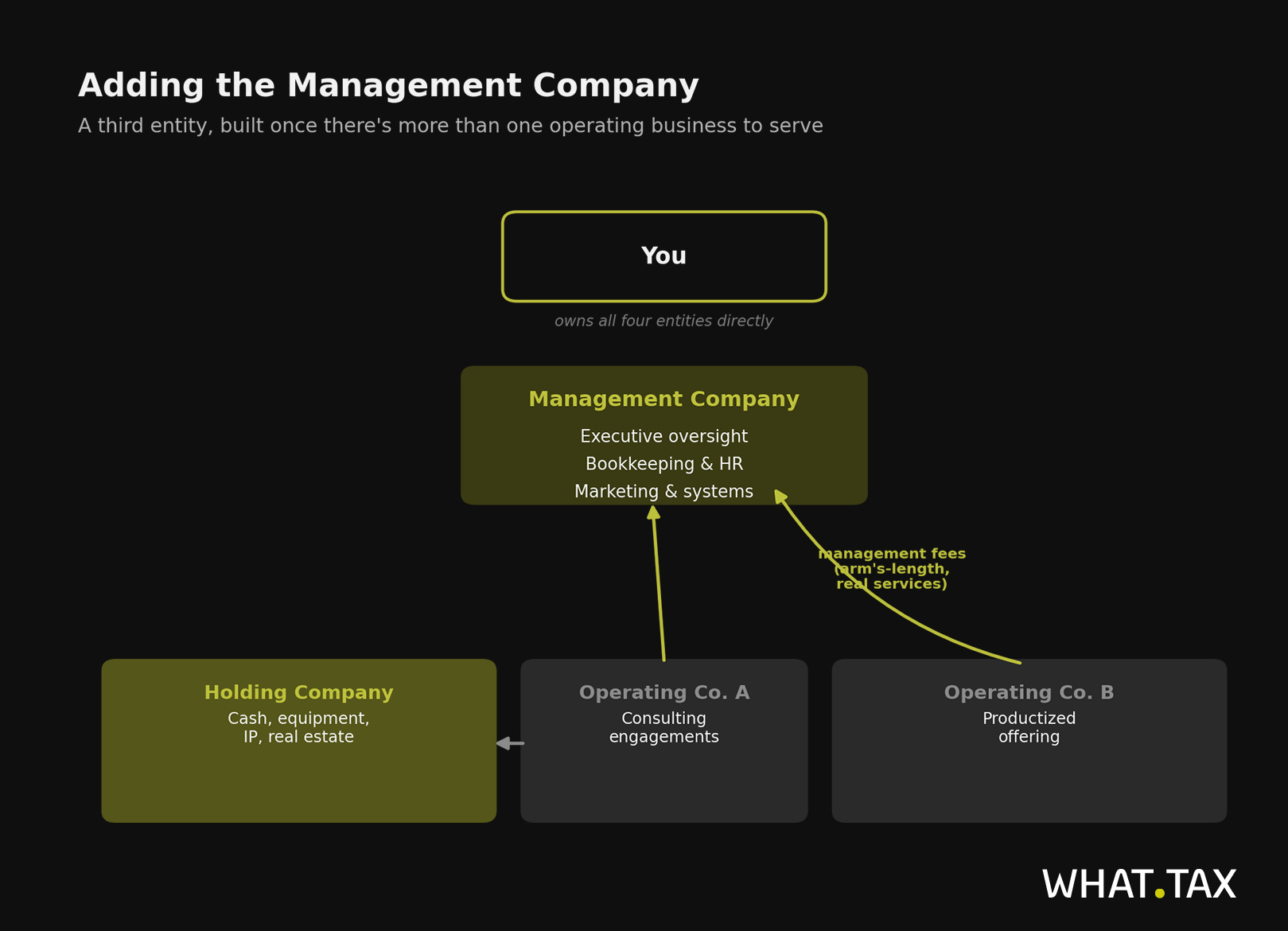
A management company is a third entity (or, for some owners, a repurposed version of the Holding Company from Part 2) that performs real, active work for your Operating Company and bills for it. Executive oversight. Bookkeeping and financial management. HR and hiring. Marketing and business development. Systems and process management. Whatever genuinely sits above the day-to-day client work.
To make that concrete: if your Operating Company is the consulting firm from Parts 1 and 2, the work that stays in Operating is the client engagements themselves, the actual consulting. What could plausibly move to a Management Company is everything that runs the business around that work: who decides which markets to pursue, who manages the team, who runs payroll and handles HR compliance, who owns the marketing function and the systems that keep the firm operating. That’s a genuinely different kind of labor than delivering client work, and it’s the kind of labor an unrelated management company could plausibly be hired to do.
The Operating Company pays the Management Company a management fee for that work, the same way it would pay any outside consultant or agency. That fee is a deductible expense to the Operating Company and income to the Management Company. If the Management Company is structured to pay you a reasonable salary for your role there while the rest flows through as a distribution, some of that income sidesteps self-employment tax the same way your original S-corp election already does for the Operating Company.
That last sentence is doing a lot of work, and it’s worth being direct about it: a management company doesn’t multiply the S-corp tax benefit out of nowhere. It’s the same “reasonable compensation versus profit distribution” mechanic, applied to a genuinely separate piece of the business. It only creates real benefit if there’s a genuinely separate piece to apply it to.
The Holding Company split works regardless of your size or complexity; it’s protection, and almost every growing business has something worth protecting. A Management Company is a different kind of move: it only works when the business has grown into something that genuinely needs it, and building one too early just adds a second entity with nothing real for it to do. Part 2 is the floor. This is the ceiling, for the businesses that have actually reached it.
This is the honest version most people don’t get: a management company is not automatically the next step after Part 2, the way Part 2 was automatically worth doing after Part 1.
It’s a strong move if:
You already run, or are actively building toward, more than one operating business, and a single company can genuinely centralize their shared admin, marketing, and executive functions
Your own role has a genuinely separable executive or oversight function distinct from the client-facing work: you’re managing the business, not just doing the work of the business
You want one clean entity handling payroll, benefits, and back-office compliance instead of duplicating it across multiple operating companies
It’s usually not worth building if you run one operating business, do the client work yourself, and would be forming a Management Company purely to bill your only company for services only you provide. That structure is legal in principle. It’s also close to exactly what two specific IRS rules were written to catch, and it’s worth knowing precisely what they are before you build anything.
Picture the consulting firm from Parts 1 and 2 two years further along: it’s launched a second line of business, a smaller productized offering with its own Operating Company, its own clients, and its own small team. Now there’s a genuine shared layer (the founder’s executive time, one shared bookkeeper, one shared marketing function) sitting above two real operating businesses instead of one. That’s the version of this structure with a real foundation under it. The same firm, still with just the one business it started with, forming a Management Company to bill only itself, doesn’t have that foundation yet.
Here’s what paid subscribers get in the rest of this issue:
A real 1981 Tax Court case where a management-type company survived an IRS challenge, and the loophole it exposed that Congress closed the very next year
The specific rule (IRC §269A) that lets the IRS collapse your Management Company entirely if substantially all its income comes from one related entity
The specific rule (IRC §414(m)) that stops a management company from doing what a lot of owners assume it does for retirement plans
What actually makes a management fee defensible, and how it’s priced
The full list of mistakes that turn this into an audit target instead of a tax strategy
Comments
Nothing yet. Say the first thing.
Sign in to join the conversation.