

Somewhere on your tax return, usually a line your software fills in without asking questions, sits a form called 8960. If your income crossed a certain line this year, that form quietly added 3.8% to your tax bill on income you’d already paid capital gains or ordinary rates on. Most people who write that check have no real idea what they’re paying for.
Here’s the part that should bother you. The tax is officially named the Unearned Income Medicare Contribution Tax. It sounds like it funds Medicare. It doesn’t. Not one dollar goes to the Medicare Hospital Insurance Trust Fund. The Joint Committee on Taxation said so plainly when the law passed: the revenue flows straight into the U.S. Treasury’s general fund, the same pool that covers everything from defense contracts to national parks. The IRS confirmed it again in its own regulations. The name is a leftover from an earlier version of the bill that got swapped out during the Affordable Care Act’s reconciliation process, and nobody ever bothered to update the label to match what the tax actually does.
This is the Net Investment Income Tax, NIIT for short, and if you’re a profitable entrepreneur, especially one who just sold a piece of a business, cashed out equity, or had a strong year on a rental portfolio, there’s a real chance you’re paying it right now without ever having budgeted for it. Let’s take it apart properly: what it actually taxes, why the number of people paying it keeps climbing, and where the legitimate levers are to reduce what you owe.
Strip away the politics and the tax itself is simple arithmetic, applied to two numbers you calculate separately.
The rate is 3.8%. The base is the smaller of two figures: your net investment income for the year, or the amount by which your modified adjusted gross income (MAGI) exceeds your threshold. Whichever number is lower is what gets taxed.
The thresholds, fixed by statute under IRC §1411, are $200,000 for single filers and heads of household, $250,000 for married couples filing jointly, and $125,000 for married filing separately. MAGI is close to your regular AGI for most business owners, with a handful of foreign-income addbacks that rarely matter outside cross-border situations.
Here’s the calculation in practice. If your MAGI lands $80,000 over your threshold, but your net investment income for the year is only $50,000, the tax applies to the smaller figure, producing a $1,900 bill. Flip it around, and it’s the opposite: if your net investment income is $120,000 but you’re only $35,000 over your threshold, the tax applies to that $35,000, not the full $120,000. The excess-over-threshold number acts as a ceiling on how much of your investment income actually gets taxed, which is exactly why reducing MAGI, even without touching your investment income directly, can shrink the bill.
NIIT has a sibling that gets confused with it constantly: the 0.9% Additional Medicare Tax, which applies to wages and self-employment income above those same thresholds. The two are mutually exclusive on any given dollar. Wages and self-employment income get hit by the 0.9% tax, never NIIT. Interest, dividends, capital gains, and passive income get hit by NIIT, never the 0.9% tax. Together, the two levies were designed to mirror the combined 3.8% employer-employee Medicare payroll tax rate, applied to income types that payroll tax was never built to reach.
Here’s what almost nobody points out when they explain this tax: those thresholds have never been adjusted for inflation, not once, since the tax took effect on January 1, 2013. Not during the 2017 tax overhaul. Not through any of the pandemic-era relief packages. Not even in the One Big Beautiful Bill Act, signed July 4, 2025, which made the 37% top bracket permanent, restarted inflation indexing for the AMT exemption in 2027, and adjusted dozens of other thresholds across the code. NIIT’s income lines were left exactly where Congress set them thirteen years earlier.
That’s not an oversight. A frozen threshold is a quiet, deliberate way to raise revenue over time without ever holding a vote on a tax increase. Every year, wages, business income, and asset values climb with inflation; more people cross a line that hasn’t moved an inch, entirely on paper.
Run the actual numbers and the gap is stark. Using BLS CPI-U data, $200,000 in January 2013 carries the same purchasing power as roughly $286,700 today. If Congress had indexed the NIIT threshold the same way it indexes the ordinary income brackets, the standard deduction, and the estate tax exemption, a single filer wouldn’t owe a dime of this tax until nearly $287,000 of income. Instead, the line sits almost $87,000 below where inflation alone would have carried it.
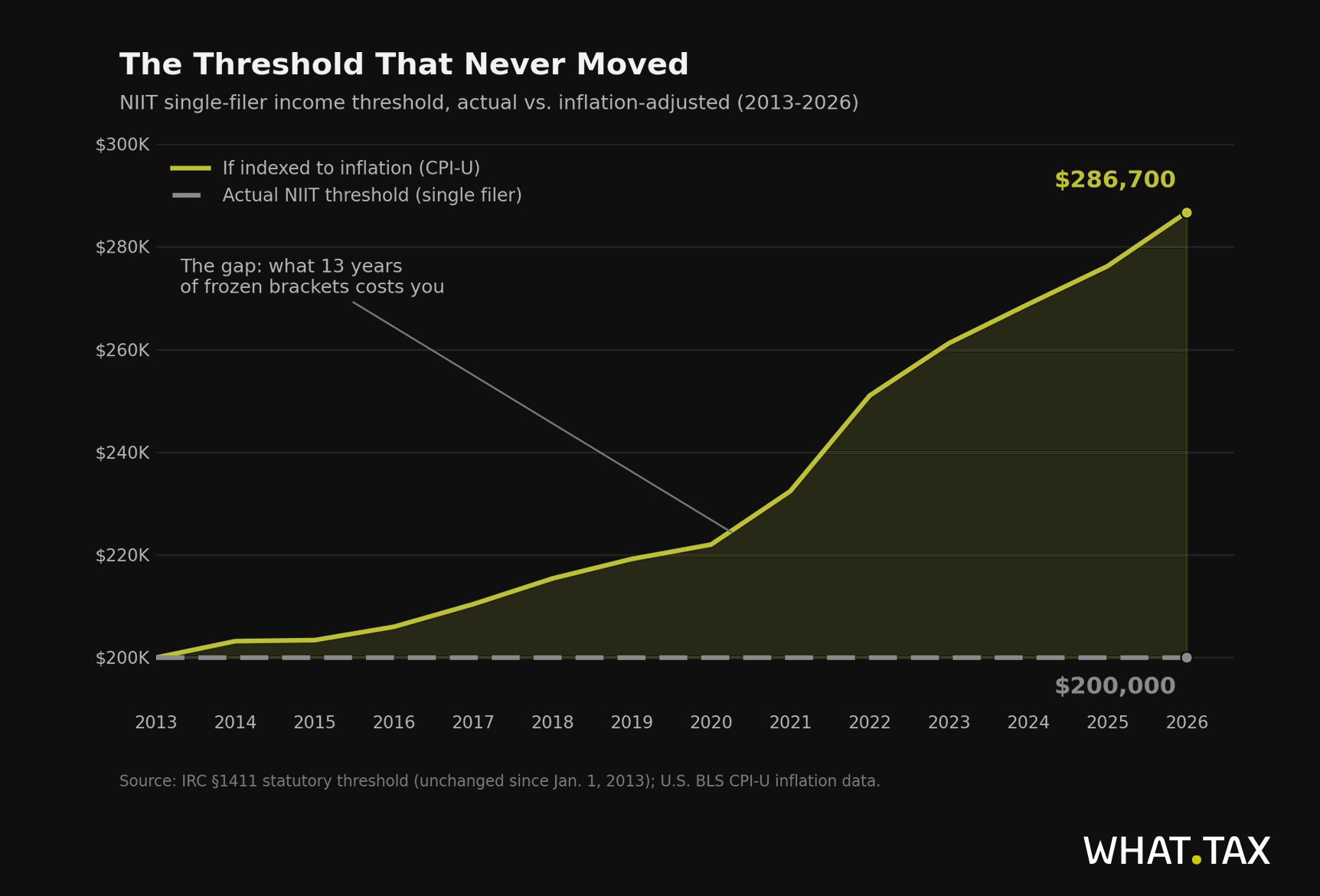
For a profitable consulting practice, a growing agency, or a rental portfolio finally throwing off real cash flow, that erosion isn’t abstract. It’s the difference between owing nothing and writing a real check, purely because the goalposts stood still while your revenue didn’t.
NIIT was sold to the public as a tax on the wealthy, and it still gets described that way. The data tells a more specific story, and it’s the one that actually matters if you run a business.
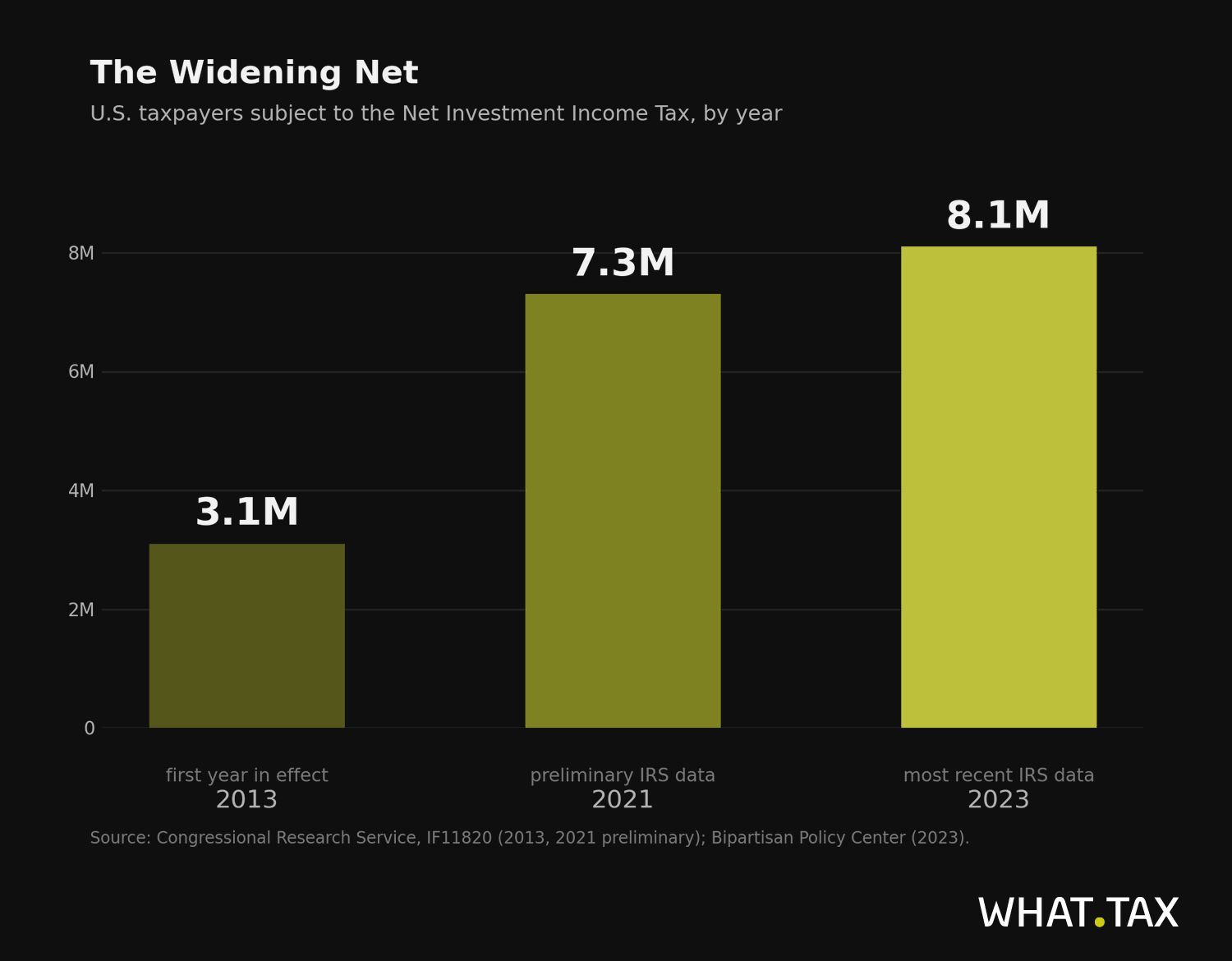
In the tax’s first year, 2013, roughly 3.1 million taxpayers owed it, generating $16.5 billion in revenue. By 2021, the most recent year with detailed figures from the Congressional Research Service, it had grown to 7.3 million taxpayers and $59.8 billion. The Bipartisan Policy Center’s more recent count puts 2023 at 8.1 million returns, better than double the total from year one. Since inception, the tax has raised roughly $340 billion, and the Congressional Budget Office projects another $642 billion over the next decade.
Now look at who’s actually writing those checks. CRS distributional data for 2019, the most detailed year publicly available, shows taxpayers earning $200,000 to $500,000 made up 69.6% of everyone hit by NIIT, yet contributed only 14.1% of the total revenue collected. Taxpayers earning $10 million or more told the opposite story: a sliver of all filers, but 31.5% of total revenue, averaging $449,642 per return.
Put plainly, the tax catches an enormous number of upper-middle earners and working business owners for comparatively modest amounts (the average bill across all NIIT filers in 2019 was $5,202), while a small number of very high earners account for the bulk of the dollar total. If you’re a founder who just had your best year yet, sold a piece of a business, or watched your rental portfolio finally turn a real profit, you’re far more likely to land in the first group than the second. The instinct to think “this is a rich person’s problem” is exactly backwards for the people most likely to be reading this.
The most common mistake people make is assuming NIIT applies broadly to “high income.” It doesn’t. It applies to a specific, defined category of income, and a lot of what actually funds an entrepreneur’s life sits outside that category entirely.
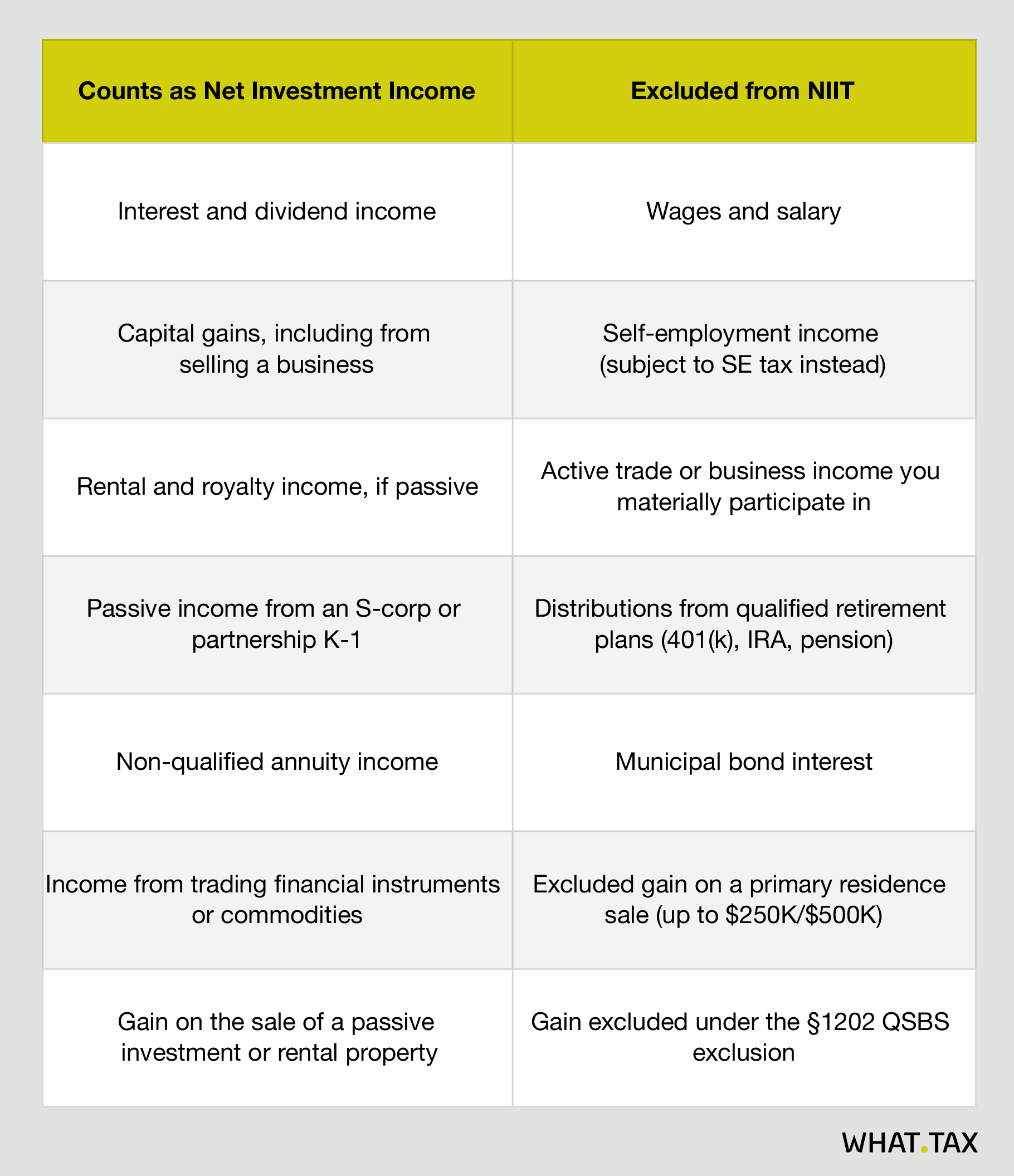
Two rows deserve extra attention. First, self-employment income is excluded from NIIT outright, even though it’s still subject to self-employment tax and potentially the 0.9% Additional Medicare Tax. NIIT and self-employment tax are separate systems that never overlap on the same dollar. Second, gain excluded from gross income under the qualified small business stock rules of §1202 is excluded from net investment income too. That’s not a minor detail. It means a properly structured QSBS exit escapes both capital gains tax and the 3.8% surtax on the excluded portion, not just one or the other. More on that shortly.
A lot of tax content conflates two completely different planning questions: how you’re taxed on payroll (self-employment tax and the Additional Medicare Tax) versus how you’re taxed on investment income (NIIT). The two get lumped together in generic “S-corp versus LLC” advice constantly, and it leads people to the wrong conclusion.
NIIT does not care what entity you operate through. A sole proprietorship, a partnership, an LLC, and an S-corporation are all treated identically for NIIT purposes on active business income. What actually determines whether your share of that income counts as net investment income is a single question: do you materially participate?
Material participation is a defined standard under IRC §469, with several ways to satisfy it. The most commonly used is simple: you worked more than 500 hours in the business during the year. Six other tests exist too, covering scenarios like being the only person who substantially participates, but 500 hours is the one most owner-operators clear without ever thinking about it.
If you materially participate, your share of the business’s income, whether it flows through a K-1 or a Schedule C, is excluded from net investment income entirely, regardless of entity type. If you don’t (a silent investor, a limited partner who never touches operations, a founder who stepped back to an advisory role but kept equity), that same income is treated as passive under §469, and passive income sits squarely inside the NIIT base.
This catches people at exactly the moment they least expect it: when they finally step back from a business they built. Founders who retire from day-to-day operations, keep their ownership stake, and start collecting distributions often don’t realize their participation has quietly dropped below the material threshold. The income doesn’t change. The tax treatment does.
Rental real estate gets its own, harsher default rule. Even if you actively manage your properties, rental activity is treated as presumptively passive under §469, which lands it inside the NIIT base almost automatically, regardless of how many hours you personally put in.
There’s a specific way out: real estate professional status. Qualifying requires more than 750 hours of work in real property trades or businesses during the year, and those hours have to represent more than half of the total personal services you performed across everything you do. A physician who owns rental properties on the side essentially never qualifies; the day job alone fails the “more than half” test. A full-time operator who develops, manages, or brokers real estate as a primary occupation often does. Qualifying isn’t the finish line by itself, either. You then have to separately materially participate in each rental activity, or make a formal grouping election under Reg. §1.469-9(g) to treat your properties as one combined activity for participation testing.
There’s a second, narrower escape worth knowing: the self-rental rule. If you personally own a property and rent it to a business you materially participate in, that rental income gets recharacterized from passive to non-passive under Reg. §1.469-2(f)(6). It’s a well-established structure, common with owners who hold their operating company’s real estate in a separate LLC for liability reasons, and it pulls that specific rental stream out of the NIIT base without requiring full real estate professional status.
Selling a business is usually the single largest NIIT exposure an entrepreneur will ever face, and it tends to land as a surprise precisely because it’s a one-time event most people never budgeted a surtax into.
The mechanics are unforgiving. Capital gain from the sale of a business is net investment income by default, whether the deal is structured as an asset sale or a sale of your stock or partnership interest. A business owner with $150,000 in W-2 wages and a $200,000 gain from selling the company lands at $350,000 in MAGI. Against the $250,000 married threshold, that’s $100,000 over the line. NIIT applies to the smaller of the two figures again: the $100,000 excess, not the full $200,000 gain, for a $3,800 bill in that scenario alone, on top of regular capital gains tax.
There’s a narrower relief valve for owners who sell an interest in a partnership or S-corp rather than the underlying assets. Under the look-through rule in Reg. §1.1411-7, the portion of gain attributable to the entity’s non-passive trade or business assets can be excluded from NII, provided the seller materially participated. It requires a proper asset-level analysis at the time of sale, and most brokers and buyers won’t do that work for you unless you push for it.
The exclusion that actually changes the math entirely is qualified small business stock under §1202. Gain excluded from gross income under §1202 is also excluded from net investment income, not just from capital gains tax. That’s a full exemption from both layers of tax on the excluded portion, not a partial reduction.
OBBBA meaningfully improved this exclusion for stock acquired after July 4, 2025. The old rule required a full five-year hold before any benefit applied. The new rule phases it in: 50% exclusion after three years, 75% after four, and 100% after five. The per-issuer cap rose from $10 million to $15 million, indexed for inflation starting in 2027, or ten times your basis, whichever is greater. Stock acquired on or before July 4, 2025 stays under the old five-year, $10 million rules; the new terms only apply going forward. Whatever gain exceeds your cap, or fails to qualify for exclusion, gets taxed at a special 28% top capital gains rate, plus NIIT on top of that if you’re over your threshold. For founders building with QSBS eligibility in mind from formation, this is one of the highest-leverage planning windows in the entire tax code for an exit, and it has to be structured years before an offer ever shows up.
None of these are exotic. They’re tools sophisticated owners already reach for, applied with NIIT specifically in mind rather than as an afterthought.
Maximize retirement plan contributions. A Solo 401(k), cash balance plan, or SEP contribution reduces MAGI dollar for dollar. This only helps if it moves you closer to or under your threshold; it does nothing to reduce net investment income itself, only the excess-over-threshold side of the equation. For an owner sitting just above the line, it can eliminate the tax entirely.
Harvest capital losses in the same year as your gains. Losses net against gains dollar for dollar in the NII calculation, not just for regular capital gains purposes. Realizing losses on underperforming positions in a year with a large gain event directly shrinks the NIIT base, not only the income tax base.
Use installment sales under §453 for a business or real estate exit. Spreading gain recognition across several years through seller financing can keep each year’s MAGI under the threshold, rather than realizing the full gain in one year that blows past it. Interest earned on the note itself is also net investment income, so that has to be factored into the analysis too.
Hold municipal bonds in the stability sleeve of a portfolio. Muni interest is fully excluded from both regular income tax and NII, one of the few true exclusions in the code. The tradeoff is lower yield, which makes this a fit for the conservative portion of a portfolio, not a wholesale allocation shift.
Fund a charitable remainder trust before selling a highly appreciated, concentrated asset. A CRT lets you contribute the asset pre-sale, have the trust sell it without immediate gain recognition to you, and collect an income stream over a term of years instead of the full gain at once. The gain keeps its character as it’s distributed, so NIIT still applies to what you receive each year, but spreading it out keeps any single year’s exposure smaller.
Time large, discretionary income events on purpose. Deferred compensation payouts, bonus timing, and equity exercises are all things founders have real control over. Realizing a large gain in a year when ordinary income is already elevated compounds the exposure; realizing it in a leaner year can meaningfully change the outcome.
The common thread across all six: NIIT rewards planning across years, not reaction within one. The owners who minimize it are thinking about timing well before a liquidity event, not during the week they’re signing closing documents.
Entrepreneurs who build real wealth eventually start using trusts, for estate planning, asset protection, or both. Most don’t realize trusts face a dramatically harsher version of this same tax.
For an individual, the NIIT threshold starts at $200,000. For a non-grantor trust, the threshold is tied to wherever the top 37% bracket begins for trusts, and that bracket is absurdly compressed. For 2026, that’s just $16,000. A trust holding $50,000 of undistributed investment income doesn’t just owe the top 37% rate on most of it; it owes the 3.8% surtax on top, for a combined marginal rate of 40.8%, a level an individual wouldn’t reach until several hundred thousand dollars of income.
The practical fix is usually structural rather than clever: distribute investment income out to beneficiaries instead of letting it accumulate inside the trust. Income that’s actually distributed carries out to the beneficiary’s own return, taxed at that person’s individual rates and thresholds instead of the trust’s compressed ones. Whether that makes sense depends on the trust’s purpose. A trust built for asset protection or generation-skipping planning may be designed specifically to retain income, in which case the tax cost is a known tradeoff rather than an oversight. The mistake is not knowing the tradeoff exists until the K-1 arrives.
NIIT isn’t a tax on being rich. It’s a tax on crossing a line Congress drew in 2013 and then simply forgot to move, while incomes, asset values, and business valuations kept climbing without it. Every year that passes without an inflation adjustment pulls more entrepreneurs into a bracket originally aimed at a much smaller, much wealthier group.
The owners who handle it well share one habit: they treat it as a planning input, not a year-end surprise. They know which of their income is passive versus active before the K-1 arrives. They think about entity structure and material participation before the business sells, not after. And they understand that a well-timed installment sale, a properly held QSBS position, or a simple retirement contribution can be the difference between a tax bill that stings and one that barely registers.
Nothing in this post is legal, tax, or investment advice. Every strategy here has nuance, qualification rules, and trade-offs that depend on your specific situation. Talk to a tax attorney before you act on any of it.
Free posts here are built to give you the full picture.
The paid tier is where I go deeper: step-by-step implementation on structuring a §453 installment sale correctly, building QSBS eligibility in from formation, setting up a real estate professional election so it actually holds up.
That level of detail is exactly what goes into the Sunday deep dives for paid subscribers. If you found this useful, subscribing (it's free) is the best way to make sure the next one lands in your inbox.
If you get value from this newsletter, please consider liking this post. It makes a significant impact and helps this work reach more entrepreneurs. Thank you for your support.
No posts
Comments
Nothing yet. Say the first thing.
Sign in to join the conversation.