
Defining an architecture capability model appears to be difficult because the term “Enterprise Architecture” is such a loosely defined term, which has changed over the last several decades. This leads to confusion if EA is “just the tech stuff that I don’t understand” or if business people rather look for BPM (Business Process Management) instead.
One takeaway from dozens of implementations — BPM or more IT-focused architecture implementations — is that three major areas determine a successful implementation:
the content that architects create,
the setup of a proper governance, and
the adoption capabilities.
Please note that the technical implementation (“getting the tool to users”) does not show up as a key capability, which is something that some people find interesting and counterintuitive.
When you look at the “three-legged stool” that you need to balance for your organization as the implementer, we see three areas: Content, Governance, and Adoption.
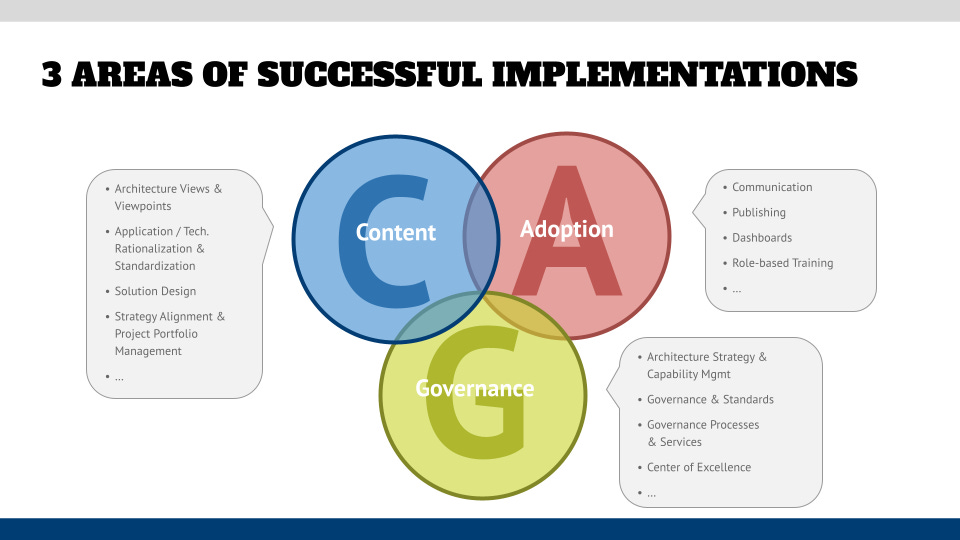
Content: This is most likely the area that brought you to identifying architecture as a key success factor for your program and got you started. It is the problem that you want to solve, and typically, you see topics like the ones mentioned in the graphic above (Figure 1). Additional topics might be Process Mining, Process Automation, or Simulation. In this group, you will find the most advocates of the ‘give them the tool and get out of the way’ or ‘the tool is just Visio on steroids’ approaches. Don’t adopt this mentality – it will lead to a low adoption rate and ultimately make your program fail.
Governance: This area defines the direction and ‘rules of engagement’ for the program and is already discussed in previous articles. In a nutshell – you must define what your participants shall do (Process Governance), how they are organized (Organizational Governance), and which standards shall be followed (Technical Governance). This area describes the ‘inside-out’ perspective – how do we get things done? In the past, many EA groups have seen this as their main focus – maybe because they could not discuss the content topics? — which led to the impression that they built their ivory towers (or were the ‘Committee of No’ vs. the desired ‘Committee of Know’).
Adoption: As in the most failing enterprise-wide implementations, this is the area that gets the least attention or will be treated as an afterthought by otherwise more technology-oriented architects. However, it will be the key driver for a successful implementation that is driven by your strategy. It takes the stakeholders, user personas, and—overall—the ‘outside-in’ perspective of your program into consideration.
My recommendation is to involve your org change management and user experience specialists early in the program and let them drive the outside view while others take care of the governance and technical aspects.
Depending on your current perspective or situation, you might focus on one area over another, but keep in mind that you want to balance these. During your implementation, you might have to shift the focus according to where you are on your journey. Initially, there will be more focus on governance and adoption, while content will become more in focus once all participants in your program have understood what is expected from them.
First, let’s talk about what capabilities are not: they are not skills and knowledge that an individual has. They are also not features and functionalities that a software has.
Therefore, it is good to make a distinction between business capabilities and technical capabilities. The latter are things that an application can do and fit more with the second scenario above. In earlier versions of my favorite architecture tool, this object was called “IT Function”, and I think this is a better term than (technical) capability. It makes it even clearer in the context of an application rationalization, where you want to find redundant functionalities to streamline your application portfolio and avoid multiple apps that do the same. You might want to find missing functionality that you can provide with another app/extension or build by yourself.
The more interesting term, in my opinion, is the business capability. This term means the definition of the “what” an organization shall be able to do. It consists of things shown in the middle of Figure 2 below — organizations, skills, knowledge, locations, applications, processes, data, and more. Together, these items provide a good high-level description of what shall be implemented, updated or retired.
Business capabilities are a core concept of every architecture – they are derived from the strategy (which is not only comprised of the items below, but also includes the services and products, the business model, and other things) and should align to it. The business capabilities are then driving the programs on the roadmap and can be used to be a litmus test for each project request by asking “which capabilities do you create/update/retire?” If the answer is “none of those,” then the justification for that project funding request is on a weak foundation. In an ideal state, everything should be aligned with the capabilities, and the results of the projects should be measured and show the accomplishments of the strategic objectives.
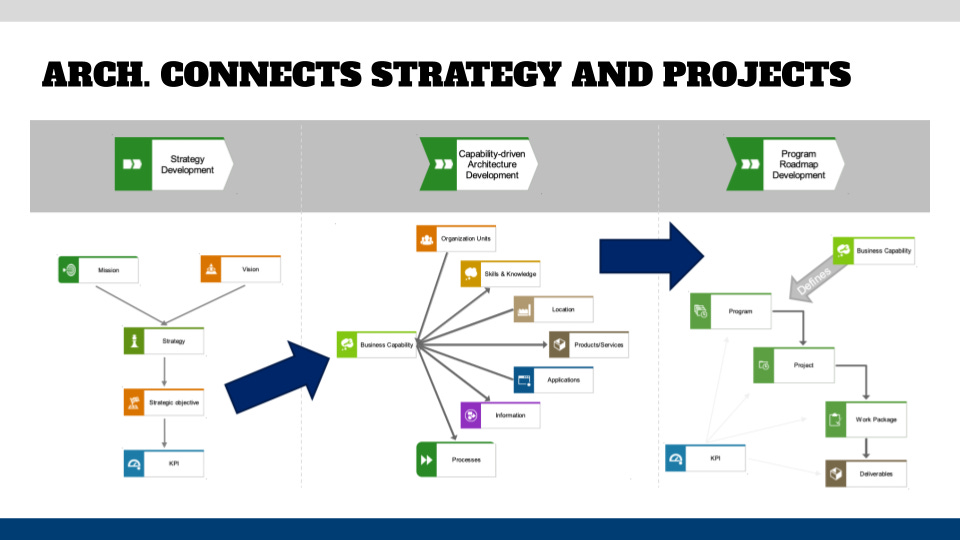
Implementing projects requires a bit more detail, though. When you look at your organization, you will find different states of maturity, or needs and requirements which might be a result of your organizational structure (some org units might have more people than others and therefore might have the need for more automation and workflow, while the smaller regions might be able to get away with a more manual approach).
To show this and have objects available in your planning and alignment during the architecture development, the concept of capability configurations comes into play. Capability configurations are subsets of the main business capabilities and might be defined either as different fidelity states of a capability (think “gold/silver/bronze” in the example above) or various states of the capability being laid out on a timeline. Either way, the capability configuration is what needs to be defined to describe the scope of a project (and, of course, show the specific processes, affected apps, data, etc. in more detail).
An architect will have to integrate this back into the overall capability model, answering the question of “how far are we in implementing the overall capability model?” This will then provide the feedback to the strategists about what the organization might be able to do soon and what the impact on products/services or program delivery might be.
So, what does that mean for your architecture practice? In my experience, they are grouped into five big buckets of business capabilities, shown in Figure 3 below:
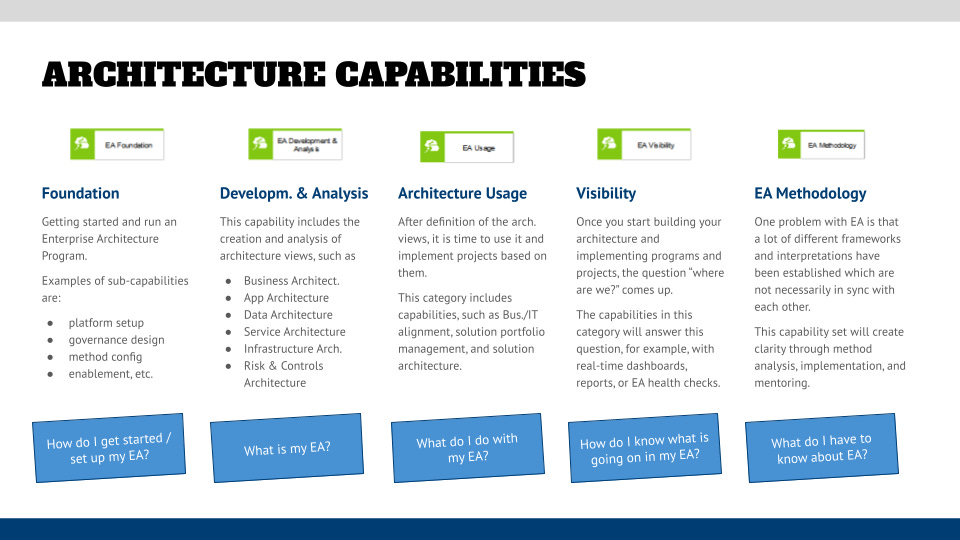
EA Foundation: This bucket includes all capabilities that are needed to answer the question of how to set up and maintain an architecture program. This includes the technical aspects of your chosen platform components and governance, but also the people side of things – the governance and adoption circles in the Venn diagram of Figure 1 above, as well as the high-level content structure (which framework to follow, the structure of the meta model, and so on).
Architecture Development and Analysis: This is the first area of content, and it includes the capabilities that cover the various views of your architecture. If you are following the TOGAF framework, for example, this covers the Architecture Development Method phases A-D. Besides modeling the content in Enterprise Baseline to get an understanding of the as-is (“what runs?”), this capability bucket also includes the various analysis techniques, such as application rationalization, technology standardization, or process mining. It basically aims to answer the question “what is my EA?”
Architecture Usage: Once you understand what your as-is architecture looks liklike — most likely on a very high level when you get started — the logical question is “what do I do with it now?” This capability area includes things like creating solution architectures (in the Projects/Solutions area of the architecture tool database), managing the solution/project portfolio, or fostering the alignment of business and IT. In TOGAF, this would include Phases E to G and the requirement management (Phase H is part of the governance definitions in the overall approach and already included in the EA Foundation area).
EA Visibility: One aspect of the architecture implementations that I have seen clients struggle with is getting an answer on how far they are in their architecture efforts. On the one hand, this is caused by the lack of a strategy and, therefore, objectives that are not well-defined, which then lead to arbitrary KPIs that will be measured. On the other hand, this directs the pure focus on non-capability-oriented measures, or “formal” measures.
An example of such a KPI would be how many training sessions have been delivered as part of a go-live. This is interesting information but does not tell the story if the implemented solution brings in the business results that should be achieved. That would be better measured six months after go-live when looking at the business results. In addition to this, many programs did not do their stakeholder needs analysis homework and determine what the information needs of these stakeholders are. This leads to generic dashboards that are mostly not relevant to an individual stakeholder and want to do too much (but are easier to build).EA Methodology: When one gets started with the topic of architecture, there is a big learning effort in basically understanding the strange language that architects use, which also contributes to the “ivory tower” perception of them.
However, many EA concepts and approaches are very valuable and therefore the question in this capability bucket is “What do I have to know about EA?” This covers things like which frameworks or notations to use, but also assessing if a new concept comes up (for example: “Do I still require an architect when I do Agile?”), and if the answer to these questions is that it is, in fact, relevant, then you need to plan how to implement this (and the impact on existing work) and actually make the changes.
One suggestion is to capture all the architecture capabilities needed in a multi-level architecture capability model. This model can act as the catalog for all the things that you need to define and implement to get your architecture program up and running — nicely laid out on a timeline later. The capability model that I brought to clients as reference content in the past included the five major capability buckets above, which were then decomposed into 24 level 2 capabilities that included ~110 level 3 capabilities.
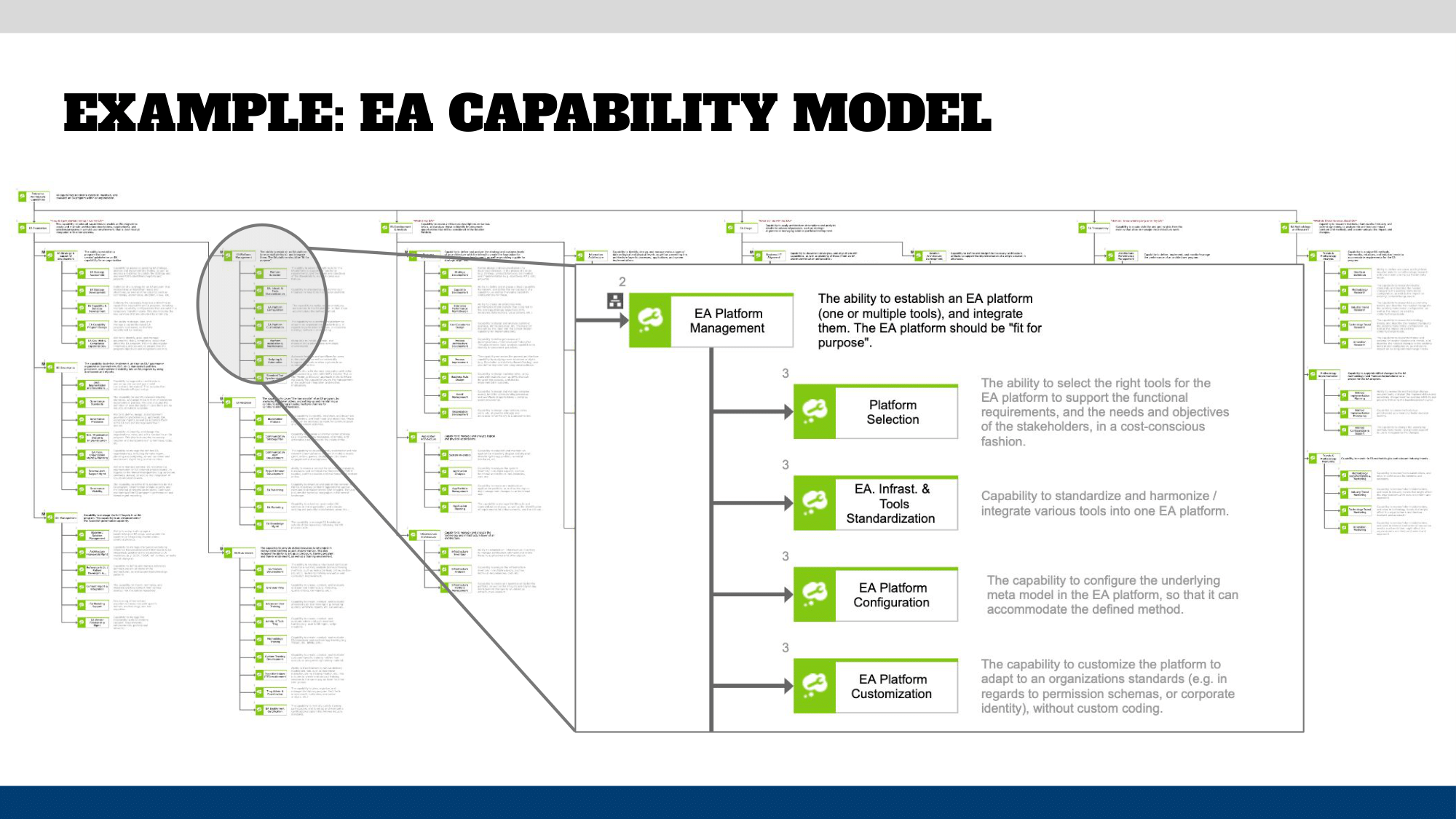
My suggestion when creating an architecture capability model is to limit yourself to 3–4 levels at maximum so that you don’t lose the high-level picture and get lost in the details (which are defined in your cap configs anyway) – this is the time for broad strokes.
I further recommend using the capability model to determine the services that the architecture organization should provide when developing an architecture strategy. It can also be used for assessing the architecture maturity, which will also be a topic for the future.
No posts
Comments
Nothing yet. Say the first thing.
Sign in to join the conversation.