
Over the past few years, Process Mining has continuously evolved to support data-driven process understanding.
Case-centric Process Mining first created transparency into business processes by assigning events to a unique case ID and analyzing them along their chronological sequence. This analysis is based on so-called directly-follows relations, which show which activity chronologically follows another in the data.
Object-centric Process Mining extended this approach to multiple business objects and their relationships. This makes it possible to model complex enterprise processes—for example, the interplay of orders, deliveries, invoices and payments—more realistically. The analysis, however, remains oriented toward observed events, object lifecycles and their chronological sequence. And this is precisely where the central conceptual limitation of observation-based methods lies: causal relationships cannot be reliably reconstructed from observed behavior alone.
Causal Process Mining overcomes the gaps of earlier techniques by leveraging the dependencies between process objects. These dependencies are grounded in domain knowledge and go beyond the observation of connecting events.
Prof. Dr. Jan Mendling – Co-Founder at Noreja and Einstein Professor at HU Berlin
For Process Mining, this means that the next stage of evolution requires an additional layer of knowledge comprising domain knowledge, business logic and context. Only this makes it possible to analyze not just which activity follows another, but also whether a business-meaningful relationship exists between those activities.
Causal Process Mining can be understood as the next evolutionary stage of Process Mining. It complements the temporal analysis of observed events with a business layer and asks not only which activity follows another, but whether a causal business relationship exists between those activities. In this way, process behavior is interpreted, assessed and validated against a business-defined target process. This makes it possible to understand why a process unfolded as it did, whether that behavior was correct from a business perspective, and what business impact results from it.
Every evolutionary stage of Process Mining gave rise to a new form of knowledge representation.
With each new knowledge representation, increasingly complex business relationships could be analyzed and understood. Whereas Case-centric Process Mining is based on event logs, and Object-Centric Process Mining introduces an object-oriented view with the Object-Centric Event Log (OCEL), Causal Process Mining requires a knowledge representation (the Event Knowledge Graph) that, in addition to events, also connects business objects, relationships, business rules and enterprise context. The causality derived from this is regarded as an elementary prerequisite for turning Process Mining into genuine Process Intelligence and for providing AI applications with meaningful context.
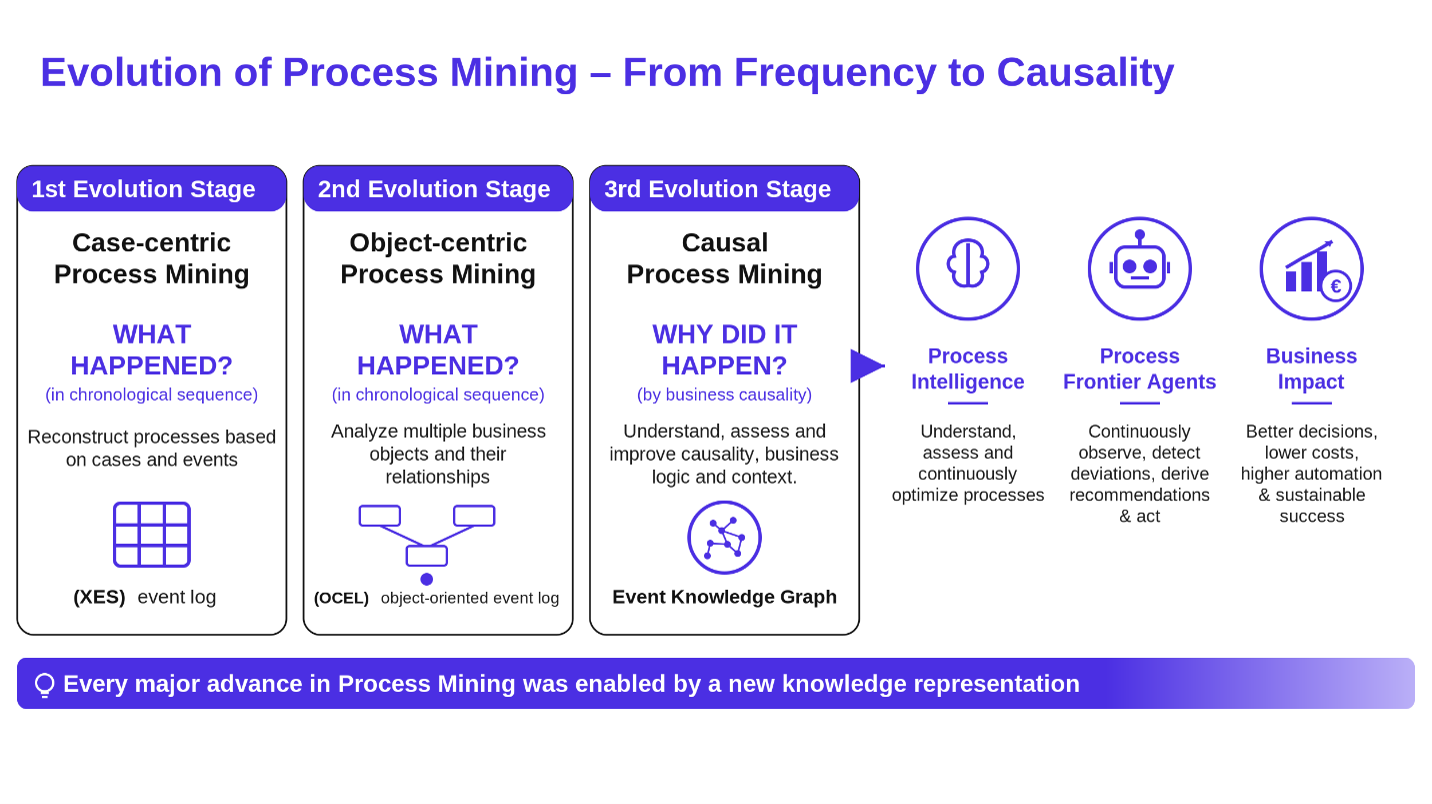
Causal Process Mining extends classical Process Mining with business logic, causality and enterprise context. At the same time, it creates the semantic foundation for Process Mining, Business Intelligence, generative AI and Process Intelligence. As a result, Process Mining evolves from a method for reconstructing past process flows into a platform for understanding, assessing and continuously improving business processes.
The key differences at a glance:
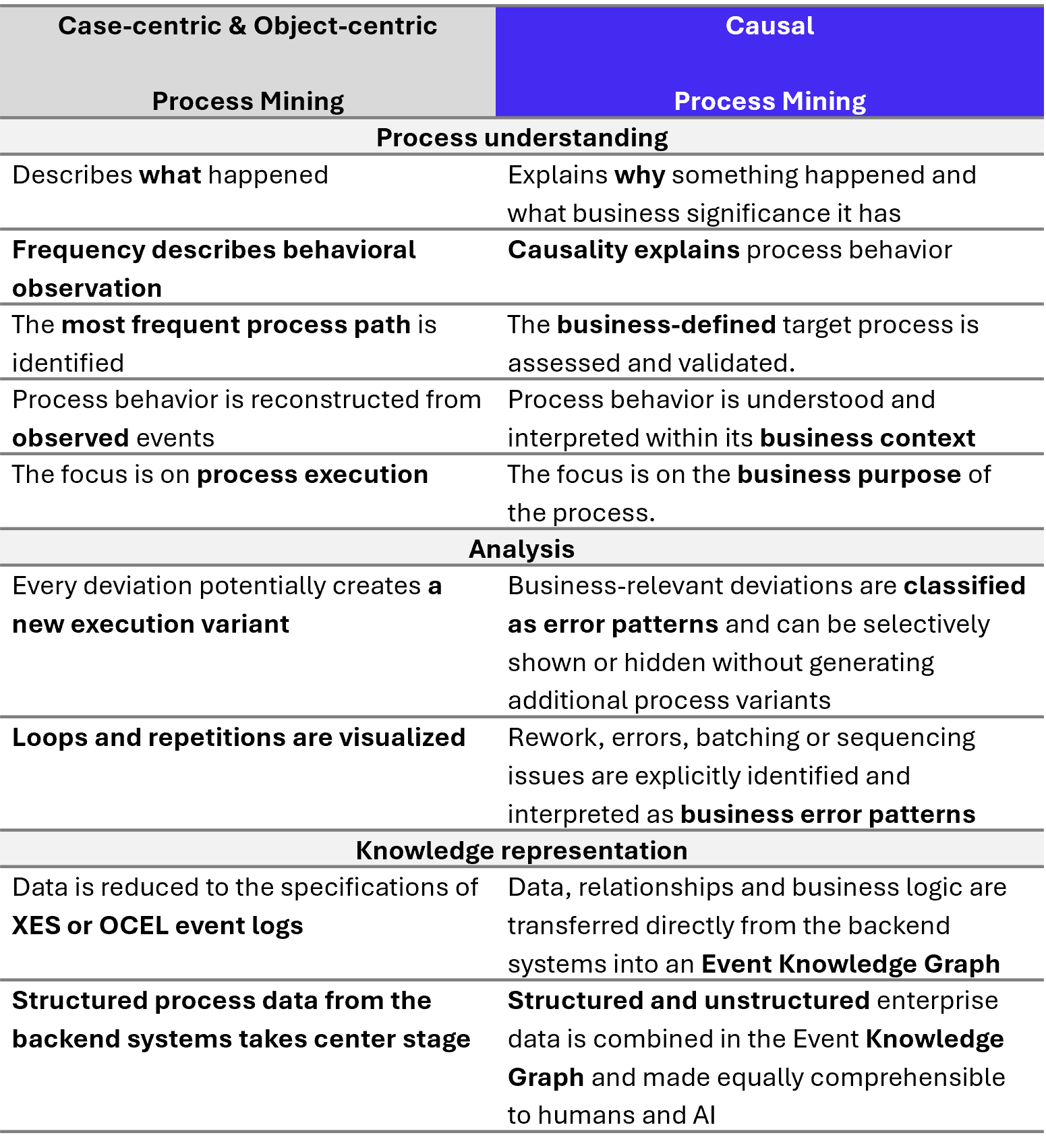
Process Frontier Agents Causal Process Mining extends classical and object-centric methods with causality, business logic and enterprise context, thereby creating the foundation for Process Intelligence. In doing so, the approach lays the groundwork for specialized AI agents – so-called Process Frontier Agents – that continuously observe processes, detect changes, assess them from a business perspective, and independently derive recommendations or actions based on business logic.
These Process Frontier Agents help companies to identify optimization potential in real time and exploit it proactively. Process Mining thereby evolves from the analysis of past events into a platform for continuous Process Intelligence – with AI that not only delivers answers, but can also justify its recommendations in a comprehensible way, grounded in business logic and enterprise context.
What does this mean for companies?
For companies, the decisive factor is which data foundation, combined with modern analytics techniques, enables long-term savings, automation and the productive use of AI. A shared semantic model built from structured and unstructured enterprise data creates precisely this foundation for Process Mining, dashboards, Business Intelligence, AI applications and AI agents.
Those who prepare their process and enterprise data today so that it can be understood and used equally by humans and AI create the basis for faster decisions, greater automation, sustainable cost reduction and long-term competitiveness in the age of AI.
Background: From research into practice
The scientific foundations of Causal Process Mining were substantially shaped and described by the research of Prof. Dr. Jan Mendling, Dr. Lukas Pfahlsberger and Dr. Philipp Waibel. From this academic basis emerged the shared vision of translating causality, domain knowledge and knowledge-based process analysis into a productive platform.
With Noreja, these concepts of Causal Process Mining were implemented for the first time as an end-to-end Process Intelligence platform. This unites causality, business logic, enterprise context and artificial intelligence in a shared semantic model – as the foundation for a new evolutionary stage of Process Intelligence.
No posts
Comments
Nothing yet. Say the first thing.
Sign in to join the conversation.