
I once worked in an organisation where I was tasked with setting up a Centre of Excellence (CoE) to support a new BPM initiative, while a major technology transformation programme was already underway. In another organisation, I worked alongside a large integration programme. Both experiences highlighted the same challenge.
While a Process CoE is not the same as a Project Management Office (PMO), the two often share activities and responsibilities, creating confusion about ownership and accountability.
In many organisations, a PMO is already in place when BPM is introduced. This often raises the question: who does what?
Sometimes, PMO teams are absorbed into a newly established BPM function as one programme winds down and the BPM initiative gains momentum. While this may be a practical solution, it is not always the ideal one.
A PMO focuses on delivering projects successfully, whereas a Process CoE is responsible for building and sustaining process management capabilities across the organisation.
Before discussing why a BPM CoE should not automatically be merged with an existing PMO, it is important to define its scope and responsibilities.
In my opinion, a Process CoE should primarily focus on business processes and end-to-end value streams. However, the boundaries are becoming increasingly blurred as BPM is often closely linked with Enterprise Architecture, Governance, Risk & Compliance (GRC), and other transformation disciplines.
As a result, there is no universally correct answer. The scope largely depends on the maturity and structure of the organization.
That said, a Process CoE is typically responsible for:
Defining and communicating the long-term BPM vision
Process architecture, orchestration, and modeling
Developing and delivering BPM methodologies and training
Supporting Process Intelligence knowledge and tooling
Defining standards, conventions, and templates
Establishing and maintaining process governance
Supporting end-to-end process improvement programs
Facilitating cross-functional alignment and providing expert advice
When establishing a Process CoE, there are common misconceptions and pitfalls that should be avoided.
A common misconception is that the CoE should own and govern every process improvement initiative.
In my experience, that is neither realistic nor desirable.
Business units should remain empowered to independently improve their own processes. The role of the CoE is to provide standards, expertise, and governance while maintaining an independent end-to-end perspective across organizational boundaries.
In other words, the CoE should facilitate and oversee process improvements rather than directly manage most of them. But in reality it is very hard to find that ideal cut-off.
Departments must remain accountable for the performance of their own processes. A CoE should advise and support, not become a substitute for operational ownership.
The CoE can quickly become the default destination for every process-related problem. When this happens, it loses its strategic focus and spends most of its time reacting to operational issues.
If governance becomes too heavy, the CoE risks being seen as an administrative burden rather than a value-adding function. A balance must be maintained between standardization and agility.
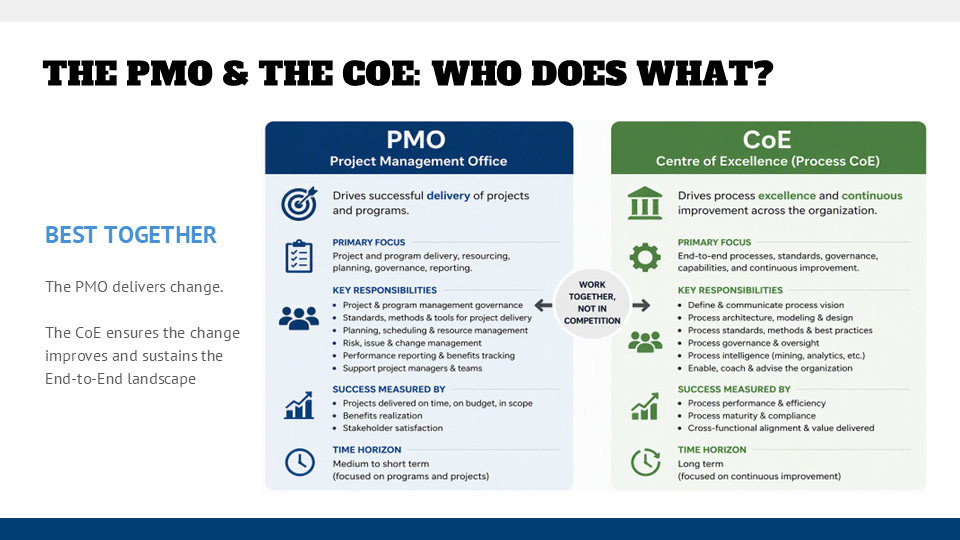
Most PMOs have at least some process-related responsibilities (and vise versa). However, their primary objective is usually the successful delivery of a specific program or portfolio of projects.
A BPM CoE, on the other hand, has a broader and more permanent mandate: improving and governing processes across the entire organization.
In some organizations the distinction is very clear. For example, a PMO supporting a construction or project-based organization focuses on project delivery, planning, reporting, and resource management. A Process CoE focuses on process performance and operational excellence.
The challenge arises when these responsibilities begin to overlap or when BPM functions are absorbed into existing PMOs without a clear definition of scope.
When the distinction becomes unclear, organizations risk creating:
Diffused ownership
Conflicting priorities
Reduced accountability
Confusion among stakeholders
For that reason, while collaboration between a PMO and a Process CoE is essential, maintaining a clear separation of purpose and accountability is often beneficial. The PMO drives programs; the CoE enables and governs process excellence across the organization on a continuous basis.
In short: a PMO exists to deliver change, while a Process CoE exists to ensure that change translates into sustainable process improvement across the organization.
No posts
Comments
Nothing yet. Say the first thing.
Sign in to join the conversation.