
Bad news, parents. It may be time to relearn subtraction.
Your grandparents already relearned subtraction once, during the onslaught of the New Math movement in the 1960s. It turns out they relearned the wrong method.
Tom Lehrer was a musical comedian from the 1950s and 1960s who wrote, sang, and played satirical songs. In the video below, he runs through the old shorthand method of subtraction, then sings a song about the “New Math” method. The audience of our grandparents and great grandparents finds it absolutely hilarious. To a modern viewer it should be unsettling.
If you watched that video and were not shocked, you misunderstood it.
Watch it again.
Lehrer is mocking the subtraction algorithm that we teach in schools nationwide.
Everyone in that room easily followed along with his first shorthand version. They knew the older method, and they found the new one absurd.
In the early 20th century, there was a “great debate” over which subtraction algorithm was the best to teach in schools. The “simple borrowing” or “decomposition” algorithm gradually won out and the other algorithms were abandoned.
We use the decomposition algorithm in schools nationwide today.
Consider the following subtraction problem:
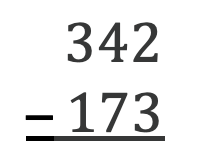
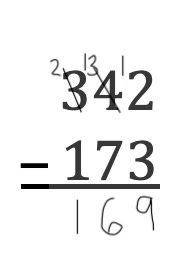
Nearly every person in the United States today would solve this using the same algorithm. We solve it column by column, moving from right to left as follows:
2 minus 3 cannot be done, so borrow 1 from 4, which becomes 3, and do: 12 - 3 = 9
3 minus 7 cannot be done, so borrow 1 from 3, which becomes 2 and do: 13 - 7 = 6
Finally, do: 2 - 1 = 1
So the final answer is 169
In The Teaching of Arithmetic (1909), David Eugene Smith tells us that the decomposition algorithm in common use today appears in the oldest known English arithmetic manuscript, in 13th-century Spain, in Italy in the Middle Ages, and in India even earlier.
New Math did not invent the algorithm. It just made it universal.
The designers of New Math promoted the algorithm because they wanted to foster understanding, a noble ideal. But the way the algorithm was taught in the classroom buried the explanation.
The goal of the New Math movement was understanding. Seeking understanding in mathematics is absolutely the right approach, but New Math failed because it was implemented from the top-down, without first getting the buy-in and understanding of the teachers.
Here is a way to present the decomposition method with an eye towards understanding.
Start with the example from the Lehrer video. But first, we rewrite the numerals in expanded form so that place value is apparent.
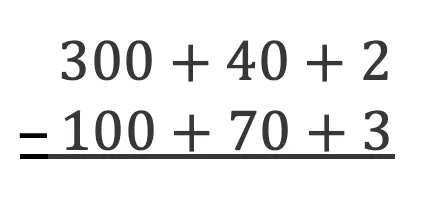
Now we subtract 10 from 40 and add it to the 2 in the ones place. We perform the far-right subtraction: 12 - 3 = 9:
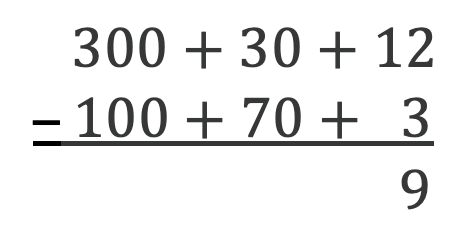
Then we subtract 100 from 300 and add it to the 30 in the tens place. We perform the next subtraction: 130 - 70 = 60.
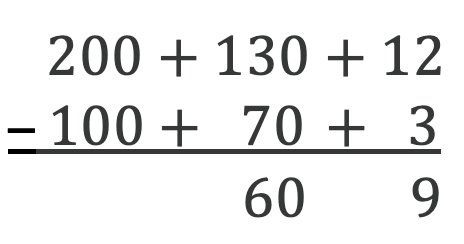
We do the final subtraction in the hundreds place: 200 - 100 = 100.
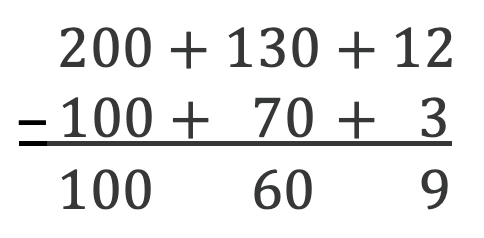
And so, our final answer is 100 + 60 + 9 = 169.
The “Austrian” or “equal additions” method, which Smith described as his preferred method is what many of our grandparents probably learned. He notes that it is not as old as other methods of subtraction, although it appears in some manuscripts as early as the sixteenth century. Smith describes two alternatives, one of which is very similar to the decomposition method, the other of which is what we now call the “equal additions” method. He says the second is preferred. Both methods use addition to find the answer.
We’ll work through the same problem as before.
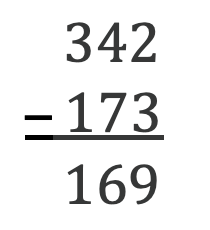
Going from right to left, we do the following:
3 + 9 = 12
Add the 1 from 12 to 7 and get 8: 8 + 6 = 14
Add the 1 to 1 and get 2: 2 + 1 = 3
Written out in expanded form, the reasoning looks like this:
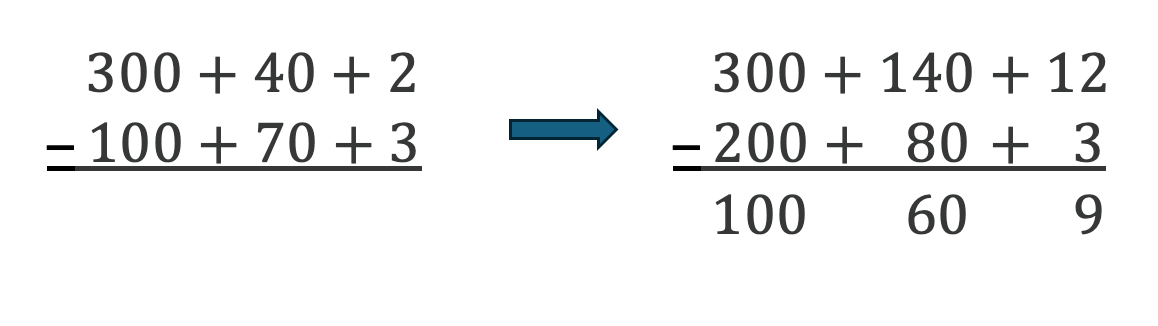
Note that for the shorthand version, we don’t even talk of borrowing from the 4 in the tens place or from the 3 in the hundreds place. We simply keep in mind that we borrowed and change the numbers accordingly. Lehrer's audience proves Smith’s preference. They were able to easily follow along with his shorthand example.
David E. Smith describes no fewer than five different algorithms in use in the year 1909 when he wrote The Teaching of Arithmetic. Although he states that some algorithms were more common than others, there was, as yet, no dominant subtraction algorithm.
He argues that the best subtraction algorithm a priori is the “Austrian” method because it is more natural, requires less memorization, and is faster:
It is more natural: it is the common method for making change:
If I owe $7.65 and pay $10, the merchant finds the change and I verify his work by saying, “65¢ and 5¢ are 70¢ and 30¢ more makes $1, and $2 more makes $10.
This reason is less applicable now when the majority of people rarely use bills and coins, but it is the way our minds naturally tend to think. Most adults do mental subtraction by using addition.
It requires less memorization: it removes the need to memorize subtraction tables. You only need to know addition tables.
It is faster: addition facts get used, and practiced, far more often than subtraction facts, so they’re faster and more reliable to call up.
That said, he was not criticizing the other methods. He wrote that switching to another algorithm after a child has already learned one well is not worth it. But for his audience in 1909, when there had as yet been no standardization, he says the better method should be taught.
The “great subtraction debate” of the early 1900s, alluded to earlier, arose as proponents of each method tried to get their own approach adopted as the standard. Early on, the Austrian method was mandated by the boards of education in New York City and San Francisco. Multiple studies found that students learning the Austrian method performed better than students using the decomposition method.
The debate continued until the School Mathematics Study Group (AKA “New Math”) wrote a series of textbooks calling for the use of the decomposition method.
Unfortunately, we did not take Smith’s advice in 1909. That said, none of this is an argument that Austrian is a silver bullet.
Understanding comes first, always, no matter which method you teach.
A child who genuinely understands decomposition will outperform a child who has merely memorized Austrian as an unexplained ritual. Smith's case for Austrian is real, but it's modest: a small, honest edge in speed and reliability once understanding is already in place.
It was never a substitute for it.
For teachers or administrators in larger schools with a standard curriculum, this is a case study. When your institution opts for a curriculum change, the teachers in the classroom need to be allowed to give their input. Ease of institutional rollout should not be the primary criterion, nor should theory be prioritized over practical experience.
For homeschoolers and smaller schools, you don’t have Smith’s problem. You don’t need to follow state standards, use a specific textbook, or train hundreds of teachers. You can teach the method you choose from day one. If your goal is that your children or your students learn subtraction, opt for the best method, which may not be the one you were brought up on.
The best algorithm is the understood algorithm. Try it with your kids this week.
Comments
Nothing yet. Say the first thing.
Sign in to join the conversation.