
In high school trig, SOHCAHTOA got me through sine, cosine, and tangent. Then we hit secant, cosecant, and cotangent, and the acronym had nothing left to give me.
My teachers told me that cotangent is the reciprocal of tangent. So I decided “co” might mean “reciprocal”.
Then we learned cosecant, the reciprocal of sine. My hypothesis was promising: “'co' must have something to do with reciprocal,” I thought.
Then we learned secant is the reciprocal of cosine. That’s weird. No “co” in sight, and we had another reciprocal. So “co” doesn’t mean reciprocal.
Most people hate trigonometry. There are six functions with two of them named as if “co” means something like reciprocal.
Fortunately, I didn’t end up hating trigonometry, but that’s only because I tricked myself with a fake explanation. Looking back at cosine, I realized you could think of it as the reciprocal of secant. Maybe that was a key… I concluded that sine, tangent, and secant are the fundamental trigonometric functions and cosine, cotangent, and cosecant are their reciprocals.
It turns out that “co” does not mean anything like “reciprocal.” I just got lucky.
That’s not a naming inconsistency. It’s because these six “functions” originated as six lengths in one diagram all related to each other. Once you can see the diagram, the “co” stops being a memory trick you have to reverse-engineer. It just tells you which line you’re looking at.
A couple of weeks ago I wrote about where “sine” actually came from. It wasn’t born as a ratio. Aryabhata measured it as a length: half a chord, like a bowstring in part of a circle. If sine is a length, the other five functions should be too. They are. All six are lengths hiding in the same diagram, the same bow and arrow, just measured along different lines.
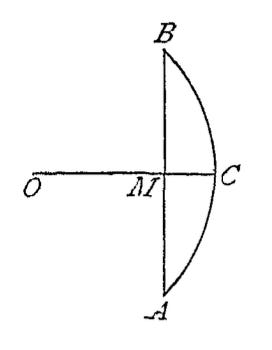
Once you can see where each one lives, “co” stops being a memory trick and starts being a direction: go find the complementary angle.
Let’s start with cosine.
“Co” is short for “complementary.” Cosine is just the sine of the complementary angle. That’s it. That’s the whole definition.
A cosine is really just a sine, measured for a different angle, one that's already in our original diagram. And the “cosine” length is there, too.
Go back to Aryabhata’s bow.
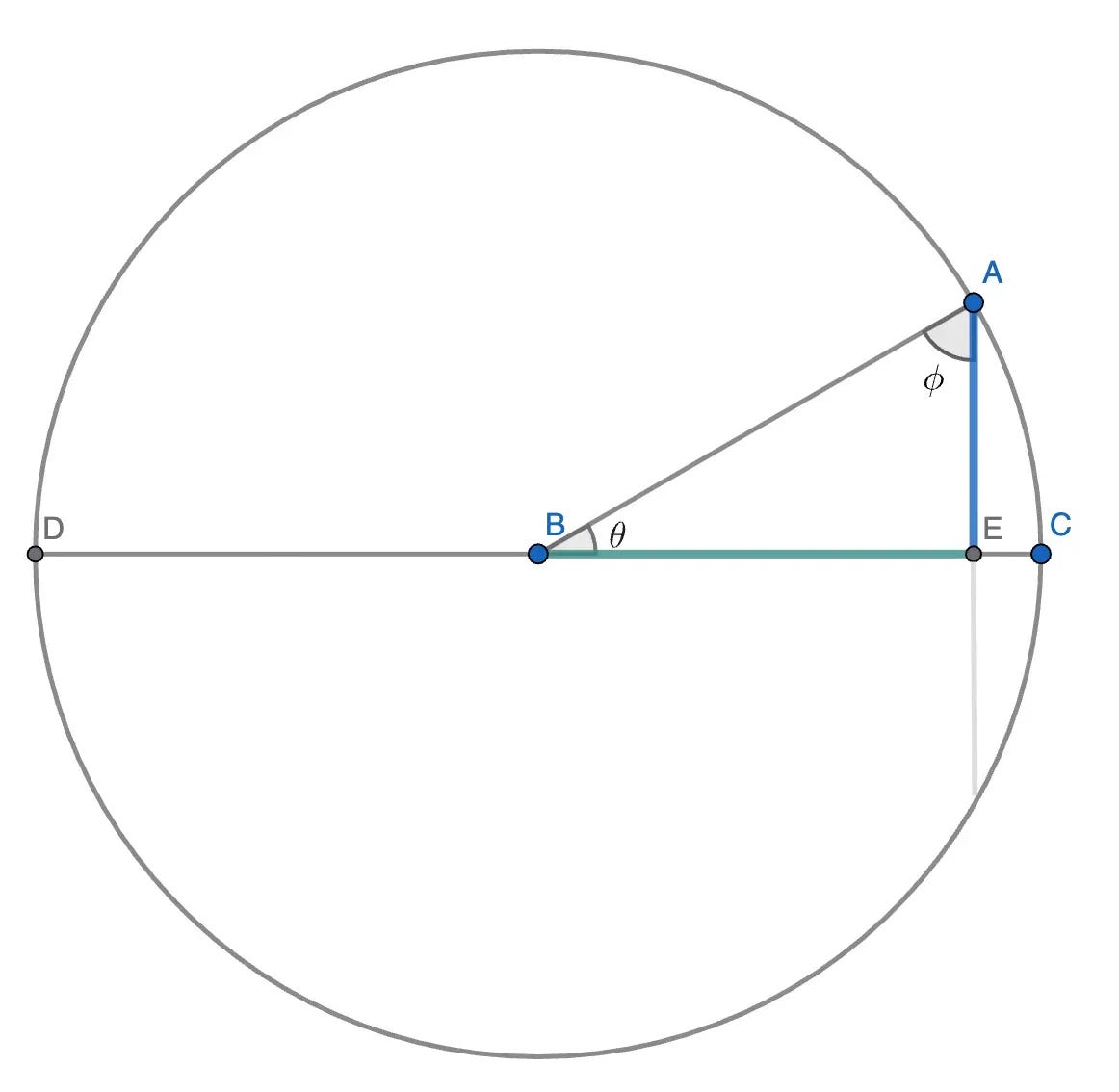
Draw a circle with radius AB = 1. Draw AE perpendicular to the diameter, DC. AE is the sine (or “half-chord”) of angle ABE. The angle BAE is the complement of ABE because the other angle in triangle ABC is a right angle.
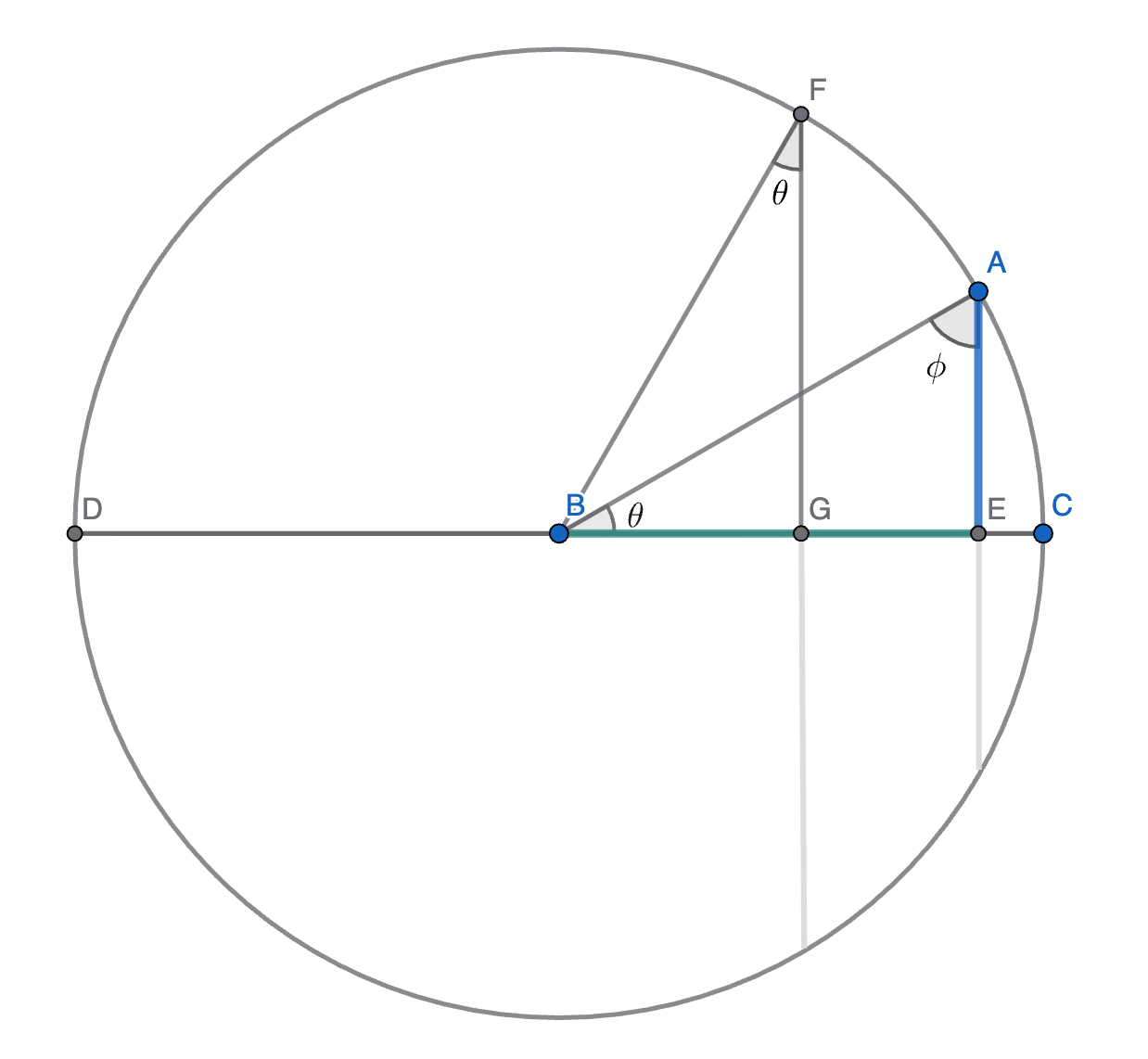
Draw another radius, FB, so that angle FBE is equal to angle ABE. Both triangles have a right angle, an equal angle, and an equal radius. By Angle-Angle-Side (or Euclid’s Elements I.26), FG = BE and BG = AE. But FG is the sine (half-chord) of angle FBE. Since FG also equals BE, then BE is equal to the sine of angle FBE, which is the complement of ABE. In other words, BE is equal to the “cosine” of ABE.
Edmund Gunter invented the term “cosine” in 1620 in a book of trigonometric tables called Canon Triangulorum. He structured his tables so that the same row of his table also gives the sine of the complement, which for the sake of brevity we call the cosine (“sinus complementi, quem brevitatis causa co.sinum dicimus”).
Gunter was being efficient. He needed a shorter word for a phrase he was tired of writing out in full, and “co” was born as an abbreviation, not a mystery.
There’s a third length hiding in that same small triangle, one that never made it into the modern curriculum at all: the versine, EC, the gap between the chord and the arc itself. Indian and Arabic astronomers called it the arrow, or sagitta in Latin, because in the bow-and-arrow picture, it’s the part that actually gets pulled back and released. We kept the bow. We kept the string. We dropped the arrow.
One clean rule: “co” means “complementary angle.” Keep that in mind. It will also explain cosecant and cotangent.
Next, let’s take a look at tangent. Go back to the bow. At point A on the circle, the top endpoint of the half-chord, draw a line perpendicular to the radius.
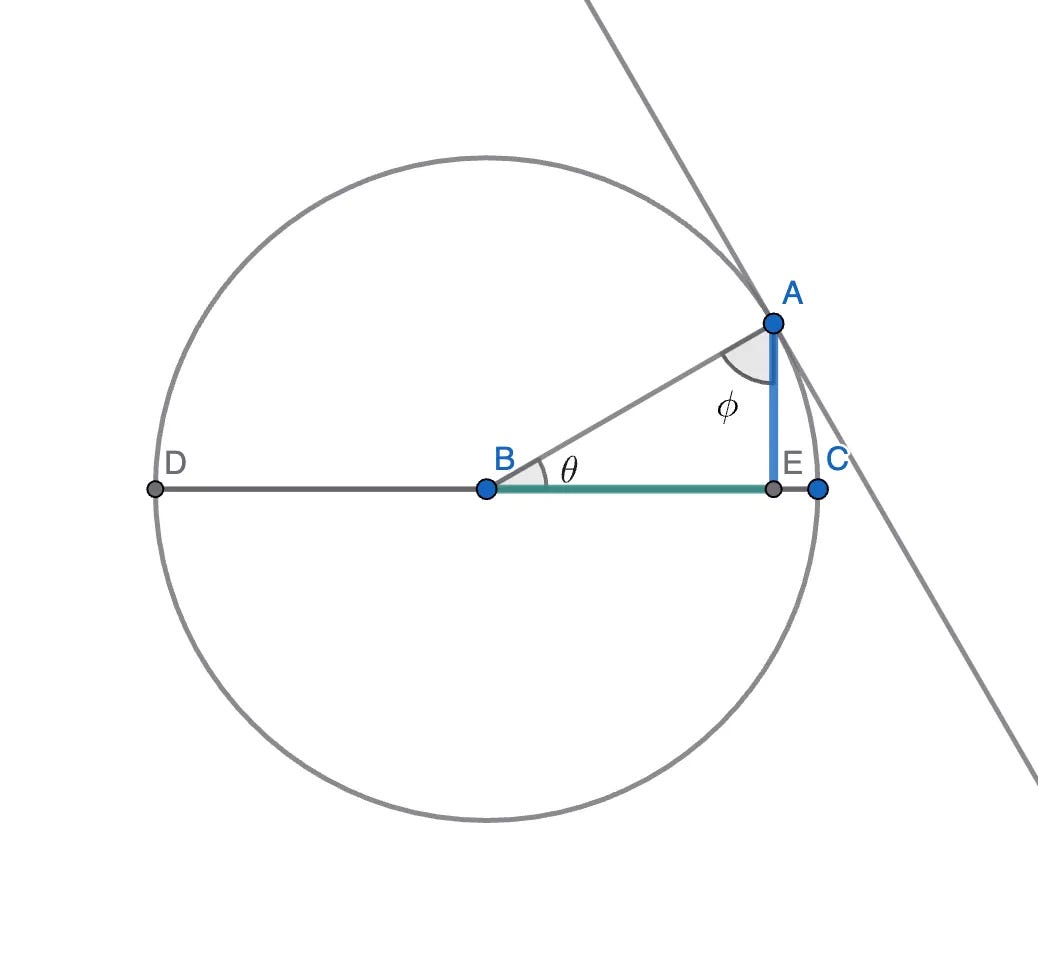
It touches the circle at exactly one point.
That’s called a “tangent” line, from the Latin root tangens, “touching.” It’s not “opposite over adjacent.” It’s a line, touching a circle, at one point.
Here’s the problem. As drawn, that line touches the circle, but it doesn’t measure anything yet. It has no defined length. Perhaps we could say the starting point is point A, but it has no ending point in either direction.
We need something to cut it.
Take the cosine line, the base of our triangle, and keep going. Don’t stop where the triangle ends. Extend it straight out until it runs into the tangent line you just drew.
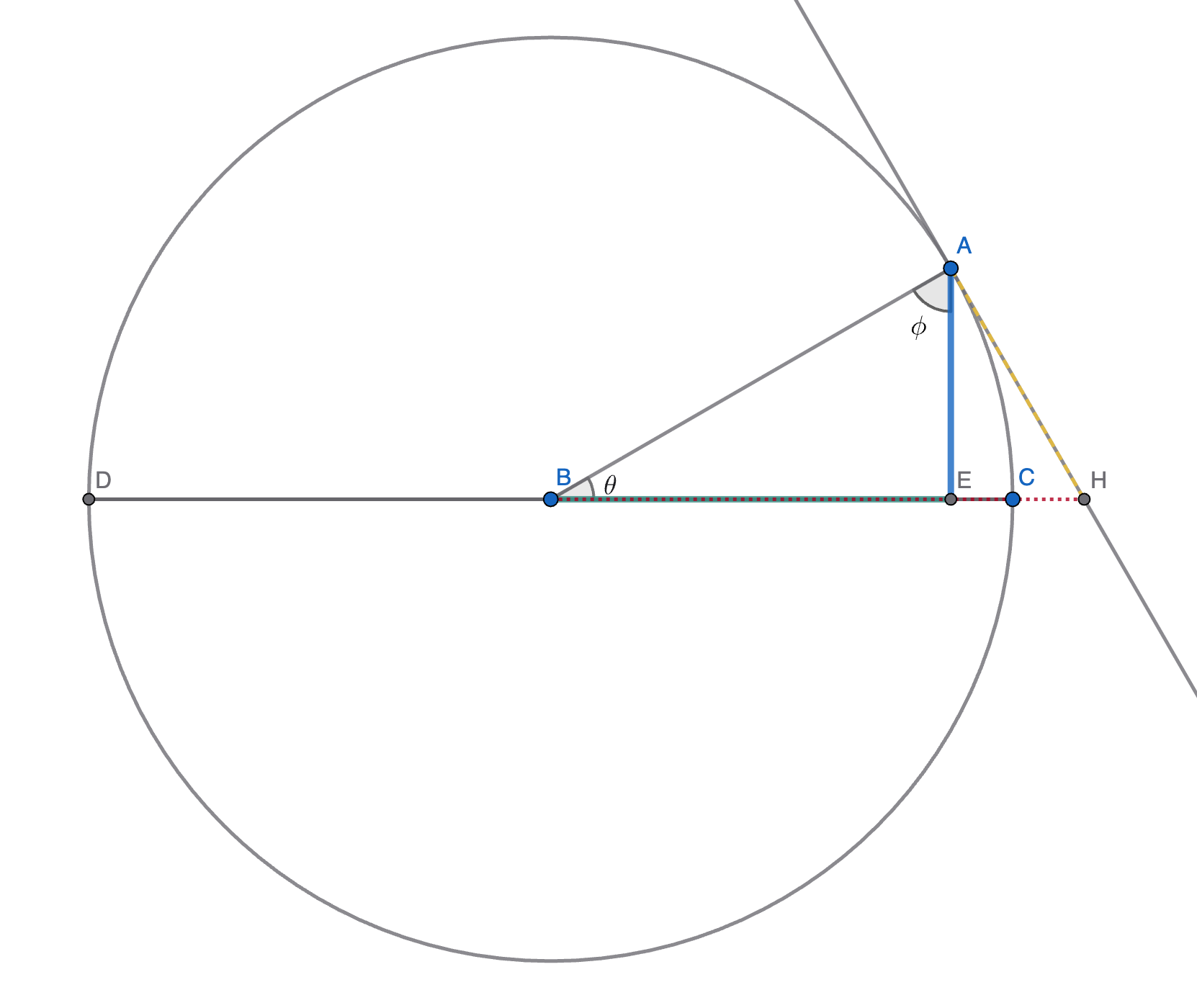
Now the tangent line has a length. It runs from point A where it touches the circle down to point H where the extended cosine line crosses it. And that extended cosine line has a length too, from B to H.
BH is called a “secant” line. From the Latin secans, cutting. And that’s exactly the job it’s doing: it cuts across the circle, and in this case it also cuts the tangent line and gives it length.
AH is the tangent, touching the circle and intersecting with the secant.
The tangent touches the circle. The secant cuts it.
You can trace a new right triangle, ABH, with the new lines we’ve drawn. The tangent AH is one leg, the radius AB is the other leg, and the secant BH is the hypotenuse.
And this large triangle is split up into the triangle we started with and a similar right triangle, triangle AEH.
Four lengths in, and every one of them has been a real, measurable line. No ratios involved. Just a bow, an arrow, a line that touches, and a line that cuts.
That tangent line doesn’t stop at the point where it touches the circle. It runs in both directions from that single point of tangency.
We already used one direction, extending the cosine line until it cuts the tangent to get tangent and secant. This time, instead of extending a line we already have, we draw a new one.
Draw a BJ perpendicular to the diameter, DC, at point B. J is the point of intersection with the tangent line from earlier.
BJ drawn from the center out to where it cuts the tangent line is the cosecant. Same word, same secans, cutting, just cutting the tangent line from the opposite side this time.
The piece of the tangent line trapped between the point of tangency and that same cut is the cotangent. Tangent’s other half, running the other way, measuring the other angle.
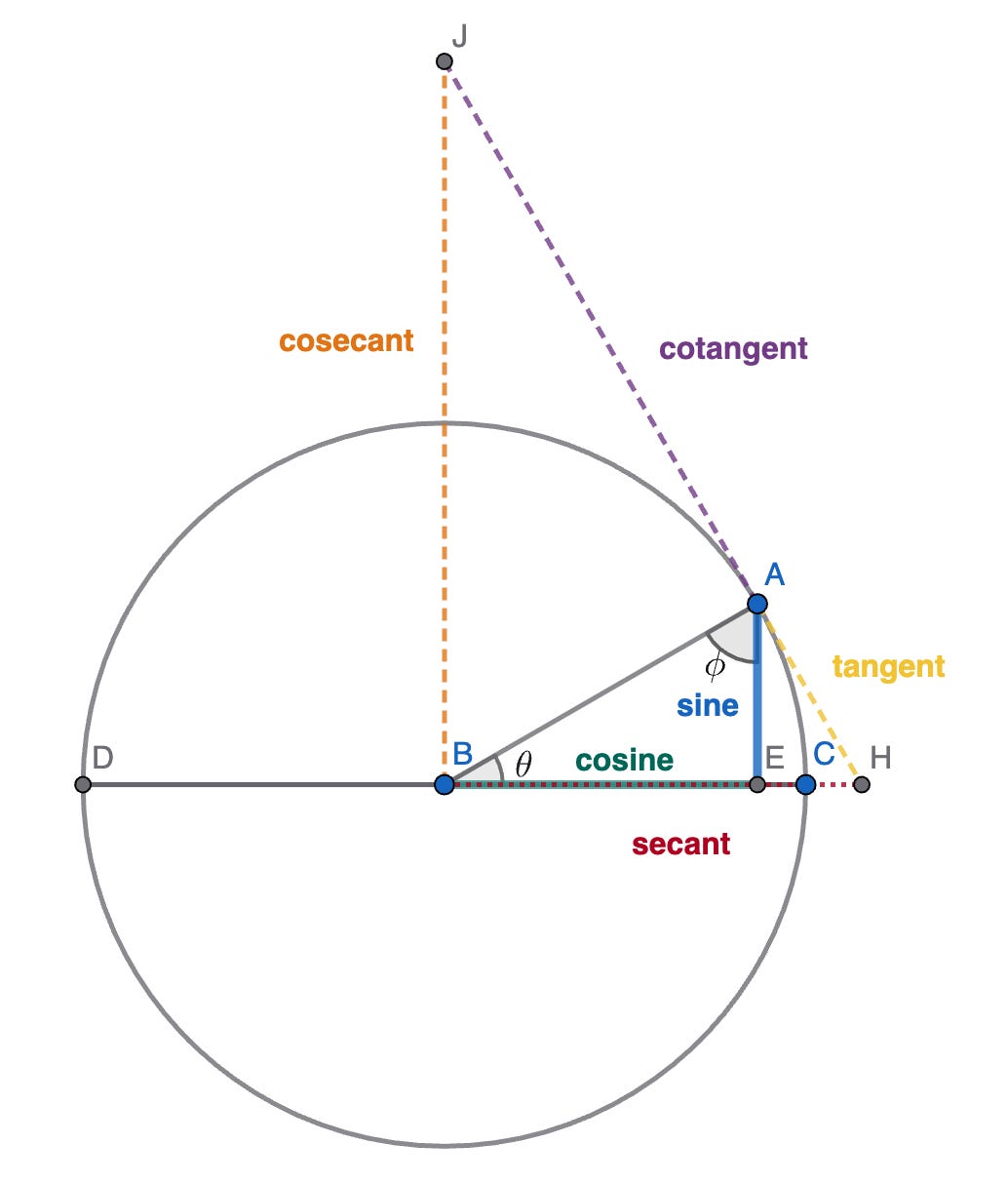
One tangent line. Two cuts. Tangent and secant on one side, built by extending cosine. Cotangent and cosecant on the other side, built by extending sine.
That’s not a coincidence.
It’s not a different rule for the “co” functions. Cotangent really is the tangent of the complementary angle. Cosecant really is the secant of the complementary angle. Not by definition someone made up. Because it’s the same line, cut from the other side, measuring the other acute angle in the triangle.
Six lengths. One bow and arrow. One tangent line, cut twice.
Here are all six lengths at once, changing together as the angle changes.
Watch the plots of sine and cosine. As one grows, the other shrinks, and they meet in the middle at 45 degrees, exactly where you’d expect the complementary angle to give you the same length twice.
Now watch tangent and secant race off the chart as the angle approaches 90 degrees. That’s not a graphing glitch. They race off the circle diagram, too. The tangent line and the cosine line are nearly parallel by then, so the cut happens further and further away. Cotangent and cosecant do the same thing in reverse, blowing up as the angle approaches 0.
None of this needed a single ratio to explain. It’s five similar triangles, AEH, ABE, ABH, ABJ, and JBH, all sharing angles, all growing and shrinking together as one triangle stretches.
That similarity is also where the modern ratio definitions come from:
SOHCAHTOA tells us that sin𝛉 = AE/AB.
But AB = 1
So sin𝛉 = AE.
Similarly, cos𝛉 = BE.
What about tangent?
Well, tan𝛉 = AE/BE in triangle ABE.
But triangle BHA is similar to triangle ABE. And similar triangles have corresponding sides in the same proportion.
So AE/BE = AH/AB = AH.
So, tan𝛉 = AH.
We can also show the following:
BH = 1/BE (secant = 1/cosine)
BJ = 1/AE (cosecant = 1/sine)
AJ = 1/AH (cotangent = 1/tangent)
Don’t take my word for it: prove it to yourself that these last three statements are true.
This is also where my lucky pattern from the beginning of this article stops being pure luck. Cosine really is 1/secant. Cotangent really is 1/tangent. Cosecant really is 1/sine. Not because someone decided sine, tangent, and secant were the “real” functions and bolted reciprocals onto them.
Because in a circle of radius 1, dividing any of these lengths by the radius doesn’t change the number, and dividing by a length is the same operation, in reverse, as the length itself. The reciprocal relationships were always going to fall out of the similar triangles. You just weren’t shown the triangles.
Gunter knew exactly what he was doing when he wrote his tables. In the same book where he coined “cosine,” he stopped to make sure nobody confused his tables for the real thing:
Now, our Sines are not half-chords, and our Tangents are not perpendiculars raised from the end of the diameter: rather, proper numbers have been substituted in their place, which for that reason we call…“artificial.”
He knew his numbers were an artificial (artificiales) substitute. He said so. Four hundred years later, we teach the substitute and have forgotten there was ever an original.
Before you introduce SOHCAHTOA, hand your students a compass, a straightedge, and a circle. Let them draw the bow, the arrow, the tangent, the two cuts. Let them find all six lengths with their own hands before you ever hand them a ratio.
Six lengths. One diagram. The bow and arrow were never gone. We just stopped giving students the thread that ties it all together.
Become a paid subscriber to get access to Euclid in Color and A Timeline of American Education in Primary Sources.
Comments
Nothing yet. Say the first thing.
Sign in to join the conversation.