
“Why is it called sine?”
He was a sharp kid. He already understood that it equaled opposite over hypotenuse. He wanted the etymology, but I didn’t know.
I told him so, and I promised an answer the next day.
After doing a little bit of research, what I gave him was accurate but lifeless: sine comes from the Latin sinus, meaning fold, translated from an Arabic word that was itself a mistranslation of a Sanskrit word.
I had the facts, but I didn’t have the archer, the bow, the half-drawn string. I didn’t know that story, so I couldn’t tell it.
I had a chance to bring that class to life, and instead I gave a curious kid a dictionary entry.
I rarely look forward to introducing sine, cosine, and tangent to my students.
I do my best to make it coherent. I explain the labels on the sides of a right triangle: opposite, adjacent, hypotenuse. My students have already met these terms in earlier theorems, so they aren’t foreign. They understand “opposite” and “adjacent” easily enough, and the etymology of hypotenuse is interesting and makes sense once you break it down.
But the real trouble starts when I try to explain what sine, cosine, and tangent actually are.
I’ve always taught them as ratios. Just a few weeks ago I learned that when sine, cosine, and tangent were first discovered, they weren't ratios at all.
And yet, in nearly every geometry class, sine and cosine are introduced as functions that take an angle and output a ratio of the sides of a right triangle.
The standard tool for teaching this is the abbreviation SOHCAHTOA:
SOH: sine = opposite/hypotenuse
CAH: cosine = adjacent/hypotenuse
TOA: tangent = opposite/adjacent
, cos(α), and tan(α) as ratios of the sides.")
This is mathematically correct. But it is also historically backward, and I think that backwardness is exactly why so many students memorize the acronym without ever understanding what the words mean.
Trigonometry gets its name from the Greek for “measure of triangles,” but the discipline itself descends from Indian astronomy, not Greek geometry. The mathematician Aryabhata, writing around 500 AD, modeled the arc of a circle as an archer’s bow, the chord connecting the two ends of the arc as the bowstring, and half of that chord as the arrow drawn back from the string’s center.
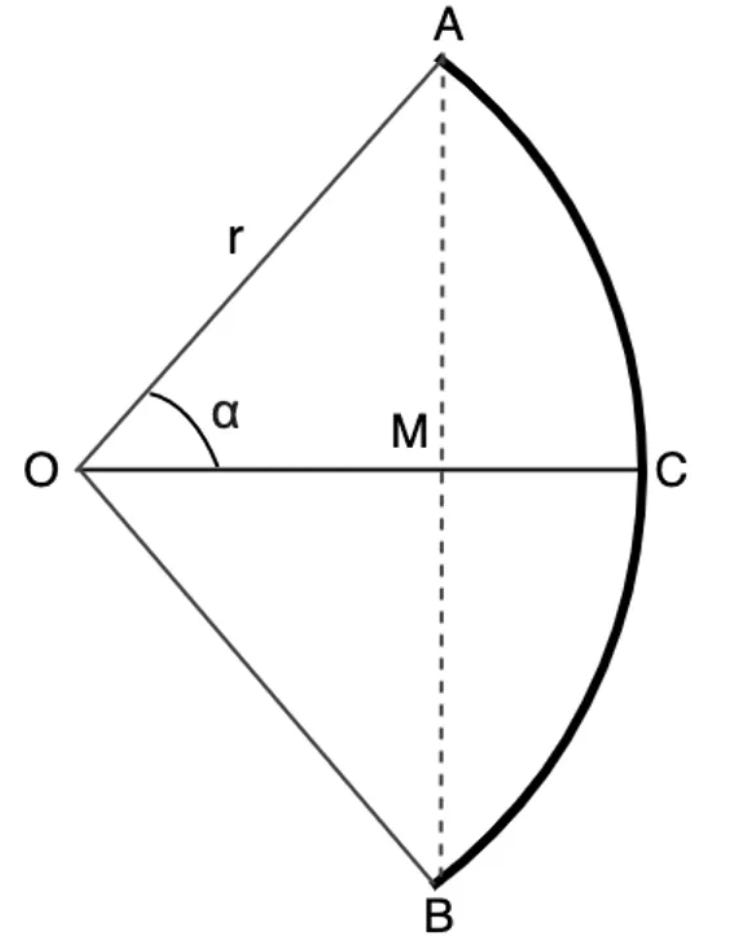
Aryabhata called that half-chord ardha-jya, “half-chord,” and shortened it over time to jya. From there the word took a strange trip. When Arabic scholars translated Aryabhata’s work, they didn’t translate jya, they transliterated its sound as jiba, a string of letters with no actual meaning in Arabic. Arabic is written without vowels, so jiba was recorded as just its consonants. Later readers, no longer aware jiba was a foreign import, assumed those consonants stood for a real Arabic word, jaib, meaning the fold or pocket of a garment. When European scholars translated Arabic astronomy into Latin in the 12th century, they translated jaib literally, using the Latin word for a fold or a bay: sinus. Sinus became sine.
 to Arabic (800AD) to Latin (1100AD) to English")
The word “sine” is a linguistic accident, the translation of a mistranslation of a faulty transliteration of a word that had meaning: “half a bowstring.”
This story isn't a trivial footnote. It gives the trigonometric function names meaning. It puts the invention of trigonometry in its historical context. Finally, it gives the concrete staging to an generally abstract concept.
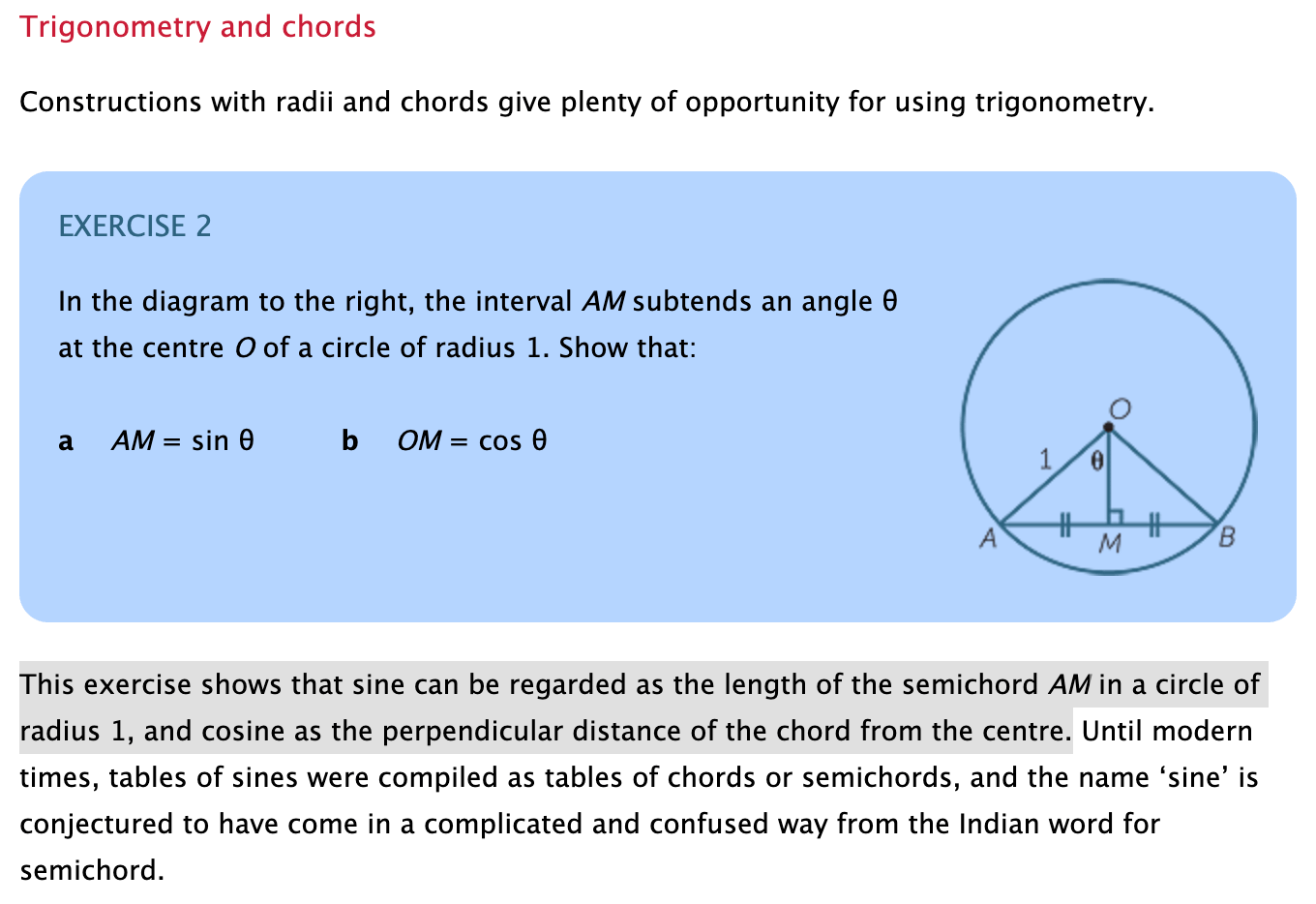
Aryabhata’s half-chord was not a ratio, but a length measured in a circle of a specific, fixed size.
Aryabhata built his sine table using a circle with a radius of 3438 units, a number he chose because it made the circle’s circumference come out to a tidy 21,600 minutes of arc. For any given angle, his “sine” was simply the number of those units in the actual half-chord. Nothing was divided by anything. You could go measure it with a ruler on a circle of the right size.
Here's how the two connect. Draw a 30-degree angle in a circle of radius 2. The half-chord measures 1 unit, physically, with a ruler. Divide by the radius and you get 0.5, which is sin(30°) in the modern sense. Aryabhata would have stopped at "1 unit." We keep going and divide by the radius. That extra step is the whole difference between his sine and ours.
Now try it again with a circle of radius 1. The half-chord still comes out to whatever it measures, but this time dividing by the radius does nothing, because you’re dividing by 1. The length and the ratio become the same number. That’s the whole trick: SOHCAHTOA is built on what mathematicians typically call normalization, but that we don’t shows students. We teach the ratio and skip the length it came from.
That circle of radius 1 has a name students will meet again: the unit circle. Except, by the time most students see it, it shows up as a brand new topic in precalculus, disconnected from the ratio they learned years earlier in geometry. Historically, the circle came first and the ratio was what fell out of it once the radius was fixed at 1. In the classroom, we’ve reversed the order entirely: ratio first, with no circle in sight, and the circle bolted on years later as if it were a new idea rather than the thing sine was measured on all along.
This is the same mistake as teaching decimals before fractions, and fractions before ratios. We hand out the portable shortcut before students have held the concrete thing it replaced.
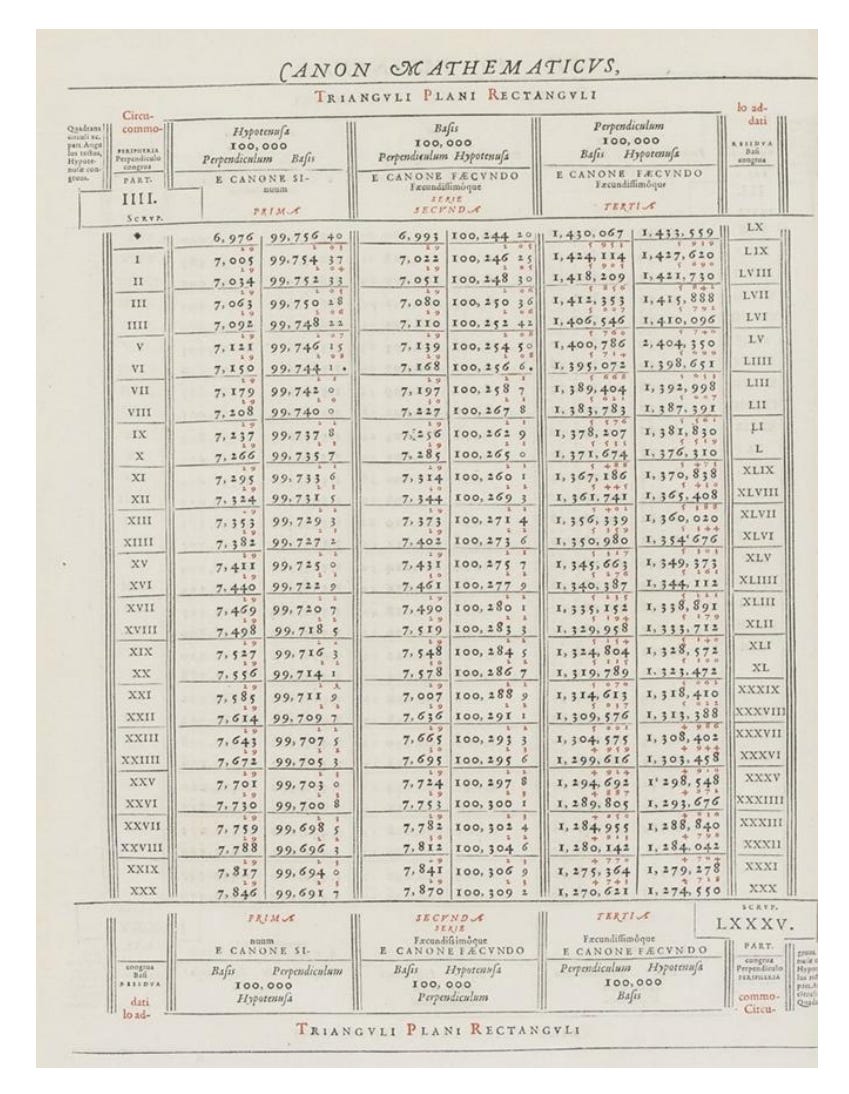
David E. Smith says that the first time that sine, cosine, and tangent were described as ratios instead of lengths was in Georg Rheticus’ Canon doctrinæ triangulorum (1551). François Viète took the ideas of Rheticus and published them later in the more famous Canon Mathematicus (1579). Once the ratio took hold in print, the length quietly disappeared from how the subject was taught, and it never came back.
Before SOHCAHTOA, before any right triangle at all, give students a circle, a fixed radius, and an arc. Have them draw the chord. Have them measure the half-chord with a ruler, in the units of that circle, the way Aryabhata’s astronomers did. Do this for a few different angles in a few different circles. Let them notice, on their own, that the half-chord grows with the angle, but not in a straight line.
Only then introduce the shortcut: pick a circle of radius 1, and the half-chord length becomes a portable number you can use in any circle, any triangle, once you scale by the radius. That’s sine. It’s a measurement that became universal once someone standardized the yardstick.
Then tell the story of sine. The story of a term that traveled between civilizations over millennia, whose name and even meaning was and is misunderstood by most of the world. But not by them. They know the truth.
Now tell them about SOHCAHTOA.
Right triangle, adjacent, opposite, hypotenuse: all of that is real geometry and none of it needs to disappear. It comes after a lot of ground work. SOHCAHTOA is a fine shortcut once a student has held the length in their hand and watched it become a ratio. Taught first, it’s an unmotivated rule attached to a word that used to mean “bowstring” and now, through two thousand years of translation error, means nothing at all.
That boy who asked me about the meaning of the word "sine" has probably graduated from high school by now.
This is the answer I owe him.
Dear readers,
A while back I made Euclid in Color, Book I free for all subscribers. I liked the idea of removing friction for people encountering Euclid for the first time.
The feedback made it worth it.
I want this newsletter to keep some real value reserved for paid subscribers, and this e-book is the clearest thing I have to offer for that. So it’s moving behind the paywall.
If you’re a free subscriber and want your own copy, download it in the next week. After that, it’s for paid subscribers only.
I put real time into this project and into this newsletter more broadly, time I could spend on work that pays. Paid subscriptions are what justify choosing this instead.
If this newsletter has been worth your time, consider becoming a paid subscriber. It’s the best way to tell me to keep going.
Check out my recent article on Liberty Sentinel commemorating the 250th.
It is a warning to take a closer look at the philosophical foundations of our public school system.
Comments
Nothing yet. Say the first thing.
Sign in to join the conversation.