
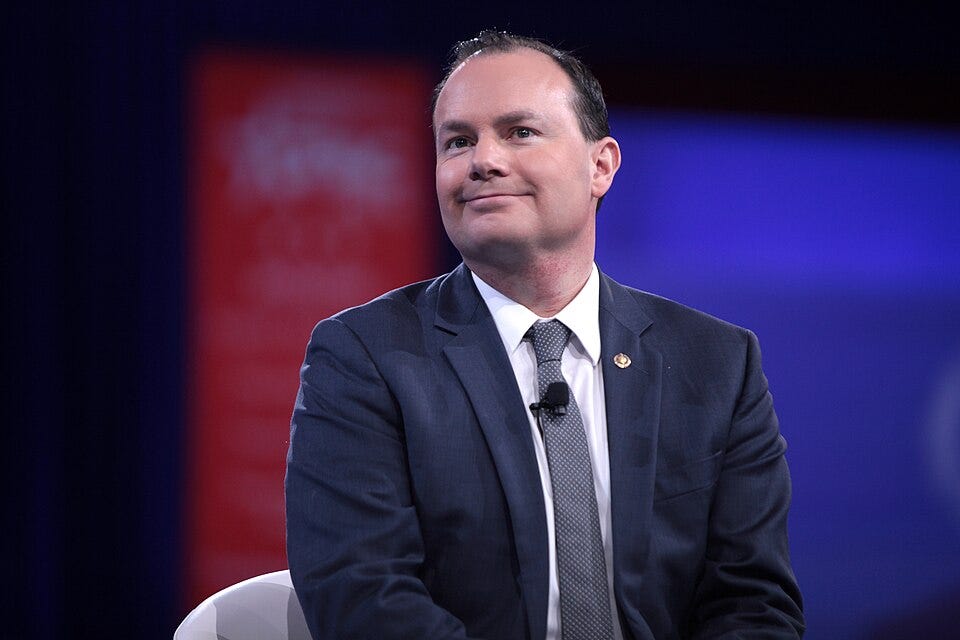
Last week, Congress did something remarkable: it passed a sweeping, genuinely bipartisan housing affordability bill with near-supermajorities in both chambers. The 21st Century ROAD to Housing Act combined over 60 pieces of legislation to tackle the affordable housing crisis from nearly every angle—including construction costs, zoning reform, corporate landlords, and rental assistance. Almost every U.S. senator and representative voted for the bill. But not Senator Mike Lee of Utah.
Lee was one of just five senators to vote against the bill, which notably does not include the sale of public lands. In a statement explaining his vote, Lee offered a grab-bag of objections: the bill included only a temporary ban on a central bank digital currency rather than a permanent one, it didn’t do enough to protect housing programs “for American citizens only,” and it lacked process, with no amendment votes. Then he cast blame for the affordable housing crisis on immigrants, calling for the continuation of “mass deportations of illegal aliens who are placing a significant burden on housing availability and affordability for American citizens.”
This statement reveals that Lee is once again playing politics with the housing affordability crisis instead of supporting solutions to it. In calling for mass deportations, he is doing the same thing he did last summer when he tried to sell off public lands: using the affordable housing crisis to push his extremist agenda. The evidence that Lee doesn’t actually care about affordable housing has been building for years, but his vote on the 21st Century ROAD to Housing Act and his statement about it leaves no doubt that he does not care about affordable housing at all.
Consider Lee’s track record. For years, he has pushed his HOUSES Act, a bill ostensibly designed to address housing affordability by selling off federal public lands. The bill is actually a Trojan horse for selling off public lands that would do nothing to bring down the cost of housing. It contains no affordability requirements, no rent restrictions, no price restrictions, and allows lot sizes so large that the bill is effectively an invitation to build trophy homes and sprawling suburbs on our public lands. If you were trying to enrich private developers and get rid of public lands, while doing nothing for working families struggling to pay rent, you’d be hard-pressed to come up with a better bill.
Last summer, Lee doubled down on his bad idea, attempting to slip a public land sell-off into the Senate budget reconciliation bill that would have made millions of acres of public land eligible for sale to private developers. Again, he framed public land disposal as a housing solution. Lee withdrew this proposal after aggressive pushback from hunters, hikers, and outdoor recreation groups across the political spectrum.
Lee’s voting record on other housing legislation is also telling. As Public Domain reported last year, Lee introduced legislation in 2016 that the National Low Income Housing Coalition warned would “eliminate nearly all federal affordable housing programs,” cutting affordable housing funding in half over a decade, and he has repeatedly introduced a bill to gut Obama-era fair housing rules that combat racial segregation in housing markets.
Tara Rollins, who has led the Utah Housing Coalition for over 20 years, told Public Domain she has never even managed to get a meeting with Lee to discuss affordable housing. “I don’t know who he’s talked to about affordable housing,” she said. “I don’t know anybody who’s met with him.” Lee has found time to cultivate donors, though. The real estate investment and commercial development industries, which both stand to gain from the privatization of public land, have contributed over $1 million to Lee’s election campaigns over the years.
As The Wilderness Society’s BLM campaign director Michael Carroll told Public Domain, Lee has “consistently tried to make selling public lands the solution to the very real affordable housing challenges Westerners face, while working against measures to address the issue.”
Earlier this year, a groundbreaking new partnership between affordable housing and conservation advocates made it clear that the housing crisis is fundamentally a policy and investment challenge, not a land supply problem—and it is certainly not a public land problem. Less than one percent of BLM-managed land in the ten most public-land-heavy Western states is located within ten miles of significant population centers. Building on remote, undisturbed public land won’t bring down housing costs in the West, nor will increasing mass deportations, despite what Mike Lee would like Americans to think.
For more information, visit westernpriorities.org. Sign up for Look West to get daily public lands and energy news sent to your inbox, or subscribe to our podcast, The Landscape.
No posts
Comments
Nothing yet. Say the first thing.
Sign in to join the conversation.