
On July 1, President Donald Trump and Interior Secretary Doug Burgum will visit Medora, North Dakota, for the grand opening of the Theodore Roosevelt Presidential Library, a privately funded $450 million museum built on 93 acres near the entrance to Theodore Roosevelt National Park. Theodore Roosevelt spent his presidency protecting America’s public lands from private interests. The administration now gathering to celebrate him has spent the past 18 months doing the opposite.
During his presidency from 1901 to 1909, Roosevelt protected approximately 230 million acres of public land, more than any president before or since. He established 150 national forests, created the U.S. Forest Service in 1905 with Gifford Pinchot as its first chief forester, and signed the Antiquities Act into law in 1906, putting it to use immediately to protect 18 national monuments. An avid hunter and angler, Roosevelt understood that protecting wildlife requires protecting their habitat. He was a staunch proponent of the belief that public lands belong to the public, to be held in trust for future generations. In contrast, an analysis from the Center for American Progress found that President Trump and Secretary Burgum have removed protections for 86 million acres of public land since Trump took office in 2025.
Roosevelt’s conservation record was connected to his broader fight against the monopolies and industrial interests that controlled the country at the turn of the 20th Century. During the Gilded Age, railroad barons, timber interests, and mining companies treated public land as their private domain. Roosevelt spent his presidency destroying that status quo. His administration filed more than 40 antitrust suits while protecting hundreds of millions of acres of federal land from commercial exploitation. Roosevelt’s conservation legacy was at its core about shifting power from private industry to the American public.
The Trump administration is actively working to reverse that shift by implementing policies that put industry back in the driver’s seat on public lands, gutting the agencies Roosevelt built, and turning America’s 250th anniversary into a vehicle for partisanship and self-promotion.
The Theodore Roosevelt Presidential Library has been years in the making, with little credit due to this administration. Staging its opening alongside a politicized version of America’s 250th birthday heading into the July 4 holiday weekend is an attempt by the Trump administration to shroud itself in the credibility of a conservation giant, while championing policies that run counter to everything Roosevelt stood for.
Even the Trump administration’s attempts to rewrite history come into play here; the uglier parts of Roosevelt’s record, from his views on race to the displacement of Indigenous peoples that the early conservation movement enabled, must also be part of telling Teddy Roosevelt’s story.
Here’s how President Trump and Interior Secretary Burgum are undoing Roosevelt’s legacy and working to usher in another Gilded Age.
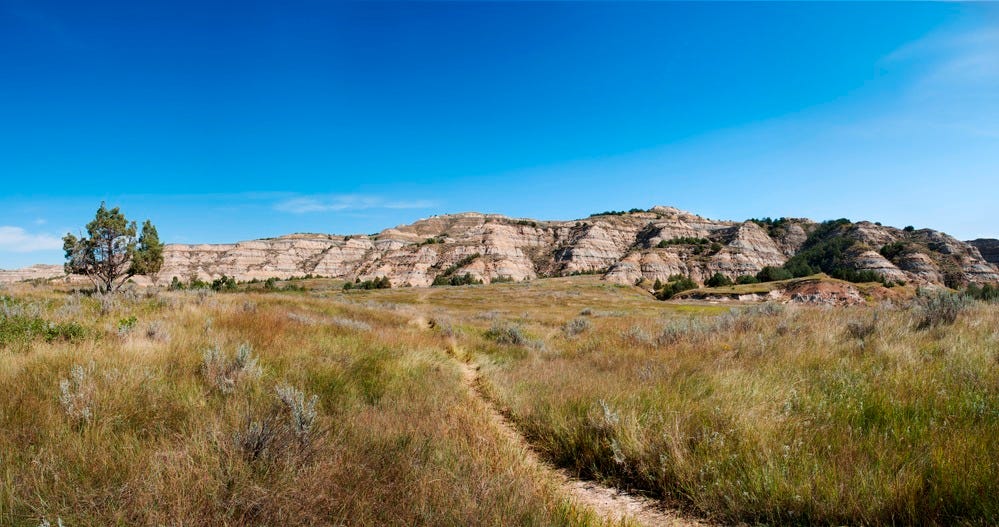
Maah Daah Hey Trail
On April 28, 2026, the Bureau of Land Management (BLM) held an oil and gas lease sale on parcels of land that directly overlap or border North Dakota’s Maah Daah Hey Trail, a nationally recognized recreation corridor. The Maah Daah Hey Trail spans 144 miles of singletrack for bikers, hikers, and horseback riders and connects all three units of Theodore Roosevelt National Park. The BLM is holding another lease sale in August that includes more parcels that overlap the trail or lie within close proximity to the national park. The Coalition to Protect America’s National Parks, National Parks Conservation Association, Badlands Conservation Alliance, and Dakota Resource Council submitted comments opposing key portions of the BLM’s August oil and gas lease sale on the grounds that the proposed lease parcels are located near Theodore Roosevelt National Park’s North Unit and the Maah Daah Hey Trail, including parcels less than three miles from the park boundary. Doug Burgum touted the trail’s proximity to the new Teddy Roosevelt Library at an event hosted by the Outdoor Recreation Roundtable in Washington, D.C., saying, “This is the first presidential library that you could hike to, ride a mountain bike to, and, yes, there is a way placed right in front of the library to tie up your horse if you decide to ride a horse.”
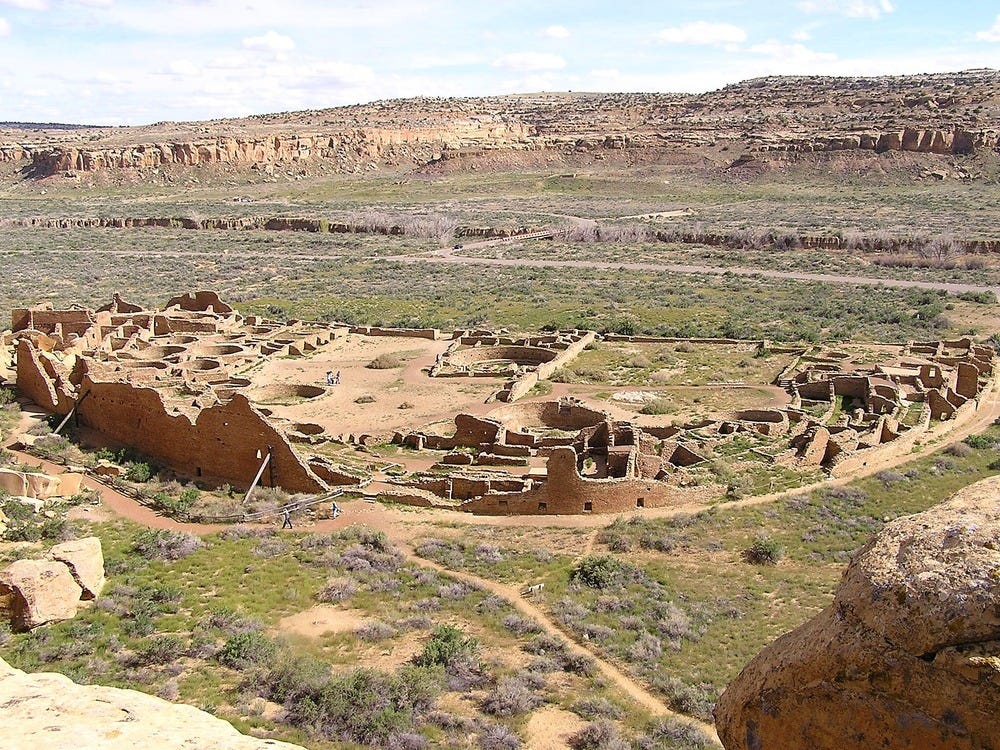
Chaco Canyon
Roosevelt designated what was then known as Chaco Canyon National Monument in 1907 using the authority granted to the president by the Antiquities Act of 1906, which Roosevelt himself signed into law. What is now Chaco Culture National Historical Park was the economic and religious center for the ancestral Puebloans and is part of a World Heritage site. In 2023, former Interior Secretary Deb Haaland signed an order placing a 20-year moratorium on new oil, gas, and mineral leasing on federal lands within a 10-mile radius of Chaco. On March 31, 2026, the BLM gave the public just seven days to comment on Burgum’s plan to remove protections from 336,400 acres around Chaco Culture National Historical Park, compared to 150 days of comment, eight public meetings, and 18 months of consideration when the protections were first established. The BLM is currently evaluating three possibilities: leaving the buffer zone; shrinking it to five miles around Chaco Canyon; or—the agency’s preference—striking the protections altogether.
Boundary Waters Canoe Area
The Boundary Waters Canoe Area within the Superior National Forest in Minnesota is the most visited wilderness area in the entire country, offering unparalleled fishing opportunities through a network of lakes and streams. Teddy Roosevelt was responsible for protecting the 3-million-acre Superior National Forest in 1909, which encompasses the Boundary Waters Canoe Area Wilderness. Twin Metals, a subsidiary of Chilean mining company Antofagasta, had been trying since the first Trump administration to build a copper and nickel mine just 5 miles south of the Boundary Waters. At the time, the company was run by billionaire Andrónico Luksic, who was criticized for his connections to the Trump family, including renting a house in Washington, D.C. to Trump’s daughter, Ivanka. In 2023, Secretary of the Interior Deb Haaland issued a 20-year mineral withdrawal for the entire Rainy River Watershed, a total of more than 225,000 acres throughout the Superior National Forest.
Despite fierce public opposition, President Trump signed a resolution opening the Boundary Waters watershed to potential mining on April 27, 2026 after Vice President J.D. Vance had to exercise his authority as president of the Senate to secure the necessary votes to get it passed. Using the Congressional Review Act to rescind a mineral withdrawal not only sets a disturbing precedent, it also permanently bars future administrations from implementing similar protections in the future. In a letter to congress, Roosevelt’s descendants spoke out against the mining project, stating that “the proposed resolution is diametrically at odds with the conservation legacy of President Theodore Roosevelt. For all these reasons we feel a deep obligation to TR to speak out loudly in support of this exceptional American wilderness area.” The Boundary Waters fight demonstrates the lengths the administration will go to deliver public resources to a private, foreign-owned mining company—exactly the sort of corporate exploitation that Teddy Roosevelt spent his presidency fighting.
Public Lands Rule
Finalized in April 2024, the Conservation and Landscape Health Rule (“Public lands Rule”) sought to put conservation on equal footing with mining, logging, and drilling as a legitimate use of BLM lands for the first time since the agency was established in 1946. In May 2026, the Trump administration repealed the Public Lands Rule to boost drilling, logging, mining and grazing on taxpayer-owned national public land. A Center for Western Priorities analysis found that nearly 98 percent of public comments opposed rescinding the Public Lands Rule. Rescinding this rule runs directly counter to Roosevelt’s belief that conservation in itself was a worthy goal, that “there can be no greater issue than that of conservation in this country. Just as we must conserve our men, women and children, so we must conserve the resources of the land on which they live.”
BLM Oil and Gas Rule
After separately cutting royalty rates from 16.67 to 12.5 percent via the One Big Beautiful Bill Act last year, the Trump administration just rolled back bonding requirements that hadn’t been updated since the 1950s. In 2024, the Interior department increased bond amounts to a minimum of $150,000 for individual leases, and $500,000 for statewide bonds, helping to ensure oil and gas companies cleaned up after themselves. This was the first time bond amounts had been increased since the 1960s. These rollbacks demonstrate how Burgum has made it easier for the oil and gas industry to operate the way the oil barons of Roosevelt’s time did, before Roosevelt spent his presidency reining them in. Taxpayers for Common Sense estimates that American taxpayers have already lost more than $1 billion in projected royalty revenue from leases sold since last July 4 when the OBBBA was signed by President Trump.
The Antiquities Act
The Antiquities Act has allowed presidents to designate national monuments to protect some of America’s most iconic landscapes. Roosevelt is directly responsible for this crucial conservation tool. He signed the Antiquities Act into law in 1906 and put it to use to protect 18 national monuments, including Devils Tower, Muir Woods, and the Grand Canyon. Since then, presidents of both parties have used the law to shield landscapes and cultural resources from extractive industries and preserve them for future generations. The Trump administration’s latest efforts to roll back Antiquities Act protections have been subtler than the failed first-term attempt in 2017, but the signs of threat are there.
In May 2025, a Department of Justice memo asserted that presidents have the authority to not just shrink but entirely revoke national monument designations. Burgum followed with a secretarial order directing his department to review existing monuments and “right-size” them, with Bears Ears, Grand Staircase-Escalante, and others specifically flagged for potential rollback. The department has not yet followed through, perhaps because of the Antiquities Act’s overwhelming public support, but the administration has pursued monument protection rollbacks through other means, such as nearby drilling and mining project approvals, like those threatening Chaco Canyon, as well as the budget and staffing cuts that are hollowing out the agencies responsible for managing them. Roosevelt created the Antiquities Act specifically to be a check on industry’s impact on public lands. Allowing a president to erase those protections returns us to the era Roosevelt rejected, where extractive industry takes precedence over the needs and desires of the American people for their public lands.
Increasing wildfire risk
The Interior department is pushing ahead with plans to consolidate its firefighting resources and personnel into a new agency, the U.S. Wildland Fire Service, at the height of summer wildfire season. Interior Secretary Doug Burgum announced in January 2026 that he was moving wildland fire staff out of the National Park Service, Bureau of Land Management, and other federal agencies and forming, without congressional approval or public input, a new and untested government wildfire bureaucracy within the Interior department. According to a survey conducted in March 2026 by Grassroots Wildland Firefighters and the National Federation of Federal Employees, about 75 percent of federal wildland firefighters surveyed have considered quitting in the past 12 months. The U.S. Forest Service, National Park Service, Bureau of Land Management, and other federal agencies that fight wildfires lost more than 26,000 rangers and staff since DOGE began laying off employees in early 2025, a 17 percent nationwide reduction. According to a Center for Western Priorities analysis of publicly available USFS data, the Forest Service treated approximately 1.4 million fewer acres in 2025 compared to 2024, leaving an area more than five times the size of Rocky Mountain National Park at higher risk of catastrophic fire.
No confirmed NPS director
The National Park Service has been without a Senate-confirmed director since the start of the second Trump administration, a surprising circumstance heading into the July 4th holiday and the celebrations around the 250th anniversary of American independence. President Trump’s first nominee, hotel and food service executive Scott Socha, was withdrawn in April 2026 after bipartisan skepticism. Socha was part of Delaware North’s leadership team during the period when the company trademarked names in Yosemite National Park and held them hostage for $51 million, a fee that later was negotiated down to $12 million. Channeling Teddy Roosevelt, CWP then-Deputy Director Aaron Weiss said in response to Socha’s nomination, “Our public lands belong to all Americans, not the concessionaires who try to trademark and cash in on the names of our nation’s crown jewels.”
U.S. Forest Service headquarters relocation
In March 2026, the U.S. Department of Agriculture announced that the U.S. Forest Service will move its headquarters from Washington, D.C. to Salt Lake City and close nine regional offices, shedding research capacity and disrupting operations heading into summer wildfire season. The plan is reminiscent of Trump’s first-term relocation of the Bureau of Land Management’s headquarters to Grand Junction, Colorado. That move resulted in many senior staffers choosing to resign or move to other agencies, and only a handful of workers ended up in the Colorado office. Hollowing out another agency through attrition may be what President Trump and Secretary Rollins are after with this latest forced relocation proposal for the people who care for our national forests, a heritage we enjoy thanks to Teddy’s Roosevelt’s establishment of the Forest Service.
DOGE staffing cuts
Since the start of the second Trump administration, more than 5,800 public lands jobs have been cut across six Western states. Prospect Partners and Hawkeye Strategies, two policy watchdog groups focused on public lands advocacy, compiled federal data on 5,874 firings across six Western states: Arizona, California, Colorado, Montana, Nevada, and New Mexico. Together, these states account for over 200 million acres of public land, or about 30 percent of the country’s total. The study examined job cuts across seven key agencies: National Park Service, U.S. Forest Service, U.S. Geological Survey, Bureau of Land Management, U.S. Fish and Wildlife Service, Bureau of Reclamation, and Bureau of Indian Affairs. The National Park Service alone lost 24 percent of its entire workforce. These staffing losses are in large part due to Elon Musk’s DOGE efforts to drastically shrink the federal workforce. Meanwhile, visitors to America’s parks and public lands remain near all-time high levels while the Trump administration continues to propose drastic cuts to popular agencies. Trump’s proposed 2026 budget would’ve meant 30 percent fewer staff across NPS, USFS, FWS, and BLM compared to 2024.
America 250 Hijacking
As the country prepares to mark the 250th anniversary of its founding, the Trump administration has diverted nearly $70 million in taxpayer funds to its own Freedom 250 commission, while the bipartisan, Congressionally-established America250 committee that was created to celebrate the anniversary received just $25 million of a promised $100 million. An additional $90 million in national park entrance fees was redirected to fund fireworks and D.C. beautification projects ahead of the anniversary, including the disastrous reflecting pool renovation. The Park Service awarded a $5 million dollar contract to a gilding studio in Maryland to repair four massive bronze horse statues and cover them with a thick layer of 23.75-karat gold leaf, a literal representation of his desire to return to the Gilded Age. Meanwhile, Trump allies have been offering donors access to the president in exchange for gifts of at least $1 million to Freedom 250, a private organization, turning a national celebration of shared American heritage into a partisan fundraising vehicle.
Reflecting Pool
The Lincoln Memorial Reflecting Pool renovation is a clear example of how the Trump administration does business in favor of its wealthy patrons and at the expense of American taxpayers. After Trump publicly said he had “a guy who’s unbelievable at doing swimming pools,” the National Park Service awarded a no-bid contract to a pool company that had done work at Trump’s private property. The project far exceeded the estimated $1.8 million, growing to over $14 million. Within two weeks of completion, the paint was peeling, and the pool had turned green with algae, growing the tally for repairs to over $16 million. Rather than take ownership for the consequences of their rushed and haphazard repair job, the administration is blaming “vandals” even though the White House has yet to offer credible evidence for those claims.
Ethical Conflicts
The Trump administration has been systematically rewriting the rules that govern grazing on public lands in favor of private ranching interests, and the Interior department official leading that effort has a direct financial stake in the outcome. Karen Budd-Falen, a senior Interior department official with extensive family ranching holdings on public lands, was barred from working on grazing issues during Trump’s first term for exactly that reason. In March 2026, Interior’s ethics office issued her a sudden waiver granting her wide latitude to shape federal grazing policy anyway. The administration’s actions to tip the scales in their own favor is essentially an effort to enrich themselves and hand power directly to the industries that they are supposed to regulate.
Erasing history
As the country celebrates the 250th anniversary of American independence, the Trump administration has been working to censor how history is told at national parks that are meant to preserve it. An executive order directed the National Park Service to identify and remove exhibits that mention slavery, civil rights, climate change, and Indigenous history from park sites nationwide. At least 45 signs were removed or altered before a federal judge ordered their restoration on June 12, with a deadline of July 4. Notably, Roosevelt’s own place in history is complex, as the conservation movement he championed displaced Indigenous peoples from lands they had stewarded for generations. National parks exist in part to tell the full story of America’s history, and are capable of both celebrating Roosevelt’s conservation accomplishments and reckoning with the difficult parts of his legacy.
As his descendant Theodore Roosevelt IV said recently, “President Roosevelt believed America’s public lands belonged to all of us, and that each generation has a responsibility to pass them on stronger than we found them. Our country’s 250th anniversary is a moment to celebrate that vision, but celebration alone is not enough. At a time when public lands and national monuments are again under threat, we should recommit to the conservation ethic that helped shape this country and ensure these places endure for all future generations.”
The very concept of public land ownership is a fundamentally American principle. Protected landscapes, natural wonders, and the reminders of our shared history belong to all Americans, not to the president alone. Teddy Roosevelt understood and fought for these values, and it is fitting to celebrate his role in shaping the modern conservation movement as part of America’s 250th anniversary.
But the Trump administration’s actions this week are an attempt to obscure the historical record. Trump is the most anti-conservation president in history, and his administration is attempting to hide that fact by hitching itself to a celebration of Teddy Roosevelt’s legacy. The Trump administration has spent the past 18 months doing exactly what Roosevelt spent his presidency working against: turning our shared natural and historical resources over to private interests and hollowing out the agencies Roosevelt helped build. Heading into the July 4 holiday, Trump and Burgum cannot even point to a confirmed director of the National Park Service.
This week should be a celebration of America—and of our national parks, often referred to as America’s best idea. Instead, President Trump is hijacking what was intended to be a bipartisan celebration and making it about himself. If the administration truly wanted to honor Roosevelt’s legacy, it would restore the federal workforce, properly fund the National Park Service, and rein in private industry’s ability to exploit public lands for financial benefit. Roosevelt fought hard to keep America’s public lands out of private hands, and a century later, Trump and Burgum are forcing us to fight the same battle.
For more information, visit westernpriorities.org. Sign up for Look West to get daily public lands and energy news sent to your inbox, or subscribe to our podcast, The Landscape.
No posts
Comments
Nothing yet. Say the first thing.
Sign in to join the conversation.