
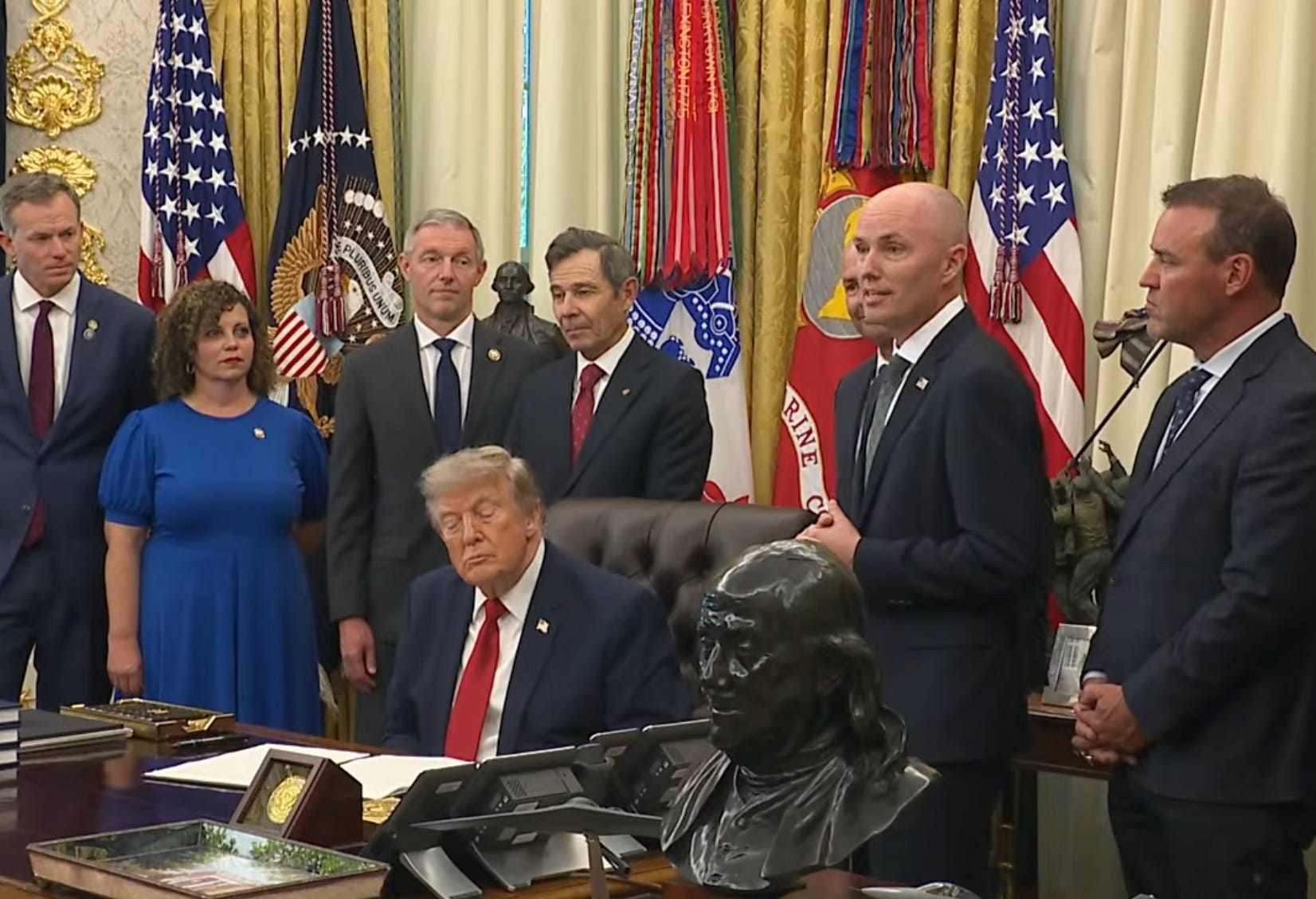
On July 13, President Donald Trump sat in the Oval Office, surrounded by Utah’s entire congressional delegation, Governor Spencer Cox, and Deputy Interior Secretary Kate MacGregor. He signed two proclamations slashing Bears Ears and Grand Staircase-Escalante national monuments by roughly 3 million acres, shrinking both monuments by about 90 percent. Grand Staircase-Escalante went from 1.87 million acres to roughly 182,000, and Bears Ears from 1.36 million acres to 121,000. The president and the officials around him leaned on claims that range from misleading to flatly false.
Describing the monuments, Trump said they were set aside “for nobody to use, right? Can’t do anything. You can’t go hunting. You can’t go fishing. You can’t do anything. You can virtually not even walk on it.” MacGregor replied, “That’s exactly right, sir.”
This is completely wrong, and MacGregor knows it—as do Utah’s leaders. Hunting and fishing are explicitly allowed in both monuments, and are, in fact, managed by the state. In both Bears Ears and Grand Staircase-Escalante, hunting for deer, elk, bighorn sheep, black bear, mountain lion, and turkey is permitted. President Joe Biden’s proclamation restoring Bears Ears celebrated its “unparalleled rock climbing” at Indian Creek and its “hunting, backpacking, canyoneering, whitewater rafting, and mountain biking” destinations. His Grand Staircase-Escalante proclamation likewise highlighted “world-class outdoor recreation opportunities” including hunting, hiking, river running, and horseback riding. Far from being lands nobody can walk on, these are lands people come from around the world to see and use.
MacGregor also offered a misleading history lesson. She noted that “the first monument that was created was only 1,200 acres,” implying that Presidents Bill Clinton, Barack Obama, and Joe Biden invented large landscape monuments, which is not true. In 1908, President Theodore Roosevelt, who signed the Antiquities Act, protected more than 800,000 acres at the Grand Canyon as a national monument, which eventually became Grand Canyon National Park. A year later, he designated 610,560 acres as Mount Olympus National Monument, now Olympic National Park.
Perhaps most misleading of all, the proclamations dismiss the landscapes themselves as “ordinary” and claim they should be smaller. The Bears Ears text writes off “deep sandstone canyons, broad desert mesas, towering monoliths” and calls the region’s cultural sites, like petroglyphs and pictographs “not unique,” while the Grand Staircase proclamation labels its cultural and paleontological resources as “relatively common.” In fact, Grand Staircase-Escalante makes more than 200 million years of Earth’s history visible through cliffs and plateaus, a landscape so rugged and remote it was among the last places mapped in the contiguous United States. The Kaiparowits Formation, located inside the monument, has become one of the most productive dinosaur laboratories on the planet, yielding more than two dozen species new to science, including horned dinosaurs found nowhere else on Earth. Just last month, scientists from the Natural History Museum of Utah uncovered a rare skeleton of a baby duck-billed dinosaur in Grand Staircase-Escalante. The canyons of Grand Staircase also hold one of southern Utah’s richest concentrations of Fremont and Ancestral Puebloan sites.
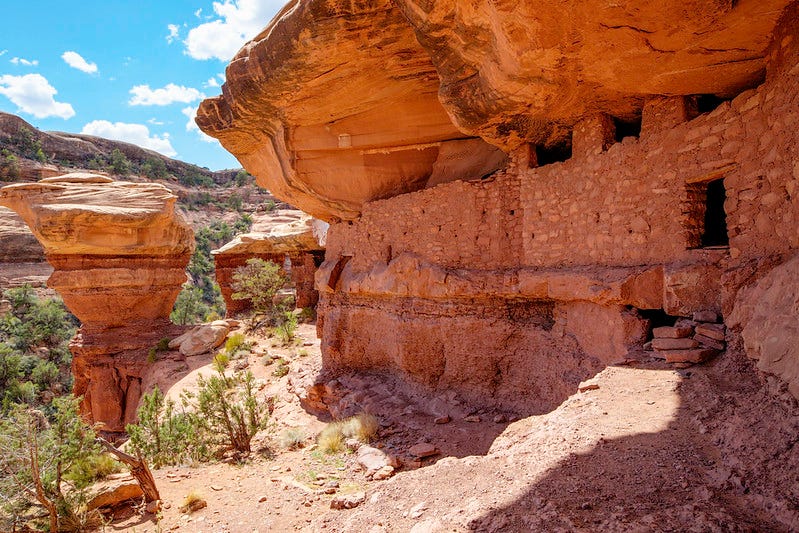
Bears Ears contains one of the densest concentrations of archaeological and cultural heritage in the United States, an estimated 100,000 sites spanning thousands of years of continuous human presence, from Archaic hunters to the cliff dwellings, kivas, granaries, and petroglyph panels of the ancestral Puebloans. To the Hopi, Navajo, Ute Mountain Ute, Ute, and Zuni Tribes, the twin buttes and surrounding canyons are not relics but a sacred homeland, which is why the five Tribal nations came together to request landscape-scale protections in the first place. Scientists say these places cannot be understood as scattered sites, but as a single landscape whose trails, sightlines, and stories make the whole far greater than the sum of its parts. Calling that “not unique” ignores the scientific record, as well as Tribal knowledge. And it also runs counter to the 1920 Grand Canyon legal precedent, which held that large landscapes themselves qualify as protectable objects.
The White House fact sheet about the reductions bends the truth further. It promises the unprotected lands “will now be available for multiple-use, sustained-yield management,” as if monument status ended multiple use. It didn’t. Recreation of all kinds continues in both monuments, livestock grazing continues in all of the places it was allowed before the monument, and timber management for restoration and wildfire mitigation continues under existing law. Existing mining and drilling leases are also still valid inside a national monument. The White House also claims that the concept of “objects of historic or scientific interest” established by the Antiquities Act has been “stretched” to include landscapes. Roosevelt protected the Grand Canyon as exactly that kind of landscape object, and the Supreme Court unanimously upheld the designation in 1920.
The proclamations also lean on national security, claiming the Bears Ears region holds resources “vital to energy and resource independence,” including “critical minerals such as silver, copper, molybdenum, lead, uranium, vanadium, and zinc.” The Grand Staircase text lists fifteen minerals, from chromium to zirconium. The government’s own assessments undercut these claims. As the Deseret News notes, the Bureau of Land Management previously found that both monuments have little to offer in terms of oil and gas potential, and Utah’s Department of Natural Resources has stated there is “very little energy potential within Bears Ears.” The Kaiparowits Plateau’s coal exists but is uneconomic, too remote and infrastructure-poor to attract investors, with no active leases since the federal government bought out the existing ones in the 1990s.
Back at the White House, Representative Celeste Maloy of Utah claimed that both monuments were created “over the unanimous opposition of Utah’s federal delegation, our governor, county commissioners, the locals.” Some Utah politicians did oppose the designations. But casting them as the voice of “the locals” erases the Tribal nations, local business coalitions, and everyday Utahns who asked for these monuments in the first place. Neither proposal originated in Washington. Both were brought to the White House by people who live close to these lands and were refined through years of consultation with Tribes, communities, and recreation, and grazing permit holders. Today, polling shows 74 percent of Utah voters support keeping Grand Staircase-Escalante protected and 71 percent support keeping Bears Ears protected. Colorado College’s most recent Conservation in the West poll found similarly overwhelming support among Utahns for leaving existing monument designations in place. If anyone is out of step with “the locals,” it is the delegation that stood behind the president as he signed these orders.
Conservation groups and Tribes are already preparing to fight the reductions in court, where the lies and misleading statements uttered in the Oval Office and embedded in the new monument proclamations will not fare well under legal scrutiny. And if the overwhelming online reaction to the reductions is any indication, they won’t age well in the court of public opinion either.
For more information, visit westernpriorities.org. Sign up for Look West to get daily public lands and energy news sent to your inbox, or subscribe to our podcast, The Landscape.
No posts
Comments
Nothing yet. Say the first thing.
Sign in to join the conversation.