
Reading scores are down. Math scores are down.
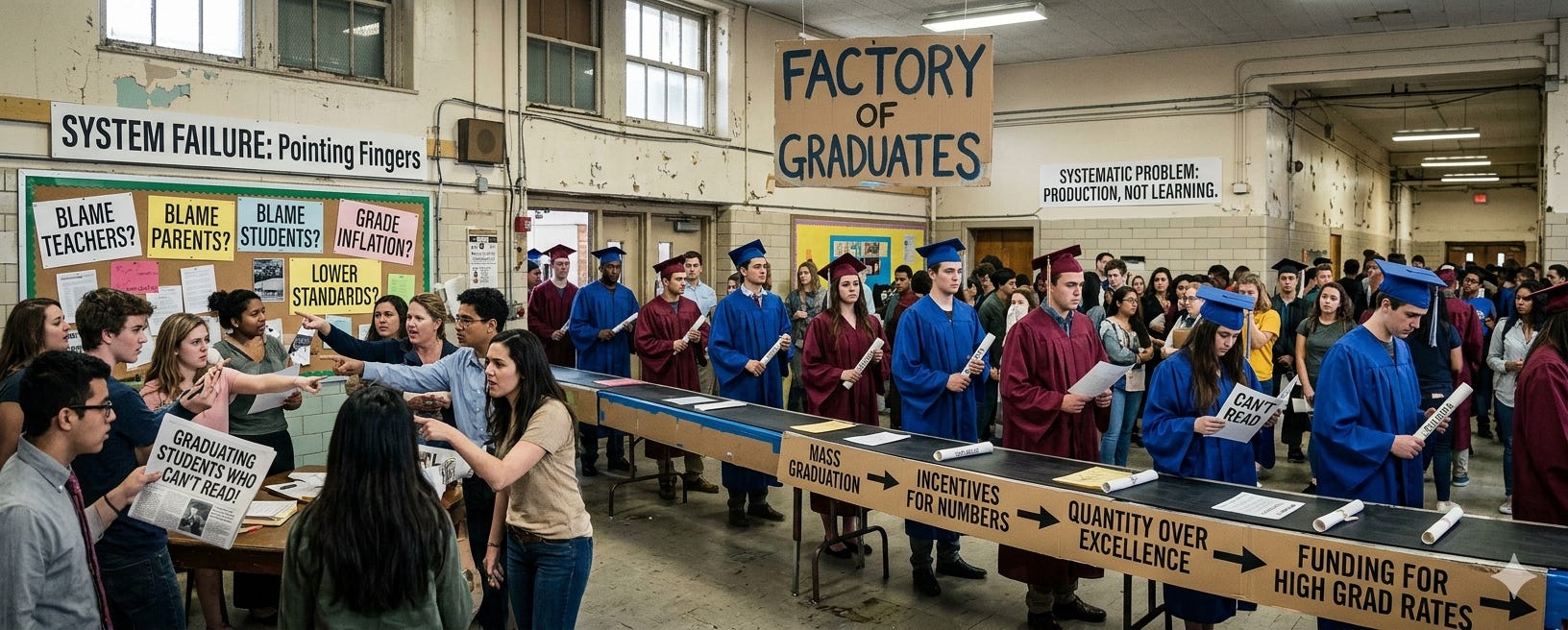
Students are graduating who can’t read.
So the obvious question is: whose fault is it?
You’re sitting in class. The lesson makes no sense. You’re behind and everyone around you seems to get it. So what do you do?
You have three options:
• Try and fail publicly.
• Check out quietly.
• Act out, and take back some sense of control.
Most choose option three.
After the outburst, they get a
or a restorative discipline conference. Then they go back to the same classroom, with the same gaps, listening to the same lesson. It’s almost like we believe exposure to instruction is the same as learning. You cannot learn fractions if you have never mastered multiplication. The gaps don’t disappear because a student sat through class.
So what happens next? They fail?
Of course not. Because if they fail, they might drop out. And if they drop out, the school loses funding. So the student shows up to tutorials, checks some boxes, and gets a 70. Or they are enrolled in a multiple choice digital course recovery option where they can guess their way through for full credit. Then they advance to the next grade, where the next teacher is expected to catch them up. Spoiler alert: they never catch up. This is how you graduate someone who cannot read.
Students are responding rationally to the environment they’re in.
They have learned through direct experience that:
• You can put forth minimal to no effort and still pass.
• You can turn things in late and still pass.
• Effort is not required to move forward.
Now layer on the cultural message they’re absorbing from various tech giants:
AI will do the thinking
Students are asking a completely logical question:
“Why should I try?”
The system has severed the link between effort and outcome. Disengagement is a logical conclusion.
“Teachers aren’t doing enough.”
“Teachers need more training.”
“Instruction isn’t engaging.”
That answer falls apart quickly.
Teachers are working inside a reality they didn’t create. COVID sent students through wildly different learning experiences: some learned a lot, some learned a little, some learned almost nothing. Then we brought them all back and treated them as if they were the same. Same grade level. Same pacing. Same expectations.
Gaps don’t magically close on their own. They compound. Six years later, teachers are managing massive academic gaps and rising behavior issues.
Blaming teachers for this crisis is like:
• Blaming firefighters for a burning house while they’re still inside trying to put it out.
• Blaming pilots for turbulence they didn’t create and can’t control.
Teachers didn’t create the learning gaps. They didn’t create the pressure to pass students along. They didn’t design the system that rewards graduation rates over actual learning.
“Parents should be doing more at home.”
Should they? If the school is sending home passing grades or even straight A’s, how are they to know?
The school isn’t raising red flags. So they trust the system. They assume that if their child is moving forward, their child must be okay.
And if a parent does push harder? They often run into walls: policies that discourage retention, pressure to keep students moving, and limited options for real academic intervention.
“But parents could fill in the gaps in learning at home.”
Is it really the parents’ responsibility to pay for outside tutoring? Expecting parents to pay for outside tutoring so their child can learn what they didn’t in school...is like paying for a second meal because the first one never came.
Some parents are starting to realize that schools are great for free child care, not so great at actually educating every student.
The education system as a whole.
The failure we are seeing today was created by decisions made above the classroom level:
Policies tied to graduation rates
Accountability systems focused on passing percentages
Pressure on schools to show “success” through data
When students fall behind, the system doesn’t stop and fix it. It finds a way to disguise the flaws. Standardized tests are administered. Students fail. Testing anxiety is cited. Waivers are obtained. Students are passed along anyway. The only thing that matters is graduation. The priorities are wrong.
Students are incredibly perceptive. They can tell when something matters. Right now, school is sending a very clear message:
You don’t need to try to move forward.
So the cycle continues. Students fall behind. They disengage. Behavior escalates. Teachers shift into survival mode. Students fall further behind. And then we look around and ask again: who’s to blame?
Not teachers. Not students. Not parents.
A system that deliberately removed the connection between effort and outcome and kept going anyway.
We have turned education into a checklist. Show up. Turn something in. Move forward. Repeat for twelve years.
Everyone gets a diploma for participating.
How do we fix it? (coming soon)
No posts
Comments
Nothing yet. Say the first thing.
Sign in to join the conversation.