
Everest Nevraumont is 11 years old.
She’s a three-time Texas State Champion in History.
She’s competed on a winning International History Bowl team.
She delivered a TEDx talk about how she uses AI in her education.
She appeared on ABC News Live after attending the State of the Union as a guest.
She says she feels “lucky” to be alive right now because students have access to better learning tools than existed 100 years ago.
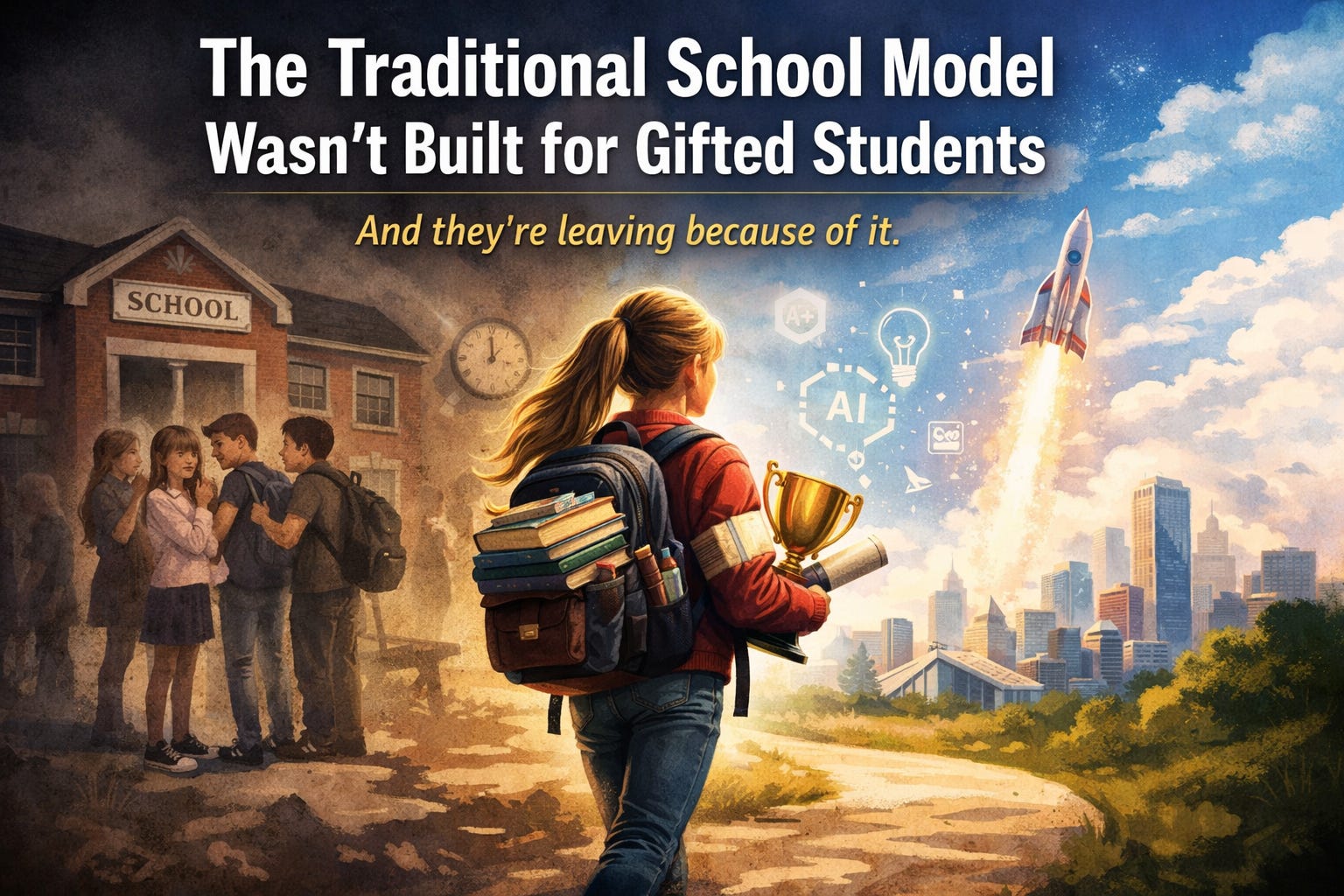
She opted out of the traditional model and is now excelling at the GT School.
Now imagine her in a typical middle school classroom.
Finishes first.
Raises her hand constantly.
Uses AI fluently.
Loves history competitively.
Be honest.
Would she be celebrated?
Or would she be told, subtly, to tone it down?
Research suggests gifted students experience disproportionately high rates of bullying. A widely cited study by Peterson & Ray (2006) found that 67% of gifted eighth graders reported having experienced bullying at some point in their school years.¹
Other studies confirm similar patterns: academically advanced students are frequently targeted for being “different,” “intense,” or visibly high-performing.²
Why?
Because standing out carries a social cost in environments that reward conformity.
Gifted students are often targeted for:
Correcting peers (or teachers)
Finishing work early
Using advanced vocabulary
Showing deep academic enthusiasm
Breaking “normal” social expectations
And the impact is not small.
Research shows that bullied gifted students are more likely to experience:
Anxiety and depression³
Academic self-sabotage
Social withdrawal
School avoidance
Some intentionally lower their performance to blend in.
Let that sink in.
In many traditional environments, the safest strategy for a high performer is invisibility.
Traditional school organizes students by age and locks them into uniform pacing.
When one student moves faster, it creates imbalance.
When one student dominates discussion, it creates tension.
When one student excels publicly, it disrupts social equilibrium.
So what happens?
They’re told:
“Let someone else answer.”
“You already know this.”
“Give others a chance.”
“Help the class catch up.”
None of those sentences say “tone it down.” But the unspoken message is clear.
Excel — but not too much.
Stand out — but not too obviously.
Win — but make it comfortable for everyone else.
We would never train elite athletes this way.
Imagine telling a sprinter:
“Slow down so the others feel better.”
Yet academically, we normalize it.
Gifted students often experience what psychologists call asynchronous development — where cognitive ability outpaces emotional or social maturity.⁴
An 11-year-old might reason like a high school debater but process rejection like a child.
That combination can make bullying especially damaging.
There’s a persistent myth:
“They’re smart. They should be tougher.”
But research suggests gifted students may experience heightened emotional intensity and sensitivity.⁵
They don’t just notice exclusion.
They analyze it.
Internalize it.
Replay it.
Now go back to Everest.
In a traditional setting:
Would her AI advocacy be welcomed — or restricted?
Would her championships inspire admiration — or social distance?
Would her intensity be nurtured — or socially regulated?
We don’t know.
But we do know this:
Environment shapes identity.
If visible excellence triggers social friction, some students adapt by dimming it
They go into survival mode.
At GT School, acceleration isn’t an anomaly.
It’s expected.
Students move at their own pace. Mastery isn’t delayed for group cohesion. AI is taught as a tool, not treated as contraband.
When finishing early is normal:
It isn’t weird.
When loving history is competitive:
It isn’t isolating.
When using AI to think better:
It isn’t cheating.
It’s literacy.
Instead of saying:
“Wait.”
The system says:
“Go.”
That subtle shift changes identity.
A child who doesn’t have to shrink begins to expand.
We measure test scores.
We measure graduation rates.
We measure attendance.
We do not measure how many high performers quietly learned to mute themselves.
We don’t measure how many potential founders, scientists, historians, and builders decided it was safer to blend in.
And that loss compounds over time.
If a system unintentionally penalizes visible excellence, excellence will adapt.
Often by disappearing.
If a system structurally prioritizes uniformity, outliers will feel pressure.
If a system structurally protects acceleration, outliers thrive.
Everest says she feels lucky.
Not because learning is easier.
But because her environment doesn’t require her to “tone it down” to survive.
Maybe the real innovation in education isn’t AI.
Maybe it’s building systems where brilliance is socially safe.
And maybe the most dangerous sentence a school can send — even unintentionally — is this:
“Tone it down.”
Peterson, J. S., & Ray, K. E. (2006). Bullying and the Gifted: Victims, Perpetrators, Prevalence, and Effects. Gifted Child Quarterly, 50(2), 148–168.
Cross, T. L., Coleman, L. J., & Stewart, R. A. (1993). The social cognition of gifted adolescents.
Wolke, D., & Lereya, S. T. (2015). Long-term effects of bullying. Archives of Disease in Childhood.
Silverman, L. K. (1997). The construct of asynchronous development.
Mendaglio, S., & Tillier, W. (2006). Dabrowski’s Theory of Positive Disintegration and giftedness.
No posts
Comments
Nothing yet. Say the first thing.
Sign in to join the conversation.