
After I wrote
Who’s to Blame for Our Education Crisis?
Many people agreed but asked the obvious question. How do we fix it?
There are several key issues that need to be addressed to improve the perverse incentives of the current model.
The entire system is built on one assumption: children born in the same year should learn the same things at the same pace.
That assumption was never true. It was put in place because it’s easy to schedule and control.
A kindergarten classroom today might contain a child who reads chapter books and a child who doesn’t know the alphabet. We seat them next to each other, hand them the same materials, and call it education. One is bored. One is lost. Neither is well-served.
Age-based grouping creates the conditions for every other problem we’re trying to solve. Behavior issues spike when students are chronically under-challenged or chronically overwhelmed. Disengagement follows. Teacher burnout follows that.
The fix: group students by readiness in core subjects, not by birthday. Groups should be fluid. A student can be at different levels in math and reading. Movement through content is driven by mastery, not the calendar.
How does this work in practice? Three options:
Ability-grouping. Subjects are scheduled at the same time across classrooms so that a student who is advanced in math attends that level, while taking a lower level in reading if needed. This starts in kindergarten, not high school.
Adaptive technology. AI-driven platforms can respond to each individual student in real time by adjusting pace, identifying gaps, providing a different explanation when the first one doesn’t land. This frees teachers to do what only a human can do: work in small groups, build relationships, and respond to what the data surfaces. A teacher with 28 students cannot give individualized attention to every child every day while also grading, planning, and preparing. An AI system can show exactly who needs what. Teachers shift from content delivery to mentoring, guiding, and motivating.
Adaptive programming also has a benefit that rarely gets named: it eliminates the need for multiple standardized tests throughout the year. The platform identifies gaps in real time. There is no longer a reason to pull students out of instruction six times a year to confirm what the system already knows.
A hybrid model. Adaptive programming doesn’t have to start in kindergarten. K-2 can continue with explicit, teacher-led phonics and math instruction in small ability groups. Beginning in third grade, schools can move to full adaptive programming or use it for specific content while spending the remainder of time on project-based, cross-curricular learning.
Passing a student to the next grade because holding them back is awkward or politically uncomfortable is one of the most harmful things we do in education. The goal should never be to just “graduate them.”

We cannot keep passing students along and hoping they will catch up. Every skill in math and reading builds on what came before. A student who hasn’t mastered foundational concepts falls further behind every single year because the gap compounds. By the time that student reaches middle school, they are carrying years of unaddressed gaps, and no teacher at that level has the time or the mandate to go back and fill them.
Moving a child forward before they’re ready guarantees they will struggle more. A student who repeats a year with targeted, structured support has a path forward. A student promoted without mastering the curriculum faces an uphill battle that often leads to anxiety, behavior issues, disengagement, or some combination of all three.
We also need to consider the message we send when a student earns a 60 and is still promoted. Social promotion sends a quiet signal that we have low expectations. Students understand this and adjust accordingly. By high school, they know the drill: as little effort as possible will get them to the next grade. That is a detrimental life lesson, and we are the ones teaching it.
Right now, time is the unit of progress. Sit long enough, you advance.
That has to flip.
Mastery-based progression means a student moves forward when they’ve demonstrated they can do the thing, not when the school year ends. It means a student who hasn’t mastered a concept stays with it instead of being carried forward into content they’re not ready for. And it means a student who masters content quickly doesn’t wait for the rest of the class to catch up.
This is not a radical idea. It’s how learning works outside of school. Nobody teaches a child to ride a bike on a fixed pacing schedule.
Accountability shifts accordingly. The right question isn’t “did this student reach grade level?” It’s “how much did this student grow from where they started?” That question rewards teachers who take on the hardest-to-reach students instead of punishing them.
Parents are beginning to realize what teachers have long been sounding the alarm about: the absurdities of excessive testing.
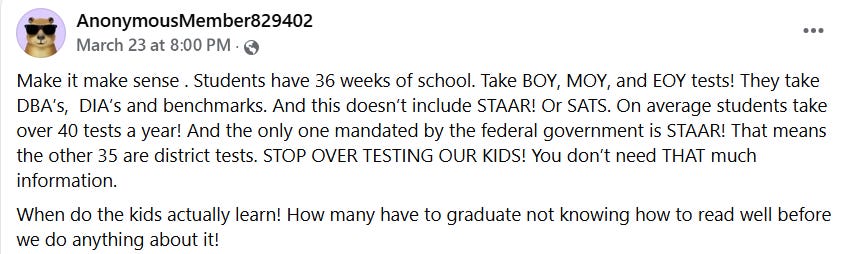
Teachers are spending enormous portions of their time preparing students for the next test, administering the next test, and analyzing the results of the last test, only to start the cycle over again: state tests, district benchmarks, interim tests, progress monitoring. Instructional time is the most finite resource in a school. We are consuming it at an alarming rate in service of an accountability system that, by most measures, isn’t producing better outcomes.
Here is what the assessment system should look like instead:
One beginning-of-year and one end-of-year national exam. Consistent across the country, so we actually know what the numbers mean when we compare them. This is the accountability measure, the data point that tells the public, policymakers, and the system how schools are performing. With the Department of Education dissolving, a nationally normed assessment would paint a clear picture of how states are performing and what is working in each state.
With this data, we can filter for confounding variables and determine which schools have successful programs. Then we can use those strategies to improve lowering performing districts.
Teacher-level formative and summative assessments, and nothing in between. Those tools should be quick, embedded in instruction, and actually useful in the classroom. What teachers do not need is a district-mandated benchmark calendar that pulls them out of instruction six times a year to generate data that largely confirms what they already knew. Everything between the national exams and the teacher’s own assessment tools should be eliminated.
Even in a better system, some students will struggle with behavior. The current response doesn’t work. Students disrupt, they are removed temporarily, taken to a cool down room or given a restorative conference and returned to class. Nothing changes. We have to start enforcing the code of conduct and not merely referring to it as a suggestion.
One child can consume the instructional time of 25 others. The learning environment must be protected without abandoning the student who needs help. This has to be an alternative setting, possibly a school within a school model.
In this structured alternative track the students:
Work at their actual academic level
Receive explicit behavior support
Progress through mastery, not seat time
Earn their way back to the main classroom by demonstrating readiness
This protects the learning of the group without abandoning the individual.
State funding formulas currently reward attendance and graduation rates. So that’s what schools optimize for, not learning.
We are paying for the wrong outcomes.
Students get passed along because retention looks bad. Graduation rates are protected because they’re tied to funding and accountability ratings. A student can walk across a stage unable to read at grade level and the system registers that as a success.
We are literally paying for the wrong outcomes.
If the goal is learning, fund learning. Specifically:
Academic growth over time. Not did the student reach an arbitrary grade-level benchmark, but how much did this student grow from where they started. Look solely at the BOY versus the EOY exams. Did they make progress?
Intervention effectiveness. Schools should be accountable for whether their interventions work, not just whether they ran them. Did the student who received reading support actually improve? That’s the question the funding should be tied to.
Right now the incentives produce exactly what we have. Change what you fund, and you change what schools do.
You cannot fix what happens in classrooms without fixing what happens before teachers ever enter one.
Education schools are still training teachers for the old model. New teachers often have far more theory than practical skills in structured phonics, mastery-based teaching, or managing flexible grouping.
State certification requirements need to reflect the model we’re asking teachers to implement. If mastery-based progression, structured phonics, and small-group differentiated instruction are the standard, then those skills need to be required, not elective concentrations, not professional development afterthoughts, but core competencies that every licensed teacher has demonstrated before they walk into a classroom.
Until teacher prep programs are held to the same standard we’re asking schools to meet, we are setting teachers up to fail and then blaming them for it.
If the problems are this clear, why haven’t they been fixed?
Because the current model has organized beneficiaries.
Teachers unions have historically resisted changes that introduce performance-based accountability, flexible staffing models, or anything that makes teacher effectiveness more visible and measurable. There are some unions doing genuinely innovative work. However, at the institutional level, protecting the existing model is often the default position.
Administrators have built careers and organizational structures around the current system.
Benchmark testing companies have multi-million dollar contracts with districts. Curriculum vendors have adoption cycles tied to the existing grade-level framework. These are specific financial interests, and they lobby, they donate, and they show up at school board meetings.
Children don’t have a lobby.
The kids are waiting. The incentives can be changed. The only question left is whether the adults are finally willing to step up and change the broken system.
No posts
Comments
Nothing yet. Say the first thing.
Sign in to join the conversation.