
Shopify has released more than 150 updates in its Spring ’26 Edition.
That sounds exciting, but also overwhelming. Most store owners do not have the time to go through every single update, compare the details, and figure out which ones actually affect their business.
So here is the practical version.
We reviewed the release and focused on the features that can directly impact sales, operations, marketing, checkout, inventory, and customer experience.
The biggest takeaway is simple:
Your products are no longer limited to your online store.
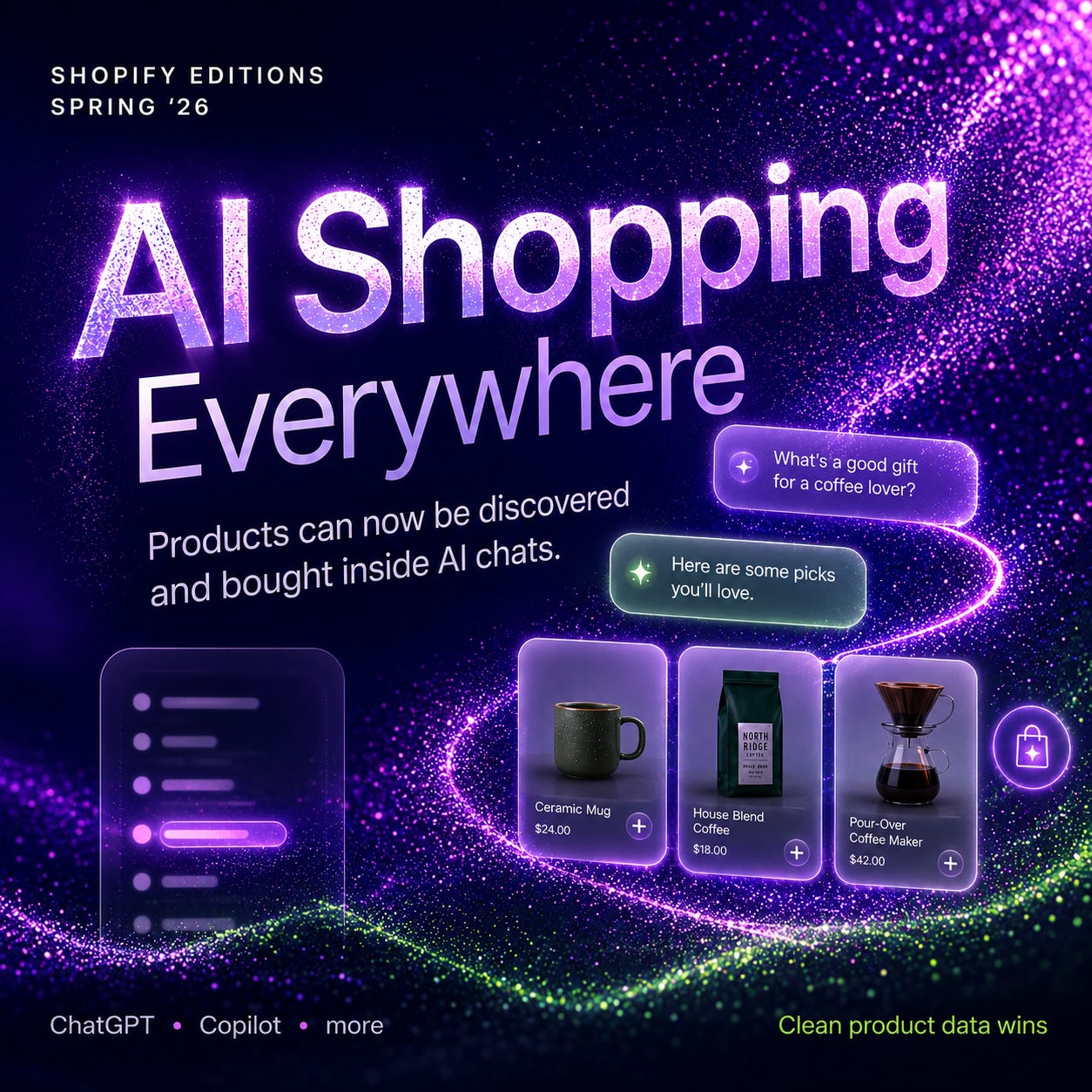
With Shopify’s new AI commerce updates, products can now be discovered, recommended, and in supported cases purchased through AI shopping experiences like ChatGPT, Microsoft Copilot, Google AI Mode, Gemini, and Shop.
That is the main shift.
Everything else in this Edition supports the same idea: helping merchants sell in more places, move faster, and let software handle more of the repetitive work.
The most important update in Spring ’26 is Agentic Storefronts.
This is Shopify’s move into AI-powered shopping.
Imagine a customer asking an AI assistant for a product recommendation. Instead of only getting a list of links, they may see actual products from Shopify merchants inside that conversation.
The product can be discovered there, compared there, and in supported channels, purchased there.
For merchants, the important part is that the order still connects back to Shopify. You are not managing a separate sales system or building a new storefront from scratch.
Shopify Catalog is the infrastructure behind this. It helps structure and distribute product data so AI agents can better understand what you sell, when it is available, how it is priced, and how it should be shown to shoppers.
The number worth paying attention to:
Shopify says AI searches powered by Shopify Catalog convert twice as well as searches that rely on scraped product data from the open web.
That makes product data much more important than before.
In the past, SEO was mostly about helping Google understand your pages. Now, the next layer is helping AI shopping agents understand your products.
That means clean titles, accurate descriptions, product specifications, pricing, availability, shipping information, images, variants, and policies are no longer just “nice to have.”
They can affect whether your products show up in AI shopping results or get ignored.
Shopify also gives merchants a place inside the admin to manage AI channels, see performance, track sales from AI surfaces, and understand which AI searches they are ranking for.
Why this matters:
AI shopping is becoming a real discovery channel. The stores that prepare their product data early may gain the same kind of advantage that early SEO adopters had years ago.
Sidekick is no longer just a chatbot that answers basic questions.
In Spring ’26, Shopify is making Sidekick more connected to the store owner’s daily workflow.
It can now work with more parts of the Shopify admin, provide more contextual help, and connect with partner apps. That means merchants can ask questions or take action without jumping between different tools all the time.
For example, Sidekick can now work with apps like Klaviyo, Loop, Smile, Judge.me, and others through app extensions.
It can also give more proactive guidance through Sidekick Pulse, helping merchants understand what needs attention when they start working in the admin.
Some examples of what this unlocks:
Sidekick can help identify what needs to be improved in the store.
It can guide merchants toward actions that may attract more customers, improve conversion, or increase repeat purchases.
It can create customer records from plain-language descriptions.
It can keep working while the merchant moves to another task.
It is also available across more devices, including mobile and Apple Watch.
The important point is not that AI can answer questions.
The important point is that AI is getting closer to the places where store owners actually make decisions.
The catch is that Sidekick is only useful when the merchant asks good questions and gives it the right context. A vague prompt still creates vague output.
Spring ’26 also brings major updates to marketing.
One of the biggest is Campaign Autopilot.
The idea is simple: merchants set the budget, rules, and guardrails, and Shopify’s AI helps run campaigns, optimize performance, and move spend toward what is working.
This does not mean marketing no longer needs strategy.
It means some of the manual campaign management work can become easier, especially for merchants who do not have a full marketing team.
Shop Campaigns are also expanding to more channels, including ChatGPT, Pinterest, and programmatic ads through Microsoft Monetize.
Shopify Messaging now supports more marketing options too, including WhatsApp and SMS automations.
Another useful update is that marketing performance can now sit closer to sales data in Shopify Analytics. Merchants can see spend, ROAS, impressions, sessions, and sales in one place.
Why this matters:
Many merchants struggle because marketing data is split across too many platforms. Ads live in one dashboard, sales live in another, and campaign decisions become harder than they should be.
Shopify is trying to bring more of that picture into the admin.
The catch:
Automated marketing still needs clear limits. If the budget, margin, audience, and product strategy are not set properly, automation can scale mistakes just as easily as it scales wins.
For merchants who sell in person, POS v11 is one of the most practical updates in this Edition.
Shopify rebuilt the POS checkout experience to make everyday retail tasks faster.
For busy stores, saving time at checkout matters a lot. Even small improvements add up quickly when staff are processing dozens or hundreds of transactions per day.
With the new POS experience, staff can move faster through common actions like adding products, adding customers, applying discounts, splitting payments, and completing checkout.
The cart stays visible through the process, which helps reduce confusion and keeps the transaction moving.
Other POS updates include faster product and customer search, scannable discounts, improved in-person pickup workflows, and new hardware support such as Verifone Victa Mobile.
Why this matters:
For retail stores, speed is not just about convenience.
A faster POS can reduce lines, lower staff pressure, improve customer experience, and make busy shopping periods easier to manage.
If a merchant has a physical store, this is one of the updates worth reviewing closely.
Inventory is one of the most expensive and risky parts of running an ecommerce business.
Too much stock ties up cash.
Too little stock loses sales.
Spring ’26 includes several updates designed to make inventory decisions easier and faster.
Sidekick can now help with purchasing decisions and smarter purchase order workflows. Shopify is also improving barcode-based receiving, inventory syncing, stock management across locations, and return data.
One useful update is shipment-level barcode receiving. Instead of receiving items one by one, merchants can scan shipment barcodes to process inventory transfers faster.
Another important update is category-specific return reasons. Customers can choose return reasons that better match the product they bought, giving merchants more useful data about issues like sizing, quality, fit, or unclear product descriptions.
Why this matters:
Inventory problems often hide in plain sight.
A product that keeps selling out may need a better reorder process.
A product with repeated returns may need better photos, clearer sizing information, or a product page rewrite.
A product sitting in the wrong location may create avoidable fulfillment problems.
These updates help merchants catch those issues earlier.
Shopify Analytics is also getting more context.
The goal is to make store data easier to interpret, not just easier to view.
Instead of only showing charts and numbers, Shopify is adding daily insights, better visualizations, chart annotations, metric targets, and more ways to compare data.
This matters because most store owners do not need more reports.
They need clearer answers.
What changed?
Why did it change?
Was that spike caused by a campaign, a product launch, a discount, a seasonal shift, or something else?
With annotations, merchants can connect events to performance changes more easily. With metric targets, they can track progress against specific goals. With new visualizations, they can see patterns that may be harder to spot in basic tables.
Shopify Flow is also getting better access to analytics data, which means merchants can build automations around store performance without needing custom code.
Why this matters:
Data is only useful when it leads to action.
If analytics can show the story behind the numbers, merchants can react faster and make better decisions.
Shopify also shipped several checkout and payment updates.
One of the biggest is that Shop Pay is now available to businesses on any platform, even if they are not using Shopify’s online store.
That gives more brands access to Shop Pay’s one-click checkout experience and Shopify’s large shopper network.
Checkout has also been improved with a cleaner experience, better mobile usability, and more flexible fulfillment options.
Customers can now choose shipping for some items and in-store pickup for others within the same checkout.
Address suggestions are also becoming faster and more accurate in supported countries, which can help reduce failed deliveries and checkout friction.
Shopify is also expanding payment options, including more local payment methods and USDC support.
Why this matters:
Checkout is one of the highest-impact parts of an ecommerce store.
Small improvements in speed, clarity, and trust can lead to meaningful conversion gains.
The online store experience also received several important updates.
Shopify Inbox now includes an AI sales associate that can help answer customer questions and recommend products based on available store data.
If a shopper is signed in with Shop, the AI assistant can also personalize recommendations based on that shopper’s history.
Storefront search is improving too. It can now better handle typos, unusual phrasing, and more natural search behavior.
That matters because customers do not always search in perfect product keywords. They search like humans. They make mistakes, use incomplete phrases, and describe what they want in different ways.
Shopify also introduced A/B testing for online store and checkout experiences through Rollouts. This means merchants can test themes, checkout configurations, and customer account experiences without relying on extra tools.
Customer accounts are also improving with branded sign-in, better navigation, smarter recommendations, and 365-day sessions that keep shoppers signed in for longer.
Another useful update is Shopify Smart Pricing, which provides product-level pricing suggestions based on sales, inventory, costs, and seasonality.
Why this matters:
The storefront is becoming more intelligent.
Search, recommendations, pricing, testing, and customer accounts are all getting closer to the way modern shoppers behave.
Spring ’26 also brings updates for B2B, international selling, and finance.
For B2B merchants, Shopify is making more wholesale features available on more plans. Merchants can access company profiles, volume pricing, and up to three B2B catalogs from the admin at no extra cost.
QuickBooks and Mailchimp also now support B2B more directly, making it easier to sync B2B orders, company details, and customer segments.
For international selling, Managed Markets has expanded to the UK and Canada. Gift cards can work in local currencies, and duties can be shown more clearly at checkout.
For finance, Shopify Balance now includes cashback on qualifying ad spend payments in the US. Shopify Tax is available in Canada, and Shopify Capital is available in France.
Why this matters:
Shopify is making more advanced commerce workflows available to more merchants.
B2B, international sales, tax, and finance tools used to feel like separate systems. Shopify is bringing more of them into the core operating layer.
For developers, Spring ’26 is a major release.
The most important updates are around Universal Commerce Protocol, Catalog API, Hydrogen, and the Shopify AI Toolkit.
UCP is the standard Shopify co-developed to help AI agents interact with merchants across the commerce journey, from discovery to checkout.
Catalog API turns Shopify’s product catalog into structured, queryable data that AI agents can use to discover and present products accurately.
Shopify AI Toolkit also makes it easier for developers to build and manage Shopify experiences from tools like Cursor, Claude Code, Codex, VS Code, and others.
Why this matters:
The developer ecosystem is what will turn AI commerce from a concept into real shopping experiences.
As more developers build on Shopify’s AI commerce infrastructure, merchants may have more places where their products can be discovered and purchased.
This release makes a few things clear.
First, AI shopping is becoming a real sales channel. It is not just a trend or a future idea. Merchants need to prepare their product data so AI agents can understand, recommend, and display their products correctly.
Second, Shopify is moving more daily work into AI-assisted workflows. Marketing, inventory, analytics, customer service, store management, and development are all becoming more automated.
Third, speed still matters. Faster checkout, faster POS, faster inventory receiving, and faster decision-making can all create real business value over time.
But there is one important warning:
These features will not create results on their own.
They still need to be set up correctly.
Clean product data matters.
Clear margins matter.
Good campaign guardrails matter.
Accurate inventory matters.
Useful prompts matter.
If merchants turn everything on without strategy, they can waste budget, show the wrong products, or create a messy customer experience.
But if they set things up properly, Spring ’26 gives Shopify stores a serious opportunity to get ahead.
If you only focus on one thing from this release, start with the AI commerce updates.
Make sure your product titles, descriptions, variants, images, pricing, availability, shipping details, and policies are accurate.
Because in the next version of ecommerce, the stores with the cleanest product data may be the ones AI shopping experiences understand first.
Source: Shopify Editions Spring ’26
No posts
Comments
Nothing yet. Say the first thing.
Sign in to join the conversation.