
If you’re trying to improve your Shopify competitor analysis, you’ve probably used a few spy tools already.
They show you:
Best-selling products
Store layouts
Apps and tech stacks
At first, it feels like you’ve found a shortcut.
But here’s the problem:
Spy tools don’t give you an advantage, they give you a delayed copy of someone else’s success.
Most Shopify spy tools only show surface-level data:
What products are trending
What ads are running
What competitors are selling
What they don’t show you is:
Why customers are unhappy
Where competitors are failing
What gaps still exist in the market
So if you copy what you see, you’re not innovating.
You’re entering a crowded space with no differentiation.
When doing ecommerce competitor research, beginners usually focus on:
Product selection
Store design
App stack
These things matter, but they’re not where the real opportunity is.
Because your competitor has already optimized them.
You’re just following behind.
If you want your Shopify competitor analysis to actually work, shift your focus:
Stop analyzing what competitors sell.
Start analyzing what their customers complain about.
This is where the real insights are.
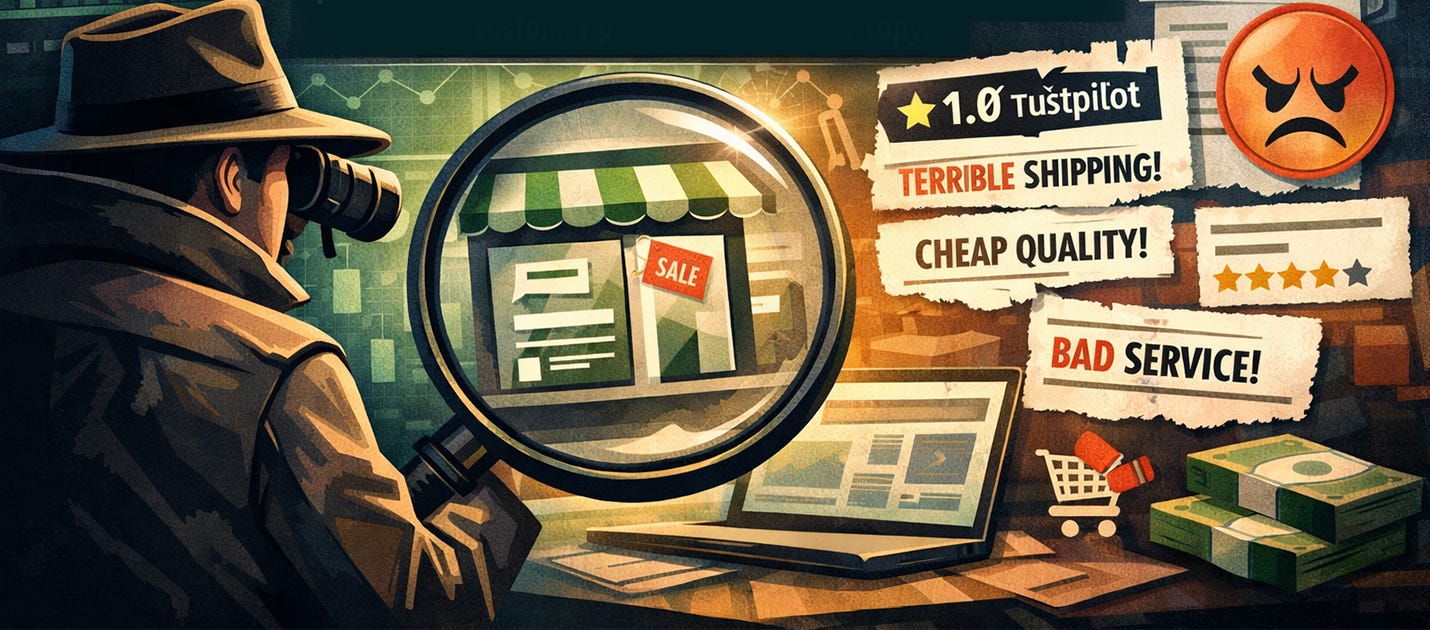
Instead of relying only on spy tools, build what we call a Rage Map.
Here’s how:
Search your competitor on Trustpilot or other platforms.
Filter for 1-star reviews
Look for repeated complaints
Take notes on patterns
Then expand your research:
Check comments on Facebook ads
Read Reddit discussions
Scan product reviews on their store
You’re not looking for random feedback.
You’re looking for consistent frustration.
Let’s say you find a competitor with hundreds of complaints like:
“Shipping to the UK takes forever”
“The material feels cheap”
“Customer support never replies”
That’s not just feedback.
That’s a blueprint.
Now your strategy becomes clear:
Slow shipping → Offer fast, local delivery
Low quality → Emphasize premium materials + proof
Poor support → Provide fast, visible customer service
Then reflect this in:
Product pages
Ad creatives
Landing pages
Messaging
You’re not just selling a product.
You’re solving a known problem better than your competitors.
Spy tools aren’t useless but they should be used differently.
Use them to:
Validate demand
Spot trends early
Identify competitors
But don’t use them to:
Copy products
Clone stores
Replicate strategies blindly
Think of spy tools as directional data, not your strategy.
No posts
Comments
Nothing yet. Say the first thing.
Sign in to join the conversation.