
The Shopify App Store ecosystem is one of the clearest examples of a platform economy in e-commerce. Thousands of independent developers, startups, agencies, and software companies build apps for Shopify merchants. These apps help online stores manage sales, marketing, logistics, SEO, product management, customer service, and daily operations.
To get a broader view of this ecosystem, we looked at Shopify’s sitemap, where developers and apps are listed. At first glance, this page does not look especially interesting. But inside it, there are useful signals about how the Shopify App Store is structured.
This analysis gives a general picture of app distribution, developer concentration, the words used in app names, and the similarities between those names.
By the beginning of July 2026, 14,410 developers had registered in the Shopify App Store and had built a total of 22,571 apps.
This shows that the Shopify App Store is not controlled only by a few large players. It is a large and diverse market with thousands of developers.
But the more important point is not just the total number of apps. It is how these apps are distributed among developers.
The data shows that the Shopify App Store has a clear long-tail structure.
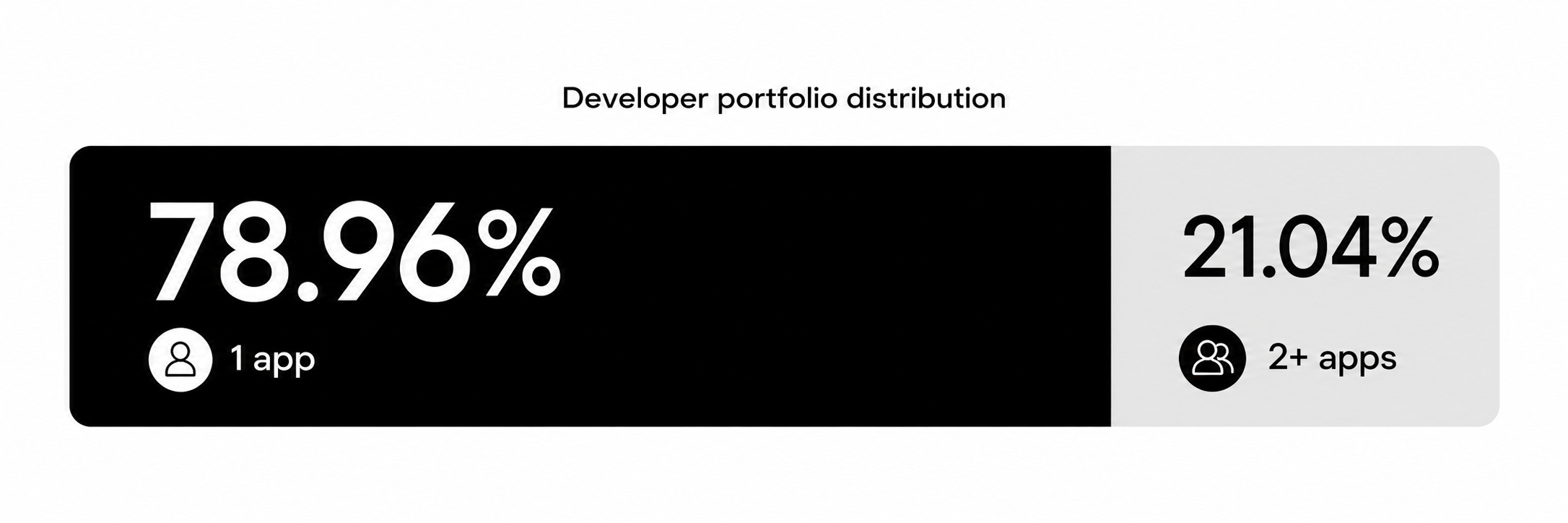
A large share of developers have chosen to focus on one specific product and provide dedicated services around it. Only a smaller number of developers have large app portfolios.
According to the extracted data, 78.96% of developers have only one app. In contrast, only 21.04% of developers have more than one app.
However, this does not prove whether some developers are connected to each other or not. It is possible that some developers have built each app under a separate partner account.
Still, the general structure is clear: most developers in the Shopify App Store appear with only one app, while a small number of developers own much larger portfolios.
Among all the developers reviewed, the largest developer by number of apps is UnReact Inc., with 159 registered apps.
This number is especially interesting when compared with Shopify itself. Shopify, even though it offers many different services across many categories, has 40 apps in this sitemap.
That number is very small compared with the total number of extracted apps.
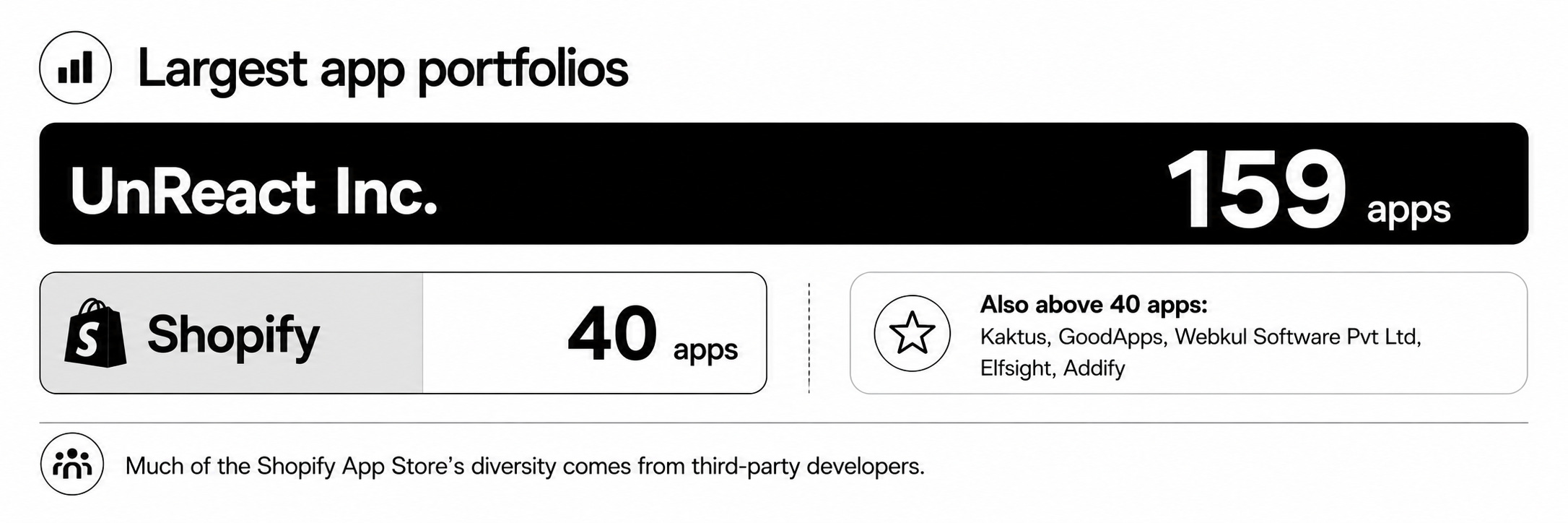
Several other developers also have more than 40 apps, including Kaktus, GoodApps, Webkul Software Pvt Ltd, Elfsight, and Addify.
This shows how much of the practical value of the Shopify App Store has been created by third-party developers. Shopify provides the infrastructure and the platform, but much of the diversity, specialization, and product innovation comes from external developers.
One of the most important findings in this review is the widespread use of the term AI in app names.
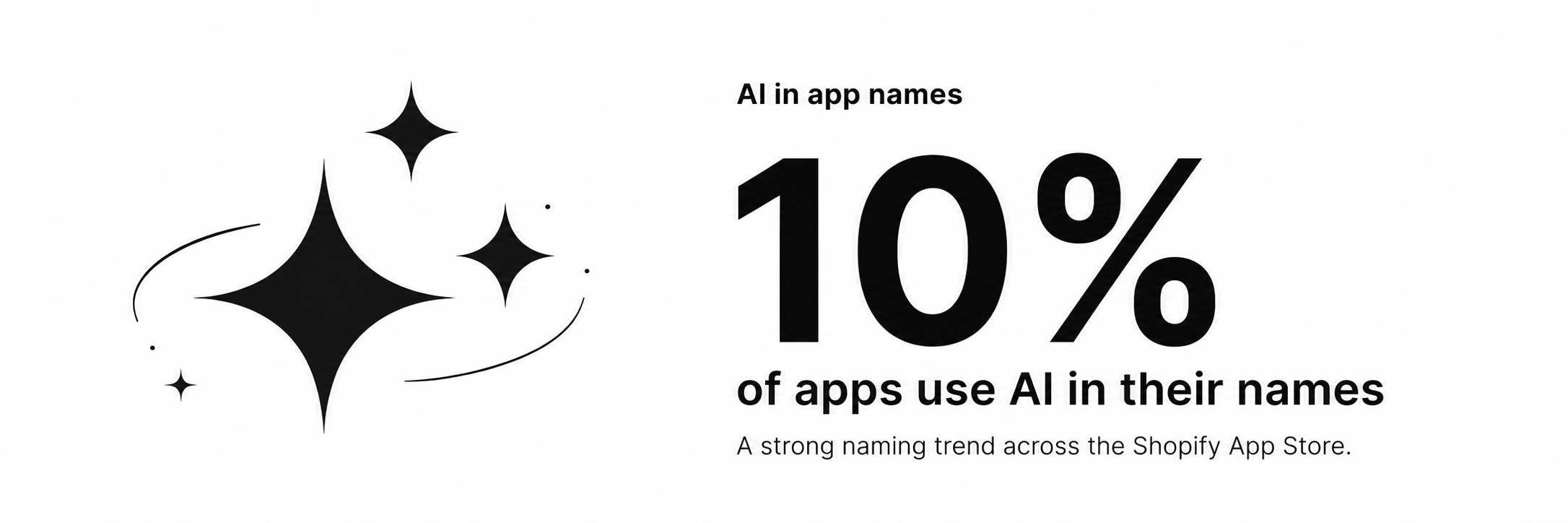
Out of 22,571 apps, 2,215 apps include AI, Ai, or .ai in their names in a recognizable way. That is around 10% of all apps on the platform, which is a significant share.
Of course, having AI in the name does not necessarily mean that the app uses artificial intelligence in a deep, real, or differentiated way.
But from the perspective of product positioning and marketing, it shows that AI has become one of the most important competitive labels in the Shopify App Store.
When we looked at the most frequent meaningful words in app names, AI ranked first.
AI appears in 2,215 app names, making it the most frequent meaningful word in this sitemap.
Product comes next, appearing in 1,108 app names. After that, Order appears in 490 app names, Shipping appears in 436, and SEO appears in 432.
Based on this, AI is the most frequent meaningful word in the names of apps in this sitemap.
This finding shows that AI is not only a technical capability. It has also become a naming tool, a positioning tool, and a marketing message.
Developers use AI to quickly explain product value, attract merchants’ attention, and place their products inside a broader wave of market demand.
To better understand how AI appears in app naming, we also looked at the overlap between AI and several important words.
The strongest overlap is between AI and SEO. In total, 236 apps have both AI and SEO in their names.
The next strongest overlap is with Product, where 194 apps include both AI and Product in their names.
Among these four areas, SEO has the highest overlap with AI.
More importantly, around 54.6% of apps that have SEO in their names also have AI in their names. This suggests that SEO is one of the areas that is gradually being handed over to AI.
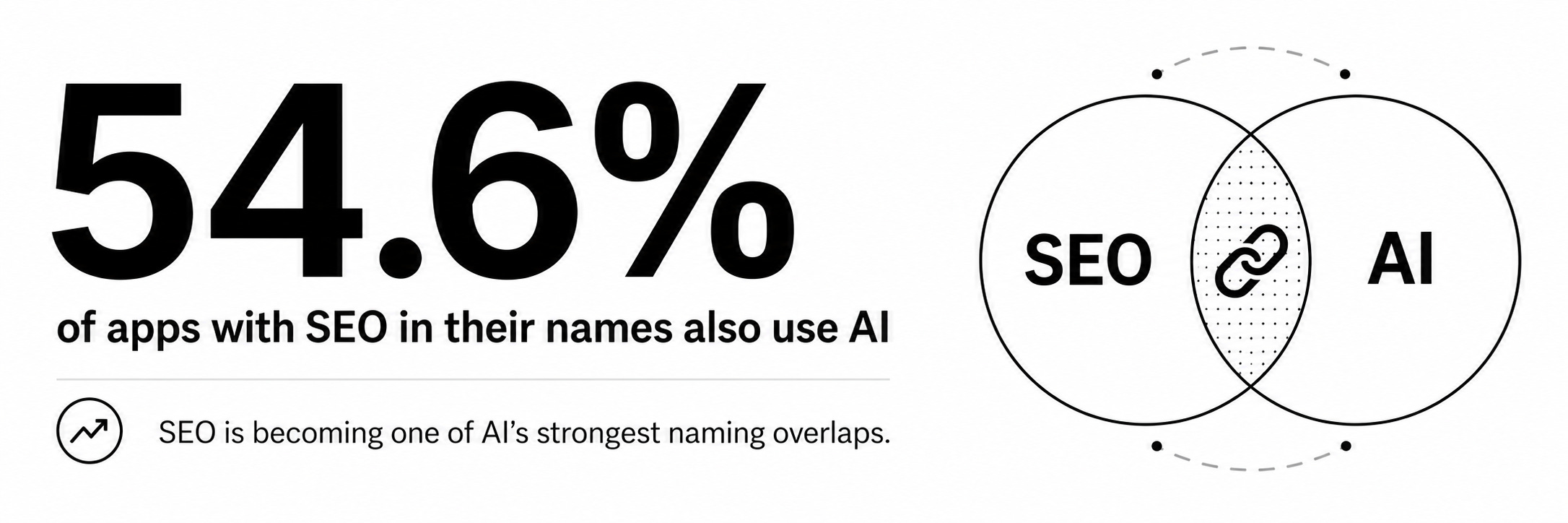
From generating product descriptions to optimizing meta tags, producing store content, suggesting keywords, and improving product pages, AI is now strongly tied to promises around organic growth and search engine optimization.
Another part of the analysis focused on similarity between app names from different developers.
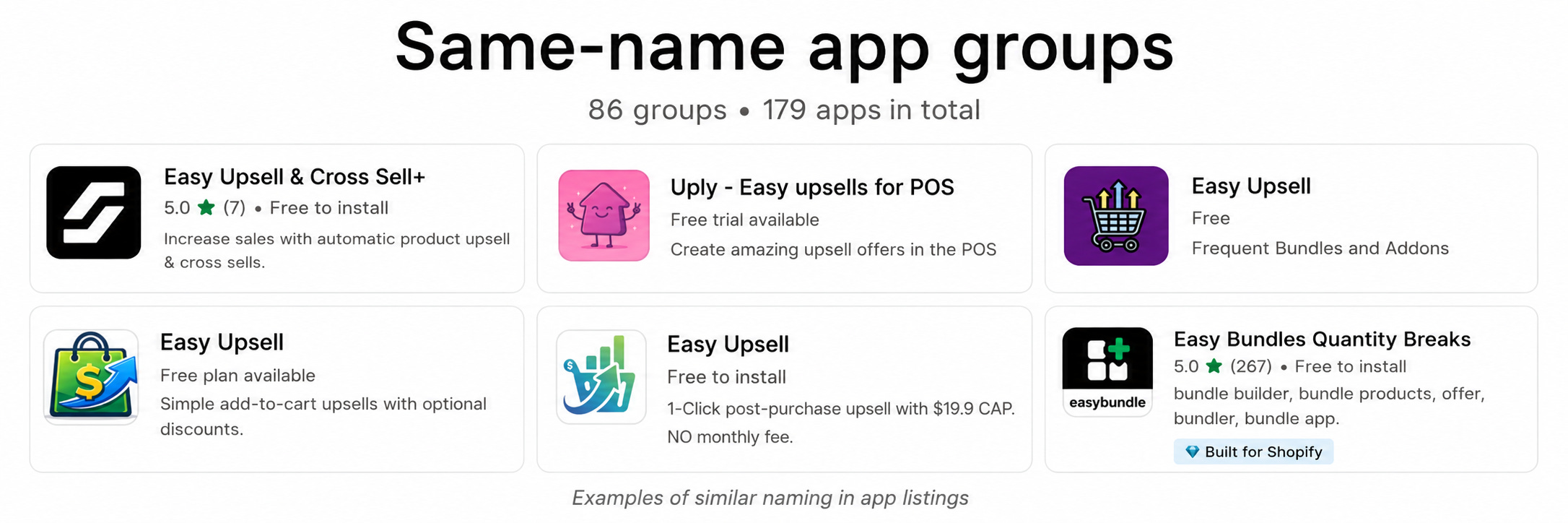
Interestingly, in Shopify, some apps have exactly the same names even though they have been uploaded by different developers. It is also interesting that Shopify has not applied a limitation on this issue, and many of these apps can receive the Built for Shopify badge.
In most of these cases, a newer app has copied the exact name of a larger app and is trying to enter the market with that name.
Based on this review, there are 86 groups of same-name apps, including 179 apps in total. This means that some app names have more than two similar versions.
Examples of these groups include Easy Upsell, EU Withdrawal Button, WhatsApp Chat Button, and Trustify: Trust Badges & Icons.
But if we take a broader view, many apps may not have exactly the same name, while still being very similar in their core phrase, positioning, or main naming message.
For this reason, we also used a broader criterion: overlap in core phrases.
With this broader criterion, the picture became very different.
In total, 2,982 phrase-similar groups were identified. Also, 8,185 apps were placed in at least one similar-name group.
This means that around 36.26% of all apps have names with significant overlap with apps from other developers.
This analysis has several clear messages for developers, product teams, and people active in the Shopify ecosystem.
First, the market is highly fragmented and strongly long-tail. Most developers have only one app, so entering the market may seem easy. But being seen and surviving in the market is much harder.
Second, AI has become one of the main tools of positioning. When almost 10% of all apps mention AI in their names, and AI is the most frequent meaningful word in app names, simply adding AI to the product name is no longer a real differentiator.
The real advantage must come from output quality, user experience, data, workflow, and proof of product value.
Third, SEO is one of the hottest connection points between AI and Shopify. The high share of SEO apps that also have AI in their names shows that developers see this area as one of the most suitable use cases for AI for merchants.
Fourth, naming in the Shopify App Store is highly competitive and repetitive. When around 36% of apps have names with significant overlap with apps from other developers, choosing a distinct, accurate, and trustworthy name becomes more important.
The Shopify App Store is large, fragmented, and highly dependent on third-party developers.
The data from this sitemap shows a marketplace with more than 22,000 apps, where most developers have only one app, while a small number of developers own much larger portfolios.
It also shows that AI has become one of the strongest naming and positioning signals in the market. Around 10% of all apps mention AI in their names, and AI is the most frequent meaningful word in app names.
At the same time, app naming is becoming crowded and repetitive. A significant share of apps use names that overlap with apps from other developers, either exactly or through similar core phrases.
In other words, the Shopify App Store is no longer just a marketplace of apps. It is a crowded positioning battlefield, where AI, SEO, naming, and trust all shape how products compete.
No posts
Comments
Nothing yet. Say the first thing.
Sign in to join the conversation.