
A recent LinkedIn post by Fabrizio Assabese, Chief Growth Officer at Judge.me, surfaced an insight that challenges a common assumption in the Shopify ecosystem.
The prevailing belief is straightforward: publishing more apps should increase total installs. Broader surface area should translate into broader distribution.
The data suggests otherwise.
According to the portfolio analysis shared by Assabese, the correlation between the number of apps a vendor operates and total installs is minimal (r = 0.19). In practical terms, product count alone does not meaningfully predict distribution.
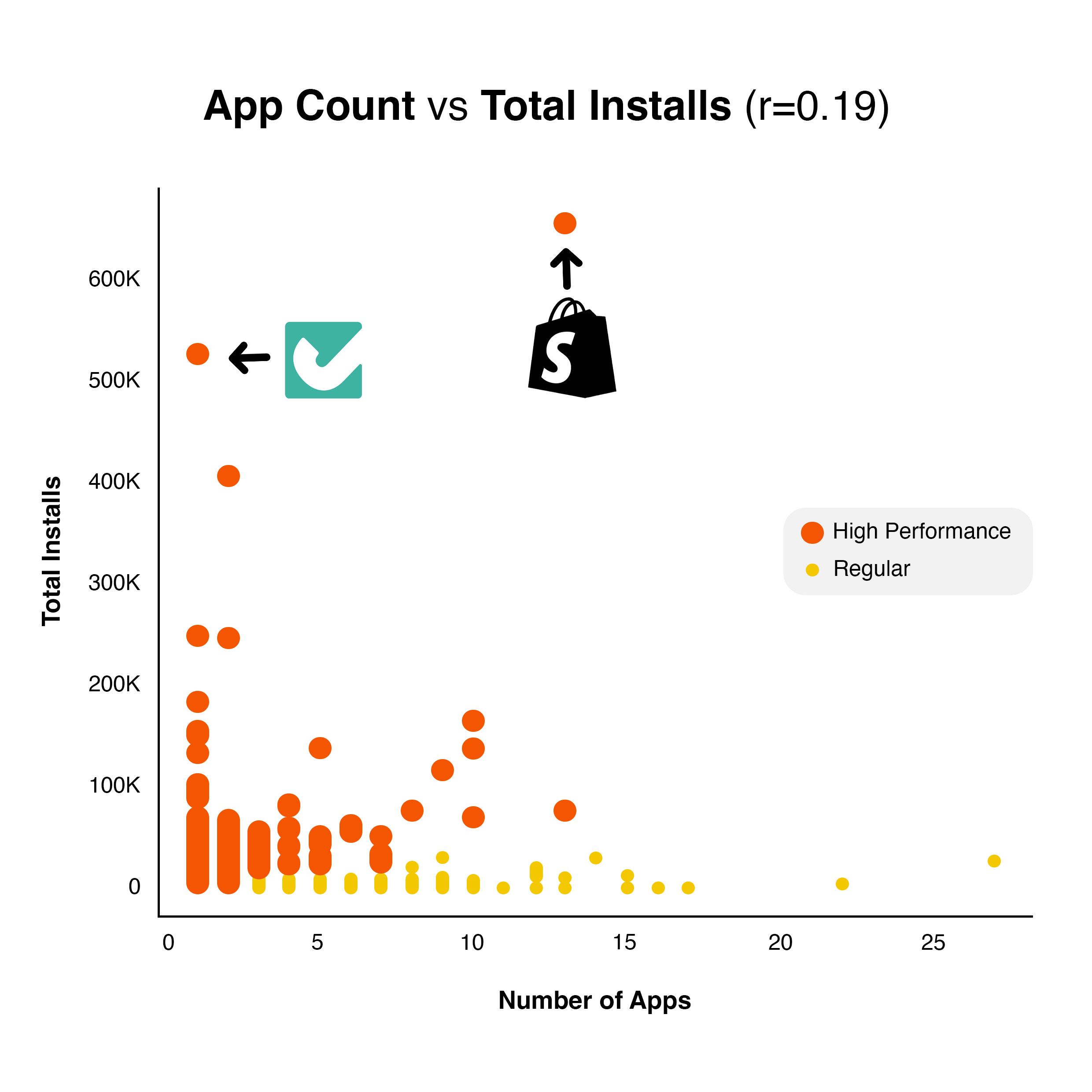
This finding reframes how growth strategy should be evaluated within the Shopify app marketplace.
The distribution of outcomes is not random.
High-performing vendors tend to cluster at two ends of the spectrum:
Single-app category leaders that concentrate resources on one product and dominate a defined use case.
Large portfolio operators that build multiple apps as part of a broader ecosystem strategy.
Both approaches are coherent. Both create structural advantages.
Single-product companies compound reputation, reviews, and brand equity around one core solution. Their growth benefits from focus and category clarity.
Portfolio-scale operators, by contrast, build integrated suites. Their advantage emerges from shared infrastructure, cross-promotion, merchant lifecycle coverage, and internal distribution leverage.
What stands out is not simply that these models succeed, but that they are fundamentally different strategic commitments.
Vendors operating a small collection of apps — typically between two and seven — appear disproportionately represented among weaker performers.
This segment often carries increased operational complexity without achieving either form of advantage:
No clear category ownership
No meaningful ecosystem integration
Fragmented brand equity
Divided marketing focus
Incremental expansion, absent a defined portfolio architecture, does not appear to change outcomes.
The data does not indicate that diversification is harmful. It indicates that partial diversification lacks structural leverage.
For builders in the Shopify ecosystem, the implication is not that more apps are inherently problematic. It is that growth requires strategic coherence.
There are two defensible paths:
Commit to depth and establish clear category authority.
Commit to breadth through intentional ecosystem design.
What the data shared by Fabrizio Assabese makes clear is that expansion without a thesis does not reliably produce scale.
In a marketplace as competitive as Shopify’s, performance appears less correlated with product count and more aligned with strategic clarity.
No posts
Comments
Nothing yet. Say the first thing.
Sign in to join the conversation.