
By: Steve Gabriel
Originally published: March 2017 (Updated 2026)
Anyone who has come across a patch of ramps, or wild leeks (Allium tricoccum), likely cannot help but feel a sense of abundance; these plants often show up in clusters that can range from a few square feet to a solid quarter acre or more of green.
Known widely today as “ramps, ” a name carried over by European settlers from “ramson” (Allium ursinum), these plants have long been part of Indigenous foodways across the Northeast. In languages of the region, they are often understood more broadly as wild onions: in Kanien’kéha (Mohawk), related to otsí:non (onion), and in Seneca as Onohsowa:nes, reflecting their place within a wider group of forest alliums rather than a single named species.
It’s one of the first offerings of the forest in spring, arriving as the woods wake from a long winter’s rest. Ramps are most commonly found in the rich, moist soils of deciduous forests, especially on north-facing slopes and along streambeds. Their range stretches from the southern Appalachians north into parts of Canada and west into the Midwest.
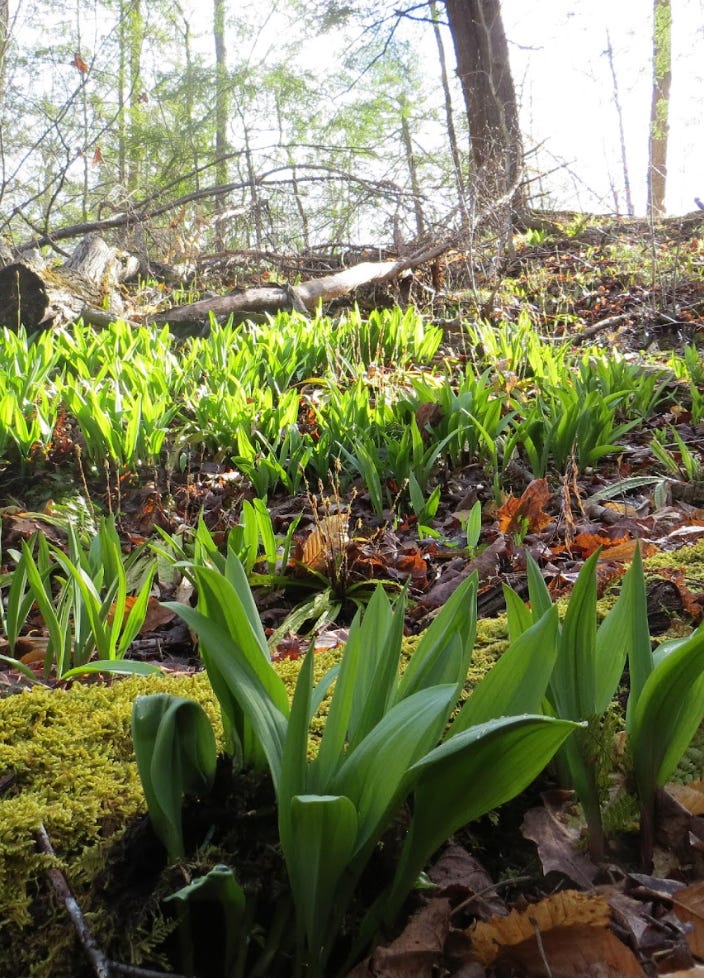
Other than being a tasty delight, ramps fulfill an important ecological role as a “spring ephemeral.” These plants leaf out before the forest canopy closes, capturing nutrients and water early in the season. As they senesce, those nutrients are returned to the soil, contributing to the cycling that supports the broader forest ecosystem.
Ramps prefer cool, moist, north-facing slopes with rich soils and a pH between 4.7 and 6.7. They are often found alongside species such as blue cohosh (Caulophyllum thalictroides), trout lily (Erythronium americanum), trillium (Trillium spp.), and Solomon’s seal (Polygonatum biflorum).
For years, I looked forward to harvesting ramps and assumed I could gather a share without inflicting harm on the population. Like many, I initially leaned on the common “1/3 rule” for wild gathering - harvest no more than a third of what you find.
But this rule does not hold up for ramps. It assumes a level of resilience that simply isn’t there. Ramps are slow-growing, long-lived perennials with limited reproduction and dispersal, and applying a blanket rule across species overlooks these realities.
Research reinforces this. A study on ramp populations in the southern Appalachians found that:
“Harvesting wild leek is not sustainable except at very modest levels… the sustainable harvest level is predicted to be 10% or less, once every 10 years.”
Another five-year study in Quebec reached a similar conclusion, noting that even relatively low harvest levels can lead to decline, particularly in less productive years.
Taken together, these findings suggest that even conservative harvest can have lasting impacts. A reasonable guideline is to limit harvest to no more than 5% of a population, and even this should be approached with caution.
Rather than relying solely on annual harvest percentages, a more effective approach is to think in terms of rotation across space and time. In practice, this means dividing a ramp patch into defined sections, and harvesting each area only occasionally, allowing multiple years for recovery before returning.
In most cases, dividing a patch into 5 to 10 zones provides a practical balance between access and recovery. Fewer zones mean shorter return intervals and greater pressure on the plants, while more zones extend recovery time and reduce impact. For ramps, which may take five to seven years to mature, a rotation of at least this length is ideal. A useful strategy is to create one zone for every year you want the patch to rest.
These zones do not need to be perfectly measured. In many cases, natural features, logs, slope changes, tree groupings, can define boundaries just as effectively as a mapped grid. Where a more formal layout is useful, patches can be divided into square blocks, for example 10–25 feet across depending on patch size, but the goal is consistency over precision.
Once divided, harvest rotates through zones on a fixed cycle. A 5-year rotation supports lighter use, typically focused on leaf harvest, while a 7–10 year rotation is more conservative and aligned with full recovery timelines. Each year, only one zone is harvested, while the rest remain undisturbed.
Rotation can also be paired with the leaf harvesting method. Leaf harvest may occur more frequently, while bulb harvest, if done at all, is reserved for rare and widely spaced intervals and more important for dividing and repopulating patches.
Not all zones should be treated equally. Before harvesting, it is important to assess density, age structure, and signs of past disturbance. Areas with a higher proportion of multiple leaf plants may be more suitable for light, selective harvest. Some zones may be skipped entirely if they show signs of stress, low regeneration, or repeated past harvest.
This approach avoids a key limitation of percentage-based harvest: even small annual harvests can become unsustainable when repeatedly taken from the same plants. By shifting harvest across space and building in time for recovery, rotation aligns harvest with the plant’s biology; slow growth, limited dispersal, and long regeneration cycles.
Field experience and emerging research suggest that leaf-only harvest is significantly less harmful than removing whole plants, particularly when done selectively. Ramps typically produce one or two leaves. When a plant has two leaves, removing one allows it to continue photosynthesis and maintain energy reserves.
While repeated defoliation can reduce vigor, occasional leaf harvest appears far less disruptive than bulb removal. In practice, this means harvesting only from mature, two-leaf plants, taking one leaf per plant, and avoiding repeat harvest in the same patch year after year. This approach does not eliminate impact, but it shifts harvest toward a form that allows populations to persist.
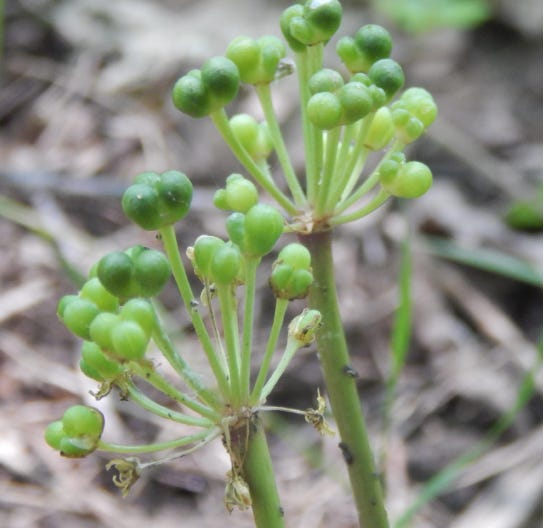
Understanding ramp reproduction helps explain their vulnerability. Seeds mature in late summer and fall to the forest floor, where they undergo double dormancy. A root forms in the first year, while the shoot emerges in the second spring. Even after establishment, plants grow slowly, taking five to seven years to reach maturity.
Seed dispersal is limited. Most seeds fall close to the parent plant, with occasional movement by ants or water. As a result, populations expand slowly, and disturbed patches may take decades to recover.
In many forests, regeneration is further constrained by deer browse, soil disturbance, and changing canopy conditions. Under these pressures, even light harvest can outpace the plant’s ability to replace itself.
Sustainable harvest, then, is not just about restraint, but also about actively supporting regeneration. One of the simplest approaches is to allow a portion of any patch to go fully to seed each year, ensuring that reproduction continues. Seeds can then be gathered at maturity, typically late summer, when capsules begin to open, and either sown immediately or stored for later use.
Fresh seed can be broadcast directly into suitable habitat, ideally in areas with exposed soil beneath leaf litter. Light disturbance, such as gently raking back leaves, can improve contact, after which seeds can be pressed into the soil and covered again. This mimics natural dispersal and is often the most reliable method.
If storing seed, it is important to recognize that ramps require warm and cold stratification to break dormancy. Seeds can be kept moist (not dry) in a breathable medium such as damp sand or peat, held warm for several months, and then exposed to winter conditions. Even under ideal conditions, germination remains slow and uneven.
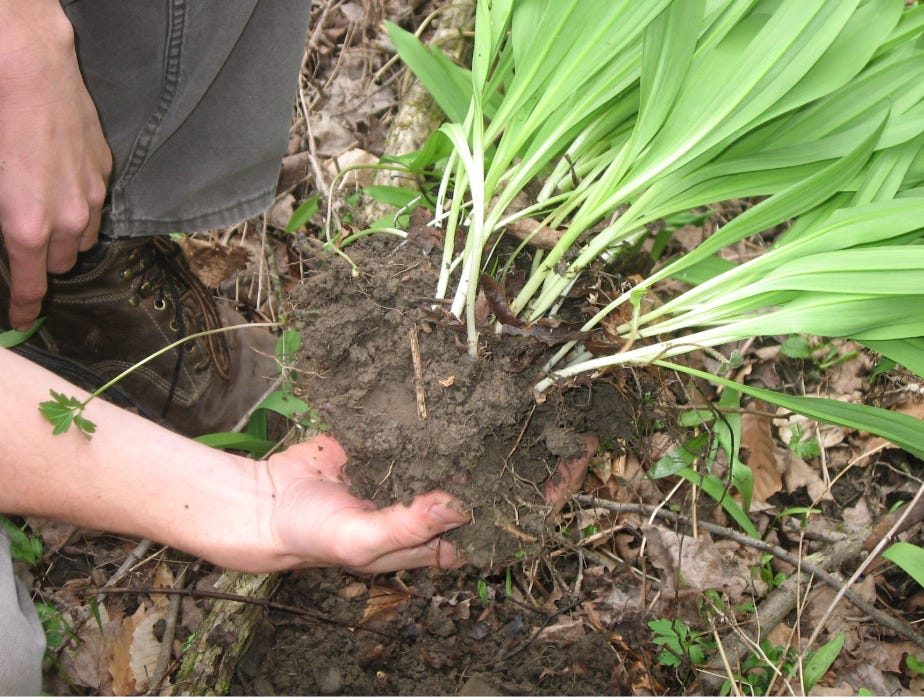
In addition to seed, dense patches can be used as a source for expansion. In areas where ramps are overcrowded, small clusters can be carefully lifted and divided or transplanted into new locations with similar conditions. This is best done during the plant’s dormant period—fall through early spring—when disturbance is less stressful. Only a small portion of any patch should be used in this way, and care should be taken to replant immediately and maintain soil moisture.
Over time, these practices—encouraging seed production, dispersing seed, and selectively dividing dense patches—can shift a population from static or declining to gradually expanding. In this way, harvest becomes part of a larger cycle of stewardship, where use and regeneration move together.
Consistent moisture is critical, and mulching with leaves—especially from sugar maple—can improve success. Shade levels of at least 50% or more are recommended.
Ramps offer one of the earliest flavors of spring, but their abundance can be misleading. Beneath the surface lies a plant that grows slowly, disperses modestly, and depends on long, undisturbed timelines.
Harvesting, then, becomes less about how much we can take, and more about how we choose to participate in that cycle—balancing use with care, and ensuring that these plants remain part of the forest for generations to come.
Nault, André, and Michel Gagnon. 1993. “Ramet Demography of Allium tricoccum, a Spring Ephemeral, Perennial Forest Herb.” Journal of Ecology 81 (1): 101–119.
Nault, André, and Michel Gagnon. 2004. “Harvesting of Wild Leeks (Allium tricoccum) and Its Impact on Plant Populations in Southern Quebec.” Biological Conservation 118 (4): 479–486.
Rock, Jennifer H., Christopher B. Beckage, and Louis J. Gross. 2004. “Population Recovery of Wild Leek (Allium tricoccum) Following Differential Harvesting in the Southern Appalachians.” Biological Conservation 116 (2): 227–234.
Davis, Jeanine M. 2014. Ramps: Sustainable Harvesting and Production. Raleigh, NC: North Carolina State University Extension.
Chamberlain, James L., Michael R. Emery, and Thomas J. Patel-Weynand. 2018. Assessment of Nontimber Forest Products in the United States under Changing Conditions. Gen. Tech. Rep. SRS-232. Asheville, NC: USDA Forest Service.
Emery, Marla R., and Rebecca J. McLain, eds. 2021. Non-Timber Forest Products in the Global Context. Cham: Springer.
Greenfield, Jake, et al. 2019. “Forest Farming of Ramps (Allium tricoccum): Ecology, Production, and Harvest Considerations.” Cornell Small Farms Program / Northeast SARE outreach materials.
United Plant Savers. 2023. “Species At-Risk List and Sustainable Harvesting Guidance.”
USDA National Agroforestry Center. 2008. Growing and Marketing Ginseng, Goldenseal, and Other Woodland Medicinals. Agroforestry Notes.
No posts
Comments
Nothing yet. Say the first thing.
Sign in to join the conversation.