
Based on this data and our direct observation and experience, we are offering a selection of willow cuttings by species as well as functional bundles for folks to try out on their projects.
Tree fodder is a well-documented practice globally, with a long history of use in Europe, Asia, Africa, and Oceania as a supplemental and emergency feed source for livestock. Despite this history, the practice remains relatively uncommon and underdeveloped in the Northeastern United States. Questions around nutritional value, seasonal relevance, establishment success, labor requirements, and risk have limited broader adoption by farmers and land stewards.
Between 2019 and 2025, Wellspring Forest Farm conducted two complementary Northeast SARE projects to address these uncertainties. The first project focused on the nutritional value and seasonal variability of common woody fodder species (FNE19-930). The second project examined the practical realities of establishing tree fodder blocks (FNE22-010), with particular emphasis on propagation, site preparation, protection from browse, and time to functional establishment.
Taken together, these projects move tree fodder from a theoretical or experimental practice toward a more clearly defined and repeatable on-farm strategy - but there is still much to learn! Our thanks to NE-SARE for supporting the work. We summarize in this article what is more detailed in the two reports posted on their site, and linked by grant number above.
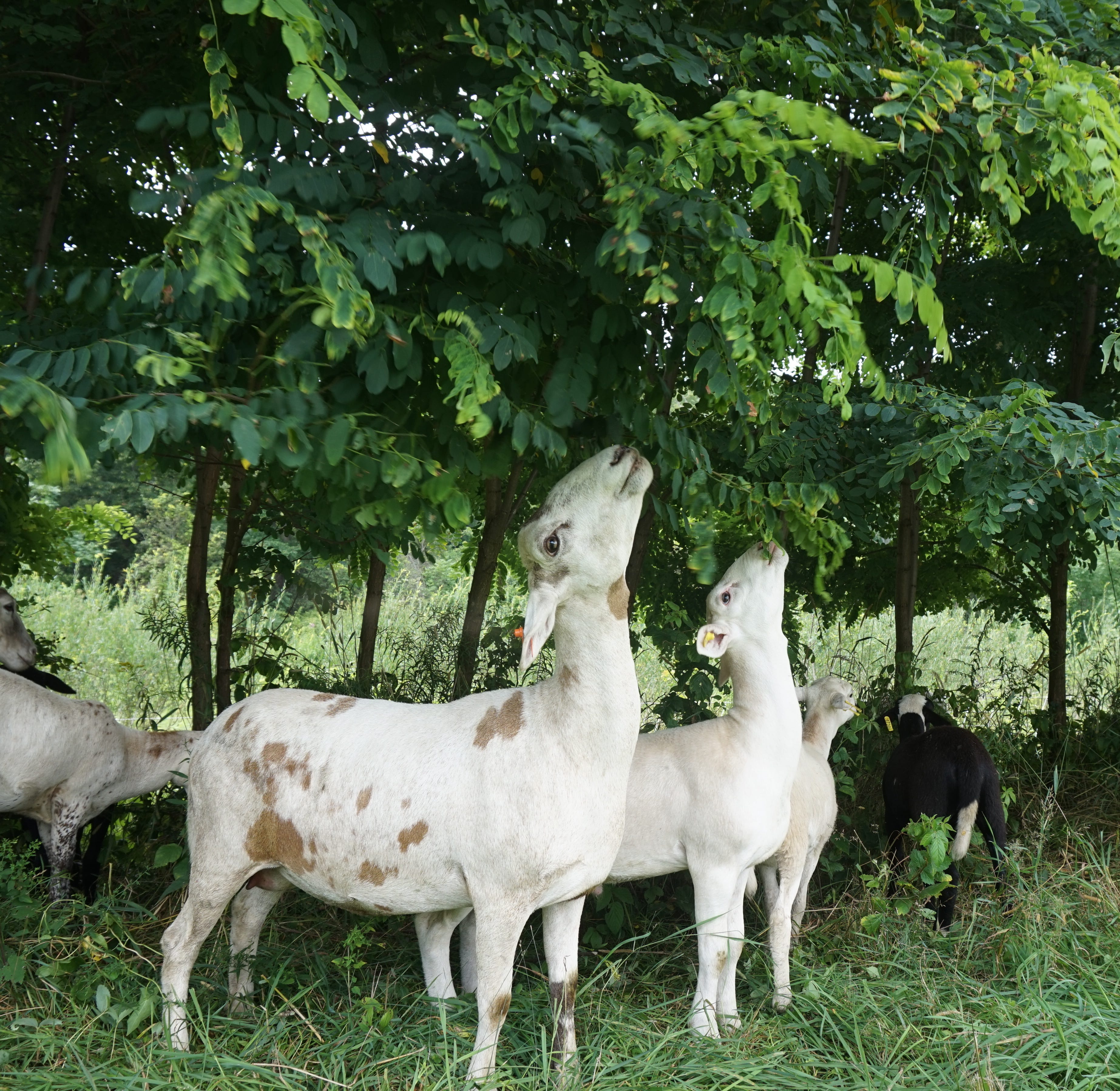
Based on this data and our direct observation and experience, we are offering a selection of willow cuttings by species as well as functional bundles for folks to try out on their projects. Context matters, along with your goals, and our aim is to provide as much detailed info on the varieties to help make a match. We detail each of these varieties in another substack post.
The first project (Quantifying Nutritional Value and Best Practices for Woody Fodder Management in Ruminant Grazing Systems) addressed a foundational question for grazing farmers: Do common woody species in the Northeast provide meaningful nutritional value for livestock, and does seasonal timing significantly affect that value?
To answer this, we collected and analyzed leaf forage samples from six woody species commonly found on Northeast farms, three that were established by us in our silvopasture system - willow, poplar, black locust - and three found commonly naturalized and labeled as “invasive” or toxic; buckthorn, honeysuckle, and wild cherry. Samples were collected repeatedly across the grazing season during two contrasting years: one unusually wet and one unusually dry. All samples were analyzed at a forage lab, using standard forage analysis metrics.
Across both seasons, results consistently showed that most of the sampled species provided good to excellent feed value, with wild cherry offering more moderate values relative to the others. Crude protein, fiber, and digestibility indicators generally fell within ranges suitable for ruminant livestock.
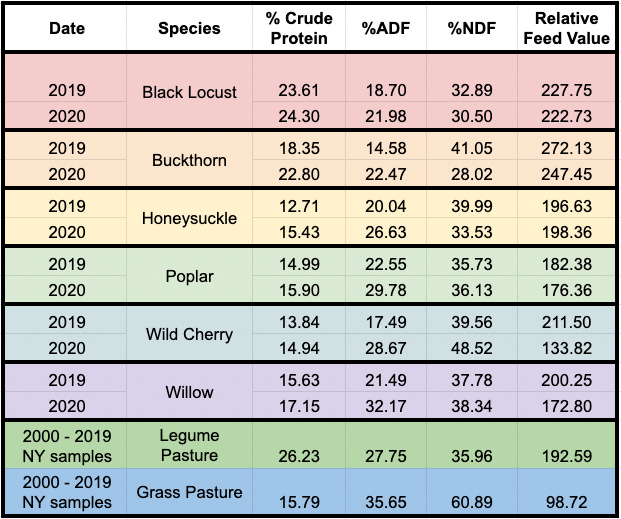
While individual nutrient values fluctuated over the course of the season, few strong or consistent seasonal trends emerged. Even when changes were observed, values typically remained within acceptable ranges. As a result, there was little evidence to suggest that precise timing of fresh fodder feeding would meaningfully improve nutritional outcomes.
An additional and notable finding was that two species often considered undesirable or “invasive”—buckthorn and honeysuckle—demonstrated strong nutrient profiles, including elevated mineral concentrations in some categories. While this does not imply that these species should be encouraged to spread unchecked, it does suggest opportunities for strategic management and utilization rather than wholesale removal, utilizing grazing animals as a form of vegetation control.
Tree fodder functions well as a supplemental and emergency feed source, particularly during periods of drought or excessive moisture when pasture performance is reduced.
Most sampled species provided adequate crude protein, fiber, and digestibility for ruminant diets.
Seasonal timing of fresh fodder feeding was not a critical management factor for the species studied.
Species differ less in overall suitability and more in specific nutrient profiles, particularly protein versus mineral contributions.
Woody fodder plantings can align well with conservation objectives (buffers, windbreaks, erosion control) while still contributing to farm productivity.
While the first project suggested the nutritional potential of woody browse, the second project addressed a more challenging constraint: successful establishment. In practice, the primary barrier to tree fodder adoption is not feed value, but the difficulty of getting trees established, protected, and growing beyond browse pressure in a reasonable timeframe. We ended up focusing on willow because it has so many varieties, clear benefits as fodder mostly from condensed tannins that support animal health, and are important species in supporting healthy riparian water corridors while offering early season pollinator benefits. More on the amazing benefits of willow here.
This project focused on willow-based fodder blocks and examined two central questions:
What are the relative costs and benefits of producing planting stock on-farm versus purchasing material?
What intensity of site preparation and protection is necessary for trees to survive and grow to functional browse-safe height?
The project tested multiple site preparation strategies and tracked survival and growth over several seasons, while also documenting real-world disruptions such as pest outbreaks, frost events, and extreme weather variability. Given that deer browse pressure was a persistent and influential factor throughout the establishment phase of the fodder block plantings, we utilized a perimeter 3D fence system rather than individual tree protection alone. Our observations indicate that the 3D fence functioned well, but as a behavioral deterrent rather than a complete physical barrier. When properly installed and maintained with adequate voltage, the fence altered deer movement patterns and reduced the frequency and severity of browse within the planting areas, but it did not eliminate deer presence entirely. Effectiveness was highly dependent on routine monitoring and maintenance, including maintaining voltage, addressing grounding issues from vegetation or fallen branches, and identifying site-specific vulnerabilities where deer could gain a running start or landing zone. These findings suggest that 3D fencing can be a cost-effective and flexible strategy for protecting tree plantings during establishment, particularly when paired with site preparation that increases tree growth.
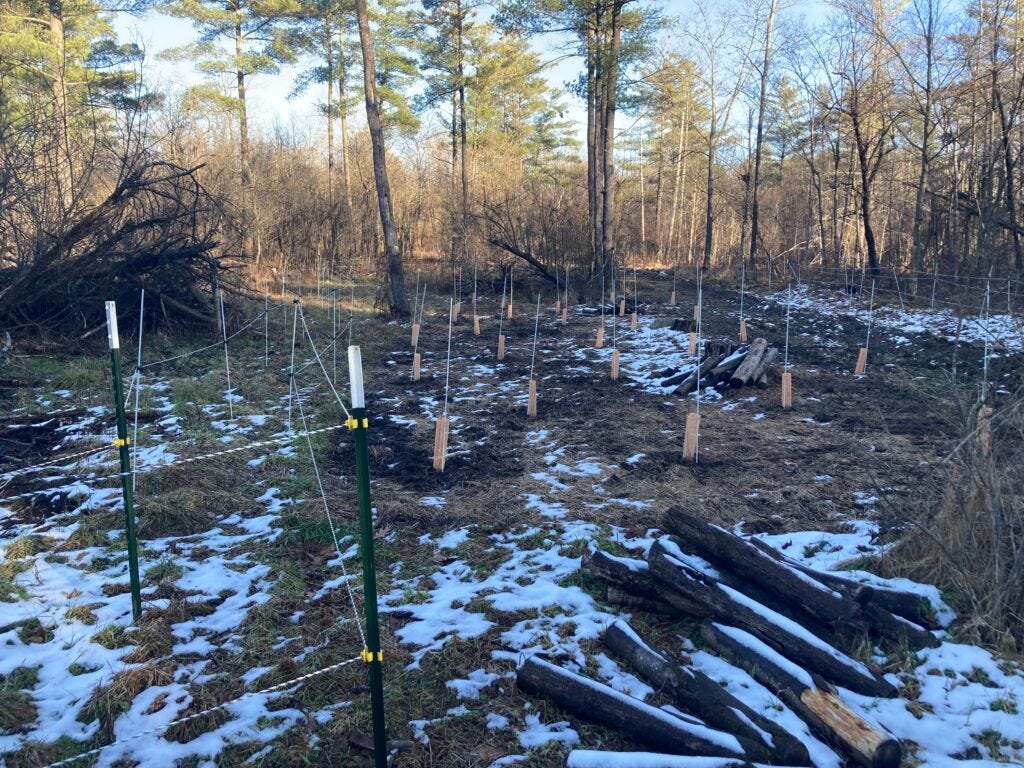
By year three, 79 trees had been planted and 67 remained alive, representing an overall survival rate of approximately 85%. However, the project emphasized that survival alone was not sufficient as a measure of success. Instead, we evaluated “thrivability,” defined as the speed at which trees reached functional browse-safe height.
Two height thresholds proved particularly useful:
48 inches, indicating meaningful establishment but continued vulnerability
72 inches, indicating substantially reduced browse risk and the potential to reduce protection
The data showed that site preparation intensity was the strongest driver of establishment speed:
The excavated and mounded site (Plot B) produced the greatest average height growth and the highest percentage of trees exceeding 72 inches by year three.
The tarped site (Plot A) showed the lowest overall growth.
The chipped site with heavy organic debris and reduced competition (Plot C) experienced higher mortality, but strong growth among surviving trees.
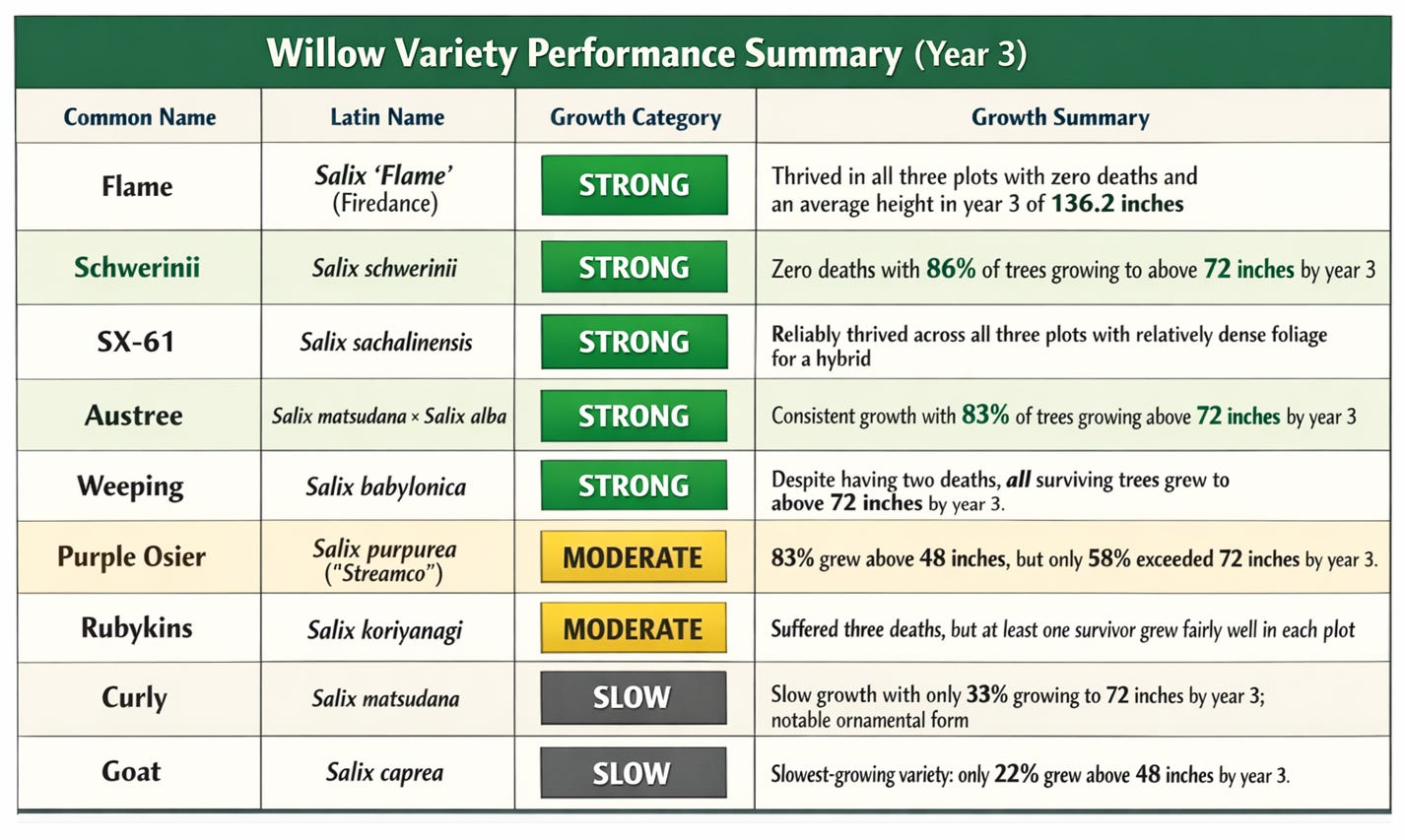
Variety selection also influenced outcomes, though not always in expected ways. Top-performing varieties for height growth and browse escape included:
Flame (Salix ‘Flame’ / Firedance)
Schwerinii (Salix schwerinii)
Sx61 (Salix sachalinensis)
Austree (Salix matsudana × alba)
Weeping (Salix babylonica)
Osier (Salix purpurea)
Slower-growing varieties included:
Curly (Salix matsudana)
Goat (Salix caprea)
One important outcome was that the strongest-performing variety, Flame, was a wild hybrid sourced directly from the farm landscape. This reinforced the value of local adaptation and farmer-led selection, and highlighted the limitations of assuming purchased material will outperform locally sourced stock. Projects should seek to source material as well as discover the own treasures that may be already present in the landscape.
In addition to the nine willow varieties included in the formal research design, we opportunistically established several additional varieties along the margins of the planting sites to take advantage of available material and favorable site conditions. While these varieties were not included in the replicated data set, their performance is worth noting.
Britzensis (Salix alba ‘Britzensis’) and Miyabeana (Salix miyabeana) both showed strong early establishment and vigorous growth in the wet, disturbed edge conditions where they were planted, and produced substantial leaf biomass relative to many other varieties. These observations suggest they may be promising candidates for fodder or coppice systems in similar site contexts and warrant further, more systematic evaluation.
In contrast, Aquatica Gigantica (Salix aquatica ‘Gigantea’) performed less favorably in our plantings, with slower establishment and less consistent growth under the same conditions. While this is based on limited, non-replicated observations, it highlights the importance of cautious interpretation of varietal claims and reinforces the value of on-farm trialing before wider adoption.
Across both projects, a consistent conclusion emerged: tree fodder systems should be designed and evaluated as long-term farm infrastructure for supplemental and emergency feed supplies. Success depends on aligning establishment strategies with labor capacity, browse pressure, site conditions, and climate variability. We just did a deep dive with willow, but many questions remain, many varieties to test, and many possibilities of how tree fodder can be incorporated into landscape planning for production and ecosystem benefits.
Seasonal timing of fresh fodder feeding is not critical. Its beneficial overall, but the specifics vary by species.
Tree fodder can be fed throughout the growing season without targeting narrow windows for optimal nutrition.Site Prep Matters: Up-front investment reduces long-term maintenance.
Site preparation conducted a season in advance (6–12 months) and focused on reducing competition and improving planting microsites significantly shortens time to browse escape.Set up site based trials; use functional height thresholds to guide decisions for protection and establishment
Trial a range of outsourced and onsite varieties, and consider these thresholds for determining viability beyond just survival:
48 inches indicates progress but ongoing vulnerability
72 inches marks a meaningful shift in management flexibility and protection needs
Match propagation methods to material size.
≤ ¾” cuttings benefit from nursery or air-prune bed establishment
~1” live stakes can be planted directly in suitable, moist conditions
Protection should be practical and monitored.
Short tree tubes and fiberglass stakes protect young plants and simplify maintenance. 3D fencing functions as a deterrent rather than an absolute barrier and requires regular inspection but is cost effective.Select varieties based on system goals.
Fast-growing hybrids support quicker browse escape, while slower-growing varieties may offer other benefits if longer protection is feasible.Source planting material locally when possible.
Locally harvested cuttings provided greater control over timing, freshness, and adaptability, and were substantially more cost-effective when establishment systems were in place.
Across both projects, the results demonstrate that tree fodder is a viable and valuable component of Northeast grazing systems when designed intentionally. While it is not a replacement for pasture, it provides meaningful supplemental feed, supports resilience during climate extremes, and integrates well with broader conservation and agroforestry goals.
When properly established, fodder blocks can function as multifunctional assets, contributing to livestock nutrition, water quality protection, soil stabilization, carbon storage, and microclimate moderation. Rather than adding complexity, well-designed tree fodder systems can increase the capacity of the landscape itself to support the farm through uncertainty.
In this way, tree fodder is not simply an additional practice, but a strategy for aligning ecological function and farm productivity over the long term. We look forward to continuing a lifetime of exploring and partnering with these trees in this way!
Thanks for reading! Visit the farm shop for available cuttings to support your own agroforestry plantings for the coming season.
No posts
Comments
Nothing yet. Say the first thing.
Sign in to join the conversation.