
There is a certain satisfaction in putting food by, a simple task that is not fully appreciated until the deep and dark days of winter, when through stored food one can reconnect to the vibrancy life takes on in the summer months. It feels deeply human to sense the comfort a stored harvest brings.
Our farm shelves are stocked with canned soups, tomatoes, salsa, and the freezer jammed full of lamb, chicken, and berries. Perhaps most abundant of all are the jars of mushrooms from the season, with specimens of lions mane, oyster, and shiitake we grew this year, as well as hunks of wild-harvested chaga and dried reishi, waiting for hot winter tea brews on the wood stove to awaken their potent medicinal compounds.
While the stored harvest brings a sense of security and abundance, in many cases processing foods means a drop in nutritional or medicinal value. As we dehydrate, can, and freeze, we can do our best to preserve the potential of food, but inevitably some of the value with fresh and live foods is lost. Curiously, with mushrooms, one could argue that dried product is not nutritionally inferior when compared to fresh, but simply different.
Vitamin D is hard to find in food, yet it plays a critical role in overall health. Specifically, the vitamin is converted in the liver and kidneys into its biologically active form, where it supports maintaining blood levels of phosphorus and calcium while also promoting bone mineralization and the absorption of calcium. It is also linked to supporting a healthy immune system and the regulation of cell differentiation and growth.
Common sources of vitamin D include sunlight, oil-rich fish, and some dairy products, though many foods are fortified with vitamin D. Fortified foods provide most of the vitamin D in the American diet, as relatively few foods naturally contain significant amounts. Almost all of the U.S. milk supply is voluntarily fortified with approximately 100 IU per cup.
Deficiency in vitamin D is linked to rickets in children and osteomalacia in adults. Those at risk for deficiency include infants who are exclusively breast-fed, seniors, people with limited sun exposure, and individuals living at northern latitudes where winter sunlight is insufficient for vitamin D production in the skin.
Despite the popular assumption that mushrooms want to be grown in dark, dank caves underground, they actually need light to fully develop fruiting bodies. Mushrooms starved of necessary UV light frequencies will appear shrunken or pale in color. Even more remarkable is that mushrooms can synthesize vitamin D when exposed to ultraviolet (UV) light, whether natural or synthetic.
Vitamin D is often described as a vitamin, but it functions more like a prohormone—a compound that sunlight stimulates organisms, including people and mushrooms, to produce. In humans, this compound is later converted into its biologically active form in the body.
One study from Penn State examined the use of pulsed UV light to increase vitamin D content in button, crimini, oyster, and shiitake mushrooms. The results demonstrated that after a very short exposure time, vitamin D₂ content could be increased from very little to upwards of 100 percent of the daily value per serving.
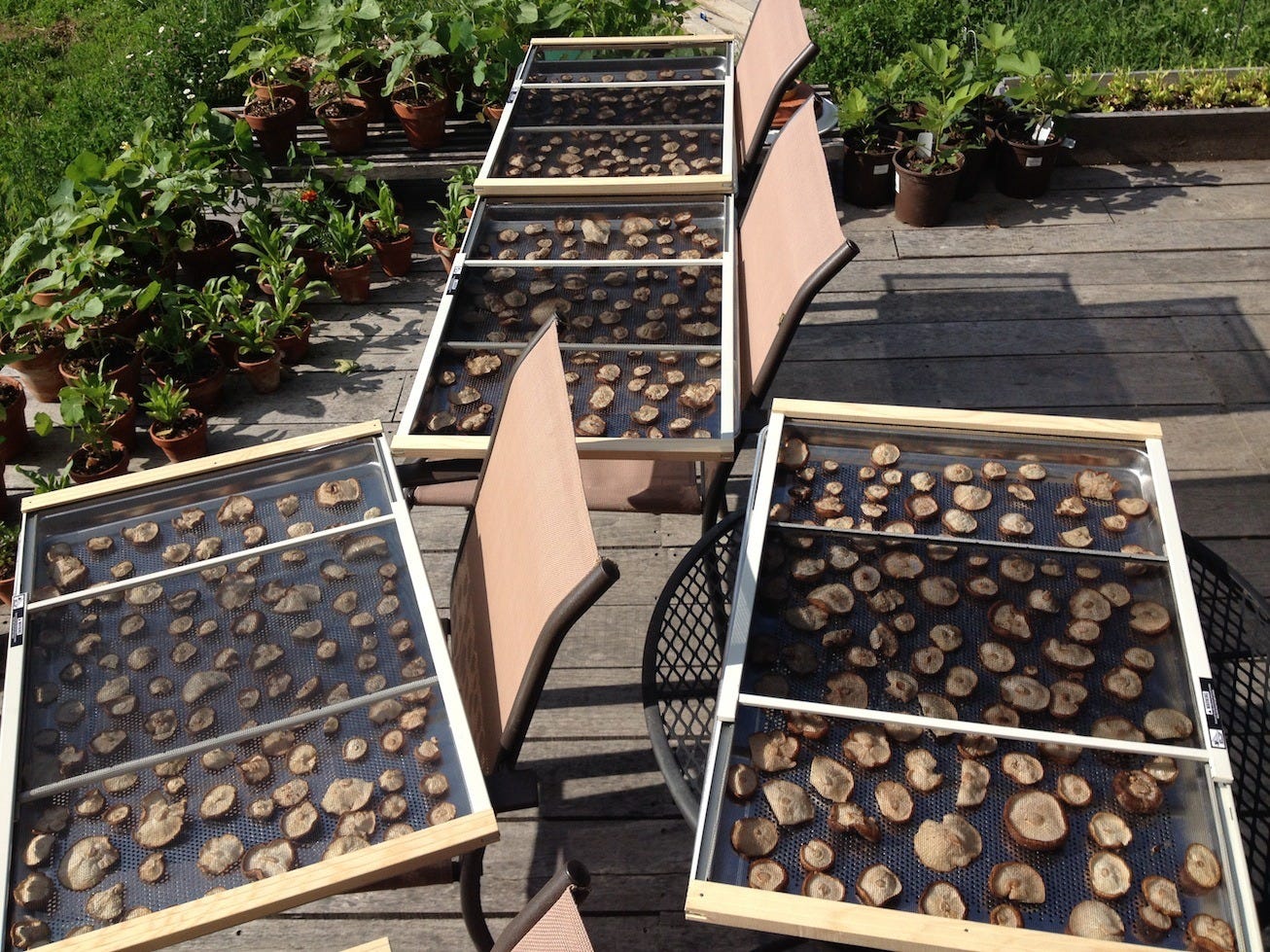
Paul Stamets further explored this relationship and compared synthetic UV exposure with natural sunlight. While UV lamps resulted in greater overall vitamin D conversion in mushrooms, natural light, as he notes, is “a convenient source…whereas setting up a UVB light chamber is not.” Natural sunlight still resulted in more than a 400 percent increase in vitamin D content. Stamets found that sun-dried shiitake increased from approximately 100 IU per 100 grams to nearly 46,000 IU per 100 grams. This rate is more than sufficient for normal consumption, as recommendations from the Institute of Medicine encourage a daily intake of 600 IU for people up to age 70, and 800 IU for those over 70.
Additional research has shown that vitamin D₂ formed in mushrooms through UV exposure is bioavailable and can raise vitamin D levels in the body when consumed as food. Importantly, once formed, vitamin D₂ remains relatively stable through common processing methods, including cooking and drying. While the degree of vitamin D accumulation varies by species, exposure time, and surface area, studies consistently demonstrate that even brief exposure to sunlight or UVB light can result in nutritionally meaningful increases.
With winter, sunlight is at a premium. In many parts of the United States—especially the Northeast—it is actually impossible to naturally produce vitamin D from the sun during winter because the sun does not rise high enough in the sky for ultraviolet B (UVB) rays to penetrate the earth’s atmosphere. This phenomenon is known as the “Vitamin D Winter.”
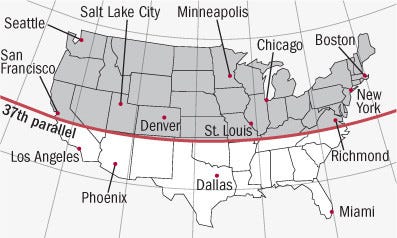
For much of the northern United States, vitamin D winter typically begins in early to mid-November and extends through late February or early March. People living north of approximately 37 degrees latitude are at greater risk of deficiency, a boundary that includes roughly half of the continental U.S.
During this period, we rely almost entirely on the stores of vitamin D already present in the body. Vitamin D can be stored in fat tissue for approximately two months, and when consumed via supplements or food sources (including mushrooms), it circulates in the blood for roughly 24 hours. This means that vitamin D produced or accumulated during late summer and early fall may help buffer deficiency into early winter, but those reserves gradually decline.
It is reasonable, then, to calculate that while one might enjoy the benefits of summer sunlight for the first part of winter, vitamin D deficiency is most likely to emerge in mid- to late winter, often beginning in January or February, as stored reserves are depleted. During this time—when sunlight cannot replenish vitamin D levels—the regular consumption of vitamin D-rich foods becomes especially important. Even modest amounts of sun- or UV-exposed mushrooms could potentially provide days or weeks’ worth of vitamin D during a season when few natural food sources are available.
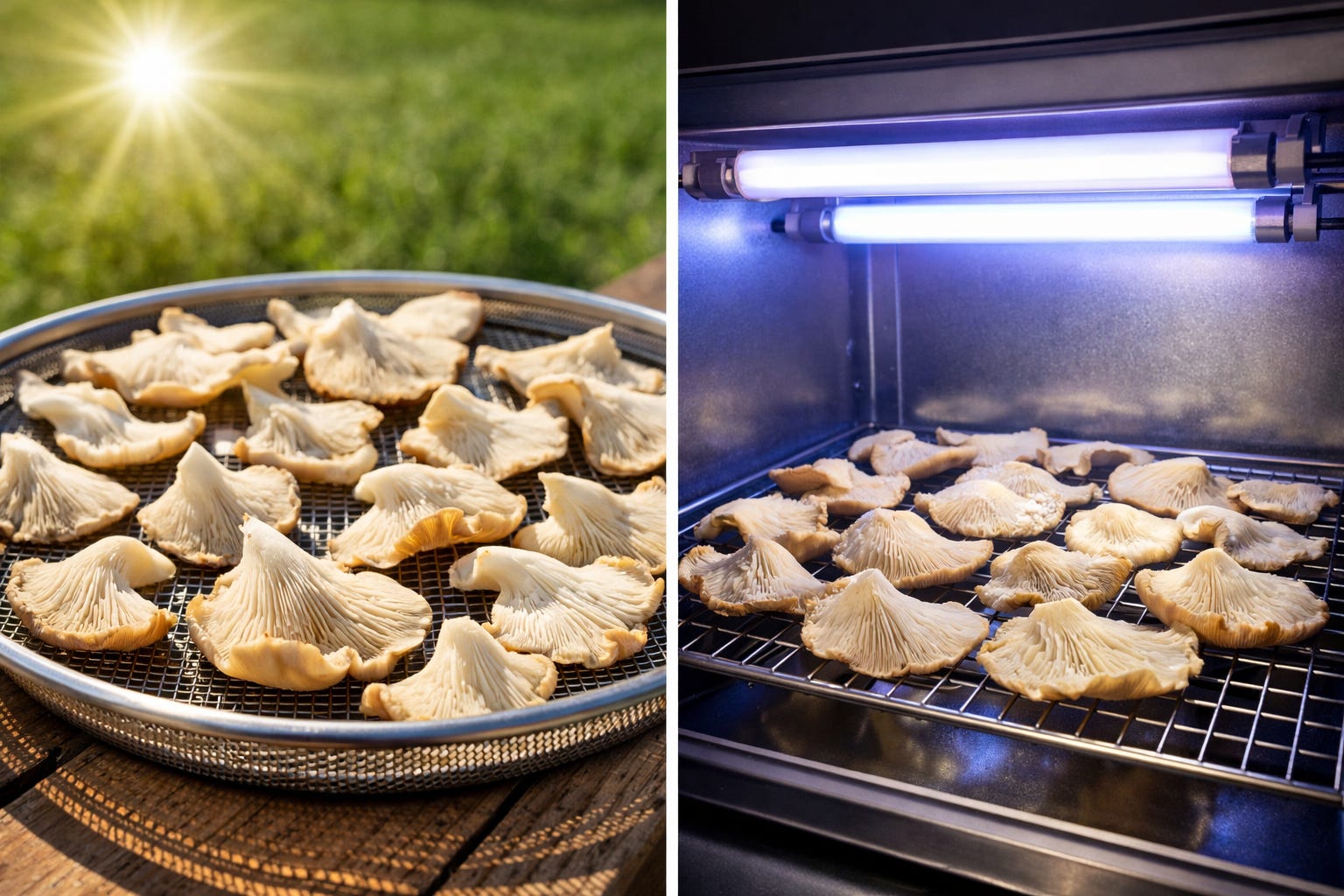
Mushrooms offer a rare opportunity to capture and store sunlight as food, but the conditions of exposure matter. Vitamin D production in mushrooms requires ultraviolet B (UVB) light, the same portion of sunlight responsible for vitamin D production in human skin. There are two main methods to achieve this:
For consumers, the most reliable way to increase vitamin D in mushrooms is through direct, unfiltered sunlight. Fresh mushrooms can be placed gills facing upward on a plate, tray, or screen and set outdoors in full sun for just 30–60 minutes before cooking or preservation. During this time, UVB rays stimulate the conversion of ergosterol in mushroom tissue into vitamin D₂.
It is important to note that standard household windows block nearly all UVB radiation. As a result, placing mushrooms on a sunny windowsill behind glass—while bright and warm—will generally not result in meaningful vitamin D production. For sunlight exposure to be effective, mushrooms must be placed outside or otherwise exposed to sunlight without glass in between.
Breaking mushroom clusters into smaller pieces, slicing thick caps, or turning mushrooms once during exposure improves results by increasing gill and tissue exposure. After sun exposure, mushrooms may be cooked, refrigerated, frozen, or dried as usual. Vitamin D formed during this process remains stable through cooking and preservation.
While simple and effective, this method is also weather- and season-dependent of course - you have to catch that sun while it shines!! But this is a very accessible option, and can work with ANY fresh mushrooms you purchase.
For farms growing mushrooms indoors or operating during seasons with limited sunlight, controlled UV exposure offers a reliable alternative.
A simple UV exposure cabinet can be assembled for well under $100 using a UVB light source, an enclosed box or cabinet to prevent light leakage, reflective interior surfaces, and a basic timer to control exposure duration. Harvested mushrooms are placed in shallow trays—ideally in a single layer with gills facing upward—and exposed to UVB light for 20–45 minutes, depending on species and handling.
Once exposed, mushrooms can be dried, powdered, or sold fresh. As with sun exposure, vitamin D₂ produced through UV treatment remains stable through dehydration and storage, making dried mushrooms and powders particularly effective ways to store sunlight for winter use.
With these methods, the question naturally becomes: how much vitamin D can mushrooms reasonably accumulate, and what does that mean for everyday use?
When mushrooms are exposed to direct, unfiltered sunlight for 30–60 minutes—laid gills up outdoors—studies and on-farm experience suggest that vitamin D₂ levels can increase several-fold. Under good summer conditions, a typical serving of fresh mushrooms may provide a few hundred international units of vitamin D, often in the range of 200–600 IU per half- to one-cup serving. This amount is enough to meaningfully contribute to daily vitamin D intake, particularly when mushrooms are eaten regularly through the winter months. Breaking clusters apart, slicing thicker caps, or simply turning mushrooms once during exposure improves these results by increasing the amount of tissue exposed to UVB light.
When harvested mushrooms are exposed to UVB light in a simple enclosed cabinet for 20–45 minutes, vitamin D₂ levels tend to be more consistent and, in many cases, higher than those achieved through sunlight alone. In this context, a fresh serving of UV-exposed mushrooms can reasonably provide several hundred to over a thousand international units of vitamin D, depending on species and handling. The advantage of this approach is not necessarily higher peak levels, but predictability—an important consideration when sunlight is scarce or inconsistent.
Once formed, vitamin D₂ typically remains stable through cooking, drying, and storage. Drying mushrooms removes water but leaves vitamin D intact, concentrating it in the final product. As a result, relatively small amounts of dried mushrooms—on the order of a tablespoon or two—can provide a substantial portion of daily vitamin D needs.
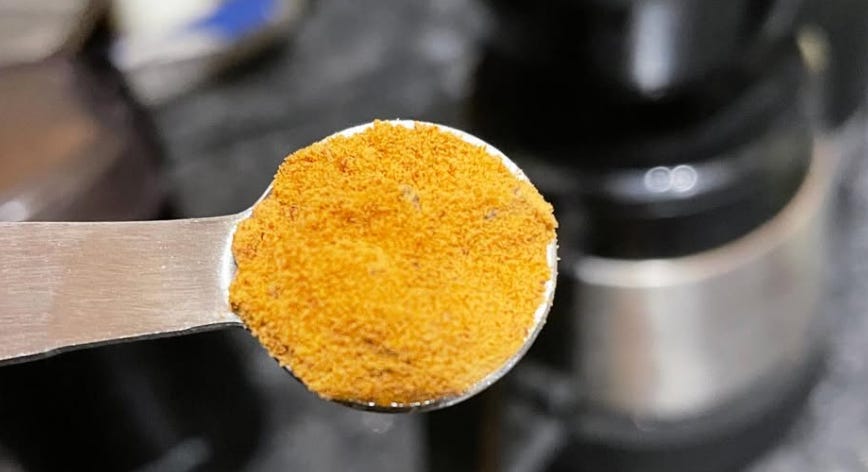
When mushrooms are further processed into powder, this concentration becomes even more pronounced. A quarter to half teaspoon of vitamin D–enhanced mushroom powder may deliver several hundred to over a thousand international units, offering a simple, food-based way to support vitamin D intake during the darkest months of the year.
Taken together, these methods suggest a useful seasonal strategy: fresh mushrooms offer a meaningful boost when eaten regularly, while dried and powdered mushrooms provide a reliable way to carry the benefits of summer sunlight deep into winter. In this way, mushrooms allow us not just to preserve food, but to preserve sunlight itself—stored in a form we can return to when the sun is at its weakest.
Our commitment goes beyond growing and selling mushrooms. We see our role as stewards of both land and knowledge, and we believe that good food carries more value when it is accompanied by a deeper understanding. This includes our ongoing learning and improvement of mushroom production to provide the best results for the wider benefit of the people who consume them.
Our tinctures and powders are already crafted as high-quality, whole-mushroom medicines, produced with care from cultivation through extraction.
Looking ahead, we plan to begin instituting a UV enhancement system in early 2026, allowing both fresh and powdered mushrooms to carry the added benefit of enhanced vitamin D.
As always, we will share what we learn along the way—offering not just products, but the information and practices that help people make the most of them, especially during the long, dark months when nourishment matters most.
Beelman, R. B., & Kalaras, M. D. (2008). Vitamin D₂ enrichment in fresh mushrooms using pulsed UV light. Journal of Food Science.
Cashman, K. D., et al. (2016). Vitamin D deficiency in Europe: Pandemic? The American Journal of Clinical Nutrition.
Holick, Michael F., & Chen, Tai C. (2008). Vitamin D deficiency: A worldwide problem with health consequences. The American Journal of Clinical Nutrition, 87(4), 1080S–1086S.
Johnson, Lana R. (2010). Vitamin D insufficiency due to insufficient exposure to sunlight and related pathology. Student Pulse, 2(12).
Kalaras, M. D., Beelman, R. B., Elias, R. J., & Erdman, J. W. (2012). Effects of UV light exposure on vitamin D₂ content in mushrooms. Journal of Agricultural and Food Chemistry.
Kurihara, Kenzo. (2009). Glutamate: From discovery as a food flavor to role as a basic taste (umami). The American Journal of Clinical Nutrition, 90(3), 719S–722S.
Magee, Elaine, Ed. (2015). Vitamin D deficiency: Symptoms, causes, and health risks. WebMD.
National Institutes of Health, Office of Dietary Supplements. (2004). Vitamin D: Health professional fact sheet. https://ods.od.nih.gov/factsheets/VitaminD-HealthProfessional/
Ohlson, Kristin. (2012). Umami: The secret flavor. Experience Life Magazine. https://experiencelife.com/article/umami-the-secret-flavor/
Penckofer, Sue, Kouba, Joanne, Byrn, Mary, & Ferrans, Carol. (2015). Vitamin D and depression: Where is all the sunshine? Issues in Mental Health Nursing. https://www.ncbi.nlm.nih.gov/pmc/articles/PMC2908269/
ScienceDaily. (2011). Vitamin D deficiency common in cancer patients. American Society for Radiation Oncology. https://www.sciencedaily.com/releases/2011/10/111003132353.htm
Shroff, Rukshana, Knott, Craig, & Rees, Lesley. (2010). The virtues of vitamin D—but how much is too much? Pediatric Nephrology, 25(9), 1607–1620.
Stamets, Paul. (2012). Place mushrooms in sunlight to get your vitamin D. Fungi.com. https://www.fungi.com/blog/items/place-mushrooms-in-sunlight-to-get-your-vitamin-d.html
Sugahara, T., et al. (1975). Contents of 5′-nucleotides and free amino acids in different varieties of dried shiitake mushroom (Lentinula edodes). Journal of Food Science.
Tavera-Mendoza, Luz E., & White, John H. (2007). Cell defenses and the sunshine vitamin. Scientific American, 297(5), 62–72.
No posts
Comments
Nothing yet. Say the first thing.
Sign in to join the conversation.