
At the tail end of March I couldn’t help but stop, pull out my phone and snap the blossoms colouring my muted neighbourhood. Most years I’m dazzled by their return, yet only in some years do I find myself lingering — outside homes, shops, along park paths, anyplace the blossoms appear. This year was one of those years. I held my gaze on weeping forsythia, cherry blossoms, Japanese quince, while others fixed theirs on me. I lingered at the peak of my hilly road, inspecting my neighbour’s wood spurge, until my focus was pulled downward toward the roughly two metre-long patch of moss enmeshed on the pavement in front of the thigh-high brick wall cordoning off the property. Maybe the size of it caught my attention, or its contrast against anthracite asphalt paving.
I wondered why moss chose to grow here.
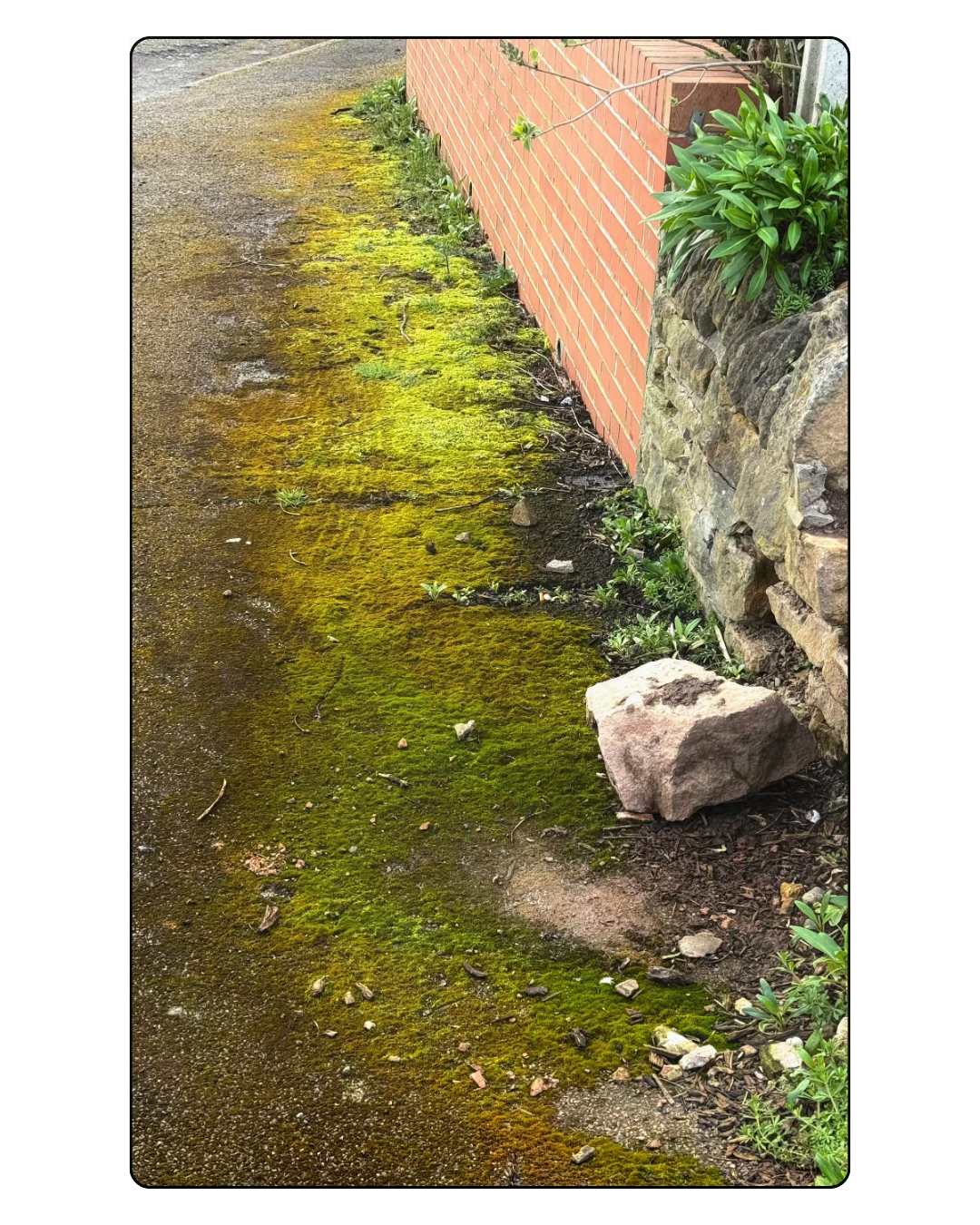
Without thinking, I recalled that my neighbour’s house had quite a gathering of tree logs and wood cuttings lying in that spot for nearly two springs gone by; their tree surgery had a delayed clear-up. Above it hung an aged oak’s cluster of branches. From the little I know of moss, its growth requires dampness, organic matter, shade, and time. Those conditions had gathered slowly, like sediment journeying to the ocean floor. Two springs later, moss had arrived.
Now that I had noticed it, I kept noticing.
It happened again. I stopped to marvel at nettle sprawling across this ninety-two-acre woodland at the dawn of April, and when I moved on, there was moss again, on the one patch man had crafted in this natural reserve. It spread thinly across the edges, crevices, and vertical surfaces of stone steps leading to a low-lying area. I chose to go down the unsteady, well-traversed, rocky path alongside. At the bottom, I turned back. With midday light penetrating the treetops, the stone-crafted, moss-cultured steps appeared like a throne. Not some stepping stones to point B. Perhaps that’s why I, and seemingly many others, had avoided it, choosing the risky path alongside something that looked, from the outside, like a place to be received rather than passed through.
Or perhaps I was afraid I’d slip, as I had once slipped on Riomaggiore’s shoreline, lined with boulders carpeted in sludgy moss. But maybe this time, the moss would have provided a soft landing.
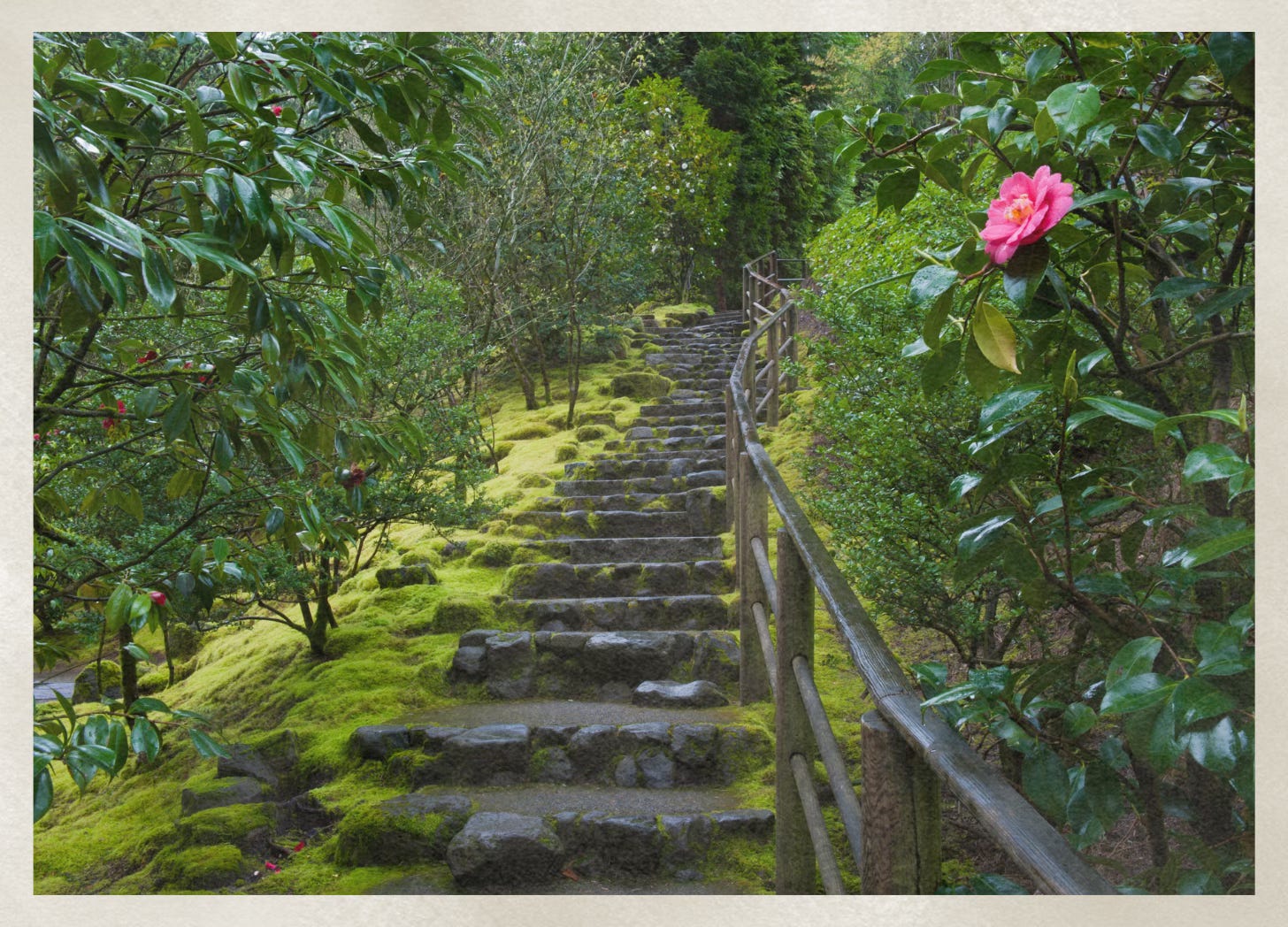
I am only beginning to appreciate that moss doesn’t care for the separation we insist upon between ourselves and the natural world. North-facing rooftops, sun-starved walls, windowsills, pavements and stone steps crafted for seamless human movement: moss arrives in all of them, sooner or later, as long as the conditions are right. There are estimated to be somewhere between twelve and twenty thousand known species of moss on earth, thriving on land and in the ocean alike. They are rootless. They draw everything they need directly from the surface they rest on, and from the air itself.
Robin Wall Kimmerer describes mosses as the coral reefs of the forest, vast intricate communities sheltering worlds within worlds. One gram of forest-floor moss, a piece no larger than a muffin, can harbour 150,000 protozoa, 3,000 springtails, 400 mites, 200 fly larvae. Within that softness, whole ecosystems are sustained.
Moss is also among the oldest land plants on earth. It has outlasted almost everything. When researchers consider the possibility of life on Mars, it is moss they turn to, after certain species survived nine months in open space, outside a station orbiting above our atmosphere. Hope for an entire planet, resting in something that has been growing at our feet for four hundred million years. Unhurried. Undeterred.
“Mosses and other small beings issue an invitation to dwell for a time right at the limits of ordinary perception.” — Robin Wall Kimmerer, Gathering Moss
I have been thinking about what it costs us not to see.
Most of the world runs on capitalist time now, where rest has been reclassified as optional, where slow has become synonymous with unproductive, where even leisure has been shaped into something to be consumed and performed. Jenny Odell wrote that “our very idea of productivity is premised on the idea of producing something new, whereas we do not tend to see maintenance and care as productive in the same way.” Rest, in this framing, is not part of the work. It is the absence of it.
But our nervous systems know otherwise.
I know what happens to my mind and body when I enter a state of genuine rest. My attention narrows, as it did on that pavement, discharging the to-do list, the ongoing strifes, the pressure of commitments, and clearing the shadow that obscures my light. My pace adjusts. Something in me slows to below its usual BPM, like a hand pressed tenderly to a spinning top. I feel lighter on my feet.
I have been chasing a particular freedom. The freedom I first found bouncing on the trampoline, as long as two single beds end to end, in my secondary school's sports hall. When I finally found my rhythm, descending from a height that had initially frightened me, the fear of falling fell away. The surface beneath me was hatched and yielding. Spongy as moss. And in that hall, floating between the ceiling and the floor with no agenda but the rebound itself, I understood something I have been slowly relearning ever since.
That patch of moss on the pavement. The mossy stone steps in the woodland. The moss living on the base of the oak trunk I retreated to. Sludgy moss on Italian shores. Each was a messenger delivering the same unhurried word.
Life requires a soft landing to let you ascend.
Text within this block will maintain its original spacing when published

Robin Wall Kimmerer, Gathering Moss: A Natural and Cultural History of Mosses (2003) — The book from which the quote is drawn. Written by a botanist and member of the Citizen Potawatomi Nation, it reads as philosophy as much as natural history. The best possible starting point for anyone the moss has begun to pull toward. Get a copy from Bookshop.org or Amazon, or your local library.
Jenny Odell, How to Do Nothing: Resisting the Attention Economy (2019) — A wide-ranging argument for reclaiming attention from the systems designed to consume it. Odell moves between art history, ecology, and political theory with an ease that makes the case feel lived rather than argued. Get a copy from Bookshop.org or Amazon, or your local library.
Elizabeth Gilbert, The Signature of All Things (2013) — A novel set across the eighteenth and nineteenth centuries, following a woman whose life’s devotion is the study of moss. Gilbert takes the plant as seriously as any scientist, and the result is a book about slowness, observation, and what it means to give your attention fully to something the world overlooks. Get a copy from Bookshop.org or Amazon, or your local library.
“Moss Spores Survived Nine Months Outside the International Space Station. Then, They Grew Normally on Earth" — Smithsonian Magazine, November 2025. The research behind the space survival detail in this essay, reported accessibly and without a paywall. Read here.
Comments
Nothing yet. Say the first thing.
Sign in to join the conversation.