
It’s near impossible for me to recall the events of all thirty-eight years I’ve collided with this world. My memory: emotionally embellished more than picture perfect. Only when I lay in a field, or trail country parks for no less than the time it takes for my bladder to fill, do some lost years in the contours of my mind resurface. And if the hour gone by is crystallised in my mind, the summer of ‘08 is immortalised. That summer lacks the nostalgia of the summer of ‘69 — yet it left a mark that time never erased.
I always yearn for summer’s return to the UK, especially as a July born. A longing intensified by the thought of my sickled West-African blood finally getting a break — the heat thaws, taking me towards home, and protecting me from returning to wards marinated with antibiotic-infused fluids thinly masked by antiseptics.
Summers of my youth were pretty predictable. Frequent sunny days averaging 26ºC for at least six weeks, with short bursts of showers sprinkled in. Daisy print tees, candy coloured pedal pushers and jelly sandals worn on those adventurous days away from my home’s window pane. Maybe I’ve coloured in this version of time. Regardless, I sensed a chapter closing during the summer of ‘08’s dark and stormy days, while clouds heaved hailstones all over us. Unlike the storms that shadow Miami Beach at 5pm in mid May, the ones haloing the UK, in 2008, chilled, with temperatures tumbling to 5ºC at their worst. According to Rothamsted Research, it was the wettest July since meteorologists began recording in 1890.
So I was right—there was a shift that summer! What I once knew as a time of sun-shimmered recreation had become something else entirely. The sky confirmed what I already felt in my body.
At the same time the storms of summer ‘08 settled in, the two-ply that cocooned my adolescence fell away. After my first full year at university — while it was the summer to let loose in Malia and Ibiza — I spent mine in a King’s Road mobile phone store, earning less than enough to cover my phone bill, car insurance, car parts, Pret’s Chef’s Italian Chicken Salad lunches and Topshop hauls. Some of our customers took a chance on a novel device that has since severed the world deep into its core. And then there were those who sheltered in the store, with many not concerned with niceties. They asserted their rank within the class, race and gender pyramid plaguing the world. Can I speak with a man instead?! a not-too-elderly, not-at-all-gentlemanly time waster protested as I greeted him. At least he looked me in the eye. Others chose to play blind, pushing past me towards male colleagues who were already occupied.
A shadow loomed over me as I gazed out the shop window at the clouds dimming the sky, entranced by the drumming of hail and the lashing of light raving across the sky. An orchestra for the tears I shed, and for the blood that boiled during encounters that were certainly not the sun.
That summer hosed down all illusions I’d carried through my youth. Each day, I smiled through gritted teeth, not knowing what storms were on their way. At 18, turning 19, I felt alone, though never actually alone. Even on the commute, bound to bump into a familiar face, I still couldn’t stop my tears from flooding the carriage. Flawed friendships, fickle finances, family feuds — pompous customers — thunderstorms from dawn till dusk. Rain splattered the pothole encrusted bridge between my first and second year and I could not shelter in the places, spaces and people that were once a sanctuary.
There is a phrase coined by poet John Keats that has stayed with me — what he called Negative Capability in his letters to his brother in December 1817, which is the capacity to remain inside uncertainty and doubt without any irritable reaching after resolution. It can be misinterpreted as ignorance or surrender. But it’s something harder: the willingness to let the storm be a storm without demanding it explain itself, or having a logical reason for arriving unexpectedly. I didn’t have this language at 18. But that summer showed me that expecting a smooth passage that I believed would come with greater autonomy was a kind of wilful blindness. Through that summer, I gradually grasped that confusion and disillusionment and the disintegration of what I thought adulthood would be, was merely treacherous roads we will pass through that can’t be bypassed.
Expecting people to be predictable is like expecting the sky to never surprise. Some stay the same for a stream of seasons long as the Nile. And then, out of nowhere, the unfamiliar brews. A shift in tone. A silence where there wasn’t one. A version of someone you didn’t know existed, arriving at your door uninvited.
I know this, because I am also capable of being that surprise guest.
Maybe it’s the river running through my chart that pushes my tides to turn dark. Fickle I may be. Fearful I can be. Unfriendly — yes, surprisingly. Clouds cloud the light within me. All the seasons live inside me, including storms I have somehow survived.
The philosopher Báyò Akómoláfé posits that disruption is not a problem to be solved but a place to dwell, a crack through which something new enters. Akómoláfé writes in his essay The Times are Urgent: Let’s Slow Down, “Our people think of the dark not as a place of horror and grief, but the place where surprises are stitched, where miracles are sown, where colours are alchemically combined, and where the new tapestries of a preferred existence is buried in wait.”
I think of my storms not as failure, and certainly not as fracture of my being. It’s the most vulnerable contour within me that exists to disrupt my status quo in a bid to better collide with the world.
Today I give grace, and I seek it too. That is how I traverse through the storms I could not forecast in others, in the world, in myself. And my god, this road is never easy! But I have gritted my teeth through enough stormy seasons, inside and out there, to know that they are hardwired into life.
…
Post-storm clarity during a drawn out season of disruption is unlike any sunny day in June. I think of a router blinking back to life. Something functional restored, but now with a system update.
I still don’t know what summoned summer’s cyclical detour that year. I don’t know why someone’s season goes sombre with no warning, or why mine does. But now I know it’s not a cue to cave inwards, but to keep moving ahead, slowing down while going over potholes. And on most days, I get onboard with plot twists and gaze towards the heart of the storm.

We all carry a season that shifted something. I’d love to know yours — and how you’ve learned, or are still learning, to move through what can’t be avoided.

Báyò Akómoláfé’s ‘How to meet the times’ conversation with the Advaya platform takes place on Earth Day (this Tuesday, 22nd April 2026). In this free webinar, he will discuss how can we respond to the old systems that are now fracturing today. Register by commenting EARTH DAY on their Instagram post here.

A Soft Mossy Landing
·
Apr 12
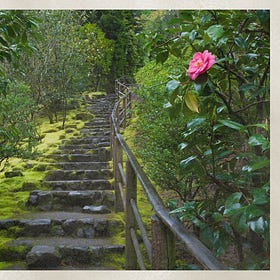
At the tail end of March I couldn’t help but stop, pull out my phone and snap the blossoms colouring my muted neighbourhood. Most years I’m dazzled by their return, yet only in some years do I find myself lingering — outside homes, shops, along park paths, anyplace the blossoms appear. This year was one of those years. I held my gaze on weeping forsythi…
Composing Life: A Spring Equinox Reflection
Comments
Nothing yet. Say the first thing.
Sign in to join the conversation.