

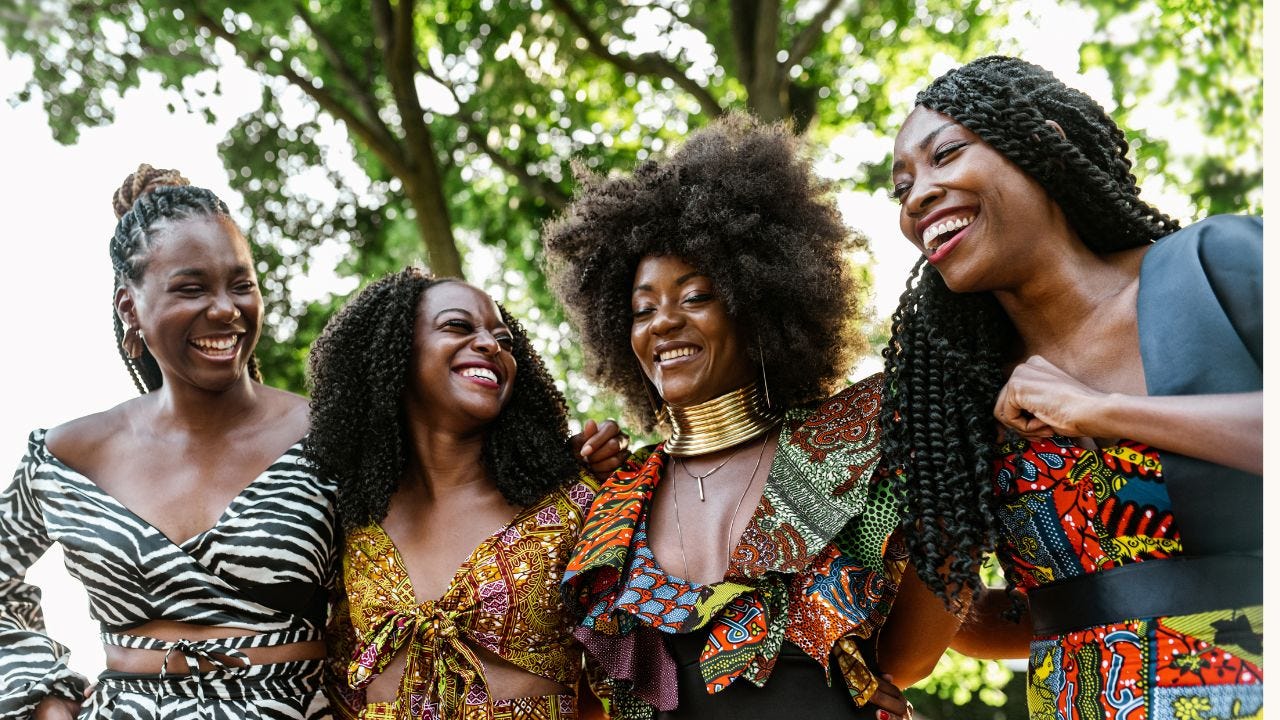
Think about the first time you realized that your hair was something other people felt entitled to evaluate. For many Black people, that awareness arrives early and without much ceremony. A comment at the kitchen sink. A correction before school pictures. An aunt with a pressing comb and a firm opinion about what looked neat. A job interview where you spent almost as much time considering your hair as preparing your answers. A professional environment where you learned to present one version of yourself during the week and reserve another for the weekend. These moments accumulate quietly, shaping what feels appropriate, attractive, polished, or safe. By the time we are old enough to question those ideas, they may no longer feel like messages we absorbed. They can feel like facts we have always known.
This month’s Mental Health Moment explored the psychology of that inheritance: what families, cultures, schools, workplaces, and institutions communicate about Black hair, how those messages shape the way we learn to see ourselves before we are old enough to challenge them, and what the slow, ongoing work of untangling them can require. This Wellness Edit is a companion to that conversation. It brings the subject into the routines, choices, products, stories, and small rituals through which our relationships with our hair are lived every day.
Because few of us encounter our hair from a completely neutral place. Our preferences have been shaped by history, policy, beauty standards, family rituals, media, and the reactions our appearance has received over time. Many people remember the compliments that came when their hair was straightened, lengthened, or otherwise altered, as well as the silence, criticism, or unsolicited advice that appeared when it was not. The CROWN Act exists because discrimination based on hair texture and protective styles has affected Black people in schools and workplaces, with real consequences for how freely people have felt able to present themselves. That is not merely background information. It is part of the context in which generations of Black people have made decisions about their hair, often from an early age and often without realizing how much that context was defining what seemed acceptable or possible.
This edition makes room for the full range of that experience: the historical and the personal, the emotional and the practical. There are tools designed to make caring for your hair feel gentler and less like a task you simply have to endure. There are books that treat Black hair as a subject worthy of thoughtful historical, cultural, and psychological examination. There are playlists for wash day, for getting ready, for feeling yourself, and for the quieter moments when you are simply tending to your hair in the privacy of your own home. Throughout it all, the goal is not to prescribe a particular relationship with your hair, but to offer language, context, and support for approaching it with greater intention, curiosity, and care.
However you wear your hair, and however your relationship with it may be changing, this edition is for you. Come as you actually are.
Hair is one of those subjects that can appear simple until you begin looking closely. What we wear, how we care for it, what we change, what we protect, and what we have learned to consider beautiful are all shaped by histories and expectations that are much larger than any individual choice. The books below approach those questions from different directions, moving between history, cultural criticism, psychology, research, and personal experience. Together, they offer language for understanding why hair can carry so much meaning and why our feelings about it are often more layered than they first appear. They are not meant to tell anyone how to wear their hair or what their choices should signify. Instead, they invite us to become more curious about the stories, pressures, pleasures, and possibilities held within something so deeply woven into everyday life.
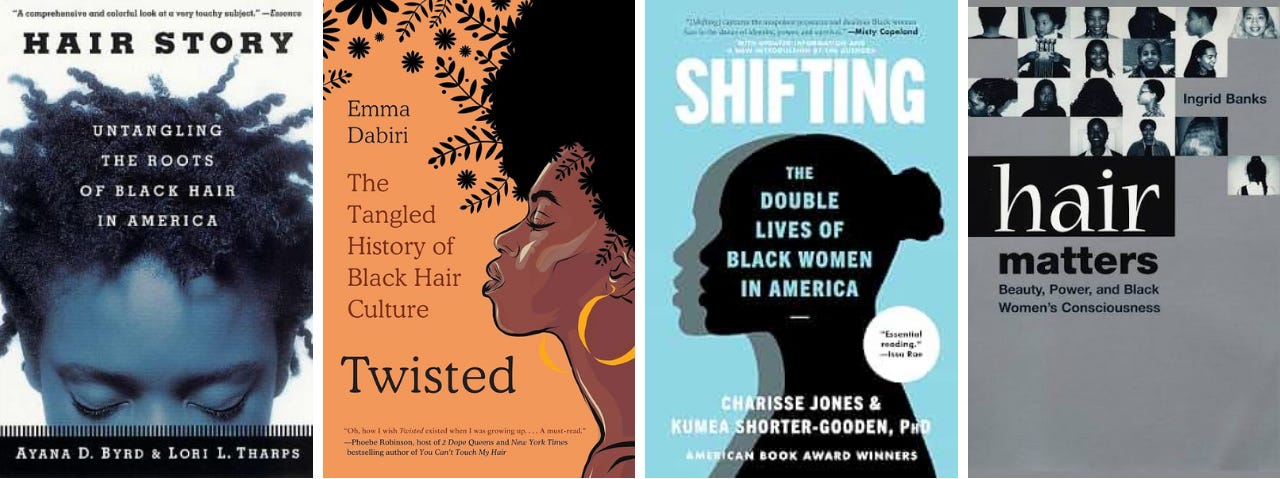
Hair Story: Untangling the Roots of Black Hair in America by Ayana Byrd and Lori Tharps. This is the book that put the history of Black hair in America into a coherent, readable, chronologically organized narrative that most of us never received in school. Byrd and Tharps trace the story from its roots in pre-colonial Africa through the transatlantic slave trade, the Harlem Renaissance, the Black Power movement, the natural hair movement, and into the contemporary moment. What the book does so well is make clear that hair has never been simply aesthetic in this community. It has always been political, cultural, and deeply personal, a site where history has been fought over, reclaimed, policed, and celebrated across generations. Reading it is clarifying in the way that understanding your own history always is: it helps you see your present more honestly.
Twisted: The Tangled History of Black Hair Culture by Emma Dabiri. Dabiri writes with the kind of intellectual sharpness and personal honesty that makes this book feel both rigorously researched and deeply human. She begins with her own experience, growing up Black and Irish, navigating hair that did not fit neatly into either world, and expands outward into a wide-ranging cultural investigation of how Black hair has been stigmatized, appropriated, criminalized, and reclaimed across history. The chapters on the natural hair movement are particularly strong, and her writing on the difference between representation and liberation resonates well beyond the subject of hair. This is a book that asks bigger questions than the one on the cover, which is part of what makes it worth reading closely.
Shifting: The Double Lives of Black Women in America by Charisse Jones and Kumea Shorter-Gooden. This one earns its place on this list because it addresses something the Mental Health Moment explored directly: the psychological cost of constant self-management and identity adjustment in environments that require Black women to calibrate themselves in order to be accepted. Hair is one of the most visible sites of that adjustment, but the book’s scope goes much further, examining how Black women learn from an early age to shift their presentation, their language, their energy, and their expectations in different contexts, and what that sustained internal labor costs over time. It is rigorous, research-grounded, and written with enough emotional intelligence to feel like something more than a social science text.
Hair Matters: Beauty, Power, and Black Women’s Consciousness by Ingrid Banks. Drawing on conversations with more than fifty Black women across generations, Banks examines what our everyday decisions about hair reveal about race, gender, beauty, femininity, sexuality, and power. What makes this book especially valuable is its refusal to flatten Black women’s experiences into a single story. Hair can be a source of pride, pleasure, creativity, frustration, conformity, resistance, or several of those things at once. Banks gives women room to speak honestly about those contradictions and about the social meanings attached to choices that can feel deeply personal. This is a particularly fitting read for this month because it does not attempt to determine what Black women should do with their hair. Instead, it invites us to notice where our preferences came from, what pressures may have shaped them, and what it might mean to make those choices with greater clarity and freedom.
Taken together, these books offer more than history, cultural analysis, research, or personal reflection. They offer a fuller way of seeing. They remind us that our relationships with our hair are never formed in isolation, but shaped by inheritance, memory, beauty standards, family, resistance, belonging, and the desire to be recognized on our own terms. Each book, in its own way, creates space to question what we have been taught, to name the pressures we may have carried without realizing it, and to decide what we want our hair to mean for ourselves. They do not insist that freedom must look like wearing our hair one particular way. Instead, they invite us to move beyond shame, performance, and expectation toward choices rooted in clarity, self-knowledge, and care. For Black women especially, seeing our hair more clearly can become part of seeing ourselves more clearly: not as problems to be corrected or images to be managed, but as whole people entitled to beauty, complexity, creativity, and change. These books are invitations to begin that work.
Wash day is many things to many people. For some, it is meditative, a weekly ritual of care that belongs entirely to them, offering a rare opportunity to slow down, be present, and tend to themselves without interruption. For others, it is labor-intensive, time-consuming, and occasionally fraught with the accumulated weight of years of being told their hair was difficult, unruly, or too much to manage. For most people, it is probably somewhere in between, depending on the week, the season, the state of their emotional reserves, how much time they have available, and how cooperative their ends are feeling. Some wash days feel restorative. Others feel like one more task on an already crowded list. The products below are chosen to support the ritual from a place of genuine care: tools and treatments that do real work, reduce damage, simplify the process where possible, and make the experience of tending to your hair feel less like something you have to get through and more like something you are actively choosing. The goal is not to make wash day effortless, but to make it gentler, more intentional, and more supportive of both your hair and the person caring for it.
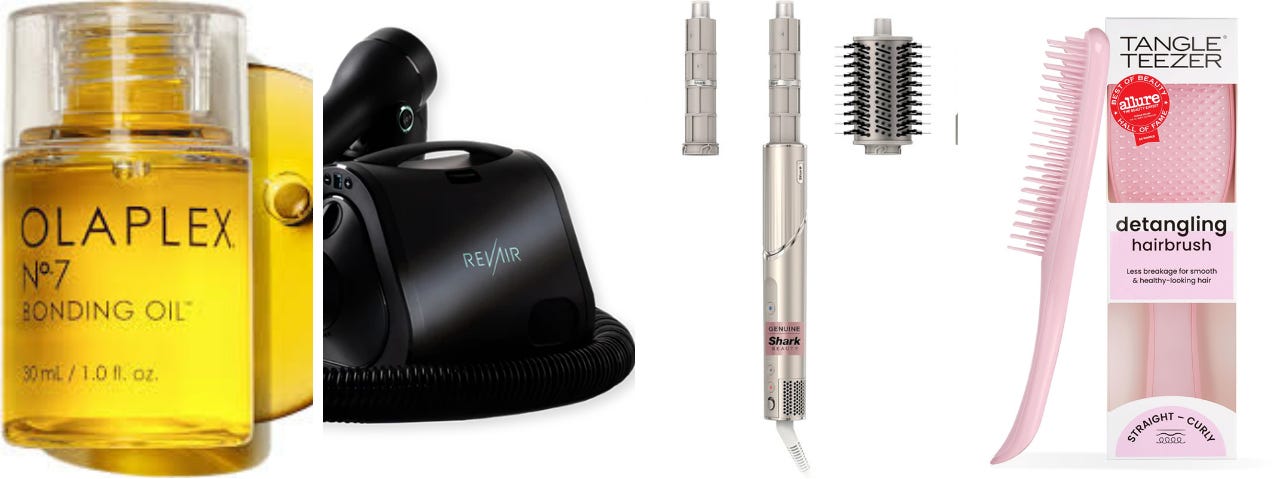
Olaplex No. 7 Bonding Oil Before reaching for the dryer or settling into your final style, a finishing oil that offers more than surface-level shine. Olaplex No. 7 is a lightweight, highly concentrated styling oil designed to strengthen the hair, reduce breakage, smooth frizz, and protect against heat up to 450°F without leaving behind the heavy, greasy coating that can make an oil difficult to use regularly. What makes it particularly useful on wash day is its versatility. A few drops can be worked through damp hair before styling to add protection and softness, then applied sparingly to dry hair to smooth flyaways, revive shine, and bring the finished style together. For anyone whose hair is regularly exposed to blow-drying, flat-ironing, chemical treatments, protective styling, or the ordinary friction of detangling and manipulation, this is the kind of product that supports both the health of the hair and the pleasure of seeing it beautifully finished. Start with less than you think you need, concentrating it through the mid-lengths and ends. You can always add another drop, but a little goes a remarkably long way.
RevAir Reverse-Air Hair Dryer The premise of this tool is simple and the result is genuinely different from anything most people have used before. Instead of blasting heat at your hair from the outside, RevAir uses reverse airflow to draw hair into the wand and dry it from root to tip with friction-free tension. The technology was designed with curly, coily, and textured hair specifically in mind, and it shows. Hair dries faster, with significantly less heat damage, and the curl pattern is maintained rather than disrupted. For anyone who has spent years navigating the tension between wanting their hair to air dry naturally and not having four hours to spare, or between loving their texture and not wanting to damage it with the heat required to style it quickly, RevAir is a real solution rather than a workaround. It is an investment, and it is worth it.
Shark FlexStyle Air Styling and Drying System For the days when you want options. The FlexStyle converts between a powerful hair dryer and a multi-styler with a single twist, offering curl-defining, volumizing, smoothing, and straightening capabilities through interchangeable attachments, all while measuring and regulating heat a thousand times per second to minimize damage. What distinguishes it from the crowded field of multi-stylists is how seriously it takes the damage question, and how genuinely it performs across different hair types and textures, including coily and curly hair that other tools tend to either damage or ignore. It is a one-tool solution for people who want flexibility in their styling without compromise in their hair health. The Black Cherry colorway, for what it is worth, is excellent.
Tangle Teezer The Ultimate Detangler Naturally Curly Detangling is one of the most consequential parts of wash day, and often the point at which the most preventable damage occurs. Designed specifically for wet curls and coils in the 3C to 4C range, this brush uses longer, firmer teeth to move through knots without requiring the aggressive pulling that can turn a routine step into an exercise in frustration. Shorter teeth help smooth the hair and preserve definition as you work, making it especially useful when distributing conditioner or detangling in sections. What makes it worth including is not the promise that every knot will disappear without effort, but that the right tool can make the process gentler, faster, and far less combative. Begin at the ends, work upward slowly, and let water and conditioner provide the slip. Wash day does not have to become a test of how much discomfort your scalp or your patience can withstand.
None of these products are necessities, and that is precisely the point. Hair care does not have to be reduced to maintenance, correction, or the work of making ourselves acceptable. It can also be a place for pleasure, experimentation, softness, and choice. The products above will not change your relationship with your hair on their own, but they may help make that relationship feel a little gentler. They may shorten a frustrating step, reduce unnecessary damage, make styling feel more creative, or turn an ordinary wash day into a ritual you approach with greater ease. There is something meaningful in choosing tools that support your hair rather than asking you to fight against it. Perhaps the deeper invitation is to tend to yourself without resentment, to make room for beauty without apology, and to remember that care does not have to be earned by exhaustion. Sometimes it can simply be something you are allowed to enjoy.
There is a particular kind of intimacy in music that helps you feel more at home in yourself. The right song can soften the edges of a long day, make an ordinary routine feel more intentional, or remind you of something you had briefly forgotten about your own beauty, strength, and presence. From Erykah Badu's unashamed self-possession to India.Arie's quiet insistence on her own wholeness, Black artists have created some of the richest and most enduring music about identity, embodiment, beauty, freedom, and self-acceptance. Their work gives language and rhythm to the experience of learning to inhabit yourself more fully, without shrinking, performing, or apologizing. The playlists below are organized around different emotional states of the hair care ritual and the broader experience of tending to yourself with intention. Each one is designed for actual listening, whether you need energy, ease, reflection, confidence, or simply something beautiful to carry you through the process.

Wash Day The playlist curated specifically for wash day energy: a long, unhurried mix of natural hair era R&B, neo-soul, and the kind of music that makes detangling feel like something you chose rather than something you are getting through. India.Arie, Jill Scott, Solange, and the wider world of artists who understand that wash day is its own kind of ceremony. For section one through deep conditioning.
Lauryn Hill, Erykah Badu, India.Arie, and Jill Scott The queens of a particular kind of Black self-possession: unhurried, musically generous, deeply certain of themselves without needing to announce it. This playlist has over 6,000 saves for a reason. Put it on when you are in the mirror, getting dressed, doing your edges, or simply moving through your space in a way that belongs to you. It is the sound of someone who has decided they are enough.
For When You Are Still Working It Out The more emotionally complex playlist, for the days when self-acceptance is not a feeling you have arrived at but a direction you are still moving toward. SZA, Sampha, Moses Sumney, and artists who understand that loving yourself is not a permanent state you achieve but a practice you return to, sometimes easily and sometimes with significant effort. For the evenings when you are being honest with yourself about where you actually are.
Black Hair Salon Songs Because the salon has always been one of the most important community spaces in Black culture. A place of transformation, yes, but also of conversation, of laughter, of being seen, of rest. This playlist carries that energy: warm, social, joyful, and deeply rooted in Black music across generations. Over 200 tracks, for the long sessions.
Taken together, these playlists make room for the full emotional range of tending to yourself. There is music for the practical work of wash day, music for the confidence that comes when you feel fully at home in your reflection, and music for the quieter moments when that sense of ease still feels like something you are learning. There is also music that carries the warmth of the salon, where hair care has never been only about hair, but about community, storytelling, laughter, observation, and the small intimacies exchanged while someone’s hands are working. None of these playlists ask you to arrive at a particular feeling before you press play. They simply meet you where you are and offer rhythm, companionship, and language for the moment. Whether you are detangling, getting dressed, sitting beneath the dryer, or moving slowly through an evening alone, let the music make the ritual feel more spacious, more enjoyable, and more fully your own.
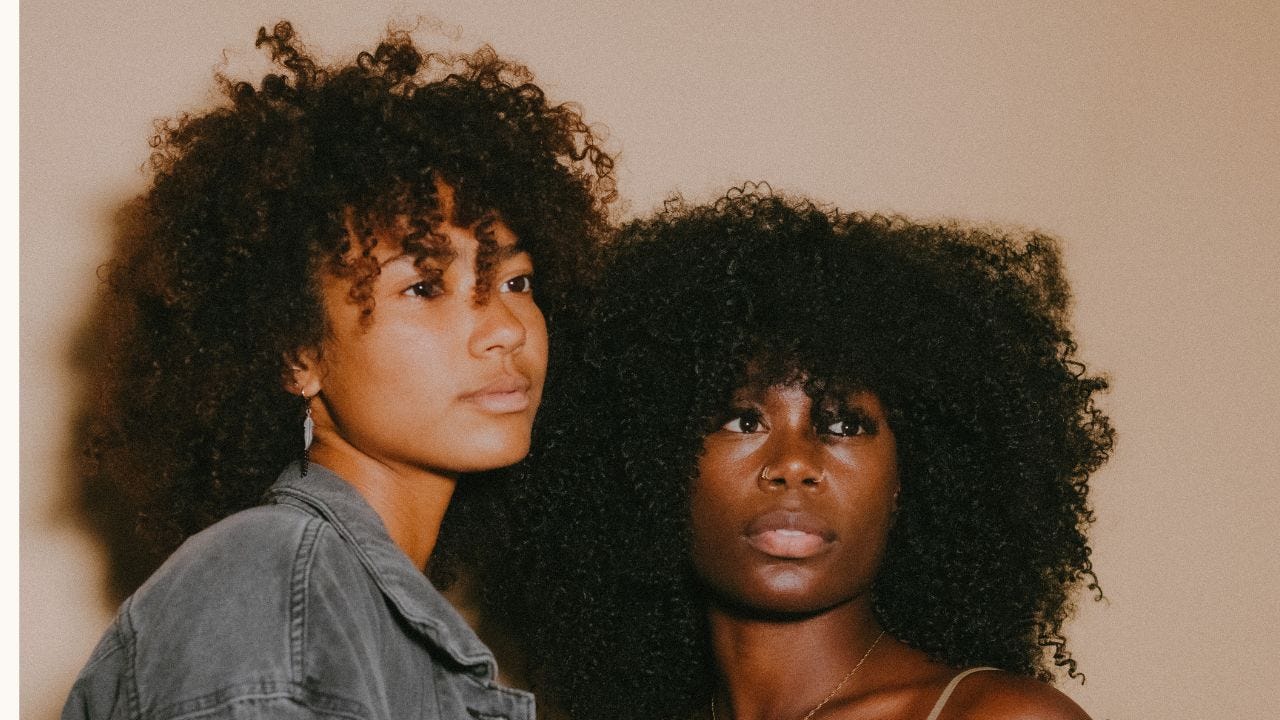
These are not rules. They are not a checklist for becoming someone who loves their hair correctly or has resolved all their complicated feelings about beauty and belonging. They are smaller than that. Gentle entry points for beginning to look at yourself with a little more honesty and a little more care.
1. Ask where the belief came from. The next time you notice a critical thought about your hair, your texture, your edges, your length, your choices, pause long enough to ask whose voice that is. Not to immediately argue with it. Just to notice where it originated. A parent. A peer. A workplace. The wider culture. Understanding the source of a belief is often the beginning of being able to decide whether it actually belongs to you.
2. Notice which version of yourself you style for different rooms. Not to judge the answer, but to see it clearly. The way you wear your hair for a job interview versus a Saturday afternoon versus a gathering with people who knew you before you had something to prove, those differences carry information. What would it mean to bring more of the Saturday version into the Monday rooms? What would it cost? What might it free?
3. Let wash day be a ritual rather than a task. This means different things for different people. For some it is music and a whole afternoon. For others it is simply putting the phone down and being present with your own hair for the duration of the process. The shift is not in the products you use or the time you take. It is in the intention. You are tending to something. Let that mean something.
4. Widen the mirrors you look into regularly. Jay-Z’s gesture toward Blue Ivy was about giving her a wider reflection. The same principle applies to you. Whose beauty do you encounter regularly in the images, accounts, publications, and spaces around you? If the dominant standard in your visual environment still does not look like you, that is worth changing, not because representation fixes everything, but because what you see consistently shapes what you come to understand as normal and desirable. Expand deliberately.
5. Grieve what was set aside without shaming yourself for having set it aside. If you look back at choices you made about your hair from a place of pressure rather than preference, that grief is real and worth acknowledging. Not as bitterness or blame toward the people who passed those messages down. They were navigating the same system with the tools they had. But naming honestly that something was set aside under pressure, that is part of what allows a more genuine relationship with yourself to begin.
6. Try something for yourself, not for anyone else. One style, one product, one choice, made purely because you want to and not because it is strategic, acceptable, impressive, or likely to be received well by anyone whose opinion matters to you. The experience of choosing something for your own enjoyment, without the audience, is one of the more direct routes back to yourself.

This month’s challenge is a simple one, though the simplest ones are often the ones that ask the most of us.
Sometime this month, spend ten minutes in front of a mirror doing something other than evaluating yourself. Not appraising, not fixing, not running through the list of things you notice and the things you would change. Just looking.
Look at your hair. Look at your face. Notice without commentary. If the commentary arrives anyway, which it will, simply notice that it arrived without following it anywhere. Return to looking.
You are not trying to arrive at a feeling of love or pride or acceptance by the end of the ten minutes. You are not trying to manufacture anything. You are simply practicing the act of being in your own presence without immediately making it into a project.
Most people have never done this. It sounds small and it turns out to be surprisingly difficult, which tells you something important about the relationship most of us have with our own reflection. We have learned to use the mirror as an evaluation, not a meeting.
This challenge is an invitation to have a different kind of meeting with yourself. To look without agenda. To stay without fixing. To be, for ten minutes, exactly as you are, without requiring yourself to be otherwise.
What you notice after that ten minutes is yours to sit with. No caption needed.
If this edition touched something tender, if the conversation about hair and belonging and inherited messages surfaced something you have been carrying quietly, that is worth more than a passing acknowledgment. Many of the beliefs people hold about their own bodies, their own beauty, their own worthiness of care, were formed early and reinforced often, and they do not simply dissolve because we understand them intellectually. Understanding where a belief comes from is the beginning of the work. The actual untangling tends to take longer, and it benefits from support.
Therapy can be a space for that kind of work. A place to look honestly at what you were taught about yourself, to grieve the choices that were made from pressure rather than preference, and to slowly, carefully, build a more genuine relationship with your own reflection. Over time, that relationship tends to reach outward into other areas of your life as well.
We offer free consultations and would be glad to connect. Just a conversation, held with care, with no performance required. Click Here to learn more
No posts
Comments
Nothing yet. Say the first thing.
Sign in to join the conversation.