
In today's brief: The unexpected reason a CEO rejects most wellness ROI claims before the second slide and the pitch structure longevity clinics have used for a decade that stands up to scrutiny.
Hola amigos,
“3.7x ROI” within 12 weeks.
You’d be surprised how many companies are brave enough to make such a claim in public, too.
My humble take:
I don’t think you can convincingly show that a wellness intervention works in less than 3 years.
These things are based on trend lines, not headlines.
I’ve seen this delivered by many wellness vendors … the meeting ends nicely, and the proposal dies in the follow-up email, and the vendor never knows why.
Multiply that meeting across an industry, and this is what you get: corporate wellness is the only shrinking wellness sector.
By the end of today, you will have:
The flaw companies see in every wellness ROI pitch
Three CFO metrics that survive an audit
The Trend Ledger: year-by-year milestones plus three copy-paste AI prompts
Everyone in wellness believes ROI is the safe language.
It sounds like what the room wants to hear, doesn’t it?
Vendors put “3.7x return” on slide two because it sounds like proof.
Whether anyone believes the number or not, often times the CFO rejects the methodology behind it.
ROI is a specific accounting claim, and to make it defensible, you need a dollar of intervention producing a traceable dollar of return inside a fixed window, with the rest of the operating environment held constant.
A workforce does not behave like that at all…
People change companies midyear
Insurance markets reprice
Leadership changes affect engagement
Promising ROI is promising what the data cannot substantiate on the timeline the CFO is being asked to fund.
The CFO knows this, and so does the auditor sitting behind him.
So most proposals end up filed in the lowest drawer.
Let’s start with the number that sounds like bad news:
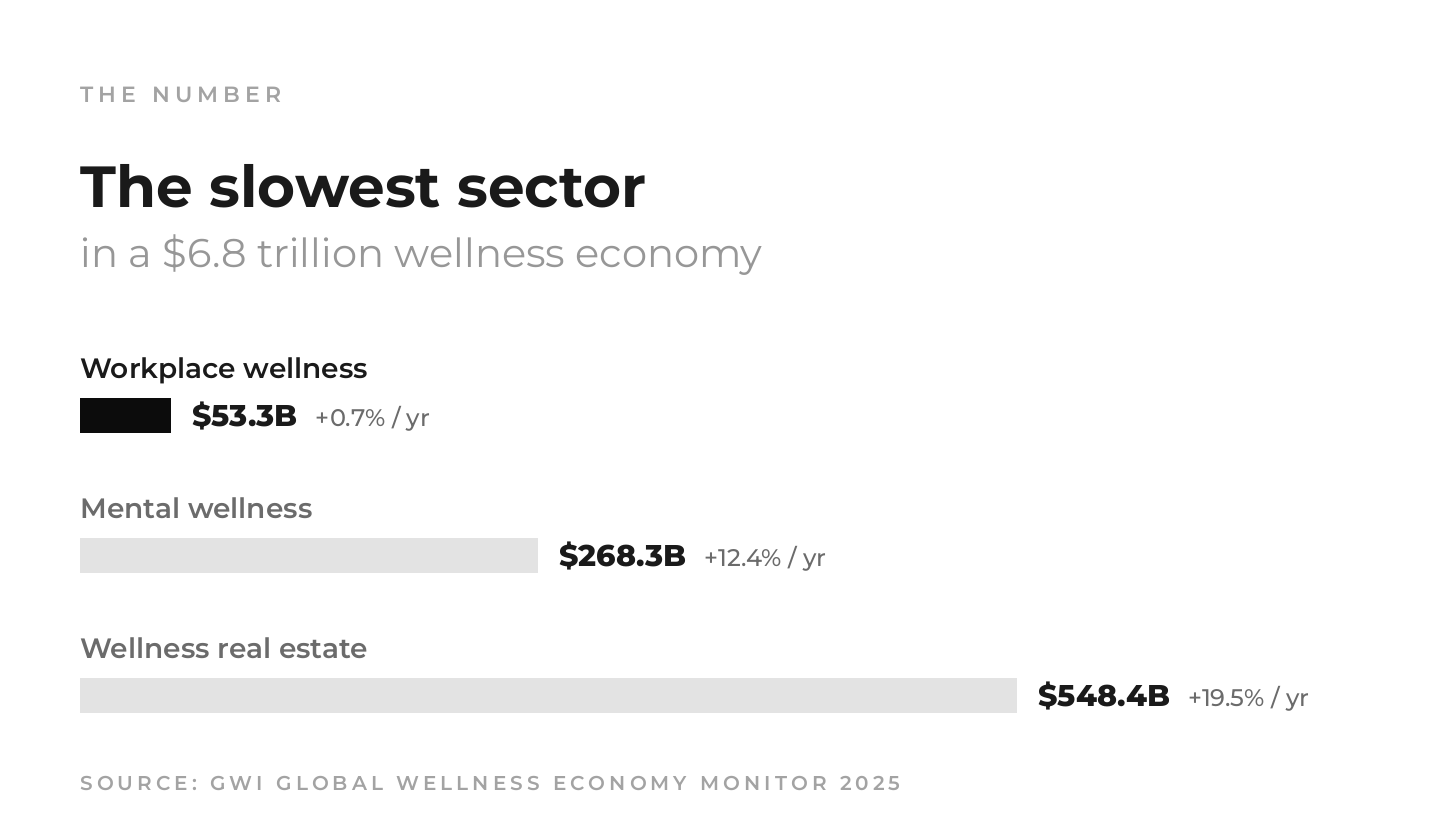
Workplace wellness reached $53.3 billion in 2024, growing 0.7% a year, after contracting 1.5% across 2023 and 2024.
It is the slowest-growing sector in the $6.8 trillion wellness economy, and only 9.8% of workers globally have access to any program at all.
The demand side is not the problem.
Gallup’s State of the Global Workplace 2026 recorded global engagement at 20%, the first back-to-back annual decline in the survey’s history, with manager engagement down from 31% to 22% in three years.
The need has never been more measurable, actually.
Longevity clinics face the identical attribution problem and solved it years ago.
A patient wants proof the protocol works.
The clinic cannot say “this added eight years to your life.”
Aging is multifactorial, and the timeline is decades.
So the clinic picks three biomarkers that respond to lifestyle, measures them quarterly, and shows the patient the trend across years.
It claims direction, not attribution.
Each single data point proves almost nothing.
Three markers trending the right way across three years is evidence a skeptic can accept.
Run the same operation on the corporate pitch.
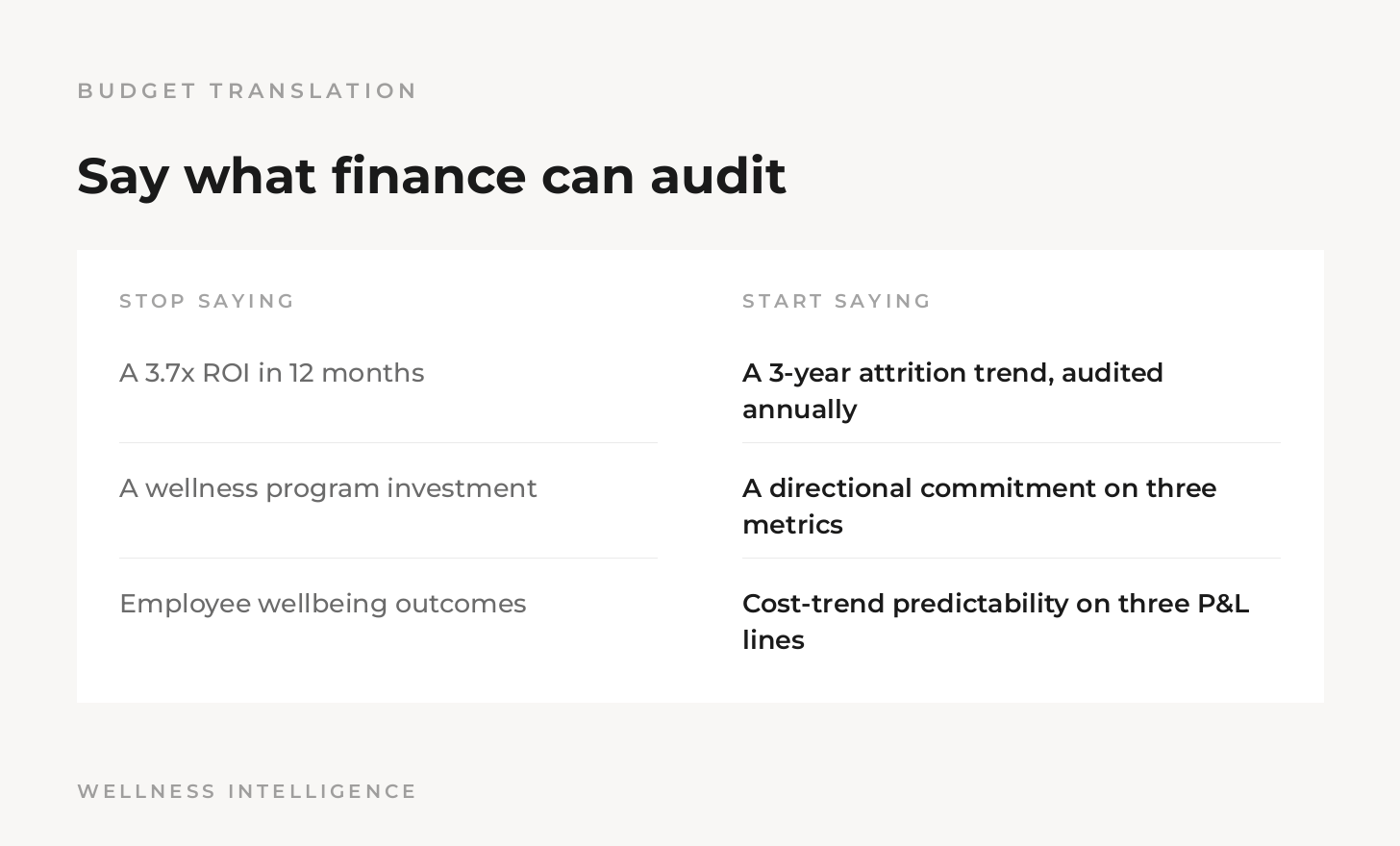
Replace the single year ROI claim with a 3 year directional commitment on three metrics the CFO already tracks:
Voluntary attrition replacement cost
Healthcare claims-loss ratio
Productivity hours lost
The owner of this conversation is the CFO, and the metric the CFO is measured on is cost-trend predictability.
“This program will deliver a 3.7x return” asks for belief.
Year 3: Voluntary attrition in the target cohort trends below benchmark, with Year 1 directional movement and Year 2 mid-trend confirmation, providing the CFO three years of reportable data and an audit checkpoint at each annual review.
The governing question, before any pitch leaves your laptop:
Which of the CFO’s existing line items does this trend affect?
If you keep reading, you’ll learn:
The CFO metrics framed as 3 year commitments
The milestones the CFO audits at each review
The boardroom sentence for each metric
The AI prompts to execute all of this
If this free intro rang a bell, well, you’d be pleased you joined me for the full brief.
I hope to see you inside.
Comments
Nothing yet. Say the first thing.
Sign in to join the conversation.