
Hola amigos,
Last night, after the kids were asleep, I sat at the kitchen table reading some of your emails.
A reader who moved to Panama three years ago and has no corporate network in the country is convinced the market has real potential. How do I win the first project, the one that becomes the case study?
To Patricia: you sent one question and it rearranged my whole evening. This newsletter is yours. And to my subscriber Jacob, you also sent a question yesterday regarding your ICP, today will shed some light.
A lot of your emails reminded me of when I arrived in Dubai in 2015 with some thousand dollars and a tourist visa. I was charging 30 usd to my first client, and I was cooking for him with the condition I could use the groceries to cook my meals too.
Every credential I had was issued somewhere else, and nobody in the new city knew who I was, let alone had seen me work.
Let’s dive in.
The answer to Patricia is a system, and it fits in three moves, here’s what you’ll learn today:
The reason experience does not transfer between markets
The room-selection logic for picking your first corporate target
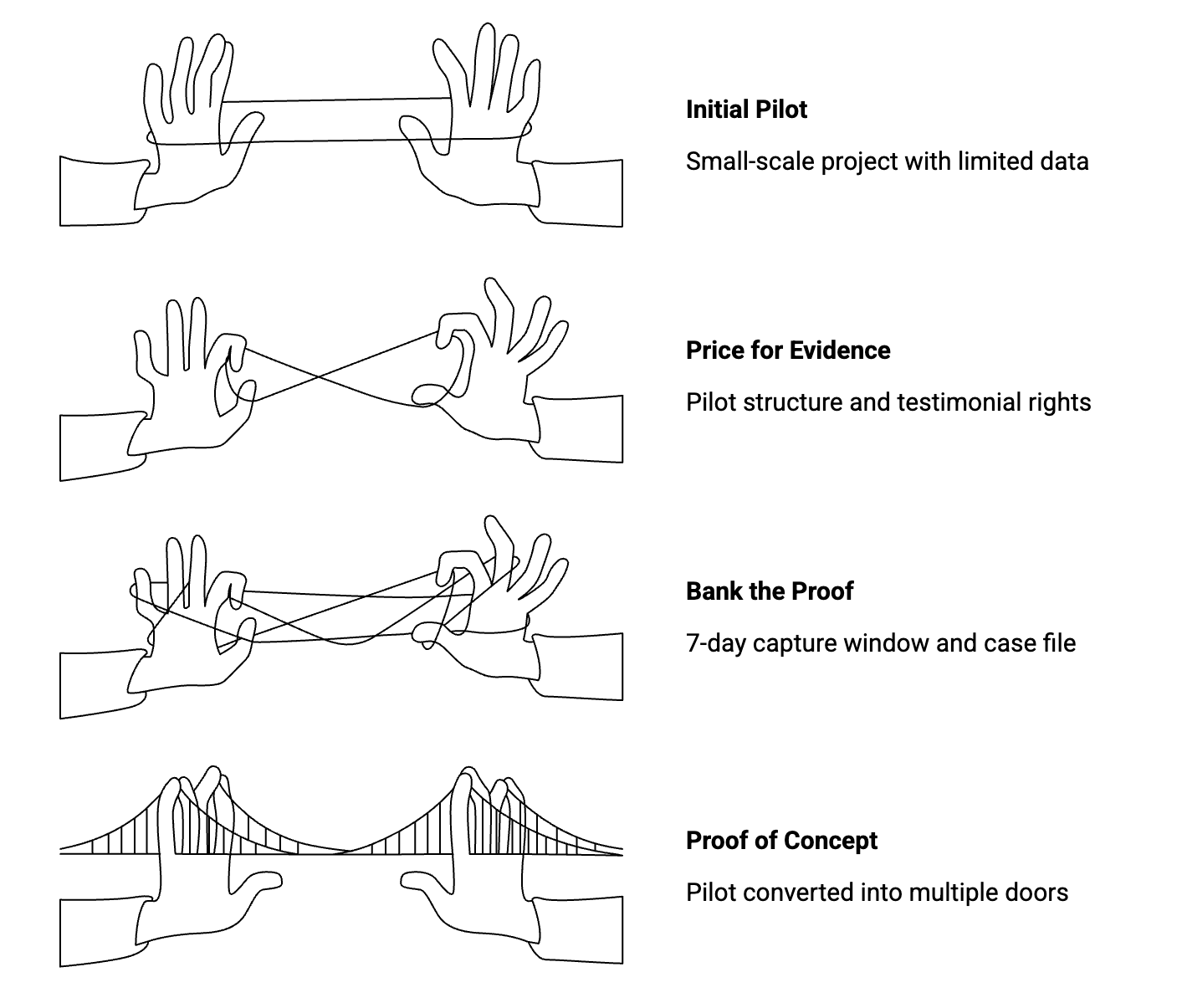
The Proof Pilot: the three-move system that manufactures your first case study
Most of this industry believes that you lead with experience in a new market.
Ten years of clients, certifications, and results from back home, so you build the website, list the credentials, reach out to companies you would like to work with, and wait for the record to speak for itself.
But the record cannot speak because nobody in the room has heard it.
Your first corporate project is not income; it is evidence, preferably local.
That decides everything downstream.
If the first project is income, you chase the biggest company you can find, quote your real rate, and lose slowly.
If the first project is evidence, you choose the smallest room that can say yes quickly, price it to remove every reason for no, and walk out with the one asset no new market will give you on arrival: local proof.
On Monday I showed you the pipeline hiding inside a client book. Within hours, DMs arrived: what if there is no book because I am just starting out?
Well, same story, different first move…
When you own trust, you convert it and when you own none, you manufacture the first unit.
The numbers that make a new market feel empty are the same numbers that make it open.
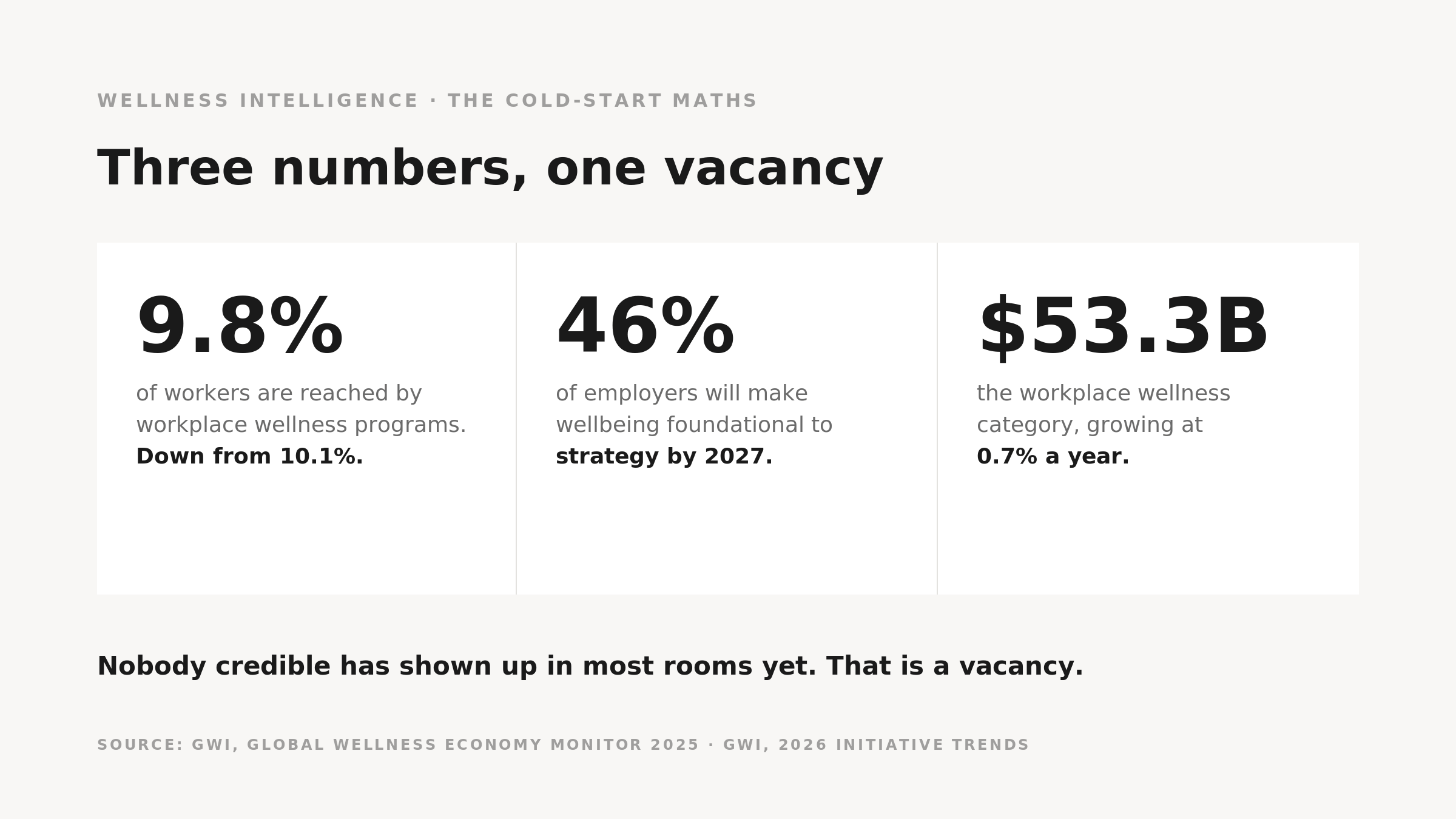
Workplace wellness programs reach 9.8 percent of workers globally, down from 10.1 percent (Global Wellness Institute, Global Wellness Economy Monitor 2025).
The category holds $53.3 billion and grows at 0.7 percent a year, which tells you the incumbents are not expanding to meet anyone.
And the Global Wellness Institute expects 46 percent of employers to make wellbeing foundational to strategy by 2027.
Now put those numbers through a market like the one my reader is standing in.
The demand is arriving everywhere, including there.
The supply of credible providers in an underserved market is close to zero.
In London or New York, the buyer has seen forty proposals, and you are the forty-first.
In an under-served market, you are frequently the first competent person to put a measured offer in front of them.
The absence of competition and the absence of proof are the same fact.
Most of the industry reads it as “nobody buys wellness here.”
The working theory: nobody has been sold to properly yet.
The instinct in a new market is to compensate for missing proof with biography. More credentials in the deck, more slides about the decade back home. Buyers buy risk reduction, and a thicker deck reduces nothing.
So you sell them something else: a small, measured offer with an end date, one a manager can approve without courage.
Instead of saying, “I have ten years of experience, and I am new to this market.”
Start saying, “I run a six-week pilot on one metric your company already tracks, and you keep the data either way.”
Look at the 4 things the second sentence does inside the buyer’s head:
Six weeks means the mistake, if it is one, is small.
One tracked metric (sick days, attrition on one team, or engagement scores) means the result falls on a number someone is already measured on.
A fixed fee means no procurement headache.
And “you keep the data” means the company wins even if you never work together again.
In a 100 to 400 person company, the person who can approve that is the HR manager or the general manager, and the approval threshold is often low enough that no committee ever forms.
Now the real questions:
Which room do you pick first?
What exactly do you charge?
How does one small pilot become the case study that opens the next ten doors?
That system is the Proof Pilot, and it is below.
Move 1: Pick the Room
The three signals that make a company the right first target (and why your dream client is the wrong one), plus where warm doors hide in a city where you know nobody.
Move 2: Price for Evidence
The pilot structure, the number to charge (never zero, and why free work produces gratitude instead of proof), and the one clause that converts a discount into testimonial rights.Move 3: Bank the Proof
The loop that turns one pilot into the next three doors.
Plus the three prompts that design your pilot tonight.
The first pilot it wins you pays for a decade of it.
Comments
Nothing yet. Say the first thing.
Sign in to join the conversation.