
1. Overview
2. White House News
3. Truth Social Posts
4. Government Department News
5. 2028 Democratic Presidential Candidates
6. AI & Tech Company News
7. Congressional Watch
8. Policy Impact Analysis & Heatmap
Trump utilized Truth Social to announce a significant shift in trade policy regarding Canada, declaring that the era of Canadian “massive amounts of Tariffs” on American farmers is over. He characterized the northern neighbor’s current trade stance as desiring the “benefits of being a State, without being one.” Additionally, he amplified political criticism regarding domestic governance, sharing media commentary that alleged “blue states are sabotaging” his administration.
The Department of War announced that Secretary Pete Hegseth has embarked on the “Arsenal of Freedom” tour, with scheduled visits to Nebraska and Wisconsin. This initiative serves to promote a “peace through strength agenda” by focusing on the revitalization of the U.S. Defense Industrial Base. The Secretary is advocating for a “commercial-first” acquisition strategy intended to increase innovation and industrial speed by stripping away existing bureaucratic requirements. Through these visits, Hegseth intends to highlight the essential role of the American manufacturing workforce in ensuring national security.
Proposed protectionist tariffs on Canadian imports threaten to inflate production costs and induce volatility for manufacturing firms heavily reliant on cross-border supply chains. Conversely, federal initiatives to prioritize defense industrial reshoring provide increased revenue visibility for contractors, though critics warn such shifts may cause “distraction” from essential military modernization goals. These competing policy pressures create a bifurcated environment where protectionist trade friction risks compressing margins for energy-intensive sectors, while targeted domestic capacity expansion mandates offer localized support for defense-oriented industrial equities.
No White House news found.
Trump declared that Canada currently desires the “benefits of being a State, without being one,” while criticizing the country for having charged “massive amounts of Tariffs” against American farmers for many years. Signaling a shift in trade policy, he emphasized that this practice is “No more.”
Regarding domestic political challenges, Trump shared a segment featuring Mark Levin, who argued that “these blue states are sabotaging you.”
Reference: https://truthsocial.com/@realDonaldTrump
Secretary of War Pete Hegseth Travels to Nebraska and Wisconsin
Defense Secretary Pete Hegseth is visiting Omaha, Nebraska, and Oshkosh, Wisconsin, as part of his “Arsenal of Freedom” tour. The initiative aims to revitalize the U.S. Defense Industrial Base to support the “peace through strength agenda” promoted by President Trump and Secretary Hegseth. The tour advocates for a “commercial-first” defense acquisition approach focused on increasing speed, innovation, and industry investment by reducing bureaucratic requirements. Secretary Hegseth intends to emphasize the role of American manufacturing and the workforce in maintaining national security and global peace.
No relevant 2028 Democratic candidate updates found for this date.
No relevant AI & tech company updates found for this date.
Covers the 2026-08-22 session — the Congressional Record is published with a one-day delay.
No Congressional Record found for 2026-08-22.
This analysis is provided for informational purposes only. It does not constitute investment advice or a recommendation to buy or sell any security.
Based on today’s policy developments, our analysis identifies the following market impact themes:
Threats of new tariffs on Canadian imports shift the cost-structure for domestic firms reliant on raw materials and energy inputs. Disruptions to integrated North American supply chains threaten to inflate consumer prices. Critics argue that these measures undermine regional economic stability and increase input volatility for manufacturing sectors. The risk remains that retaliatory trade actions trigger a broader slowdown in cross-border commerce.
High-level visits to defense manufacturing sites signal a federal commitment to domestic capacity expansion. This policy emphasis supports long-term revenue visibility for defense contractors and specialized industrial firms. Opposition figures caution that prioritizing regional industrial output may distract from broader military modernization needs or budgetary discipline. The sector remains sensitive to how these site visits translate into specific, funded government contract mandates.
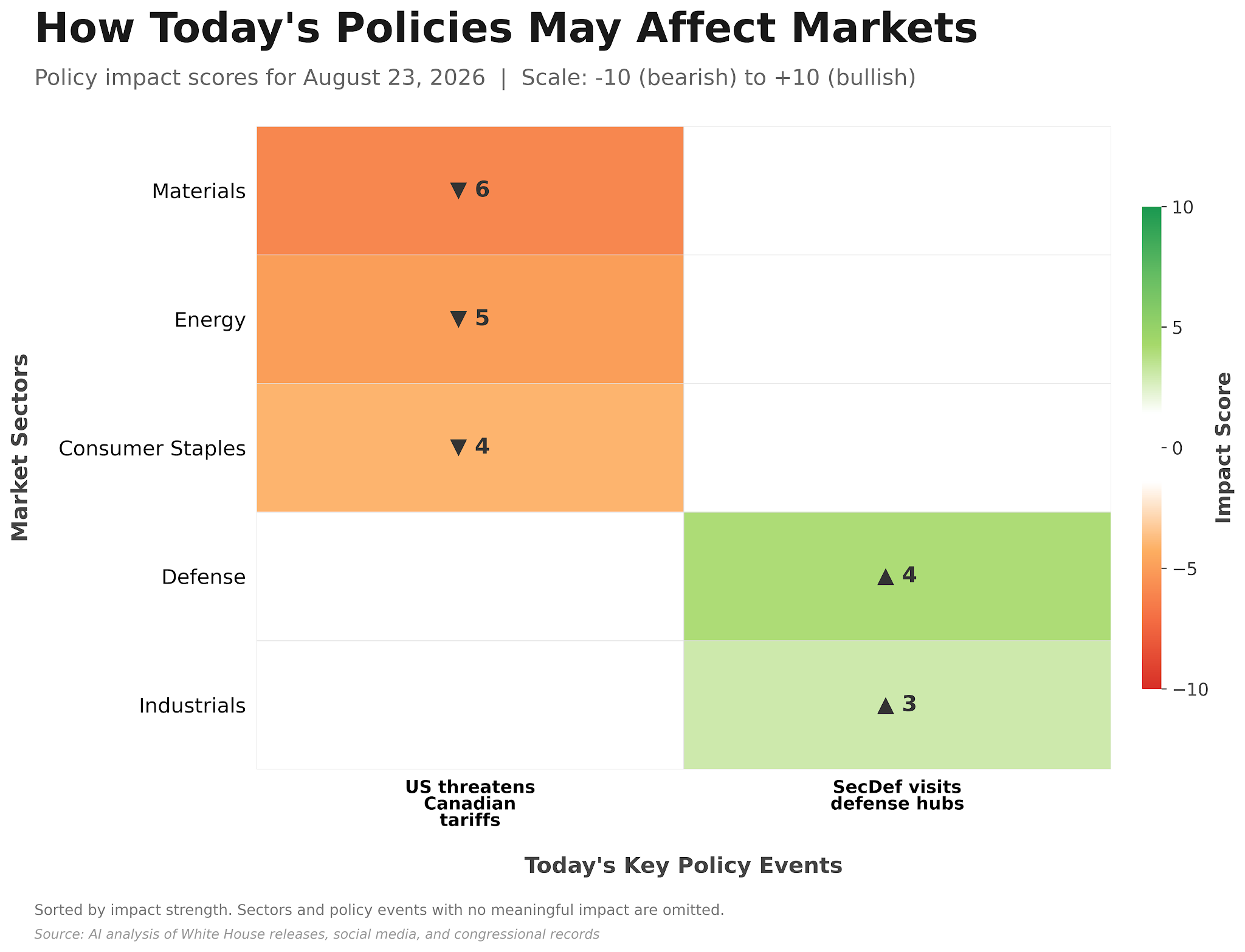
Each cell shows an estimated impact score on a fixed scale of -10 to +10, reflecting how today’s policy developments may affect each market sector. Positive scores (green, ▲) suggest bullish impact; negative scores (red, ▼) suggest bearish pressure. Rows and columns are sorted by impact strength, and sectors and policy events with no meaningful impact are omitted. The heatmap, the analysis below, and the Impact on Market themes above are produced from a single unified analysis: the heatmap visualizes the magnitudes, while the text explains the causal reasoning behind them.
Trade rhetoric regarding Canadian imports creates immediate supply chain volatility for firms dependent on cross-border inputs. Tariffs raise landed costs for domestic manufacturers while potentially compressing margins in consumer staples and energy sectors. Increased risk premia follow the threat of retaliatory measures from trading partners. This dynamic forces firms to reassess procurement logistics under heightened uncertainty.
Simultaneously, the Secretary of War’s visit to industrial hubs in the Midwest underscores a pivot toward domestic defense production. Concentrated site visits often precede government procurement announcements or accelerated contract flows for regional manufacturers. While these investments provide a demand floor for the industrial base, critics argue that such localized focus risks creating inefficient subsidy dependency. Broader market participants remain watchful for shifts in federal expenditure prioritization.
Comments
Nothing yet. Say the first thing.
Sign in to join the conversation.