
1. Overview
2. White House News
3. Truth Social Posts
4. Government Department News
5. 2028 Democratic Presidential Candidates
6. AI & Tech Company News
7. Congressional Watch
8. Policy Impact Analysis & Heatmap
President Trump highlighted his administration’s commitment to drug policy during Overdose and Drug Poisoning Awareness Week, noting a 22 percent decline in fentanyl-related fatalities. The White House also commemorated National Park Week, announcing that national parks will offer free admission on August 25 to celebrate conservation efforts, including the Great American Outdoors Act. Furthermore, the President focused on educational freedom by hosting students and parents at the White House to promote a policy agenda that prioritizes parental rights and removes federal influence from curricula. Finally, the administration announced “Operation Economic Outcast,” a comprehensive financial offensive designed to fully isolate the Iranian regime.
The State Department officially launched “Operation Economic Outcast,” sanctioning nearly 60 individuals and entities to disrupt Iranian military, cyber, and petroleum-trading networks. In a separate foreign policy shift, Secretary of State Marco Rubio rescinded Syria’s designation as a State Sponsor of Terrorism and delisted Hay’at Tahrir al-Sham, citing improved cooperation on counterterrorism. Additionally, the Department of War announced a $750 million investment to secure rare-earth elements in Brazil to reduce reliance on Chinese supply chains. HHS, alongside the Department of Agriculture, launched the “Harvest to Hallways” initiative, providing $95 million in funding to improve school nutrition and kitchen infrastructure. The Treasury Department also formed a Quantum-Readiness Task Force to protect financial systems from emerging technological threats.
Governor Gavin Newsom announced that California intends to sue the Trump administration over an Executive Order affecting mail-in ballots, calling the policy an “Orwellian” measure. He also promoted California’s economic status by citing $366 billion in venture capital funding, contrasting this with what he termed “right wing propaganda.” Governor JB Pritzker issued a statement condemning the Supreme Court’s decision to uphold portions of the President’s voting order, accusing the President of attempting to “rewrite the rules” and acting as if he “aspires to be a king.” Meanwhile, Governor Wes Moore introduced an ad campaign for new chip-and-tap EBT cards to prevent skimming, noting his concern that the federal government “creates new barriers” to food assistance.
OpenAI reported the disruption of a covert Russian influence operation that utilized ChatGPT to generate content for a front organization known as the International Burke Institute. The campaign, which targeted platforms like X and Telegram, sought to manipulate public opinion by praising Russia and criticizing Western nations. OpenAI’s internal detection systems identified the network by flagging inauthentic patterns, including non-idiomatic phrasing and literal machine translations originating from Slavic languages.
Government commitment to long-term aviation contracts strengthens the defense industrial base by securing multi-decade cash flows, though ongoing supply chain constraints and inflationary pressures threaten the execution of these capital-intensive projects. Simultaneously, the escalation of “economic warfare” against regional actors through financial decoupling introduces bearish risks for maritime shipping and commodity brokers, as compliance costs mount alongside the threat of retaliatory infrastructure disruption. Finally, federal efforts to bolster strategic resource sovereignty via public-private capital mobilization for rare-earth inputs aim to insulate the semiconductor sector from foreign supply shocks, despite concerns that such interventionist measures may distort market-based commodity pricing and expand sovereign debt.
During Overdose and Drug Poisoning Awareness Week, President Trump reaffirmed his administration’s commitment to “defeat the scourge of illicit drugs” by targeting fentanyl supply chains and cartel presence. Key actions include securing the southern border, signing the HALT Fentanyl Act, and designating fentanyl a weapon of mass destruction. The administration reports that these efforts contributed to a 22 percent drop in fentanyl deaths. Additionally, President Trump launched the Great American Recovery Initiative to expand treatment access and support addiction recovery, aiming to “end the devastation” caused by narcotics.
Reference: https://www.whitehouse.gov/briefings-statements/2026/08/presidential-message-on-overdose-and-drug-poisoning-awareness-week/
During National Park Week, President Trump celebrated the National Park Service’s contributions to America’s “natural resources, historic landmarks, and magnificent landscapes.” Highlighting his administration’s commitment to conservation, he noted signing the Great American Outdoors Act and the “Make America Beautiful Again Executive Order” to address infrastructure and regulatory needs. To commemorate the agency’s milestone year, the President announced that national parks will be free to United States residents on August 25. He reaffirmed his goal to make America’s Great Outdoors a source of “national pride and breathtaking splendor.”
Reference: https://www.whitehouse.gov/briefings-statements/2026/08/presidential-message-on-national-park-week/
The Trump Administration has launched “Operation Economic Outcast,” described as “the single greatest financial offensive ever marshalled against an adversary.” Aiming to “sever every economic lifeline” sustaining Iran, Treasury Secretary Scott Bessent announced that this operation represents the “endgame” following the dismantling of Iran’s military and nuclear capabilities. Framing Iran as “the world’s largest state sponsor of terrorism,” the administration asserts this campaign fulfills President Trump’s promise to ensure the regime “stands alone, bankrupt, and broken” to prevent it from ever obtaining a nuclear weapon.
Reference: https://www.whitehouse.gov/releases/2026/08/operation-economic-outcast-total-isolation-of-the-iranian-regime/
President Trump welcomed students, parents, and advocates to the White House to celebrate the new school year. The Administration highlights an “unparalleled record of expanding educational freedom, restoring parental rights, returning power to the states, and putting American students first.” Under the leadership of the President and Secretary of Education Linda McMahon, the Administration claims to have “delivered historic results in record time.” The President’s agenda emphasizes that “educational freedom belongs to parents” and advocates for schools to be “free from ideology, waste, and federal overreach.”
Reference: https://www.whitehouse.gov/releases/2026/08/president-trump-champions-educational-freedom-putting-students-and-parents-first/
No relevant Truth Social posts found.
The U.S. has initiated “Operation Economic Outcast,” imposing sanctions on entities and individuals enabling Iranian military, cyber, and oil-trading activities. The measures target those responsible for targeting U.S. forces, intelligence gathering, and a procurement ring supporting missile programs. Cyber sanctions follow FBI indictments of Iranian nationals linked to attacks on U.S. critical infrastructure. Additionally, the U.S. is targeting global shipping networks moving Iranian petroleum, which allegedly funds the IRGC-Qods Force. The administration aims to “disrupt, expose, and dismantle” Iran’s malign operations and proliferation networks.
Rescission of Syria’s Designation as a State Sponsor of Terrorism
Secretary of State Marco Rubio has formally rescinded Syria’s designation as a State Sponsor of Terrorism and delisted Hay’at Tahrir al-Sham as a Specially Designated Global Terrorist. These actions follow a 45-day Congressional notification period and align with President Trump’s efforts to support Syrian economic recovery. The administration cites Syria’s recent cooperation in countering ISIS, al-Qa’ida, and Iran-aligned groups as justification. The move aims to remove barriers to private investment and further integrate Syria into the global economy.
Secretary Rubio’s Call with German Foreign Minister Wadephul
Secretary of State Marco Rubio held a discussion with German Foreign Minister Johann Wadephul regarding the Russia-Ukraine conflict. Both leaders emphasized the necessity of achieving a “lasting and durable peace.” Furthermore, they reaffirmed the shared commitment of the U.S. and Germany to maintaining freedom of navigation in the Strait of Hormuz and preventing Iran from acquiring or developing nuclear weapons.
Secretary Rubio’s Call with ROK Foreign Minister Cho
Secretary of State Marco Rubio spoke with Republic of Korea Foreign Minister Cho Hyun to discuss various aspects of the U.S.-ROK Alliance. The Secretary emphasized the importance of maintaining close coordination between the two nations on matters integral to their ongoing partnership.
This fact sheet details sanctions against nearly 60 entities and individuals under Operation Economic Outcast. The Treasury and State Departments are targeting procurement networks that enabled strikes against U.S. service members and the “shadow fleet” operators facilitating the illicit sale of Iranian petroleum. By restricting these revenue streams, the U.S. aims to curb Iran’s ability to support terrorism and destabilize the region. All property of the sanctioned parties within U.S. jurisdiction is blocked, and transactions with these entities are prohibited.
Secretary of State Marco Rubio issued a statement congratulating Ukraine on its 35th independence anniversary. Reaffirming the U.S. commitment to Ukraine’s sovereignty, the Secretary highlighted the enduring cooperation between the two nations. The statement emphasizes ongoing U.S. efforts to support a negotiated settlement to the Russia-Ukraine war, with the goal of establishing a “lasting and durable peace” while strengthening bilateral economic and security ties.
The Department of War’s Economic Defense Unit announced a $750 million investment in US SIIE, LLC to support rare-earth element production at the Pela Ema Project in Brazil. This funding is part of a larger $1.55 billion initiative intended to bypass Chinese supply chain dominance. The project aims to secure vital materials like Dysprosium and Neodymium for defense applications, including fighter jets and nuclear submarines. Officials stated that securing these supply chains is a “fundamental warfighting requirement” to maintain the nation’s technological edge.
The Department of War awarded a $131.23 billion ceiling contract to Boeing for the F-15 Eagle program, covering production, modernization, and sustainment through 2037. Additional awards include a $27.4 million contract to the University of New Mexico for nuclear systems development, a $99 million contract to Hardwire LLC for advanced metallic armor processing, and a $68.8 million dredging contract to Great Lakes Dredge & Dock Co. Other agreements were issued to General Dynamics Land Systems, Widman Inc., and Agate Construction for various maintenance, logistical, and infrastructure projects.
Press Gaggle With Secretary of War Pete Hegseth
Secretary of War Pete Hegseth emphasized a “generational investment” in the $1.5 trillion budget, stating the administration remains committed to funding the defense industrial base. Regarding Iran, Hegseth described the current blockade of the Strait of Hormuz as “ironclad” and noted that economic pressure is intended to force nuclear negotiations. He clarified that while economic measures are the primary focus, the military has not ruled out “kinetic strikes.” Additionally, Hegseth defended long-term munitions contracts as “sacred” investments necessary for future national security requirements.
HHS Joins USDA to Announce Harvest to Hallways Initiative to Invest in Child Nutrition Programs
HHS Secretary Robert F. Kennedy, Jr. and Agriculture Secretary Brooke L. Rollins have launched the “Harvest to Hallways” initiative to improve school nutrition. Supported by President Trump, the program aims to connect local farmers with schools and upgrade kitchen infrastructure to serve more nutrient-dense meals. The initiative includes $70 million for cafeteria infrastructure and $25 million in Farm to School Grants for Fiscal Year 2026. Secretary Kennedy stated, “Every school meal should make a child healthier,” as part of the administration’s broader “Make America Healthy Again” agenda.
Treasury Announces the Quantum-Readiness Task Force
The Treasury Department has launched the Quantum-Readiness Task Force to guide the U.S. financial sector’s transition to post-quantum cryptography. Authorized by President Trump’s Executive Order 14412, the public-private initiative aims to protect sensitive financial data and critical infrastructure from future quantum computing threats. The task force will focus on three workstreams: Sector Alignment and PQC Transition, Third-Party and Vendor Readiness, and Digital Assets and Emerging Technology Risk, ensuring an orderly and resilient shift to quantum-safe technology.
Remarks from Secretary of the Treasury Scott Bessent on Operation Economic Outcast against Iran
Secretary Bessent detailed “Operation Economic Outcast,” a campaign directed by President Trump to “sever every economic lifeline” supporting the Iranian regime. Describing the operation as an “economic onslaught,” Bessent stated the U.S. aims to force Iran to choose between global isolation and returning to the global economy. New sectoral sanctions target Iran’s digital assets, technology, gold, aviation, and shipping. The Treasury is also sanctioning over 60 entities and individuals, warning that any bank facilitating Iranian money laundering will be removed from the U.S. dollar system.
Treasury Launches Unprecedented Campaign Against Iranian Regime on Economic D-Day
The Treasury Department initiated “Operation Economic Outcast,” a government-wide campaign to neutralize Iran’s financial resources. Secretary Bessent stated that under President Trump, America is “no longer managing the Iranian threat” but “ending it.” The initiative targets networks used by the regime to bypass sanctions and fund terror. The Treasury is expanding secondary sanctions and issuing sectoral determinations on Iranian industries. Foreign entities are being given a timeline to cease Iran-related activities, with the U.S. threatening unilateral enforcement against those who continue to facilitate Iranian revenue.
Treasury and State Departments Deliver Additional Sanctions Relief on Syria
In accordance with President Trump’s policy, the State Department rescinded Syria’s designation as a State Sponsor of Terrorism and removed Hay’at Tahrir al-Sham (HTS) from the list of Specially Designated Global Terrorists. Secretary Bessent stated the move will “give the Syrian people a chance at greatness” and promote stability through investment. While HTS is no longer blocked, the Treasury simultaneously designated two former HTS affiliates linked to al-Qa’ida and Hurras al-Din to maintain pressure on terrorist financing and uphold U.S. counterterrorism commitments.
Governor Newsom signs legislation 8.24.2026
Governor Newsom signed a series of bills into law, including AB 1778 regarding testosterone, AB 2056 concerning teacher exchange programs, AB 2134 on city council absences, AB 2692 related to common interest developments, SB 557 regarding child abuse in family resource centers, and SB 897 and SB 927 addressing abandoned vehicles and intercountry adoptions, respectively.
Governor Newsom announces judicial appointments 8.24.26
Governor Newsom announced the appointment of twelve Superior Court judges across Humboldt, Imperial, Los Angeles, Monterey, San Bernardino, San Diego, Yolo, and San Joaquin counties. The appointees include Heather Durand, Martin Gonzalez, Kjehl Johansen, Lindsey Berg-James, William Patrick Dudley, Michael Garabed, Katherine Lucero, and Binh Dang. These appointments fill various vacancies created by retirements and elevations, with several appointees set to serve in interim roles.
Governor Newsom announced that California intends to sue the Trump administration over an Executive Order regarding mail-in ballots, labeling the policy “Orwellian.” Concurrently, the Governor is advancing an “Election Protection” legislative package aimed at safeguarding the electoral process and protecting ballots from what the administration describes as “new threats from Donald Trump and his election-rigging allies.” The initiative builds upon previous investments in state election systems to ensure legal protections for every lawful vote.
FACTS NOT ON FOX NEWS: California attracts more startup investment than 49 states combined
Governor Newsom announced that California attracted $366 billion in venture capital funding in 2026, surpassing all other 49 states combined. The administration stated that more than 4,000 California startups secured this funding, highlighting the state’s leadership in technology and innovation. The Governor asserted that while “right wing propaganda may try to paint a different picture,” California remains the nation’s top economy, leading in GDP growth, business starts, manufacturing, and high-tech industries, while outperforming Texas and Florida in economic growth rates.
Governor Whitmer is reminding Michigan residents that the August 31, 2026, deadline is approaching to apply for federal assistance following severe April weather. President Trump approved a major disaster declaration for 27 counties, and over $28 million has already been distributed to more than 5,000 applicants. Residents impacted by storms, flooding, or tornadoes are encouraged to apply for FEMA’s Individual Assistance program or SBA low-interest disaster loans before the deadline at 11:59 p.m. to help cover uninsured or underinsured losses.
Governor Moore Unveils New Ad Campaign Highlighting New Fraud-Resistant EBT Cards
Governor Moore announced the “Don’t Wait, Activate” ad campaign to encourage Marylanders to transition to secure “chip-and-tap” EBT cards. As of August 23, 2026, 58% of recipients have activated their new cards. The state is rolling out this technology to combat “skimming” and theft. Current magnetic-stripe cards will be deactivated on September 30, 2026, though benefit balances will transfer automatically. The administration emphasizes these measures help residents maintain secure access to food assistance while the federal government “creates new barriers” to such benefits.
Gov. Pritzker’s Statement on Supreme Court Ruling on Mail-In Voting
Governor Pritzker condemned the Supreme Court’s decision to allow portions of President Trump’s executive order targeting mail-in voting. Pritzker characterized the move as an “unprecedented attempt to interfere in our elections” and accused the President of trying to “put fear in Americans” and “rewrite the rules.” He affirmed that Illinois will maintain free and fair elections, stating that “Instead of focusing on being President, Donald Trump aspires to be a king.”
Daily Public Schedule: Monday, August 24, 2026
Governor Pritzker has no public events scheduled for Monday, August 24, 2026.
Senators Ossoff and Reverend Raphael Warnock announced over $4 million in federal funding for the Savannah/Hilton Head International Airport. Provided through the Federal Aviation Administration’s Airport Infrastructure Grant program, the funds are designated for taxiway reconstruction. Senator Ossoff stated, “Georgia’s airports are a key driver of job creation and economic competitiveness.” This investment follows a series of previously announced infrastructure awards aimed at enhancing airport capacity, security screening, and tarmac facilities throughout Georgia.
Sen. Ossoff Working Across the Aisle to Strengthen Diabetes Prevention
Senator Ossoff is cosponsoring the bipartisan SCREEN for Type 1 Diabetes Act of 2026, which directs the CDC to launch a national public awareness campaign regarding early detection and management of the disease. Senator Ossoff noted, “Too many Georgians suffering from Type 1 Diabetes face life-threatening complications because the disease is caught too late.” The legislation is part of the Senator’s broader health care efforts, which include supporting hearing loss coverage for children, expanding cancer screening access for seniors, and capping insulin costs for Medicare beneficiaries.
Disrupting a new covert influence campaign from Russia
OpenAI has disrupted a covert Russian influence operation that used ChatGPT to generate social media content for a fake think tank called the International Burke Institute (IBI). The campaign used VPNs to bypass regional restrictions, creating English and German posts on platforms like X, Telegram, and Substack to manipulate public opinion. The operation promoted IBI articles that praised Russia and criticized Western nations. OpenAI identified the network by detecting inauthentic patterns, such as literal machine translations from Slavic languages and non-idiomatic English phrasing.
Covers the 2026-08-23 session — the Congressional Record is published with a one-day delay.
No Congressional Record found for 2026-08-23.
This analysis is provided for informational purposes only. It does not constitute investment advice or a recommendation to buy or sell any security.
Based on today’s policy developments, our analysis identifies the following market impact themes:
The massive F-15 contract award signals a long-term commitment to traditional aviation platforms while securing steady, multi-decade cash flows for prime contractors. By integrating foreign military sales into these production cycles, the administration is effectively underwriting global defense demand. However, supply chain bottlenecks and inflationary pressures remain significant risks to executing these multi-billion dollar deliverables on schedule.
The implementation of Operation Economic Outcast targets the financial lifelines of the Iranian regime, impacting global commodity brokers and maritime shipping lanes. This represents a significant escalation in “economic warfare” that seeks to alter regional power dynamics through total financial decoupling. Bearish risks include potential retaliatory actions against U.S.-linked infrastructure and increased costs for multinational corporations maintaining compliance with rapidly evolving sanctions.
The investment in rare-earth carbonates underscores a shift toward building domestic resilience in critical material inputs. By mobilizing public-private capital for off-take agreements, the government is creating a floor for prices while insulating strategic industries like semiconductors from foreign supply shocks. Critics suggest that such interventionist policies may distort market-based pricing for commodities and increase government debt burdens.
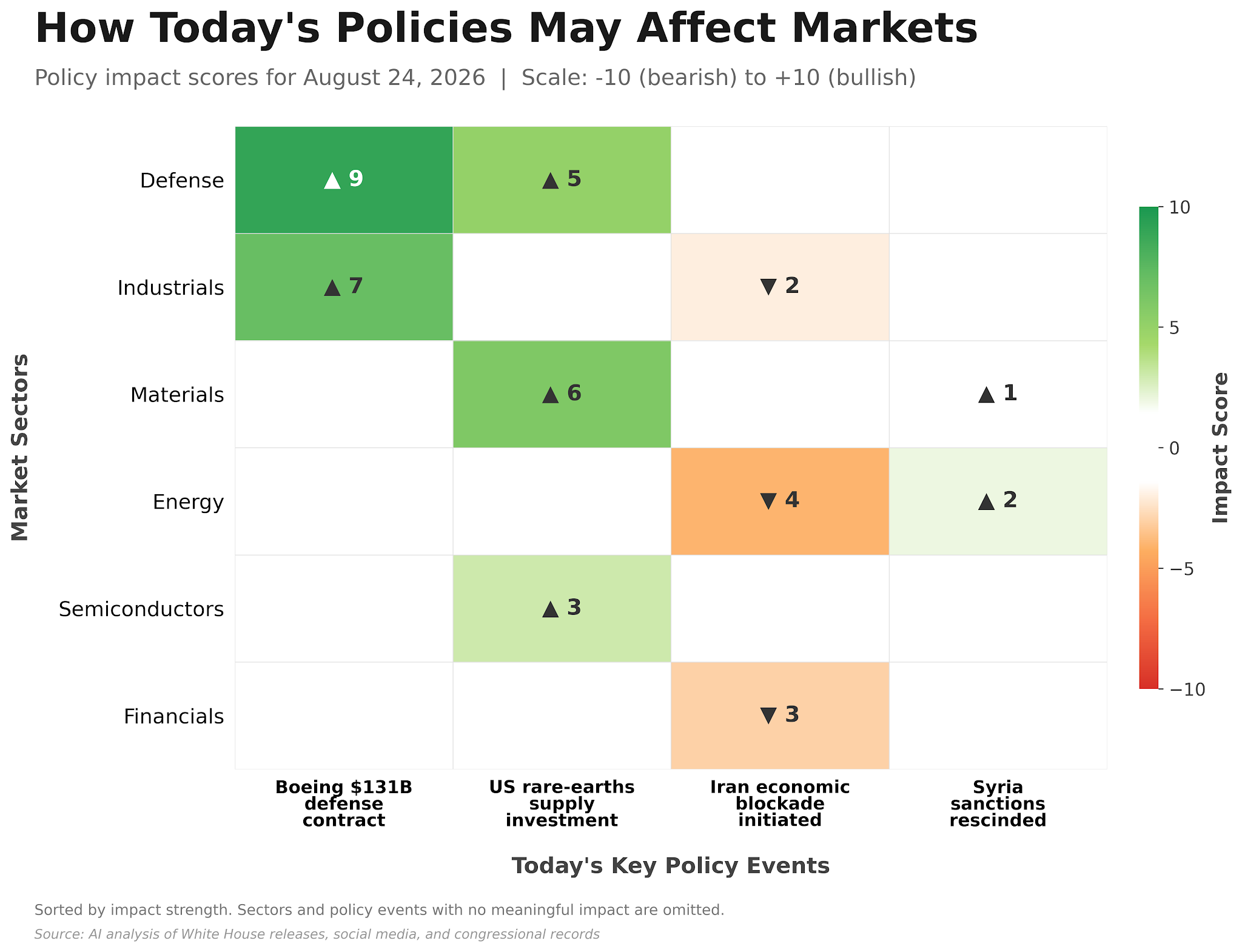
Each cell shows an estimated impact score on a fixed scale of -10 to +10, reflecting how today’s policy developments may affect each market sector. Positive scores (green, ▲) suggest bullish impact; negative scores (red, ▼) suggest bearish pressure. Rows and columns are sorted by impact strength, and sectors and policy events with no meaningful impact are omitted. The heatmap, the analysis below, and the Impact on Market themes above are produced from a single unified analysis: the heatmap visualizes the magnitudes, while the text explains the causal reasoning behind them.
The administration’s shift toward a highly aggressive posture against Iran marks a period of heightened geopolitical risk. By targeting international shipping and petroleum brokers through Operation Economic Outcast, the Treasury aims to constrict global supply chains connected to Tehran. This creates immediate friction for maritime logistics and energy firms operating in the Middle East, potentially increasing insurance premiums and operational costs in the region. Critics argue these measures could provoke retaliatory cyber activities, creating volatility for digital infrastructure providers.
Conversely, the massive F-15 sustainment contract and the rare-earth supply chain initiative provide a significant long-term tailwind for the defense and materials sectors. By prioritizing domestic capacity and securing critical mineral offtake agreements, the Department of War is effectively de-risking the industrial base from foreign dependency. While these investments drive demand for defense primes and specialty metal producers, opposition figures remain concerned that such “reckless spending” on military programs diverts essential resources from broader infrastructure or domestic fiscal stability. The alignment of these contracts with long-term sustainment needs suggests a structural increase in capital flows into the defense sector that will persist well beyond the current fiscal year.
Comments
Nothing yet. Say the first thing.
Sign in to join the conversation.