
1. Overview
2. White House News
3. Truth Social Posts
4. Government Department News
5. 2028 Democratic Presidential Candidates
6. AI & Tech Company News
7. Congressional Watch
8. Policy Impact Analysis & Heatmap
Trump announced that a new ballroom and military facility is under construction at the White House, claiming the project will provide the executive mansion with “Great National Security.” He emphasized that the development is currently ahead of schedule and under budget. Furthermore, Trump stated that the construction is funded entirely by “Great American Patriots and Companies,” requiring “ZERO Dollars of Taxpayer Money.”
The State Dept engaged in several international activities today, including Secretary Rubio’s discussion with Dominican Republic Foreign Minister Víctor Bisonó Haza regarding digital infrastructure and trade. Concurrently, a U.S. delegation participated in APEC Senior Officials’ Meetings in Dalian, China, to promote “America First” foreign and trade policies within the region. Additionally, representatives from the DRC and the AFC/M23 reached a framework agreement in Switzerland to establish a ceasefire verification mission and a roadmap for long-term regional stability.
Governor Gavin Newsom signed five new bills into law, including legislation targeting the integration of artificial intelligence within the State Bar of California and privacy mandates for immigration service providers. The legislative package also formalizes procedures for child custody mediation and updates financial disclosure requirements for local agencies. Additionally, the governor established new mandates regarding the instruction of preventative health topics within public schools.
State-level adoption of sector-specific AI mandates introduces operational friction for technology firms by replacing federal consistency with a fragmented regulatory landscape, potentially creating a “global competitive disadvantage.” Conversely, the emergence of private-public infrastructure funding provides a new mechanism for facility development, though this shift risks the “erosion of standard budgetary oversight” and increased conflicts of interest. Geopolitical stabilization efforts through trade dialogue offer temporary relief for globalized supply chains by mitigating immediate escalation risks, yet these tactical pauses may fail to resolve underlying structural protectionism. These policy developments collectively signal an environment where compliance complexity and administrative shifts are balanced against a cautious reduction in cross-border trade friction.
No White House news found.
Trump reported that significant progress is underway on a new ballroom and military complex on the White House grounds, a project he described as something presidents have desired for 150 years. He asserted that the facility will provide the White House and Washington, D.C. with “Great National Security” and emphasized that the construction is currently under budget and ahead of schedule. Furthermore, Trump stated that the project is being funded entirely by “Great American Patriots and Companies,” requiring “ZERO Dollars of Taxpayer Money.”
Reference: https://truthsocial.com/@realDonaldTrump
Secretary Rubio’s Call with Dominican Republic Foreign Minister Bisonó Haza
Secretary of State Marco Rubio spoke with Dominican Republic Foreign Minister Víctor Bisonó Haza to congratulate him on his appointment and affirm the U.S.-Dominican Republic partnership. The discussion focused on bolstering economic resilience through secure digital infrastructure. Both officials also explored expanding bilateral trade and investment, emphasizing new opportunities for U.S. companies to contribute to the Dominican Republic’s economic growth through transparent and mutually beneficial partnerships.
United States Participates in Third APEC 2026 Senior Officials’ Meetings in Dalian, China
A U.S. delegation led by Casey Mace is attending the APEC 2026 Senior Officials’ Meeting in Dalian, China, to advance “America First” foreign and trade policies. U.S. officials are focused on creating regional opportunities for American businesses in agriculture, energy, and health sectors. The delegation is promoting initiatives to reduce services export barriers and utilize U.S. innovation in supply chains. Additionally, a workshop on ocean technology is addressing illegal fishing and marine debris to support responsible economic development.
Representatives from the DRC government and the AFC/M23 met in Switzerland alongside international mediators to assess progress on the Doha Framework for a Comprehensive Peace Agreement. The parties reported progress on the Expanded Joint Verification Mechanism Plus (EJVM+) and scheduled a ceasefire verification mission for August 24. They established a new review mechanism and a roadmap for further negotiations, reaffirming their commitment to conflict resolution and stability in the Great Lakes region through the implementation of existing obligations.
Governor Newsom Signs New Legislation
Governor Newsom signed five bills into law, including legislation addressing artificial intelligence within the State Bar of California (AB 1651), privacy protections for immigration support service providers (AB 2624), and procedures for child custody mediation (AB 2789). Additionally, the new laws cover financial posting requirements for local agencies (SB 1126) and mandates regarding pupil instruction in preventative health (SB 1133).
Daily Public Schedule: Saturday, August 22, 2026
Governor Pritzker has no public events scheduled for Saturday, August 22, 2026.
No relevant AI & tech company updates found for this date.
Covers the 2026-08-21 session — the Congressional Record is published with a one-day delay.
No Congressional Record found for 2026-08-21.
This analysis is provided for informational purposes only. It does not constitute investment advice or a recommendation to buy or sell any security.
Based on today’s policy developments, our analysis identifies the following market impact themes:
California’s adoption of sector-specific AI rules for the legal industry signals a fragmented regulatory future. Tech companies now face a patchwork of state-level mandates rather than a unified federal standard. This increase in compliance complexity creates significant operational headwinds. Critics argue this hinders innovation and places domestic firms at a global competitive disadvantage.
The use of private funding for federal facility construction marks a shift in fiscal execution. This model seeks to bypass traditional appropriations while signaling strength in executive capacity. Market participants must monitor whether this trend expands to larger public works. Critics remain wary of potential conflicts of interest and the erosion of standard budgetary oversight mechanisms.
U.S. participation in trade meetings in China indicates a preference for dialogue over immediate escalation. This tactical pause helps manage risks for firms heavily reliant on complex cross-border logistics. Lowered tensions provide temporary support for globalized supply chains. However, skeptics suggest these diplomatic efforts often fail to address deeper structural trade protectionism and long-term security disputes.
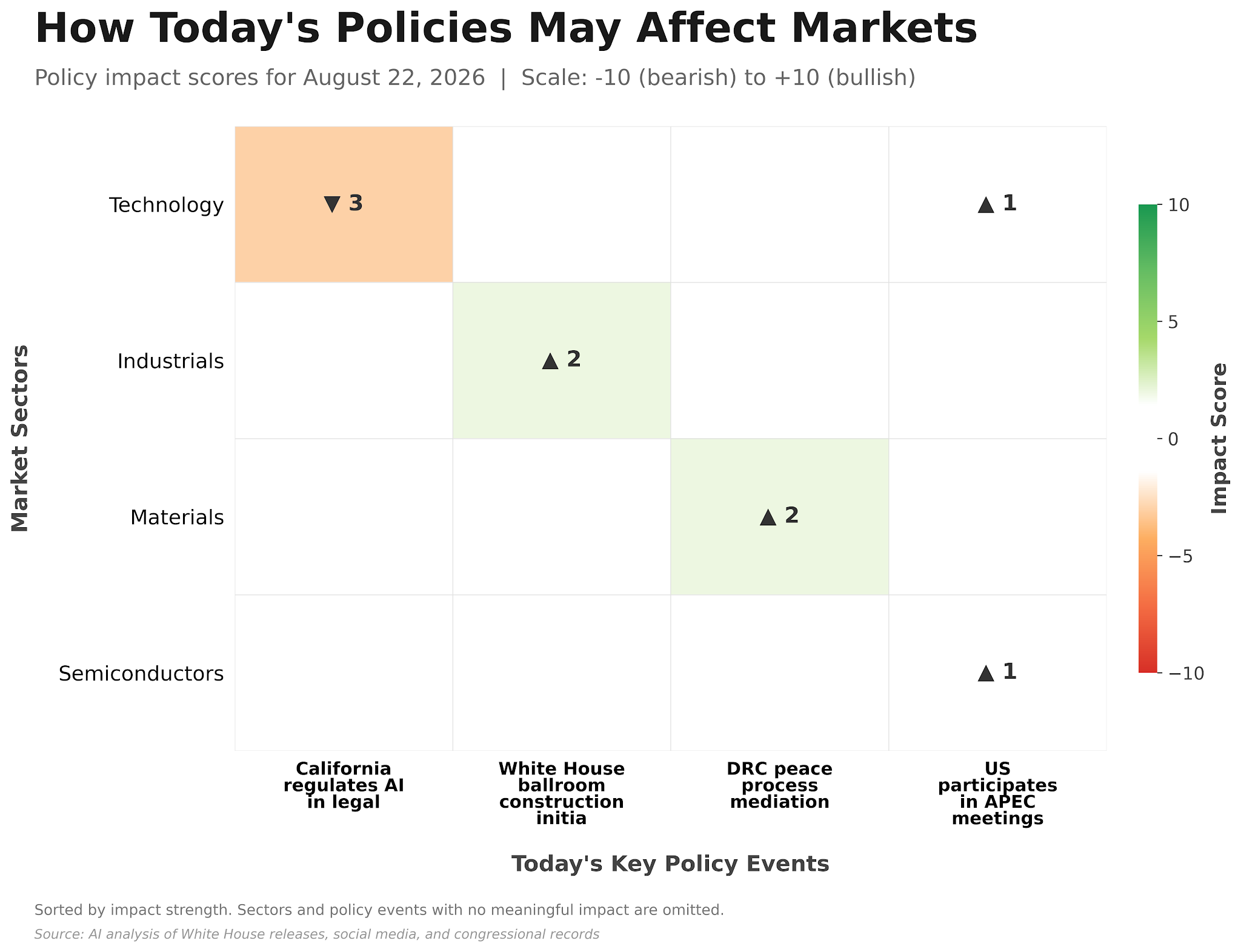
Each cell shows an estimated impact score on a fixed scale of -10 to +10, reflecting how today’s policy developments may affect each market sector. Positive scores (green, ▲) suggest bullish impact; negative scores (red, ▼) suggest bearish pressure. Rows and columns are sorted by impact strength, and sectors and policy events with no meaningful impact are omitted. The heatmap, the analysis below, and the Impact on Market themes above are produced from a single unified analysis: the heatmap visualizes the magnitudes, while the text explains the causal reasoning behind them.
Policy developments in California establish a precedent for vertical-specific AI regulation. The new state law mandates stricter oversight for artificial intelligence within the legal sector. This creates a compliance burden for technology firms serving professional services markets. Analysts observe this as a potential blueprint for broader state-level legislative restrictions. Such measures increase operating costs for AI developers focusing on legal automation.
Simultaneously, the administration’s focus on the White House facility project highlights a reliance on private-sector partnerships for public infrastructure. While proponents cite national security benefits, critics characterize the funding model as lacking transparency. Concurrently, diplomatic engagement at the APEC forum in China suggests a stabilization in trade rhetoric. This reduces immediate geopolitical risk premia for semiconductor and technology supply chains. However, trade uncertainty remains a persistent concern for global operations. The DRC mediation efforts provide potential upside for mining and materials firms by signaling improved regional stability in critical mineral zones. The interplay between domestic regulation and international diplomacy defines the current macro landscape.
Comments
Nothing yet. Say the first thing.
Sign in to join the conversation.