
1. Overview
2. White House News
3. Truth Social Posts
4. Government Department News
5. 2028 Democratic Presidential Candidates
6. AI & Tech Company News
7. Congressional Watch
8. Policy Impact Analysis & Heatmap
President Trump visited South Carolina to highlight his “America First leadership,” crediting his administration for significant tax cuts, border security, and economic growth. The White House emphasized that the state is thriving due to pro-growth policies that have “ignited a private investment surge.” These efforts, according to the administration, have contributed to “energy dominance” and provided tangible benefits for the state’s families, seniors, and workers.
On Truth Social, President Trump promoted his endorsement of Darline Graham for the U.S. Senate and reaffirmed his support for congressional term limits, calling the policy “very popular with the public.” He announced the nomination of Dr. Heidi Overton as FDA commissioner and acknowledged the departure of U.S. Attorney Ed Martin. Additionally, he celebrated a Supreme Court ruling regarding a White House construction project and touted data showing a 22% decrease in fentanyl deaths.
The Department of War met with Kuwaiti officials to formalize defense cooperation, including a $1.98 billion investment in counter-drone systems and Kuwait’s entry into the State Partnership Program. HHS announced the confirmation of Mark Cruz as director of the Indian Health Service and launched a national alert initiative for missing autistic individuals. Secretary Robert F. Kennedy, Jr. also highlighted 555 days of reforms intended to address the “chronic disease epidemic” and requested public input on vaccine recommendation frameworks. The State Department announced an upcoming economic summit to strengthen the partnership with El Salvador, characterizing President Bukele as a “valued partner.”
Governor Gavin Newsom announced that one million families have claimed CalKIDS accounts, while cautioning that a new federal Colorado River plan offers only “short-term stability” for the water crisis. In Illinois, Governor JB Pritzker announced appointments to the newly formed Northern Illinois Transit Authority and signed several bills into law, including legislation creating a PFAS Wastewater Citizen Protection Committee. Pritzker also enacted mandates for sanitary conditions for lactating and menstruating workers at construction sites and authorized disability designations on driver’s licenses.
The House of Representatives held a pro forma session and reported several bills out of committee, including measures to authorize funding for the National Law Enforcement Museum and to address antisemitic discrimination in schools receiving federal funds. Other reported legislation includes the Urban Bird Treaty Program, a land exchange in San Bernardino County, and provisions addressing harassment within NOAA. The Senate also held a brief pro forma session, though no legislative business was conducted in either chamber.
The administration’s deployment of emergency regulatory waivers for energy supplies provides a bullish tailwind for domestic production capacity by easing supply chain bottlenecks, though critics argue this approach risks the “circumvention of established environmental standards.” Concurrently, escalating geopolitical tensions surrounding the Iranian economy drive a bullish trend in the defense and industrial sectors as increased government reliance on strategic sealift capabilities sustains higher contract flows. Conversely, the transition in FDA leadership introduces significant bearish uncertainty for the pharmaceutical sector, as the impending shift in oversight prompts institutional caution regarding the future speed of clinical trial approvals and the viability of long-term research and development incentives. These policy interventions collectively force a re-evaluation of sector-specific risk premiums, balancing immediate inflationary relief against the potential for long-term regulatory instability.
President Trump is visiting South Carolina to highlight the success of his “America First leadership.” The administration claims the state is thriving due to its economic and security policies, citing “the largest tax cuts for working families in a generation,” “the most secure border in history,” and “plunging crime rates.” Furthermore, the White House asserts that President Trump’s agenda has “ignited a private investment surge” and continues to deliver results for South Carolina workers, seniors, and families through pro-growth policies and “energy dominance.”
Reference: https://www.whitehouse.gov/releases/2026/08/president-trump-and-republicans-deliver-for-south-carolina-families/
Trump traveled to South Carolina for a rally to support Darline Graham, the sister of Lindsey Graham, whom he has endorsed for the United States Senate. He also expressed his support for congressional term limits, noting that the concept is “very popular with the public.” Regarding personnel, Trump announced his intent to nominate Dr. Heidi Overton as the next FDA commissioner and thanked Ed Martin for his service as the United States Attorney for the District of Columbia as he departs to focus on legal battles surrounding the midterm and 2028 presidential elections.
On infrastructure and national security, Trump celebrated the Supreme Court’s decision to allow construction on the “Military/Ballroom Complex” at the White House, highlighting that the project is “vital for National Security” and currently ahead of schedule. Further advancements were noted regarding the facility, alongside a new initiative to ensure “Drone Dominance“ through multifront cooperation with industry leaders. Regarding international affairs, he shared Dr. Sebastian Gorka’s report on the rescue of Christian missionary Kevin Rideout from ISIS, and promoted an operation designed to “crush Iran’s shadow economy.”
Domestically, Trump touted a 22% decrease in fentanyl deaths and highlighted an emergency EPA fuel waiver intended to lower domestic gas prices. He linked the cessation of tax breaks for illegal immigrants to his policies and shared reports of declining pharmacy costs. Additionally, he shared coverage regarding an illegal immigrant accused of a violent crime, a voter fraud arrest involving a Chinese national, and signs of a strong “hard goods“ economic boom.
Reference: https://truthsocial.com/@realDonaldTrump
Advancing the United States-El Salvador Economic Partnership
The United States plans to host an economic summit with El Salvador to strengthen the bilateral partnership. Describing President Bukele as “one of our most valued partners in the region,” the State Department aims to deepen diplomatic ties and advance shared economic interests between the two nations.
Readout of the 16th U.S.-Kuwait Joint Military Commission
U.S. and Kuwaiti officials met at the Pentagon to formalize operational roadmaps and strengthen defense cooperation. Discussions focused on regional security, integrated air and missile defense, and maritime security. Kuwait intends to invest $1.98 billion in Anduril counter-small unmanned aircraft systems. Additionally, Kuwait was formally accepted into the State Partnership Program, pairing with the Maryland National Guard. Both nations also discussed the America First Arms Transfer Strategy to streamline foreign military sales and accelerate the modernization of Kuwait’s armed forces.
Department of War Releases Its Fiscal Year 2025 Annual Report on Sexual Assault in the Military
The Department released its FY 2025 report on sexual assault and harassment, noting a decrease in prevalence since FY 2023. Unwanted sexual contact rates fell for both men and women, while sexual harassment rates also declined across the force. The Department estimates that 20,492 service members experienced unwanted sexual contact in FY 2025, a decrease from previous figures. Additionally, the reporting rate for sexual assault incidents rose from 25% to 33%. Officials emphasized that these issues “undermine” values and erode trust in the force.
The Department of War awarded several major contracts, including a $1.2 billion multiple-award contract for strategic sealift services to seven shipping companies. Ten firms were awarded a combined $997 million for construction and maintenance of fuel and pipeline facilities globally. Marine Corps support service contracts held by Booz Allen Hamilton, Concurrent Technologies, and KPMG were increased by $96.7 million. Finally, Corvid Technologies received a $33.8 million contract to provide weapon sled assemblies for the Navy/Marine Expeditionary Ship Interdiction System.
HHS Welcomes Mark Cruz as 12th Director of the Indian Health Service
The U.S. Senate confirmed Mark Cruz, a citizen of the Klamath Tribes, as the 12th director of the Indian Health Service. Nominated by President Trump, Cruz will oversee the federal health system serving approximately 2.8 million American Indians and Alaska Natives. HHS Secretary Robert F. Kennedy, Jr. stated that Cruz has been an “invaluable partner” as a senior advisor. Cruz will continue his advisory role while working to improve tribal self-determination, food sovereignty, and healthcare access across the agency’s 600 facilities.
HHS Launches First National Autism Missing and Endangered Person Alert Initiative
HHS Secretary Robert F. Kennedy, Jr. announced a new federal initiative to improve response times when autistic individuals go missing. In coordination with the DOJ and DHS, the program establishes a national framework for law enforcement and first responders to prevent injury and death among vulnerable populations. Additionally, the Centers for Medicare & Medicaid Services released an Applied Behavior Analysis toolkit for states, while the Health Resources and Services Administration is launching clinical training programs to increase diagnostic accuracy and expand access to care.
Marking 555 days in office, President Trump and HHS Secretary Robert F. Kennedy, Jr. highlighted reforms aimed at ending the “chronic disease epidemic.” Key actions include the “Make Our Children Healthy Again” strategy, updated dietary guidelines emphasizing whole foods, and a push to remove artificial petroleum-based dyes from the food supply. Furthermore, the TrumpRx program reportedly saved Americans $700 million by implementing “Most Favored Nation” drug pricing, significantly lowering costs for over 800 prescription medications through federal supply chain reforms.
HHS has issued a Request for Information to evaluate current federal vaccine recommendation categories, including routine, risk-based, and shared clinical decision-making. Supporting President Trump’s executive order on childhood vaccine recommendations, the inquiry seeks public feedback on whether these frameworks ensure “scientific rigor, informed choice, and public trust.” The Department aims to determine if the existing classification system sufficiently accounts for individual circumstances and evidence-based standards to better assist patients and parents in making healthcare decisions.
Governor Newsom and First Partner Jennifer Siebel Newsom announced that one million families have claimed CalKIDS accounts, which provide up to $1,500 for education and career training. The Governor also launched the “California Golden Start Challenge,” a public-private partnership with Invest America to boost savings. Micron Technology has pledged $250 million toward the initiative. The state noted that this program predates the federal government’s “Trump Accounts.” Officials encouraged families to claim their accounts, noting that millions of dollars remain available for eligible children.
Governor Newsom Issues Statement on Federal Colorado River Plan
Governor Newsom released a statement regarding the U.S. Department of the Interior’s new two-year framework for managing the Colorado River. While the Governor described the plan as a “necessary step” to address the regional water crisis, he emphasized that it offers only “short-term stability.” He called on all seven basin states to increase conservation efforts and work toward a “durable long-term approach” that distributes responsibility fairly across the region to ensure future prosperity.
Gov. Pritzker Announces Appointments to Northern Illinois Transit Authority (NITA)
Governor Pritzker appointed Bashir Qaasim, Nedra Sims Fears, Nirali Shah, Rosa Ortiz, and Vanessa Uribe to the newly formed Northern Illinois Transit Authority (NITA) Board, and reappointed Neema Jha to the Chicago Transit Authority Board. NITA, established by a 2025 reform package, replaces the Regional Transportation Authority to oversee CTA, Metra, and Pace. The Governor stated the board will “deliver transformative reform and investments” to modernize Illinois transit, improve regional coordination, and integrate fares while ensuring resources are used effectively to strengthen operations.
Gov. Pritzker Announces Four Appointments to Boards and Commissions
Governor Pritzker announced new appointments: Sarah Biernat to the Children and Family Services Advisory Council, Julie Rodriguez to the Guardianship and Advocacy Commission, and Erik Mahan to the Illinois Criminal Justice Information Authority. Additionally, William Hobert will continue serving as Chair of the Illinois Finance Authority. These appointees represent diverse professional backgrounds in fields including early intervention, community health, law enforcement, and global financial derivatives trading. These positions remain subject to confirmation by the Illinois Senate.
Gov. Pritzker Takes Bill Action
Governor Pritzker signed several pieces of legislation, including HB 2955, which creates the PFAS Wastewater Citizen Protection Committee. Other enacted measures include SB 0807, delaying Unemployment Insurance Act changes; SB 2524, allowing disability designations on driver’s licenses; and SB 3465, mandating sanitary conditions for menstruating and lactating workers at construction sites. The Governor also signed bills addressing dental practice regulations, insurance disclosures, prescription transfers, and technical revisory updates, with various effective dates ranging from immediate implementation to July 2027.
Daily Public Schedule: Friday, August 21, 2026
Governor Pritzker has no public events scheduled for Friday, August 21, 2026.
No relevant AI & tech company updates found for this date.
Covers the 2026-08-20 session — the Congressional Record is published with a one-day delay.
The Senate met briefly for a pro forma session lasting less than one minute. No legislative business or committee activity was conducted during this time.
None — No legislative action was taken [None]
The House held a brief pro forma session lasting three minutes. Members introduced 20 new public bills and filed several committee reports regarding various natural resource, education, and agency reauthorization measures.
H.R. 309 — Authorizes funding for the National Law Enforcement Museum [Reported to the House]
H.R. 3276 — Establishes the Urban Bird Treaty Program [Reported to the House]
H.R. 8476 — Addresses antisemitic discrimination in educational institutions receiving federal funds [Reported to the House]
H.R. 3925 — Facilitates a land exchange in San Bernardino County, California [Reported to the House]
H.R. 2406 — Addresses sexual harassment and assault involving NOAA personnel [Reported to the House]
H.R. 6893 — Reauthorizes the Chesapeake Bay Office of the National Oceanic and Atmospheric Administration [Reported to the House]
None — No committee hearings or markups were held in either chamber.
The Senate and the House of Representatives are both scheduled to meet for pro forma sessions on Monday, August 24, 2026.
Reference: Congressional Record Archive
This analysis is provided for informational purposes only. It does not constitute investment advice or a recommendation to buy or sell any security.
Based on today’s policy developments, our analysis identifies the following market impact themes:
The administration is prioritizing short-term supply chain relief through emergency regulatory waivers to mitigate domestic price spikes. This strategy aims to dampen inflation for households, though it faces criticism from those concerned about the circumvention of established environmental standards. While the immediate effect is bullish for domestic energy accessibility, the long-term impact on infrastructure investment remains a subject of debate.
Targeted operations against the Iranian economy underscore a hardening stance that increases uncertainty in global markets. Increased contract flows for strategic sealift capabilities provide a counter-cyclical boost to the industrial and defense base, ensuring hardware mobility remains robust. A bearish risk persists regarding potential maritime trade disruptions should regional tensions escalate beyond the current economic sphere.
The nomination of a new FDA commissioner signals an impending pivot in agency oversight and pharmaceutical policy. Shifts in leadership often precede changes in the pace of clinical trial approvals and drug pricing negotiations. Markets are closely monitoring how this transition will impact future R&D incentives and the speed-to-market for novel medical technologies.
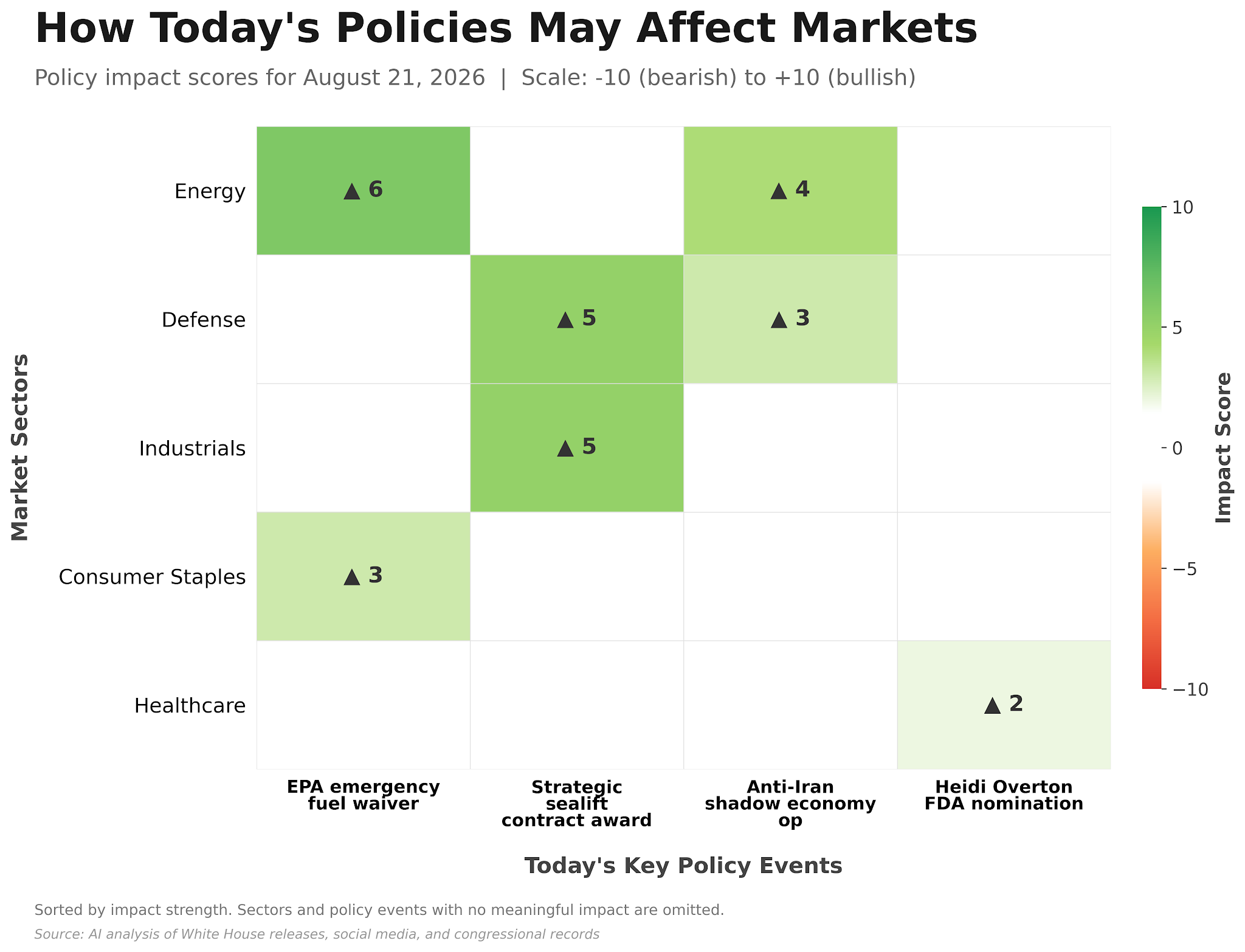
Each cell shows an estimated impact score on a fixed scale of -10 to +10, reflecting how today’s policy developments may affect each market sector. Positive scores (green, ▲) suggest bullish impact; negative scores (red, ▼) suggest bearish pressure. Rows and columns are sorted by impact strength, and sectors and policy events with no meaningful impact are omitted. The heatmap, the analysis below, and the Impact on Market themes above are produced from a single unified analysis: the heatmap visualizes the magnitudes, while the text explains the causal reasoning behind them.
The administration’s decision to enact emergency fuel waivers signals a targeted effort to temper inflationary pressures in the energy market. By expanding supply, the policy aims to lower costs for consumers, though some critics characterize such waivers as “short-term fixes” that overlook longer-term environmental impacts. Concurrently, the issuance of a massive multi-billion dollar strategic sealift contract provides a significant capital injection for the industrial and logistics sectors. This move highlights the government’s focus on maintaining global supply chain resilience and military readiness.
Heightened geopolitical tensions arise from the announced operation to neutralize Iran’s shadow economy. This policy intensifies the “economic pressure campaign,” which may increase regional volatility and risk premia for energy-reliant sectors. While the administration frames these actions as essential for national security, observers note the potential for retaliatory disruptions in shipping lanes. Meanwhile, the FDA leadership nomination suggests a potential shift in regulatory philosophy. Analysts observe that a new commissioner may influence the approval velocity for new therapies, directly impacting investor sentiment across the healthcare landscape. The intersection of these supply-side interventions and geopolitical maneuvering sets a complex backdrop for sector valuations.
Comments
Nothing yet. Say the first thing.
Sign in to join the conversation.