
1. Overview
2. White House News
3. Truth Social Posts
4. Government Department News
5. 2028 Democratic Presidential Candidates
6. AI & Tech Company News
7. Congressional Watch
8. Policy Impact Analysis & Heatmap
Noctral is an app for anyone carrying an argument they’d like to test on someone sharper. Free on iOS.
→ Download on the App Store
→ noctralai.com
President Trump signed a National Security Presidential Memorandum to “reinvigorate America’s leadership in space transportation,” setting a goal of 1,000 annual launches by 2030. This policy mandates that federal agencies prioritize domestic launch vehicles and streamline infrastructure development to ensure U.S. superiority. Additionally, the administration showcased its “America First” economic agenda through various cabinet-level infrastructure and manufacturing announcements. First Lady Melania Trump also expanded her “Fostering the Future” initiative with a $2 million donation to provide scholarships at Indiana and Purdue Universities.
On Truth Social, President Trump announced the nominations of Phil Axt and Jesus Osete to U.S. District Court positions, labeling Axt a “true warrior” for the Constitution. The President also confirmed that Director of Legislative Affairs James Braid will depart the White House in September, crediting him with securing the “most successful Republican Congress in History.” Finally, Trump shared a media report featuring a former FBI agent, who argued that presidential support “empowers” law enforcement to improve national safety.
The State Dept held security and economic discussions with Canadian officials while coordinating on regional security issues in Haiti and Venezuela. Meanwhile, the Treasury Dept, in a coordinated effort to disrupt financing for Hizballah, sanctioned a smuggling network that utilized commercial couriers to move millions in cash. Treasury also imposed sanctions on 15 individuals linked to cocaine trafficking networks in Ecuador. Additionally, the State Dept sanctioned leaders of the Cuban Institute of Friendship with the Peoples for their alleged role in promoting “Marxist” subversion, while the Dept of War awarded a $5.7 billion contract for logistics services and issued new funding opportunities for national security technology.
Governor Gavin Newsom announced $11.3 million in funding for 13 communities to support “bold, locally driven” housing production and launched a school-based albuterol access program. Governor Gretchen Whitmer secured $108.9 million for 75 outdoor recreation projects, emphasizing the expansion of public land access. Governor Wes Moore introduced a $3 million “Pay It Forward” fund to provide interest-free loans to nursing students, aiming to combat the state’s workforce shortages. Governor Tim Walz appointed two new District Court judges, describing his selections as individuals with “remarkable integrity” and “brilliant legal minds.”
OpenAI launched a “Strategic Futures” team to examine the risk that transformative AI could lead to a “concentration of power” that threatens the democratic “bargain.” The organization intends to explore mechanisms to protect individual rights and prevent power imbalances as states gain increased technological capabilities. Separately, Palantir detailed the integration of agentic AI into its security workflows, using a multi-agent harness to automate vulnerability hunting and code remediation to maintain a “durable, adaptive security infrastructure.”
Federal mandates for space and defense logistics drive revenue growth for large-cap industrial contractors through guaranteed supply chain commitments, though this reliance on state-directed policy raises concerns regarding “supply chain fragility.” Simultaneously, restrictive retail fee mandates and elevated compliance requirements for international financial operations tighten profit margins for retail platforms and multinational banks. While these measures aim to fortify financial integrity and national security, the associated cost of navigating regulatory hurdles and potential “geopolitical overreach” threatens to elevate operating expenses across the financial services sector.
President Trump signed a National Security Presidential Memorandum aimed at “reinvigorating America’s leadership in space transportation” with a goal of enabling over 1,000 annual launches and reentries on U.S. soil by 2030. This initiative seeks to defend “vital national and economic interests” against adversaries challenging American space superiority while simultaneously unlocking new commercial opportunities. The administration characterizes this action as a continuation of the President’s “consistent leadership as a driving force for American strength and achievement in space.”
Reference: https://www.whitehouse.gov/fact-sheets/2026/08/fact-sheet-president-donald-j-trump-launches-the-golden-age-of-space-transportation/
President Trump issued a memorandum establishing national space transportation goals to “secure America’s continued superiority in space,” targeting over 1,000 annual launches by 2030. The directive mandates that executive agencies improve launch infrastructure, expedite permitting, and prioritize commercial space transportation for government needs. Key instructions include developing an industrial base strategy, updating export controls, and ensuring reliable spectrum access. Additionally, the policy requires federal agencies to favor United States-manufactured vehicles for government payloads and rescinds previous directives to align with this new framework.
Reference: https://www.whitehouse.gov/presidential-actions/2026/08/national-security-presidential-memorandum-nspm-17/
Members of President Trump’s Cabinet are traveling nationwide to promote the “America First agenda,” highlighting achievements in manufacturing, infrastructure, energy, and veteran care. Secretaries have announced investments in rail, transit, and rural health, while emphasizing tax policies and small business support. Cabinet officials, including Robert F. Kennedy Jr. and Scott Turner, have promoted faith-based approaches to homelessness and youth fitness. Commerce Secretary Howard Lutnick stated, “President Trump set out to bring technological manufacturing back to America,” adding, “he’s actually doing it, and he’s doing it right now.”
Reference: https://www.whitehouse.gov/releases/2026/08/president-trumps-cabinet-champions-america-first-successes-nationwide/
First Lady Melania Trump announced that her Fostering the Future initiative is expanding to 26 universities following a $2 million donation from IndyCar and Fox Corporation to fund scholarships at Indiana and Purdue Universities. During a Rose Garden ceremony alongside President Trump, the First Lady stated, “America’s greatest competitive advantage remains in its own people,” emphasizing that her program “elevates America’s youth based on merit and talent.” The partnership will be featured during the upcoming Freedom 250 Grand Prix, showcasing the initiative’s commitment to supporting foster care students.
Reference: https://www.whitehouse.gov/briefings-statements/2026/08/2-million-donation-expands-first-lady-melania-trumps-fostering-the-future-initiative-to-indiana-university-and-purdue-university/
President Trump nominated Phil Axt, the Solicitor General of North Dakota and a graduate of Yale Law School, to the U.S. District Court for the District of North Dakota, describing him as a “true warrior” who will defend the Constitution. Additionally, he selected Jesus Osete to serve as a Judge on the U.S. District Court for the Western District of Missouri, noting Osete’s current role in the Department of Justice’s Civil Rights Division and stating he has the strong support of Senators Eric Schmitt and Josh Hawley.
Regarding staffing changes, Trump announced that Director of Legislative Affairs James Braid will be departing the White House in September. Trump credited Braid with playing a “critical role” in legislative accomplishments, including the passage of the GENIUS Act, success in shutdown negotiations, and overseeing the fastest Cabinet confirmation rate in decades, calling the current legislative session the “most successful Republican Congress in History.”
Separately, Trump highlighted a media report featuring a former FBI agent who argued that Trump’s support “empowers” law enforcement to enhance national safety.
Reference: https://truthsocial.com/@realDonaldTrump
Secretary Rubio’s Meeting with Canadian Minister of Foreign Affairs Anand
Secretary of State Marco Rubio met with Canadian Foreign Minister Anita Anand to coordinate on shared security and economic priorities. The discussion covered the Standing Group of Partners in Haiti, earthquake assistance for Venezuela, Arctic security, and efforts to combat online scam centers. Secretary Rubio also emphasized the “need for immediate, significant, and irreversible reforms in Cuba.”
U.S. Sanctions Smuggling Network for Qods Force and Hizballah
The Treasury Department has sanctioned ten individuals involved in a smuggling network facilitating cash transfers between Iran’s IRGC-Qods Force and Hizballah. The network reportedly utilized couriers on commercial flights to move hundreds of millions of dollars to fund Hizballah, which the U.S. states is used by the Iranian regime to “spread terror throughout the Middle East.” The action, coordinated with Turkish partners, targets networks that “threaten peace, undermine the sovereignty of the Lebanese state, and endanger the security of our regional allies.”
Sanctioning Ecuador-Based Cocaine Network Linked to Violent Gangs and Mexican Cartels
The U.S. sanctioned 15 individuals and entities, along with 10 fishing vessels, for trafficking cocaine from South America to Mexico for U.S. distribution. These operations are linked to the Sinaloa Cartel, CJNG, and Ecuadorian groups Los Choneros and Los Lobos. The State Department described the move as a priority for the Trump Administration to “dismantle the cartels profiting at the expense of American lives” and disrupt the convergence between Ecuadorian terrorist organizations and major Mexican cartels.
Secretary Rubio announced sanctions against three leaders of the Cuban Institute of Friendship with the Peoples (ICAP), including Fernando González Llort, and nine additional entities. The move follows accusations that the Cuban regime exploits educational exchanges to radicalize subversives and spread “Marxism, racial resentment, and Communist violence.” The administration stated it will not tolerate the regime’s “decades-long campaign of subversive anti-American activities” or its efforts to fund repression through state-controlled economic sectors.
This fact sheet details the specific designations under Executive Order 14404. Targets include ICAP leadership—specifically Fernando González Llort, Noemi Ramona Rabaza Fernandez, and Leima Martinez Freire—and entities in the metals, mining, and construction sectors. Designated enterprises include Empresa de Níquel Comandante Ernesto Che Guevara, METALCUBA, GEOMINSAL, and ACINOX Comercial. Additionally, the Ministry of Construction and the labor-supplying agency ACOREC S.A. were sanctioned for their roles in sustaining the Cuban regime’s repressive apparatus and economic control.
Secretary Rubio has designated U.S. citizen Min Zin as wrongfully detained by China. Mr. Zin was arrested on June 3 in Yunnan after traveling to attend a government-invited academic conference. This designation brings the total number of wrongfully detained U.S. citizens in China to two, including Dr. Youlin Chen. The State Department stated that the safety of U.S. citizens remains a top priority and affirmed it will continue to advocate for the release of all citizens arbitrarily detained or exit-banned in China.
Office of Strategic Capital Posts Application for National Security Fund Finance Program
The Office of Strategic Capital (OSC) has released a Notice of Funding Opportunity for the National Security Fund Finance program. Established under the One Big Beautiful Bill Act signed by President Trump, the program provides loan support to investment fund managers. This initiative aims to address critical mineral and material shortages by leveraging private capital. Interested parties must submit proposals by 5:00 p.m. EDT on November 1, 2026.
U.S. – Jamaica Joint Statement on Status of Forces Agreement
The United States and Jamaica have signed a Status of Forces Agreement to formalize terms for temporary military presence during joint training and operations. This pact, following discussions between Defense Secretary Pete Hegseth and Jamaican officials, seeks to strengthen security cooperation. The agreement is intended to bolster regional security and combat criminal organizations and narco-terrorists. The partnership reflects a shared commitment to “advance peace through strength” and deepen the security relationship between the two nations.
The Department of War awarded several major contracts, including a $5.7 billion multiple award contract to FedEx, UPS, and Polar Air Cargo for small package delivery services through 2030. Other awards include $494 million to ASRC Research and Technology Solutions for DCSA support, $264 million to HITT Contracting for a nuclear power training facility, $156 million to Boeing for P-8A Engine Build-Up kits, and $117 million to Red Eagle 3 JV for an engine test cell facility in Florida.
The Treasury’s Office of Foreign Assets Control (OFAC) has sanctioned 10 individuals involved in a smuggling network that transfers millions of dollars in cash to Hizballah via couriers on commercial flights. The network, managed by Yunus Alper Yilmaz, operates through front companies in Türkiye and the Middle East to bypass the formal financial system. Additionally, OFAC re-designated Hizballah as an entity controlled by Iran’s Islamic Revolutionary Guard Corps-Qods Force. U.S.-based assets of these individuals and linked entities are now frozen.
Treasury Sanctions Major Ecuador-Based Cocaine Network Linked to Violent Gangs and Mexican Cartels
OFAC sanctioned 15 Ecuador-based targets and blocked 10 vessels associated with a cocaine trafficking network linked to the Los Choneros and Los Lobos gangs. Operating under the cover of fishing businesses near Manta, these actors move narcotics to Mexican cartels for U.S. distribution. Treasury Secretary Scott Bessent stated, “Under President Trump’s leadership, Treasury is relentlessly targeting the narcoterrorist networks that profit from poisoning Americans.” This action supports broader interdiction efforts, including Operation Pacific Viper, which has seized over 112 tons of cocaine since mid-2025.
U.S. Treasury Proposes Common Sense and Low-Cost Investment Rules for Trump Accounts
The Treasury Department proposed new guidance for “Trump Accounts,” aiming to maximize long-term savings for children by restricting investments to low-cost, diversified index ETFs. The rules prohibit products with excessive fees or complex strategies to ensure returns are not depleted by costs. Treasury Secretary Scott Bessent noted, “Under President Trump’s leadership, Treasury is putting simple, commonsense protections in place to help families keep more of their investment returns.” The framework establishes criteria for eligible investments, prioritizing transparency and decades of compound growth.
Governor Newsom awards $11.3 million to 13 prohousing communities to build more affordable housing
Governor Newsom announced $11.3 million in funding for 13 jurisdictions through the Prohousing Incentive Program. The grants support communities that demonstrate “bold, locally driven policies” to accelerate housing production and reduce costs, such as streamlining multifamily development and up-zoning. This initiative is part of a broader strategy to address the state’s housing shortage and homelessness, which includes the Housing Accountability Unit’s oversight to ensure local compliance with state laws and expanded support through Proposition 1 and CARE courts.
California sends FREE life-saving asthma inhalers to ALL schools
Governor Newsom launched the School Albuterol Access Initiative, a CalRx® partnership with Amneal Pharmaceuticals to provide free emergency albuterol inhalers and spacers to 10,000 public and charter schools. Over three years, schools will receive an annual stock to treat students experiencing respiratory distress. The program also provides training guidelines for school staff on recognizing symptoms and emergency protocols. Private schools may purchase the supplies at discounted rates. The initiative aims to reduce school absenteeism caused by asthma, which affects approximately 1 million children in California.
Gov. Whitmer Secures Funding for 75 Local Parks and Outdoor Recreation Projects
Governor Whitmer announced a $108.9 million investment in public lands, including $45 million in Michigan Natural Resources Trust Fund grants for 75 projects. Funded by state oil, gas, and mineral revenues, the initiative aims to expand outdoor access and support local economies. Key acquisitions include 22,650 acres in the Keweenaw Peninsula, 460 acres near Porcupine Mountains Wilderness State Park, and 1,400 acres in the Au Sable River watershed. This investment supports the state’s outdoor recreation industry, which currently sustains 126,000 jobs.
Governor Wes Moore and Social Finance have launched the $3 million Maryland Pay It Forward Fund to support nursing students. Funded by the state and Blue Meridian Partners, the initiative provides zero-interest loans for tuition and living expenses to students in Associate Degree in Nursing programs. Designed to address a critical state nursing shortage, the program allows graduates to delay repayments until they earn over $50,000 annually. A pilot program will begin during the 2026–2027 academic year at the Community College of Baltimore County.
Daily Public Schedule: Thursday, August 20, 2026
Governor Pritzker has no public events scheduled for Thursday, August 20, 2026.
Governor Walz Appoints Wesley Abrahamson and Devona Wells to Fill Second Judicial District Vacancies
Governor Tim Walz has appointed Wesley Abrahamson and Devona Wells as District Court Judges in Minnesota’s Second Judicial District, covering Ramsey County. Abrahamson, a senior attorney in the Ramsey County Attorney’s Office, replaces the Honorable Reynaldo A. Aligada, Jr. Wells, an assistant county attorney in Hennepin County, replaces the Honorable Joy D. Bartscher. Governor Walz praised Abrahamson’s “remarkable integrity and fortitude” and described Wells as a “brilliant legal mind who uses her talents as a force for good.”
OpenAI has launched the “Strategic Futures” team to analyze how free societies can maintain individual rights and agency alongside transformative AI. The team identifies the potential “concentration of power” as the most serious long-term risk of AI development. They argue that as states potentially gain the ability to project force and generate revenue without relying on human labor or public consent, the traditional democratic “bargain” is threatened. The group aims to explore structural mechanisms to prevent power imbalances, drawing inspiration from the American Founders’ approach to checking power.
Securing Software at the Speed of AI
Palantir has integrated agentic AI into its security workflows, utilizing a multi-agent harness to perform source-code review, vulnerability hunting, and runtime validation. Key insights include the necessity of a structured harness to orchestrate AI models, the critical role of organizational context, and the importance of maintaining data sovereignty. By shifting from vulnerability identification to automated remediation using its software production platform, Palantir aims to create a durable, adaptive security infrastructure that compounds institutional knowledge while evolving alongside emerging threats.
Covers the 2026-08-19 session — the Congressional Record is published with a one-day delay.
No Congressional Record found for 2026-08-19.
This analysis is provided for informational purposes only. It does not constitute investment advice or a recommendation to buy or sell any security.
Based on today’s policy developments, our analysis identifies the following market impact themes:
Federal mandates for space launch acceleration and massive defense logistics contracts represent a return to state-directed industrial policy. By mandating U.S.-sourced vehicles and multi-year supply chain commitments, the administration creates a reliable revenue stream for large-cap industrial players. However, critics warn that concentrating government orders on a few prime contractors creates ‘supply chain fragility’ and risks inefficiency. Increased protectionism in these sectors may also provoke retaliatory trade measures from international partners.
The administration is simultaneously tightening the leash on financial intermediaries through both targeted sanctions and retail-account fee mandates. Treasury’s push to limit expense ratios in children’s savings accounts reduces the fee-based revenue potential for retail financial platforms. Simultaneously, the aggressive designation of international smuggling networks forces banks to adopt higher compliance thresholds. Financial industry observers worry these dual pressures will elevate operating expenses while limiting the growth potential of new retail financial products.
Foreign policy actions, such as sanctions against Cuba and Hizballah-linked actors, are increasingly integrated with domestic economic goals. These moves seek to eliminate illicit competition and safeguard national financial integrity, but they alter the cost structure for multinational firms operating in sensitive jurisdictions. While investors appreciate the focus on stability, some raise concerns about ‘geopolitical overreach’ and the potential for these designations to disrupt broader trade relationships. Compliance costs remain the primary risk for companies lacking robust, automated verification systems.
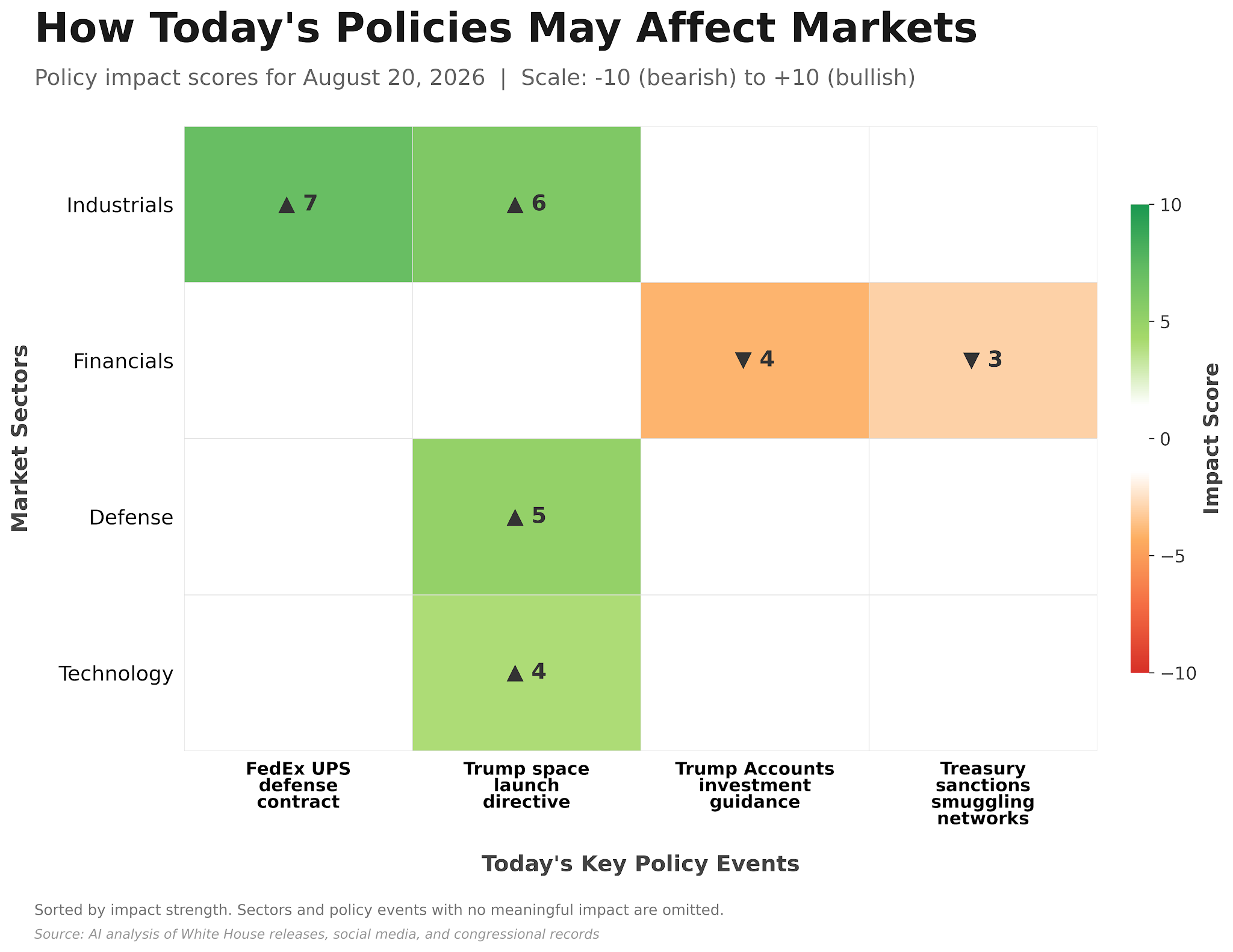
Each cell shows an estimated impact score on a fixed scale of -10 to +10, reflecting how today’s policy developments may affect each market sector. Positive scores (green, ▲) suggest bullish impact; negative scores (red, ▼) suggest bearish pressure. Rows and columns are sorted by impact strength, and sectors and policy events with no meaningful impact are omitted. The heatmap, the analysis below, and the Impact on Market themes above are produced from a single unified analysis: the heatmap visualizes the magnitudes, while the text explains the causal reasoning behind them.
The administration’s focus on ‘American strength’ through space transportation infrastructure marks a significant shift for industrial and aerospace firms. By prioritizing domestic manufacturing and aggressive launch targets, the directive creates long-term demand for high-end industrial contractors. Concurrently, the multi-billion dollar logistics contract awarded to major air-freight carriers provides a demand floor for the sector, insulating these firms from broader consumer-spending volatility through 2030. These actions underscore a pivot toward government-led industrial capacity expansion.
Conversely, the financial sector faces increased regulatory headwinds. New Treasury guidance for ‘Trump Accounts’ enforces strict fee caps on managed savings, which analysts at major banks note could compress margins for retail-focused wealth managers. Furthermore, expanded sanctions against international smuggling networks continue to raise compliance costs for financial institutions. While these actions aim to curb illicit flows, they increase risk-management overhead for firms with global operations. Critics argue these measures represent ‘regulatory creep’ that complicates standard cross-border transaction protocols. The combined effect is a dual-track market environment where government-backed industrial growth offsets heightened operational friction in the financial services landscape.
Comments
Nothing yet. Say the first thing.
Sign in to join the conversation.