
Preface: In the thermoeconomic framework I have been working on, societies succeed not merely by generating energy but by intelligently managing entropy across complex systems. Coal has been, and remains, one of the principal sources of energy across the globe, no more so than in China. However, the processes by which coal is mined and converted is not free of entropic consequences. Coal gangue is one of the manifestations of this. Yet, coal gangue recycling in Shanxi exemplifies the proposition that social and economic systems ultimately hinge on the dialectic between nature’s tendency to entropy and human efforts to respond by way of negentropic measures. In the case of coal gangue recycling, we have a discrete technological intervention that contributes to a broader mosaic of negentropic processes reshaping China’s resource flows. What appears as isolated innovation — converting mining waste into high-value construction materials — accumulates into system-wide EROEI gains, reduced disorder and circular material cycles. China’s scaling experiments offer replicable models for the Global South, where resource constraints and legacy wastes intersect most acutely. Such interventions demonstrate how targeted negentropic design can yield compounding thermodynamic and economic returns, advancing sustainable development at scale. Again, I thank my colleagues in the “hard sciences” for their assistance and support, not to mention forbearance, in the preparation of this essay. All errors are, needless to say, mine.
In the coal-rich province of Shanxi, in inner NW China, a significant industrial project is transforming one of mining’s most persistent liabilities into valuable resources. A new facility in Datong, launched last year, is pioneering large-scale conversion of coal gangue into building-grade sand, aggregate, bricks, lightweight ceramsite and other industrial materials. Coal gangue is the rock waste generated during coal extraction and processing. This initiative is part of China’s broader push toward a circular economy, exemplifying how waste streams can be re-engineered into productive inputs. This process aims to not only yield environmental benefits but also measurable improvements in system-wide energy return on energy invested (EROEI). In other words, the initiative pushes beyond superficial “green recycling,” and aims to make an impact in terms thermodynamic and economic restructuring. It is a negentropic process that locally reverses entropy by converting disordered waste into ordered, functional materials.
Other provinces that have extensive coal sectors, and coal gangue waste management problems include Shaanxi, Inner Mongolia, Henan and Hebei. That these provinces also share a reality of extensive ageing industrial cities in crying need of renewal and upgrading makes the coal gangue conversion capability a cost-effective pathway to support local redevelopment projects. Urban renewal provides the demand anchor for the scaling up of coal gangue conversion, all the better when demand and supply are located within reasonable distance. I will discuss the latest urban renewal plans in a future essay.
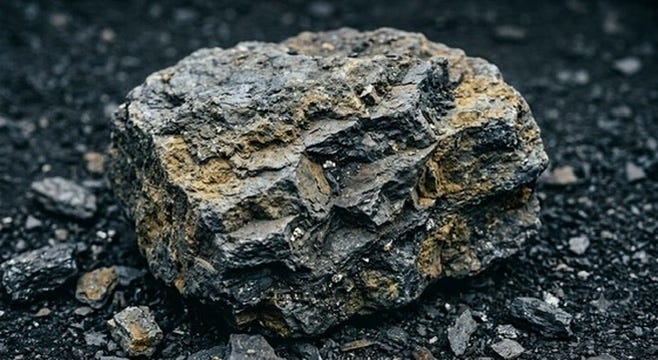
Coal gangue is a big problem. It makes up between 10-20% of raw coal output (Wu et al., 2024). China produces 600-800 million tonnes annually, with cumulative stockpiles exceeding 7 billion tonnes (and some estimates reaching 60-70 billion tonnes when accounting for historical accumulations) (see Li et al., 2026 for further discussion). This is substantial volume by anyone’s language. Utilisation rates of gangue have improved to around 60-72%, but significant gaps remain, especially in high-production regions.
Shanxi is a coal heartland province. It faces acute pressures. Gangue piles cover vast land areas; they risk spontaneous combustion thereby releasing pollutants and greenhouse gases; they leach heavy metals into soil and water; and, as such, demand ongoing remediation. Conventional disposal is an energetically costly overhead with no useful output; it is pure entropic waste. The Datong project in Yun’gang District’s Tashan Industrial Park aims to address this at scale. Planned as China’s first 10-million-tonne-level coal gangue comprehensive utilisation demonstration, it involves roughly 70 billion RMB in investment (~US$10 billion). The first phase targets 2 million tonnes annual processing, scaling toward 10 million.
At its core is the innovative “1267” technical framework: one crushing plant, two photovoltaic (photoelectric) sorters, six operational modules, and seven high-value products. Advanced technologies include millisecond-level photoelectric sorting for quality grading, suspension preheating combined with rotary kiln calcination, and a pioneering belt-type roasting machine for ceramsite production that maximises heat recovery. Outputs include lightweight, high-strength ceramsite (one-third the weight of natural gravel, with excellent insulation properties — nicknamed “breathing building materials” - on which see Wang et al., 2020, Liu et al., 2026), refined kaolin (see Ren et al., 2023), prefabricated building components and more (see Xue et al., 2026). These feed into diverse downstream applications including construction, water treatment, soil remediation and green assembly-style building chains.
This initiative builds on earlier successes. A Shanxi Coking Coal plant operating since 2008 has already consumed 3.06 million tonnes of gangue to produce 1.06 billion bricks, which displaced virgin clay and reduced land use for traditional brick-making.
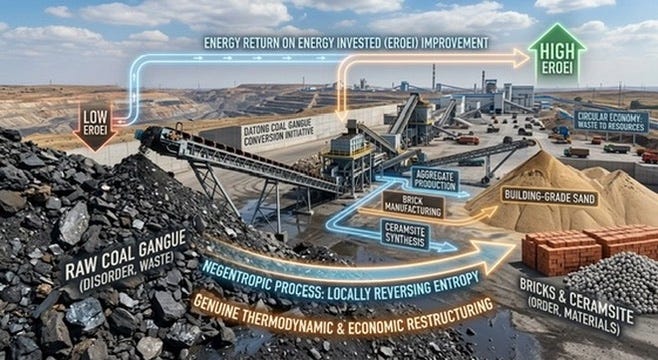
Now, all of these downstream applications are useful in and of themselves. However, arguably, the true value of such recycling is most evident when viewed through a systems-level EROEI lens. Traditional mining and waste management invest energy in extraction, transport, piling and eventual remediation. This management approach yields negative or zero net return, and are major operational, engineering, ecological and financial headaches. Spontaneous combustion, leaching and land sterilisation compound these losses. Recycling aims to turn the ledger on its head. The calculation is that energy for crushing, sorting and processing gangue displaces far greater inputs required for quarrying and processing scarce virgin sand and gravel (global construction sand demand is enormous; suitable deposits are depleting as recently documented in a Reuters report and in academic studies elsewhere); firing conventional clay bricks at ~1000°C; and remediating contaminated sites and managing distant supply chains.
The Datong project’s heat recovery and multi-product integration amplify returns. Waste heat can support nearby processes or district heating. Outputs substitute for high-embodied-energy materials. When gangue — a liability with storage and hazard costs — becomes feedstock, the marginal input energy cost turns negative relative to virgin alternatives. This boosts overall system EROEI by avoiding externalities and creating closed loops.
Broader circular models, like those at Tashan Park, illustrate the principle: coal → electricity → building materials, with fly ash feeding cement production and waste heat warming residences. Each stream becomes input for another, structurally reducing disorder. Add to this proximity to end demand, by way of urban renewal initiatives, and there are multiple layers or dimensions of downstream benefits of this approach.
In thermodynamic terms, waste accumulation is entropic. That is, energy dissipates, materials disperse into disordered, thereby creating polluting states. Recycling gangue into graded aggregates, sintered products or geopolymers reorganises matter into high-utility forms. In other words, the materials conversation process leads to local order creation, or in other words, negentropy. This aligns with circular economy goals of “reduction, reuse, and recycling” but elevates them through intelligent material flow redesign.
China’s policy support, including targets for “zero-waste cities,” a new generation of urban renewal (15th Five Year Plan) and overall incentives for resource efficiency, accelerates this. Shanxi’s circular economy efficiency stands at 0.76 overall (Hou et al., 2025), yet waste reuse lags in production and utilisation stages (0.48 and 0.56 in some metrics). This disparity highlights potential for projects like Datong to close gaps.
Resource substitution is a bonus. Construction sand is the world’s second-most-consumed resource after water. Gangue-derived alternatives directly alleviate shortages, and at the same time goes towards mitigating mining impacts elsewhere. Economically, it inverts the economic calculus: waste with negative value (disposal costs) becomes a competitive input, enabling different cost structures than have been the case with conventional recycling.
Undoubtedly, negentropic claims require rigorous environmental integrity. Coal gangue often contains arsenic, mercury, lead, chromium and other heavy metals. Without proper immobilisation, recycled products could redistribute pollution. Research and practice emphasise solutions. These include sintering and geopolymerisation lock metals into stable crystalline phases or glassy matrices, which drastically reduces leachability. Studies on fired bricks and aggregates show compliance with standards (e.g., GB 5085.3-2007) when processes are optimised. In the Datong project, photoelectric sorting and controlled calcination enhance purity and stability.
It’s not all plain sailing, however. Long-term durability under freeze-thaw, acid rain, abrasion and dynamic loading (e.g., in backfill mining) conditions demands ongoing monitoring. Acidic conditions or mechanical stress can mobilise certain fractions (Pb, Zn, Mn often more mobile). Best practices include pH control, microstructural engineering, and regulatory oversight to ensure “clean cycling.” So, we are still in early days even if the situation is very promising.
The Shanxi development summarised above goes beyond mere incremental progress. Rather, it models scalable resource substitution amid the dual constraints of energy transition and material scarcity. As China decarbonises its historic dependency on coal, such innovations ease the path by valorising legacies of past extraction. What is the waste of past transformations can now be mobilised to substitute for increasingly rare or difficult to access materials, and contribute to ongoing ambitions to upgrade China’s cities.
Nationally, utilisation has risen. Filling / backfill as a growth area alongside power generation and materials is increasingly commonplace. Regional strategies matter, as we all should know. China’s “mayoral economy” model — as Jin Keyu has described — means much of the operational action and imperatives emerge at a city and provincial level, rather than merely respond to central government diktat. In this case, Shanxi’s higher-calorific gangue suits energy and bricks; alumina-rich types of gangue elsewhere are likely to favour extraction and premium materials. Economically, the overall approach supports industrial upgrading, job creation in green tech and exportable “Energy Construction Solutions.” Thermodynamically, it demonstrates how human ingenuity augments natural negentropic processes (like biological cycling) at industrial scales.
To maximise impact, priorities going forward will include progress towards scaling advanced sorting and low-energy processing. There will also be a need for rigorous, transparent entire life-cycle assessments incorporating full EROEI and toxicity metrics. Anchoring the conversion processes to prefabricated or green building industrial chains for multiplied effects speaks to the scaling pathway, while exploration will doubtless be undertaken to identify possibilities for cross-sector symbiosis (e.g., with cement, construction, and remediation) to generate greater market reach and footprint.
The Datong coal gangue project and similar efforts in Shanxi embody negentropic innovation. They reorganise material and energy flows to increase order and utility within the economic system, and mitigate waste along the way. By elevating EROEI through avoided costs, resource substitution and tighter — if not fully closed — loops, they advance a circular economy that is thermodynamically sound and practically scalable.
Developments like this illustrate that circularity, when grounded in rigorous engineering and systems thinking, can transcend slogans to deliver measurable gains in resilience and sustainability. China’s experience provides a valuable learning model — albeit imperfect but nonetheless advancing — for other coal-intensive regions across the globe. Ultimately, success will hinge on maintaining environmental safeguards while expanding these models, proving that intelligent design can turn yesterday’s waste and legacy burdens into tomorrow’s foundations for social and economic upgrading. In a world grappling with resource depletion and entropy on a planetary scale, such developments offer glimpses of pragmatic hope.
Comments
Nothing yet. Say the first thing.
Sign in to join the conversation.