
Preface: China’s urban evolution is shifting gears. We are all familiar with the story of the rapid slowdown in the (residential) real estate sector, the dynamics of which I have explored previously. What is perhaps less well understood is that not only did the deleveraging of real estate presage the dramatic ramp-up in high tech industrial capacity development, but it has also laid the groundwork for a move towards qualitative renewal in the urban lived environment. This short essay discusses some of the key policy directions in this regard. For those who follow the ongoing western commentary about Chinese “over investment” this turn will continue to befuddle these commentators. They will doubtless resort to hoary old ideas that investment is all the government can do to keep growth on target, while at the same time refusing to acknowledge that the objects and purposes of investment are entirely legitimate and understandable as a society seeks to upgrade its overall conditions.
In July 2026, President Xi Jinping, during an inspection trip to Shanghai, called for advancing high-quality urban renewal. This intervention comes at a pivotal moment, reframing urban development away from narrow fixed-capital expansion toward a comprehensive vision of liveable, resilient and sustainable cities. Set against a backdrop of the policy-induced deleveraging of China’s helter-skelter real estate sector since 2020, this call for, and push into, questions of urban renewal represents a certain level of confidence; namely, that China and the real estate market and associated sectors are ready to step out of the shadows of the contraction and into a new phase of modernisation.
China has plenty of houses for people to live in; and there will doubtless be more to come. The pipeline has not ceased producing dwellings; don’t confuse a sustained slowdown in the rate of development with an absence of development. What Xi’s call for urban renewal does is position real estate development within a wider context that integrates economic upgrading, ecological harmony, demographic adaptation and spatial efficiency. The call — backed by not insubstantial funding support — is also a direct rebuttal of persistent (western) narratives that portray China’s infrastructure needs as largely exhausted since the late 2000s stimulus era.
A clutch of western observers and analysts have long suggested that China reached “peak infrastructure” around 2009, with further investment yielding diminishing or even negative returns. What’s been invested since, the infrastructure that has been developed over the past decade and a half, is often derided as wasteful. This view assumes that once basic networks of roads, rails and utilities were established, additional capital formation would inevitably produce waste. Yet this perspective overlooks fundamental realities: material depreciation, evolving needs, per capita shortfalls relative to advanced economies, not to mention the dynamic requirements of ongoing urbanisation.
Let’s not forget that right now, about 68% of China’s population is now urbanised. That’s about 952 million urban dwellers, leaving some 450 million as rural residents. China targets 85% urbanisation by 2049. By 2049, China’s population is projected to be approximately 1.27 billion people according to United Nations medium-variant demographic forecasts. Taking 85% of this 2049 projection equals roughly 1,079,800,000 people (about 1.08 billion) who would be living in urban areas under the specific milestone target. This means there is a need for urban accommodation for another 127,800,000 people. On an annual average basis, that is equivalent to net additional urban accommodation for 5,556,000 people. Depending on household composition going forward, we are looking at a need for an additional 2.2 million+ additional dwellings per year, on average, for the next 23 years.
We also should note that roughly 16% of today’s housing stock was built pre-1990 and that around 20% of all urban dwellings is over 30 years old. Many buildings built before 1990 used low quality concrete panel assembly methods. Most lack basic modern infrastructure and amenities such as elevators, private kitchens or central heating. From a structural integrity point of view, it is likely that many of these older structures will have an active service life of between 30 to 50 years. These structures are difficult to renovate and are likely to be demolished and replaced.
Now, basic arithmetic tells us that by 2040, any home built before the year 2000 will be over 40 years old. According to China's official 2020 census data, over 30% of China’s urban housing stock fits this timeline. This equates to approximately 100 to 150 million dwellings. The State Council identified and targeted roughly 219,000 old urban residential compounds built before the end of 2000 for its national Old Urban Community Renovation Projects (OCRP). In the central core districts of the major First tier megacities like Beijing and Shanghai, the problem is even more concentrated, where over 60% of all residential structures predate 2000.
While 30% of urban stock will cross the 40-year mark by 2040, a much larger wave of buildings constructed during the massive building boom of the early 2000s will clear the 30-year mark. Data from the Ministry of Housing and Urban-Rural Development reveals that an estimated 80% of all Chinese urban buildings will be over 30 years old by 2040.
There are clear drivers for urban renewal, involving new dwelling construction to accommodate future urbanisation needs; demolition of dwellings that are, from an engineering and amenities point of view, beyond their useful life; replacing these older structures with fit-for-purpose higher quality dwellings; as well as upgrading amenities in existing older dwellings. Add to this a greater emphasis on liveable public spaces and public amenities, and Chinese cities’ infrastructure demands are anything but settled. Indeed, China’s urban renewal agenda decisively debunks those claims that China’s infrastructure ceiling was reached around 2009, by viewing cities not as static assets but as living systems requiring continuous modernisation.
The State Council’s approval of the Urban Renewal 15th Five-Year Plan (2026–2030) provides a clear strategic and operational blueprint. This landmark document shifts focus from large-scale greenfield expansion — characteristic of earlier rapid urbanisation — to systematic upgrading of existing urban stock. Targets are ambitious and concrete, pardon the pun: renovation of approximately 115,000 old residential communities, 500,000 unsafe or dilapidated housing units, around 1,500 outdated industrial districts and 4,000 urban villages. Most critically, it mandates upgrades to 365,000 kilometres of ageing underground pipelines, including 175,000 km each for water supply and drainage, alongside substantial expansions for gas, sewage and heating networks. Industry estimates place related investment in the 15–20 trillion yuan range over the period, underscoring the scale of this “subterranean overhaul.”
This program goes well beyond a maintenance exercise. Instead, it addresses genuine absorptive capacity that persists despite impressive absolute achievements. China’s total infrastructure stock ranks among the world’s largest — boasting extensive high-speed rail, expressways and water conservancy systems that benefit hundreds of millions. Yet per capita metrics and quality benchmarks reveal substantial room for catch-up. Overall infrastructure quality scores place China behind leading OECD economies such as Switzerland, the United States and Japan, particularly in urban utilities, resilience features and integrated systems.
Investment as a share of GDP remains elevated at around 4.8%, reflecting continued prioritisation of foundational improvements. Yet, despite the massive aggregate numbers and high percentage of GDP devoted to investment, China’s per capita capital stock and annual per capita fixed capital formation remain lower than major high-income economies. On a per capita basis, China’s annual fixed capital investment is around US$6,000. This is considerably less than the U.S. (~$20,200), Australia (~$18,150), the EU(~$10,100) and Japan (~$9,300) based on World Bank data.
What this comparative data suggests is that China still has some way to go, to achieve the levels of investment made, and fixed capital formed, by high-income economies.
Critics of sustained infrastructure investment also often ignore the effects of asset ageing and obsolescence. Much of China’s urban fabric, as noted earlier, was built hastily during earlier industrialisation and urbanisation waves (including pre-reform legacies and 1980s–2000s developments). It suffers from outdated plumbing, wiring, insulation and — in parts of the country — seismic vulnerabilities. “Laopoxiao” (old, shabby, small) residential compounds exemplify this, with poor energy efficiency and inadequate amenities for contemporary living. Industrial precincts similarly demand conversion to higher-value uses. Renewal investments replace depreciated capital, preventing decay and unlocking productivity gains — precisely the opposite of wasteful “bridges to nowhere.”
Far from having absorbed all possible investment by the late 2000s, China confronts a rolling need driven by natural wear, technological progress, and rising living standards.
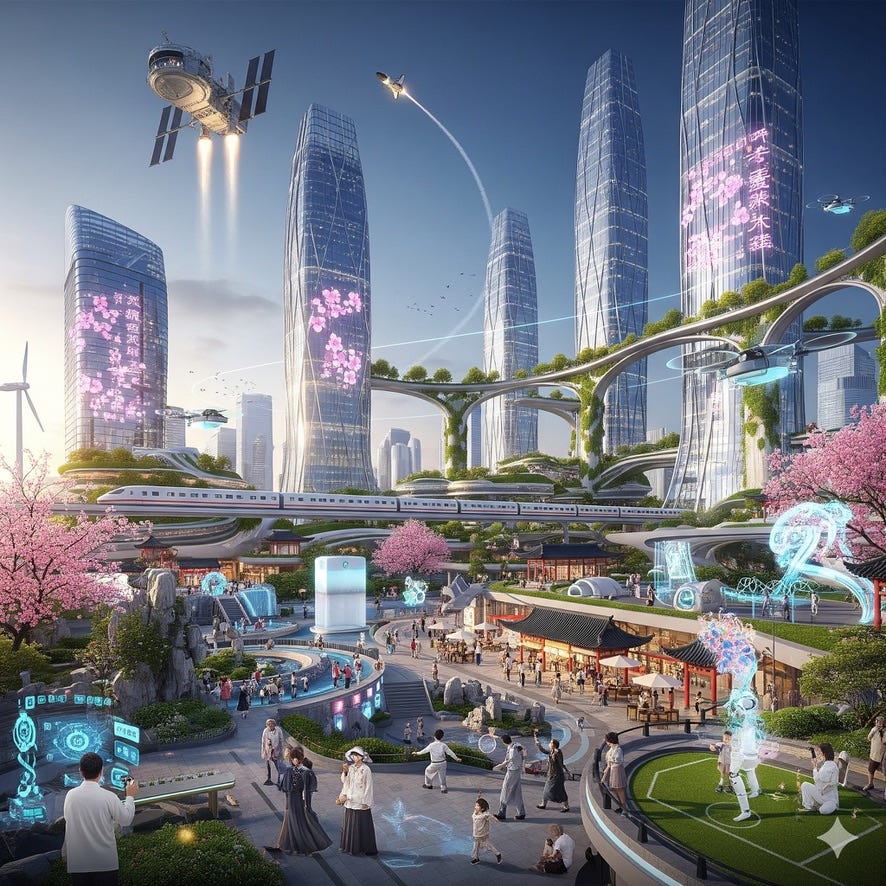
The urban renewal drive seamlessly aligns with the “Beautiful China” vision enshrined in the 15th Five-Year Plan. As I have articulated in recent analyses of “Beautiful China” this embodies a philosophical commitment to harmony between humanity and nature, where beauty represents the highest form of order integrating aesthetics, ethics, and ecology. Urban renewal operationalises this by embedding green development, cultural preservation, and liveability upgrades. Projects emphasise sponge-city techniques for water management, expanded public spaces, digital infrastructure, and low-carbon transitions. Pipeline modernisations reduce leaks, enhance efficiency, and bolster resilience against climate impacts, while community renovations add elevators, green areas, elderly-care facilities, and smart services.
This approach directly responds to demographic realities. As noted, China’s urbanisation rate now exceeds 67%, with the urban population surpassing 960 million. The country enters the final phase of urbanisation amid rapid ageing. A shrinking working-age cohort and rising elderly population demand higher-quality urban environments that support productivity (services delivery), health and social cohesion. Isolated, lonely older people is not a recipe for a functional community. Compact, well-serviced cities reduce per-person infrastructure burdens, improve access to care and amenities, and make urban living more attractive — potentially mitigating some downward pressures on household formation and consumption. Renewal investments thus serve as demographic stabilisers, enhancing quality of life while fostering the human capital essential for high-income status.
Central to efficiency gains is the promotion of urban agglomerations around transport-linked city clusters. This spatial strategy — evident in initiatives around the Yangtze River Delta, Greater Bay Area, and Beijing-Tianjin-Hebei — maximises infrastructure provisioning through density and connectivity. Clustered development minimises duplication, optimises resource flows (energy, water, logistics), and creates economies of scale in services. Spatial clustering is a key feature of China’s industrial model, as I have explained elsewhere. It counters sprawl’s inefficiencies and aligns with sustainability goals. Moreover, these agglomerations drive industrial clustering and compounded learning effects. Proximity facilitates knowledge spillovers, innovation diffusion, supply-chain integration, and talent mobility — hallmarks of dynamic economic ecosystems. Firms benefit from shared infrastructure, specialised labor pools, and collaborative R&D, accelerating technological upgrading and productivity growth. This spatial agglomeration transforms infrastructure from a cost centre into a platform for sustained competitiveness.
The renewal agenda also signals a sophisticated evolution in capital formation. Rather than broad quantitative expansion, it emphasises “smart” and high-quality investments with multiplier effects on consumption and services. Renovations boost domestic demand through construction activity, property value uplift, and expanded community services. They create jobs in skilled trades, digital tech, green industries, and elderly care — sectors less exposed to external demand fluctuations. By converting underutilised or obsolete assets into vibrant mixed-use zones, the policy unlocks stranded value and generates new revenue streams via tourism, culture, and innovation hubs. This represents a qualitative leap: infrastructure not as an end in itself, but as an enabler of broader common prosperity and ecological civilisation.
Chinese urban renewal also has a digital dimension supporting driverless cars (dense 5G and 6G networks) and an expanded low altitude economy. By 2030, a fifth of new cars sold in China will be fully driverless, and 70% will feature advanced assisted-driving technology. This is partly made possible by the fact that China had built 4.958 million 5G base stations, while the total length of its optical fibre network reached 74.99 million kilometres. China is the global leader in 6G network and technology development, with trials now active. The 6G spectrum is able to deliver data transmission speeds hundreds of times faster than the current 5G systems, enabling more data intensive applications and uses. Driverless transportation, sensor-driven functions and expanded robotics and urban automation will lean heavily on the developments in 6G systems.
Western commentary has often framed China’s real estate adjustments — necessary deleveraging after a period of rapid credit-fuelled growth — as symptomatic of deeper structural malaise or inevitable slowdown. Headlines dwell on unsold inventory, developer challenges and local government finances. Yet the urban renewal push demonstrates strategic resilience and foresight. It pivots challenges into opportunities, channeling resources toward high-return, people-centred development rather than perpetuating old models. This confidence contrasts with narratives of inevitable stagnation. By addressing real gaps in quality and maintenance while aligning with long-term goals, China is building cities befitting a modern socialist power — innovative, liveable, beautiful, resilient, culturally rich, and intelligent, as envisioned in the 15th FYP.
Implementation will require careful coordination: mobilizing diverse funding (central support, local bonds, private capital), navigating complex property rights in old neighbourhoods, and ensuring local adaptation. Success hinges on prioritising genuine needs over rote targets and integrating digital and green technologies from the outset. Early demonstrations in cities like Shanghai and through flagship zones offer models for scaling.
In sum, Xi’s call for high-quality urban renewal, operationalised through the 15th Five-Year Plan, marks a mature phase in China’s development trajectory. It rebuts notions of exhausted infrastructure potential by highlighting persistent per capita and quality deficits, the imperatives of renewal, and the efficiencies of agglomeration. By weaving together Beautiful China ideals, quality-of-life enhancements, ecological balance, demographic management and smart capital formation, this agenda positions urban spaces as engines of the next generation of growth. City clusters amplify these benefits through industrial synergies and learning effects, fostering innovation ecosystems that compound national advantages.
As China navigates global uncertainties and domestic transitions, this urban vision recognises that true modernisation is measured not merely by scale but by harmony, resilience and human fulfilment. The coming years of renewal will test execution, but the strategic direction — upgrading the built environment to match the aspirations of an advancing civilisation — promises enduring dividends for China and instructive lessons for global urbanism.
Comments
Nothing yet. Say the first thing.
Sign in to join the conversation.