
Preface: Chinese economic discourse and governmental thinking about the economy is anchored by Marxist political economy. Yet, western commentators are incapable of taking Chinese Marxist political economy seriously. A refusal or inability to understand Chinese Marxist political economy on its own terms, as a distinct and legitimate ontology, invariably renders western observations partial at best and often downright misleading. This essay explores a recent case of this comprehension failure, by focusing on an article published in Qiushi — the Communist Party’s official journal — last December in which a selection of remarks by President Xi Jinping on the strategic importance of promoting domestic demand are presented.
So much of western commentaries on Chinese economic policy continues to suffer from a persistent failure to treat Chinese Marxism seriously. (When I speak of “western” commentaries, I also include here those commentaries that come from Chinese commentators usually found in American think tanks; the idea of “western” speaks to a particular discursive frame or conceptual posture.) Whenever Marxism (or Marxism-Leninism) is invoked in the context of discussions about China’s political economy, it is invariably framed as a question of “ideology” or some kind of “window dressing”. The ideological framing leads one to pose questions of the functioning of Marxism-Leninism as a “legitimising” political discourse, rather than as a discursive technology within the wider apparatus of government itself.
We rarely see any sustained engagement with the critical conceptual categories that Chinese policymakers and leaders themselves mobilise to frame problems of economic growth and development, structural change, questions of supply and demand, and at root the circuits of social and economic reproduction. One of the consequences of this is the persistence of conversational discordance wherein western commentators and Chinese policy texts in effect “talk past each other.”
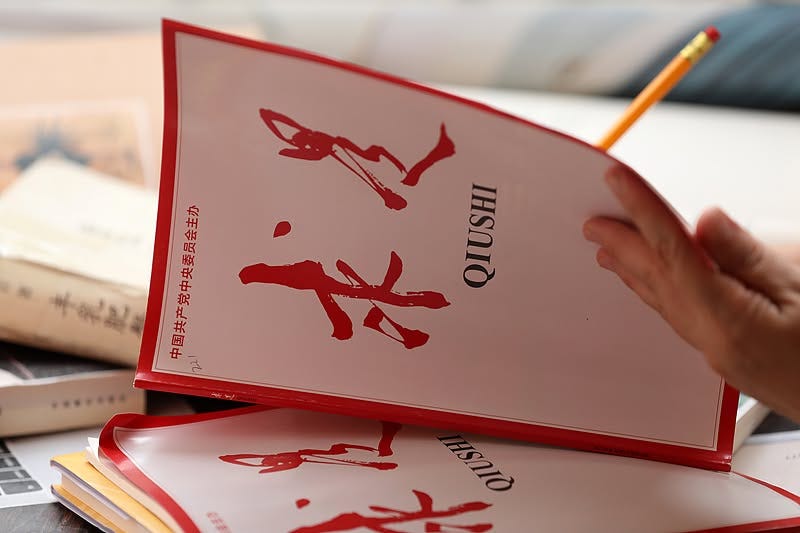
When western commentators invoke concerns about trade imbalances, industrial overcapacity and so-called competitive “distortions” and modern-day mercantilism – whether it’s state subsidies, an undervalued RMB or “below market” interest rates and “easy finance” – they often do so by projecting these issues onto Chinese statements and perspectives that are, at root, organised on the basis of an entirely different ontology. An excellent example of this is the December 2025 Qiushi magazine compilation of excerpts of Xi Jinping’s various remarks on expanding domestic demand, and how western commentators reacted to it. The article was titled “Expanding Domestic Demand is a Strategic Move” (扩大内需是战略之举) and is a curated selection of Xi’s statements over the decade since 2015. A full English translation of this article, undertaken with the aid of AI, is provided in the appendix at the end of this essay. The original Chinese edition can be accessed here. While western commentators quickly embraced passages that spoke to what could be framed as excessive capacity or subdued consumption, when read carefully and fully, the selection reveals no such concordance with the mainstream equilibrium frameworks that inform the western commentaries, but rather, a coherent developmental logic grounded in Marxist political economy.
Qiushi — literally, “seeking truth” — is the official magazine of the Communist Party of China, and thus holds particular weight within the institutions of policy discourse. Put plainly, it’s worth paying attention to.
When the December 2025 issue of Qiushi came out, western commentators quickly pounced on the opening excerpt, which was drawn from a speech delivered by Xi at the Second Plenary Session of the 18th Central Committee’s Fifth Plenum on 29 October 2015. In that speech, he said:
“In the past, our country’s production capacity lagged behind, so the focus of our work was placed on expanding investment and raising production capacity. Now overall capacity is in excess; continuing to rely single-mindedly on expanding the scale of investment to push up the growth rate has limited effect and diminishing marginal returns. Although investment can be an important short-term driver of economic growth, final consumption is the enduring driver of growth. While expanding effective investment and giving play to its key role, we must more effectively bring into play the foundational role of consumption in growth.”
Read in isolation from the remaining text, let alone situated within its temporal context, it would appear that the passage affirmed the core claims within the mainstream western narrative, namely that China has excessive or overbuilt capacity driven by an over-reliance on (state / public) investment — often portrayed as “wasteful” — and that even Xi understood and admitted that there was a need to “rebalance” towards consumption. There was a sense of “gotcha” or “see, I told you so” from assorted commentators.
And yet, when we read the remainder of the article, the compilation doesn’t affirm these western mainstream claims at all. Rather, the body of the article systematically undermines such as one-dimensional and reductive reading.
Immediately following these 2015 comments, we find a statement from 2016, which sets out the governing theoretical framework. It reads:
“Supply and demand are the two basic aspects of the internal relations of the market economy; they stand in a dialectical relationship of both opposition and unity. The two are inseparable from each other, interdependent and mutually conditioning. Without demand, supply cannot be realised; new demand can give rise to new supply. Without supply, demand cannot be satisfied; new supply can create new demand.”
Xi then goes on to reject a dualistic either / or choice between supply-side and demand-side management. Rather, policy choices must be made contingent on a proper understanding of the concrete conditions of the moment, but supply and demand “must coordinate with and promote each other.” Other excerpts from 2020 onward return to the same broad conceptualisation, by discussing the need to establish “a higher-level dynamic balance in which demand trails supply and supply creates demand,” to “organically combine the implementation of the strategy of expanding domestic demand with the deepening of supply-side structural reform,” and to treat expanding domestic demand not as a temporary expedient but as “a strategic move.” Other passages from remarks made between 2022 and 2024 speak of “demand creation of supply, supply creation of demand,” and the imperative of ongoing deepening of supply-side reform alongside demand expansion. Xi speaks of breakthroughs on bottlenecks and weak points with the supply chain system, noting that imbalances and blockages between the two are sources of economic and financial risk (2022–2024). The most recent excerpts from the 2024 Central Economic Work Conference and the October 2025 Explanation of the 15th Five Year Plan recommendations treats expanding domestic demand — especially, but not exclusively, consumption — as a strategic necessity while at the same time insisting that supply- and demand-side action must be coordinated in the pursuit of dynamic balance.
The discussion focused on questions of dynamic balance, and issues of demand in which demand cannot be reduced to consumption alone. Indeed, even within mainstream economic discourse, demand is understood to encompass both investment and consumption demand, a point that is regularly conflated – perhaps disingenuously and deliberately — by the mainstream western commentators.
The language and the conceptual framing contained in these passages reflect a particular and distinct ontology. They are not casual throwaway metaphors, or mere fragments of ideological utterances. Mainstream economics frames the economy as a system tending toward equilibrium, whether static or expanding, between aggregate supply and aggregate demand. Mainstream models are usually constructed on the basis of simplifying assumptions of a single representative agent or a single-commodity world. This leads to the persistence of equilibrium and supply-demand balance in aggregate as a static, monetarily accounted benchmark (as percentage of GDP).
This framing is not how Chinese official discourse conceptualises the world. By contrast, the national economy is conceptualised as comprising circuits of social reproduction, anchored by the development of the productive forces. As a dynamic system, with both qualitative and quantitative change at its heart, systemic imbalances are a feature of structural transformation rather than anomalies to be eliminated once and for all. In this framing, “balance” is dynamic, provisional and historical rather than static and atemporal. Dynamic balance — dongtai pingheng 动态平衡 — is the objective to be pursued while striving towards enabling the realisation of successively higher technical and organisational levels as the mode of production itself upgrades. The concept is invoked on a number of occasions by Xi in the December 2025 collection.
Indeed, the idea of dynamic balance is one that deserves much further attention, as it points to an understanding of economic processes and systems not as equilibrating questions but as multidimensional systems in perpetual motion, in which the centre of gravity is not a static equilibrium state, but a continual dynamic of transformation. Dynamic balance is about smoothing or unblocking circulation systems, which is the basis of sustained systemic upgrading. Dialectic notions of quantity into quality, and quality into quantity; of the negation of the negation and such like would then feature in this understanding. (I may return for a more detailed discussion of dynamic balance some time in the future.)
Suffice to note that this is a distinctly Marxist framing of historical development and political economy. This framing becomes even clearer when we look at other, related, materials from Qiushi. Take for example an explanatory piece from March 2025 called “Persist in Coordinated Efforts on Both Supply and Demand Sides, and Dynamic Balance” (坚持供需两侧协同发力、动态平衡). This essay quotes the same 2016 dialectical formulation, and is explicit in its process-dynamic oriented language when it speaks of aggregate supply–demand balance being “relative and temporary”; and that the movement from balance to imbalance, and then again to new balance is “an objective law of economic development.” A “higher-level dynamic balance” can only be realised by coordinating the expansion of domestic demand with the optimisation of supply capacity.
This is the same circulation logic that runs through the December 2025 excerpts. The national economy is treated as a continuous, dialectical process of production–distribution–circulation–consumption in which supply and demand are inseparable elements. The Marxist vocabulary (“对立又统一,” “辩证关系,” “动态平衡,” “客观规律”) is is the explicit theoretical frame used to reject any one-sided diagnosis (pure excess capacity / pure under-consumption) and to justify the simultaneous pursuit of demand expansion and supply-side upgrading under the dual-circulation strategy.
In short, both the long compilation and this shorter explanatory article present the same position: macroeconomic management is the practical application of dialectical materialism to the circuit of social reproduction.
We can take a look at another recent essay, in the May 2026 issue of Qiushi, titled “Strengthen, Optimise and Expand the Real Economy” (做强做优做大实体经济), another set of curated remarks from Xi spanning the decade from 2015. This essay anchors the entire discussion in the primacy of material production. We can note that from 2016 onwards, Xi has insisted that the real economy, particularly manufacturing, is the “foundation of the nation,” the “source of wealth creation,” and the base that finance must serve. He would go on in discussions about the development of a socialist financial system that such a system must serve the real economy and that its virtual expansion or expansion purely for its own sake would not be followed by China. The real economy is the foundation upon which expanded social and economic reproduction depends; and for Xi, that means promoting the development of advanced productive forces.
If this is the discursive “family” in which Xi’s remarks are to be understood, it’s worth returning briefly to the 2015 excerpt and situating it historically. In other words, a proper understanding of the remarks quoted in the excerpts must understand the situation or context in which the remarks were made. With the aid of the rear vision mirror of hindsight, it is clear that in 2015 a recognition of overall excess capacity should not have been surprising. The observation was made at a time a few years after China delivered a massive, 4 trillion RMB stimulus package in the wake of the global financial crisis of 2008. This stimulus package and subsequent credit and investment expansion channeled substantial new system liquidity via local government financing vehicles. On the back of the stimulus, China witnessed an explosion in development projects, including major or accelerated urban and related infrastructure. By 2013, there were already some concerns that capacity utilisation in steel, cement, aluminium, glass and shipbuilding was problematically low. Xi’s remarks in 2015 simply reflected the fact that the substantial quantitative expansion of investment had reached a point of diminishing returns and that further scaling (pure quantity) would not suffice. What followed was not a flip to a pure “demand-side” diagnostics but rather, the elevation of supply-side structural reform as the critical direction; and that this supply-side structural reform would be pursued in conjunction with a longer-term aim of expanding and upgrading domestic demand. The logic here was later extended via the dual-circulation model, in which domestic circulation would be the main body, with international circulation as a complement (以国内大循环为主体、国内国际双循环相互促进的新发展格局).
Put another way, this model would secure the internal circuit of production, distribution, circulation and consumption while at the same time opening up to external resources and markets in ways that would strengthen national developmental capacity. The promulgation of the dual circulation concept is also another case of misplaced western interpretation. When the concept was first aired, in 2019, the mainstream response was to “read” the formulation as signalling a Chinese retreat to autarky. In my book, China, Trust and Digital Supply Chains (2023), I dissect this misconception in detail arguing that not only did the formulation not signal an autarkic retreat but rather, it pointed to renewed emphasis on international interactions. This frame of course emerged prior to the pandemic, but the idea of opening up took new life as the pandemic-related closures began to be lifted in 2022/23. Part of the misread was entirely philological: the original Chinese formulation contained a Chinese “comma” (a dunhao 顿号、) which is used to separate items in a related list. By understanding this basic grammatical device, the formulation is better understood as “a new development pattern of “dual circulation,” in which domestic and foreign markets reinforce each other, with the domestic market as the mainstay.” There was no autarkic retreat.
For those familiar with Marxist economics, particularly as adumbrated in Capital, it is clear that at the core of this approach lies the notion of circulation. This conceptualisation is drawn directly from Capital Volume 2 in which Marx discussed at length schemas of simple and expanded reproduction. In this discussion, these schemas were the means by which Marx examined the conditions under which capital reproduced itself on an expanding scale while the technical composition of capital, the proportionality cross departments, and the relations between production and consumption continuously evolved. Marx’s discussion of reproduction schemas was thus far more than static balance sheets, but reflected a dynamic frame that sought to capture quantitative and qualitative transformations, their drivers, and the issues that would impact the smooth operation of capital accumulation and expansion. Of course, in doing so, Marx also identified the sources of potential systemic crisis, which would disturb, or stymy the dynamic transformation of value.
Unsurprisingly, Chinese policy discourse has long treated the unimpeded circulation of the national economy — the metamorphosis of capital through its successive forms — as a central policy objective. This is entirely consistent with the conceptual understanding that one would derive from Marx’s Capital about the dynamics of systemic reproduction and expansion. The fundamental issue here is not one of verging towards an equilibrating state as one would find in mainstream economics, but of the smoothness and speed of metamorphosis and flow. The dual circulation conceptualisation is a contemporary expression of this fundamental concern under conditions of heightened external uncertainty and the concomitant need to raise the quality of domestic productive forces.
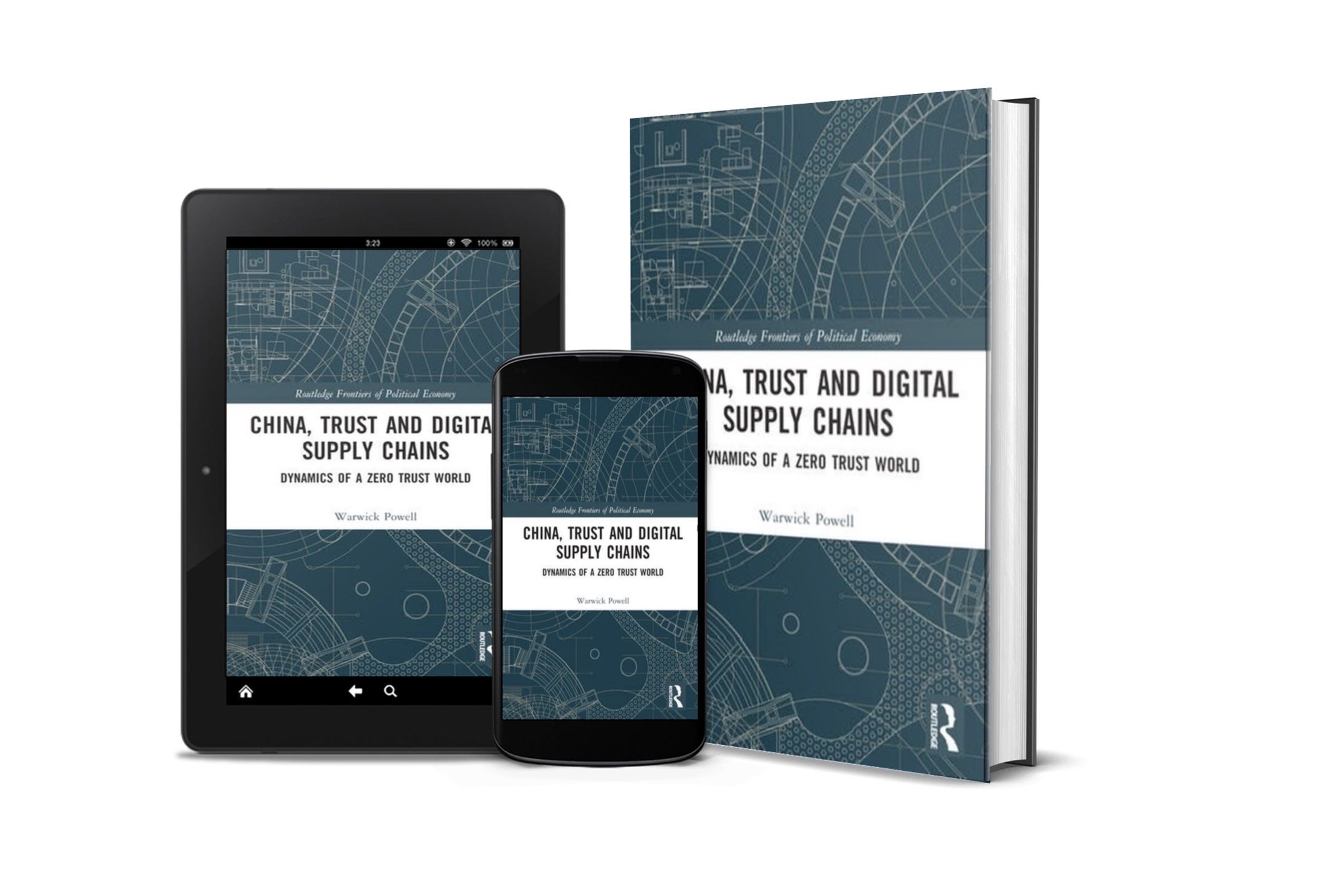
My own book, China, Trust and Digital Supply Chains, examines this theoretical lineage seriously. It explores how Chinese policymakers mobilise categories of circulation, drawn particularly from Capital Volume 2, to conceptualise how supply chains can be enhanced through the development and implementation of digitalisation systems. In this case, supply chains are the modern analogue of the abstracted circuits of capital metamorphosis discussed by Marx. I analysed the dual-circulation strategy not as a tactical response to trade friction or some sign of planned retreat from global engagement, but as an effort to reconfigure the circuits through which value is produced, distributed and realised within a large continental economy that seeks to maintain developmental autonomy while deepening and expanding external interconnectivity. I demonstrated that these concepts are central to how Chinese policy thinkers and analysts actually think through the problems of logistics, data flows, industrial upgrading and domestic demand. Marxist political economy is anything but ideological or ornamental. Indeed, treating such categories as mere ideology empties them of explanatory content and leaves the analyst with assorted residual explanations — state capitalism, elite politics, neo-mercantilism or what-have-you. What this means is that the mainstream western commentator misses the fundamental coherence of the Chinese developmental project as it is conceived by Chinese policy makers and leaders themselves.
In the classical Marxist schema, simple reproduction (the circuit that merely replaces the existing scale of production) is analytically prior but historically secondary to expanded reproduction — the continuous enlargement and restructuring of the material base. Marx’s schemes in Volume II of Capital are not blueprints for static balance; they are devices for revealing the conditions under which the system can reproduce itself on an expanding scale while the organic composition of capital, the technical conditions of production, and the relations between departments change. The Chinese formulations — “demand traction of supply, supply creation of demand,” “higher-level dynamic balance,” “smooth circulation of the national economy” — sit comfortably inside this lineage. They treat the circuit of social reproduction (production–distribution–circulation–consumption) as a continuously evolving process in which temporary imbalances are both inevitable and the motor of structural advance.
Luigi Pasinetti’s structural economic dynamics supplies a complementary formal apparatus, as I have argued elsewhere. Pasinetti’s framework centres on the evolving composition of demand and the differential rates of technical progress across sectors; growth is inherently unbalanced in the short run, and the long-run path is one of continuous reallocation of labour and capital toward sectors with rising productivity and changing demand elasticities. “Balance” is therefore never a fixed point but a moving target defined by the evolving technical and demand structure. This maps closely onto the repeated Chinese insistence that supply-side structural reform must continuously raise the quality and adaptability of the supply system while domestic demand (especially consumption) is expanded and upgraded — not in order to restore a pre-existing equilibrium, but to enable the next round of expanded reproduction under higher productive forces.
Western equilibrium-centred critiques (excess capacity as simple over-investment relative to a given demand schedule, or under-consumption as a permanent shortfall to be closed by income redistribution alone) therefore miss the historical-dynamic character of the problem as it is posed in the Chinese materials. The 2015 recognition of overall excess capacity is not an admission that the system has permanently overshot a static optimum; it is a diagnosis that the quantitative expansion of the preceding investment boom had reached the point at which further simple scaling produced diminishing returns and that a qualitative reconfiguration of the productive structure was required. We should note, in passing, though this deserves further consideration, that at the time — 2015 — China also launched Made in China 2025, a blueprint for industrial renewal that has since been anchored by the very Marxist concept of “new quality forces of production” (新质生产力). In other words, while Xi spoke of the need to expand consumption in 2015, he also recognised the centrality of production upgrading via investment.
Subsequent emphasis on dual circulation, new quality productive forces, and the primacy of the real economy is the practical expression of that same developmental logic: keep enlarging and upgrading the material base while managing the continuous, historically specific adjustments between departments and between supply and demand that expanded reproduction entails. Dynamic balance.
The point of this discussion hasn’t been to simply point out how mainstream western commentators have cherrypicked certain passages from a recent publication of excerpts of comments by Xi Jinping, but to suggest that there are both practical and intellectual consequences of the evident interpretative failure. That they have cherry-picked is evident and disingenuous, all the more egregious for those who read Chinese given that the selection was at the time only available in Chinese. More substantively, however, these western commentators, their concerns about bilateral trade imbalances, Chinese industrial capacity and the competitive pressure exerted by Chinese firms on incumbent western industries, are articulated in a frame and in a language that simply does not map onto the intellectual framework that organises Chinese policy. It is clear that Chinese policy discourse is focused on the question of continuous upgrading of the material base, which refracts through practical concerns for the security and resilience of industrial and supply chains. Chinese policy makers are at the same time concerned with the challenges of constructing a large-scale domestic market that is capable of sustaining expanded reproduction at a higher level of quality. Demand and supply aren’t treated as sacrosanct abstract artifacts, but as dynamic features of a complex evolving system. Chinese policy priorities revolve around the question of dynamic balance while upgrading production and consumption. Production and consumption are conceptualised as symbiotic elements in circuits of value transformation, wherein the objective of policy is to smooth out the circuits of flow, remove bottlenecks and catalyse ever-increasing material and energetic efficiency across the system writ-large.
Chinese policy makers aren’t interested in western exhortations about increasing consumption at the expense of ongoing investment in the productive forces and the factors that sustain circulation and expanded reproduction. Such a proposition makes little sense in an ontology that frames production and consumption as symbiotically inter-dependent. Western pressure around ideas of excess capacity, suppressed consumption and the like will do little to impact China’s policy priorities, which are founded on an altogether different frame. Western diagnostics are simply not accepted, in part because their conceptual frame is at odds with the Marxist political economy that girds Chinese thinking. The result is the ships passing in the night effect. Western mainstream exhortations that China should “rebalance”, “reduce excess capacity” or “boost consumption” encounter a conceptual frame that speaks of demand expansion, capacity adjustment and structural upgrading — but within a different conceptual architecture and toward different long-term ends.
If western analysts are serious about understanding how Chinese policy and political leaders frame economic priorities and approaches, they’re going to have to abandon the presupposition of mainstream lenses — namely that the economy is a single commodity, single producer, single consumer equilibrium system. Instead, they’re not only going to have to take Chinese Marxism seriously (reading Marx might help, as it’s most unlikely any of them have, given the cartoonish caricatures they paint) but reframe their own approach to economic questions.
By persisting with imposing mainstream Western economics onto a discursive ontology that is unrelated leaves the western commentator clutching thin air. The treatment of Marxism-Leninism as cosmetic or ideological compounds the analytical paucity. Marxist categories are not ornamental. They constitute the foundational ontology that emphasises the primacy of the development of the forces of production, the historical character of economic structures, the understanding of “balance” not as a telos but as a dynamic challenge within the context of an evolving and at times accelerating system of transformation in the circuits of capital evolution and social and economic reproduction at a higher level. To fail to understand this frame, and worse to simply dismiss it as “ideology” is to presume that only the categories of mainstream economics count as genuine knowledge of the economy. That presupposition itself is an ideological move that closes off the possibility of understanding Chinese policy on the term in which it is actually formulated and rationalised.
Source: Qiushi, 2025/24
Author: Xi Jinping
15 December 2025
This is a selection of important statements by General Secretary Xi Jinping on expanding domestic demand as a strategic move between October 2015 and October 2025.
I
In the past, our country’s production capacity lagged behind, so the focus of our work was placed on expanding investment and raising production capacity. Now overall capacity is in excess; continuing to rely single-mindedly on expanding the scale of investment to push up the growth rate has limited effect and diminishing marginal returns. Although investment can be an important short-term driver of economic growth, final consumption is the enduring driver of growth. While expanding effective investment and giving play to its key role, we must more effectively bring into play the foundational role of consumption in growth.
(Speech at the Second Plenary Session of the 18th Central Committee’s Fifth Plenum, 29 October 2015)
II
Supply and demand are the two basic aspects of the internal relations of the market economy; they stand in a dialectical relationship of both opposition and unity. The two are inseparable from each other, interdependent and mutually conditioning. Without demand, supply cannot be realised; new demand can give rise to new supply. Without supply, demand cannot be satisfied; new supply can create new demand.
The supply side and the demand side are the two basic means of managing and regulating the macro-economy. Demand-side management focuses mainly on aggregate problems and short-term regulation; it works primarily by adjusting taxation, fiscal expenditure, monetary credit and the like so as to stimulate or restrain demand and thereby promote economic growth. Supply-side management focuses mainly on structural problems and on stimulating the motive force of growth; it works primarily by optimising the allocation of factors and adjusting the structure of production so as to raise the quality and efficiency of the supply system and thereby promote economic growth.
Looking at the history of world economic development, whether economic policy places greater emphasis on the supply side or the demand side must be decided according to a country’s macroeconomic situation. To talk about the supply side while abandoning the demand side, or to talk about the demand side while abandoning the supply side, is one-sided. The two are not an either-or, mutually exclusive relationship in which one replaces the other; rather, they must coordinate with and promote each other.
(Speech at the Seminar for Provincial- and Ministerial-Level Leading Cadres on Studying and Implementing the Spirit of the Fifth Plenum of the 18th Central Committee, 18 January 2016)
III
We must firmly implement the strategy of expanding domestic demand. Building a complete domestic demand system has a bearing on our country’s long-term development and lasting peace and stability. After reform and opening up, and especially after joining the WTO, China entered the international great circulation, forming a development model in which both markets and resources (such as mineral resources) were “outward-oriented” and becoming the “world’s factory.” This played an important role in enabling us to seize the opportunities of economic globalisation, rapidly raise our economic strength and improve the people’s livelihood. In recent years economic globalisation has encountered headwinds; this epidemic may intensify the trend of de-globalisation, and the inward-looking tendency of various countries has clearly risen. The external environment facing our country’s development may undergo major changes. Implementing the strategy of expanding domestic demand is needed to cope with the impact of the epidemic at present, needed to maintain the long-term sustained and healthy development of our economy, and needed to meet the people’s ever-growing needs for a better life.
The advantage of a large-country economy is that it can circulate internally. China has a population of 1.4 billion; per capita GDP has already exceeded US$10,000; it is the world’s largest and most potential-rich consumer market. The optimisation and upgrading of household consumption, combined with modern science and technology and modes of production, contains enormous room for growth. We must firmly grasp expanding domestic demand as the strategic fulcrum, so that production, distribution, circulation and consumption rest more on the domestic market and achieve a virtuous cycle, clarify the strategic direction of supply-side structural reform, and promote the dynamic balance of aggregate supply and aggregate demand at a higher level. Expanding domestic demand and expanding opening-up are not contradictory. The smoother the domestic circulation, the more it can form a gravitational field for global resource factors, the more it will favour the construction of a new development pattern with the domestic great circulation as the main body and the domestic and international dual circulations promoting each other, and the more it will favour the formation of new advantages in participating in international competition and cooperation.
Consumption is an important engine of our country’s economic growth, and the middle-income group is an important foundation of consumption. At present China has about 400 million middle-income people, the largest absolute scale in the world. We must take expanding the scale of the middle-income group as an important policy objective, optimise the structure of income distribution, and improve the mechanism whereby knowledge, technology, management, data and other factors of production are evaluated by the market according to their contribution and remuneration is determined accordingly. We must expand investment in human capital so that more ordinary labourers can enter the middle-income group through their own efforts.
(Speech at the Seventh Meeting of the Central Financial and Economic Affairs Commission, 10 April 2020)
IV
This year I have repeatedly said that we must promote the formation of a new development pattern with the domestic great circulation as the main body and the domestic and international dual circulations promoting each other. This new development pattern has been put forward in light of changes in our country’s stage of development, environment and conditions; it is a strategic choice for reshaping our country’s new advantages in international cooperation and competition. In recent years, as the external environment and the factor endowments possessed by our country’s development have changed, the momentum of the international great circulation in which both markets and resources were outward-oriented has clearly weakened, while the potential of our domestic demand has been continuously released and the vitality of the domestic great circulation has grown stronger day by day; objectively there is a tendency of the one waning and the other waxing. Theoretical circles have conducted much discussion of this objective phenomenon; research can continue to be deepened and insightful views put forward.
Since the international financial crisis of 2008, our country’s economy has already been shifting toward one with the domestic great circulation as the main body. The ratio of the current-account surplus to GDP has fallen from 9.9 percent in 2007 to less than 1 percent at present, and in seven years the contribution of domestic demand to economic growth has exceeded 100 percent. In the period ahead, the characteristics of the domestic market dominating the national economic circulation will become still more pronounced, and the potential of domestic demand for economic growth will be continuously released. We must uphold supply-side structural reform as the strategic direction, firmly grasp expanding domestic demand as the strategic fulcrum, make production, distribution, circulation and consumption rest more on the domestic market, raise the adaptability of the supply system to domestic demand, and form a higher-level dynamic balance in which demand trails supply and supply creates demand.
(Speech at the Symposium of Experts in the Economic and Social Fields, 24 August 2020)
V
We must accelerate the cultivation of a complete domestic demand system. This is an important foundation for unblocking the national economic circulation and strengthening the principal position of the domestic great circulation. Economic activity is a dynamic, cyclical process that repeats itself again and again. We must advance deep-level reform and strengthen policy guidance, and concentrate on clearing the key blockages that constrain economic circulation. Taking the satisfaction of domestic demand as the basic standpoint, we must organically combine the implementation of the strategy of expanding domestic demand with the deepening of supply-side structural reform, concentrate on raising the adaptability of the supply system to domestic demand, and form a higher-level dynamic balance in which demand trails supply and supply creates demand. We must strengthen the construction of the modern circulation system, improve both hardware and software, channels and platforms, and consolidate an important foundation of the domestic and international dual circulations.
(Speech at the Second Plenary Session of the 19th Central Committee’s Fifth Plenum, 29 October 2020)
VI
On the question of upholding expanding domestic demand as the strategic fulcrum. Forming a strong domestic market is an important support for building the new development pattern and is also where the advantages of a large-country economy lie. The expansion of domestic demand that we emphasise is by no means simply an expansion of government public expenditure; effective institutional arrangements must be made in the rational guidance of consumption, saving and investment.
The most fundamental way to expand consumption is to promote employment, improve social security, optimise the structure of income distribution, expand the middle-income group, and solidly advance common prosperity. We must combine expanding consumption with improving the quality of the people’s lives, adapt to the actual needs of different income groups, and raise residents’ consumption capacity and willingness through high-quality supply. We must orderly cancel some administrative restrictions on consumption and purchasing so as to release consumption potential; adapt to the trend of upgrading of the consumption structure, innovate consumption formats and models, form new growth points such as service consumption, and promote the return of overseas consumption. We must attach importance to rural consumption demand and fully tap the consumption potential of counties and townships. We must improve the vocational and technical education system and achieve more adequate and higher-quality employment. We must reasonably increase public consumption and raise the efficiency of expenditure on public services such as education, medical care, old-age care and child-rearing.
We must strengthen the stamina of investment growth and continue to give play to its key role. We must optimise the investment system and promote the rational conversion of saving into investment. We must give play to the guiding and leveraging role of central budgetary investment and play a role in fields with strong externalities and high social benefits. We must comprehensively improve the investment environment, form good investment expectations, and stimulate the investment vitality of the whole of society. We must vigorously develop the digital economy, increase investment in new-type infrastructure, accelerate the digital, intelligent and green transformation of traditional industries, and promote the digitisation of industry and the industrialisation of digital technology. We must popularise advanced and applicable technologies and expand investment in equipment renewal and technological transformation in manufacturing. We must deeply advance new-type urbanisation, implement urban renewal actions, and promote the renovation of old urban residential areas. We must raise the level of infrastructure and circulation, build a modern logistics system, and implement a number of major projects in the fields of comprehensive transport, basic scientific research, public health, ecological protection and rural construction.
(Speech at the Central Economic Work Conference, 16 December 2020)
VII
In today’s world the scarcest resource is the market. Market resources are our country’s enormous advantage; we must fully utilise and give play to this advantage, continuously consolidate and strengthen it, and form a solid support for building the new development pattern. Expanding domestic demand is by no means a temporary measure to cope with financial risks and external shocks, nor is it about flooding the system with liquidity, still less is it simply about increasing government input. Rather, in light of the actual situation of our country’s economic development, we must establish effective institutions for expanding domestic demand, release the potential of domestic demand, accelerate the cultivation of a complete domestic demand system, strengthen demand-side management, expand household consumption, raise the level of consumption, and make the construction of a super-large-scale domestic market a sustainable historical process.
(Speech at the Seminar for Provincial- and Ministerial-Level Leading Cadres on Studying and Implementing the Spirit of the Fifth Plenum of the 19th Central Committee, 11 January 2021)
VIII
We must uphold high-quality development as the theme, organically combine the implementation of the strategy of expanding domestic demand with the deepening of supply-side structural reform, strengthen the endogenous motive force and reliability of the domestic great circulation, raise the quality and level of the international circulation, accelerate the construction of a modern economic system, concentrate on raising total-factor productivity, concentrate on enhancing the resilience and security level of industrial and supply chains, concentrate on advancing the integrated development of urban and rural areas and coordinated regional development, and promote the effective qualitative improvement and reasonable quantitative growth of the economy.
(Report to the 20th National Congress of the Communist Party of China, 16 October 2022)
IX
Insufficient aggregate demand is the prominent contradiction facing current economic operation. We must vigorously implement the strategy of expanding domestic demand and adopt more forceful measures so that social reproduction realises a virtuous cycle. China has effectively responded to the Asian financial crisis of 1998, the international financial crisis of 2008 and the impact of COVID-19 since 2020 by expanding domestic demand, and has accumulated successful experience; we must optimise policy measures and fully give play to the foundational role of consumption and the key role of investment.
First, place the recovery and expansion of consumption in a priority position. As our country’s new-type industrialisation, informatisation, urbanisation and agricultural modernisation advance in depth, consumption is increasingly becoming the foundational force driving economic growth. We must enhance consumption capacity, improve consumption conditions, innovate consumption scenarios, and fully release consumption potential. Consumption is a function of income; we must increase the income of urban and rural residents through multiple channels, especially raising the consumption capacity of middle- and low-income residents who have a high propensity to consume but have been heavily affected by the epidemic. We must reasonably increase consumer credit and support consumption in housing improvement, new-energy vehicles, old-age services, education, medical care, culture, sports and other services.
Second, effectively drive investment by the whole of society through government investment and policy incentives. At present the expectations of private investment are relatively weak; government investment must give full play to its guiding role—this is a powerful tool for coping with cyclical fluctuations in the economy. Government investment must increase intensity in laying foundations, benefiting the long term, making up shortcomings and adjusting structure; accelerate the implementation of major projects of the 14th Five-Year Plan; strengthen infrastructure construction in transport, energy, water conservancy, agriculture and information; and strengthen inter-regional infrastructure connectivity. We must support city clusters and metropolitan areas in building modern infrastructure systems and implement urban renewal actions and rural construction actions. We must increase investment in science and technology and industry and carry out in advance the construction of major scientific and technological infrastructure and the R&D capacity for key core technologies. Policy-based finance must give play to its counter-cyclical regulatory role, increase financing support for major projects that conform to national development plans and industrial policy orientations, and take into account both economic and social benefits. We must relax market access for private investment, encourage and attract more private capital to participate in the construction of major national projects and projects that make up shortcomings. We must strengthen project reserves and preliminary work and reinforce the guarantee of factors of production.
(Speech at the Central Economic Work Conference, 15 December 2022)
X
Better coordinate the expansion of domestic demand and the deepening of supply-side structural reform, and strengthen the motive force and reliability of the domestic great circulation. The key to building the new development pattern lies in realising the unimpeded circulation of the economy. Whether this can be achieved depends mainly on whether the supply and demand sides both have strong motive force, overall matching, dynamic balance and virtuous interaction. This requires organically combining the strategy of expanding domestic demand with the deepening of supply-side structural reform, so that both the supply and demand sides exert force simultaneously and coordinate with each other, forming a higher-level dynamic balance in which demand trails supply and supply creates demand, and realising the virtuous cycle of the national economy. We must resolutely implement the Outline of the Strategy for Expanding Domestic Demand, form a complete domestic demand system as soon as possible, and concentrate on expanding consumption demand that is supported by income, investment demand that has reasonable returns, and financial demand that is constrained by principal and debt. We must establish and improve long-term mechanisms for expanding household consumption, so that residents have stable incomes and can consume, have no worries about the future and dare to consume, and enjoy an excellent consumption environment with a strong sense of gain and are willing to consume. We must improve mechanisms for expanding investment, expand the space for effective investment, moderately advance the deployment of new-type infrastructure construction, expand investment in high-tech industries and strategic emerging industries, and continuously stimulate the vitality of private investment. We must continue to deepen supply-side structural reform, continuously promote scientific and technological innovation and institutional innovation, break through the blockages, choke points and weak points constraining supply, enhance the competitiveness and security of industrial and supply chains, adapt to and satisfy existing demand with independently controllable, high-quality supply, and create and lead new demand. Serious imbalance and mismatch between supply and demand and impeded circulation are one of the root causes of major risks in the economic and financial fields; coordinating the expansion of domestic demand and the deepening of supply-side structural reform also helps prevent and defuse risks in the economic and financial fields.
(Speech at the Second Collective Study Session of the 20th Central Political Bureau, 31 January 2023)
XI
We must coordinate the relationship between aggregate supply and aggregate demand and unblock the national economic circulation. We must uphold coordinated efforts and dynamic balance on both the supply and demand sides, continuously deepen supply-side structural reform, advance some things while retreating from others, preserve some things while pressing down on others, and enhance the adaptability and balance between supply and demand. Expanding domestic demand concerns both economic stability and economic security; it is not a temporary expedient but a strategic move. We must accelerate the making up of the shortcomings in domestic demand, especially consumption, so that domestic demand becomes the main driving force and stabilising anchor of economic growth.
(Speech at the Central Economic Work Conference, 11 December 2024)
XII
The draft of the Recommendations highlights strengthening the domestic great circulation, makes deployments for building a strong domestic market and accelerating the construction of a high-level socialist market economic system, emphasises upholding expanding domestic demand as the strategic fulcrum, closely combining benefiting the people’s livelihood with promoting consumption and investing in things with investing in people, vigorously boosting consumption, expanding effective investment, resolutely removing the choke points and blockages that hinder the construction of a unified national market, and emphasises fully stimulating the vitality of all types of business entities, accelerating the improvement of the market-oriented allocation system for factors of production, and raising the effectiveness of macroeconomic governance. At the same time it proposes expanding the international circulation, steadily expanding institutional opening-up, safeguarding the multilateral trading system, and high-quality joint construction of the Belt and Road.
(Explanation of the Recommendations of the CPC Central Committee on Formulating the 15th Five-Year Plan for National Economic and Social Development, 20 October 2025)
Comments
Nothing yet. Say the first thing.
Sign in to join the conversation.